Showing posts with label science fiction. Show all posts

Moxyland

It’s not often that I let go and enjoy a book just for the ride. I’m more of an intensive reader, who looks for what he wants, enjoys it when it’s there, and complains when it’s not. Simple. Cut and dry. But there’s that something other that comes along every once in a while and just grabs you. There’s something about it. It’s got class. It’s got style. It’s got “Moxy”, kid.

MOXYLAND is Lauren Beukes' first novel, and if you’ve been hiding under a rock somewhere (like I feel sometimes) you might not know that she missed getting the Campbell for best new writer this last year by just a hair. MOXYLAND was a very interesting novel for me. Not only is it Science Fiction, but it’s told through four separate first-person viewpoints. This would normally be a tough row for anyone to handle, but Beukes pulls it off really well.

Kendra, Lerato, Toby, and Tendeka are all young hipsters living in a near future South Africa where technology bumps a go-go and the Government rules with an electronic fist. Everyone’s wired up through their cell phones, and the cops use that to full effect. Screw up once? They tase you hard. Want more? Cell phone privileges revoked, and then it’s game over for you, because on-line presence is so important to the life of the future. The world Beukes has painted for us is filled with internal nano-tech, and viral crowd-control, and bit of the Big Brother a-la 1984. People have become advertisements and sports coats broadcast your picture gallery of choice. Right from the get go, we’re dropped into the middle of this nitty-gritty, chaotic landscape, with street slang tossed like hot popcorn through the air. It’s so hard to just not be dragged into this novel with eyes wide and fingers itching to turn the page.

The pacing of the book was fast and even, with most of the forward plot progression dealing with the efforts of Toby and Tendeka to put one over on the Big Man Government. They’re the street-level rebels that don’t like how they’ve been treated, and can’t handle the fact that the Government has all this power over them. Anything they and their pack of friends can do to throw a finger in their direction, while staying below the radar of the police, is on the agenda for the day. Lerato is Toby's buddy, a brilliant programmer that plays occasionally to the tune of her friends and hacks the corporate firewalls through dangerous backdoors. And Kendra, the art-school dropout, gets caught up in the middle of everything.

As with most first-person viewpoints done well, characterization is great. Each of the four players came across to me as complicated and full. They’re in the middle of their lives, the middle of their story. No farm boys here. No little girls waking up from eternal sleep to find a new world surrounding them. This was one of the most engaging things about this book for me. It was immersive in a way that I have only very seldom found. At the same time though, the multiple viewpoints did take a bit of getting used to. Three of the main characters sounded really similar to one another, with Lerato standing out. The others got a bit muddled for me at first, and only after a while became distinct enough for me to differentiate between them. Regardless, each was easy to read and immediately engaging. Really impressive all, especially given that this is Beukes debut novel.

The piece that kept this novel from being great in my mind is a complete, finished story. The end really left me wanting. There’s a big twist for one character, and a very literal ending for another, but there wasn’t a whole lot that really left me feeling satisfied when it was all said and done. The book is fairly short as it is. I would have liked to see more of the story. More of the world. I wasn’t ready for it to be done. So give it up for Lauren, peoples. She’s definitely one to keep on the radar. Check this book out.

Recommended age: 16+
Language: Some, but not a lot
Violence: Fighting with cops, but nothing gory
Sex: A couple scenes, but they're quick with little detail

Lauren Beukes' Website
Moxyland Website


The Postmortal

In THE POSTMORTAL, Drew Magary explores what the realistic fallout would be if scientists discovered a cure for aging. A “vaccine” that would stop aging in its tracks. Take it when you’re twenty-five, and you’ll be twenty-five forever. On the surface, this sounds really appealing. Who wouldn’t want to live forever, after all? But that’s where the “realistic” part comes in. The future Magary paints is much bleaker than the knee-jerk reaction everyone automatically thinks of.

This near future is seen through the eyes of John Farrell, who gets the Cure relatively early on, when it’s still on the black market and officially banned by the US Government. Farrell takes us from the dawn of this new age all the way to its natural conclusion, at least for him. At each stage, Magary does an excellent job exploring the nooks and crannies of a society that’s had death relegated to such an afterthought. What happens to Hollywood, for example, if the movie stars stop getting old? You don’t really get many new movie stars, for one thing. The established stars become entrenched in their roles, and new ones have an even harder time breaking in to the business. Imagine a world where authors aren’t just competing with Stephen King and John Grisham, but with Twain, Dickens, Tolstoy, Cervantes, Poe, Shakespeare, and all the other greats. As an author, the thought gives me nightmares, although as a reader, it would be epic!

The book has a lot going for it. Compelling characters with conflicts you can relate to (not always a given in a Science Fiction setup like this one), a plausible near-future setting, and a "What if" foundation that really makes you want to keep reading, because surely it can't get any more horrible for these people. (Hint: it can.)

My biggest gripe with the book (and it’s fairly substantial) is that the basis of the novel seemed off to me the entire time. Yes, scientists discover the cure for aging, but it’s treated by everyone as the cure for death. The two don’t go hand in hand in my mind. After all, how many people actually die of old age these days? You’re not suddenly immune to cancer, accidents, car wrecks, drowning, gunshot wounds, choking--the list goes on and on of things that can still kill you. Sure, the death rate would decrease, but it wouldn’t decrease at the marked rate depicted by Magary.

In the end, this is a fairly moot point, however. I don’t think I’m spoiling anything to say that Magary does have his characters eventually find the cure for cancer and other diseases. Science is rushing along so quickly (both in his imagined future and in our own present) that it’s not a huge leap to believe this can and will happen. And once those two cures are developed (one for aging, one for disease), then it’s definitely believable to me that the results could be as catastrophic as Magary depicts.

I enjoyed THE POSTMORTAL, both as a thought experiment and as Science Fiction. It was interesting to see how something that seems so good on the surface can have so many far reaching consequences. I’m not convinced it would play out exactly as Magary portrays it, but he makes a good enough argument for me to concede the very frightening possibility.

Recommended Age: 18+
Language: Plentiful
Violence: Lots of it, at times very detailed and gory.
Sex: A few fairly explicit scenes


God's War

If I haven't said so before, Night Shade Books is putting out some seriously great stuff. There just comes a point where I get tired of all the same crap out there, and need something completely different. I've had this type of experience before with other novels from Night Shade like THE WINDS OF KHALAKOVO and NEVER KNEW ANOTHER. This time it was Kameron Hurley's GOD'S WAR that had me nodding in appreciation.


GOD'S WAR is an SF novel taking place on a world that is currently entrenched in a Holy War, and has been involved in this same Holy War since...well, forever. If you are a male, you get sent to the war front and have what amounts to an almost zero-percent chance of survival. The war is brutal. This story follows Nyx, a female bounty hunter who used to be a sanctioned assassin (they call them "bel dames" in the novel) as she takes on a mark that has potential to alleviate all her financial concerns. Of course, as a reader, you know that nothing good can possibly happen in this type of scenario.


Pretty much everything technology-based in GOD'S WAR is done through bugs. Most everything is organically grown and repaired through small and large creepy crawlers. Organs and limbs can be regrown. Everything has a kind of dingy feel to it.


The characters in this novel are all deeply flawed, and perhaps that is why I enjoyed the novel so much. Perfect characters are boring. Characters that have to overcome themselves as much as their external obstacles, however, really work for me. Nyx is the main character, and she is essentially a complete screw up. Her decisions--often poor ones that he has alternative but to make--lead to terrible situations. The other main character is Rhys--a "magician" from the opposite side of the war. He has a limited ability to control bugs. The dynamic between the two main characters is great. The weird loathing trust that has a slight hint of attraction is extremely well done.


The tone of this novel is very grim. Very dark. There is a overall sense of hopelessness that this Holy War is eventually going to kill everyone. And that is where the main story comes into play. That job I mentioned earlier? It not only pays well, but just may end the war. Of course, there are ways to end a war while making things so much worse. That is what this novel explores. Of course all of this is reinforced by some pretty wicked-awesome world building. From politics to religion, Hurley covers it quite well in the novel. It's all top-notch, really.


There were a few things that nagged at me while reading. I mention them because I would be completely enjoying the novel, and then get yanked out periodically. The main thing was transitions. When switching from one PoV to another there would be no time anchors. Sometimes only a little time had passed, and at others a LOT of time had passed. It's like the clarification that would have smoothed this all over was cut just to get to the next section in a hurry. GOD'S WAR isn't long. Smoothing these parts out would have made this novel one of the better ones of the year for me. Additionally, another really minor thing is how it seems like Nyx's forward motion in plot centers around her being abducted every few chapters. It gets a tad worn.


But look, the rest of the novel more than makes up for those small annoyances. The real test is whether or not I see improvement in the second novel, INFIDEL. And yes, I will most certainly be reading it. GOD'S WAR is exactly the type of novel needed by readers everywhere to get them past the monotony of general SF and Fantasy.


Go buy this novel. You'll dig it.


Recommended Age: 18+

Language: Lots and lots.

Violence: Even more violence than language. Nyx cuts off people's heads as proof of her bounty being complete.

Sex: A ton of references, and some scenes (non detailed). Gay or straight, GOD'S WAR isn't picky. Actually there are some pretty good reasons for some of the homosexual relations in the novel. It isn't there for shock value.


Go check out Kameron Hurley's site:


http://www.kameronhurley.com/


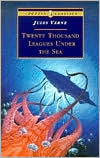
Twenty Thousand Leagues Under the Sea

Twenty Thousand Leagues Under the Sea. Jules Verne. 1870. Puffin Classics. 280 pages.

In the year 1866 the whole maritime population of Europe and America was excited by a mysterious and inexplicable phenomenon.

I didn't seek out an abridged version of this Jules Verne classic. But when I discovered that the edition I'd checked out from the library was abridged--after I was four or five chapters into it--I didn't try to 'fix' it either.

I'll start with the good news. I definitely liked this one more than Journey to the Center of the Earth! There were times I actually thought Twenty Thousand Leagues Under the Sea was a good read. That the story had action and adventure and mystery.

Basic plot: A professor and his servant are 'captured' by a 'sea monster' created by the cranky Captain Nemo.

While reading this one, I started thinking about Frankenstein--which is a good thing, I think. I never did quite decide how the characters matched up between the two. But I think that there are definite similarities in theme. Frankenstein is one of my comfort reads--a book I love and adore. Twenty Thousand Leagues Under the Sea is a good read, but I'm not sure I'll ever want to reread it. If I ever do read it again, I might try the unabridged version.

© 2011 Becky Laney of Becky's Book Reviews


Deadline

Full disclosure. I loved Mira Grant's novel, FEED. I didn't think I would because I was a tad tired of zombies, but FEED was still awesome...especially the ending which was absolutely incredible. Sure there were some things that made me say "meh", but I personally thought the characters were fun (specifically in the latter half of the novel when the story got really grim and bleak), and the setting was fantastic. Not to mention, Mira Grant's writing appealed to me with its accessibility and her sense of pacing. If was my personal pick for the Hugo this year. I bought copies of her books and lugged them to WorldCon so I could stalk Mira down for signatures. Yeah, I'm a fan.


After I read FEED, I knew immediately that's I'd gobble up the next book in the series, DEADLINE. But I was worried. WAAAAAAAY worried. If you've read FEED, you know how the book ends. How the heck to you follow THAT?


DEADLINE is told from Shaun Mason's eyes, and the change in tone is really what helps set this apart from the prior novel. Shaun is an angry, angry guy. As the reader, you get to see his grief and complete lack of faith in anything. For the most part this is all executed extremely well. However, during the novel he has a penchant for wanting to punch anything and everything. It gets old, and feels unneeded.


Luckily neither Shaun nor the reader is given much time to dwell on the tragic ending of FEED. Things happen fast and furious to start out. Again, Mira Grant perfectly illustrates that in a world of zombies, the humans are still the biggest danger to humanity.


You may be asking yourself, "Self, why hasn't the reviewer talked about what the book is about?" You see, FEED is still relatively new, and the ending is one of those endings that MUST NOT be ruined. If I talk about DEADLINE with very much detail at all, it will hurt your reading of FEED. Here's what I can give you. Shaun and the crew are investigating a conspiracy that was introduced in the first book. The conspiracy is even bigger than anyone realizes, and Grant does a great job of illustrating the danger our protagonists (not to mention the world) face.


One thing I've noticed about zombie novels in general is how much it bugs me when the world introduced in the novel isn't self-aware. What I mean is that our culture has been exposed to zombie-related media for so long now, that we will have a grasp of the situation when the zombie plague runs wild (note: when, not if). Mira Grant's novels address this so well, that it makes reading other zombie novels that don't take it into account feel unrealistic. This world feels legitimate.


There is one thing that I should mention that did kinda nag at me a bit. Middle novels are hard, and not only is the author trying to set up the third novel in the series, but he/she is also trying to refresh the reader on the events from book one. DEADLINE suffers the effects of this in certain areas. There are certain bits of information that just don't need to be fully explained again. The pacing can get bogged down a bit due to the over-explanation (or repeated explanation) of details that the author feels essential the reader understand completely. This isn't a huge deal for the most part, but it bothered me enough to notice and to bring up.


That said, this book has some moments that are just freaking awesome. And I don't just mean action scenes, though the book does have plenty of those as well that had me giggling with horrific glee. DEADLINE has some terrific character scenes that show just how crazy things are getting for people.


Now, depending on how observant a reader you are, you may catch one of the major twists (there are a few). I caught it very early on in the novel, but it didn't affect my enjoyment of the novel (at least I don't think it did...it's not like I can test it). If you don't catch the twist, the ending is a serious "HOLY CRAP!" moment. Like FEED, it was the ending to DEADLINE that won me over on loving the novel.


Here is the question you need to ask yourself. Do you want to read a zombie novel that pulls in Science Fiction sensibilities without losing the Horror aspect of the sub-genre? Do you want a zombie series that shows just how much more horrible humans can be as opposed to the zombies? How about a series with good characters? If you answered "yes" to any of the questions, you need to pick up FEED and DEADLINE by Mira Grant. If you answered "no", too bad, read the books anyway. They are completely awesome.


Recommended Age: 17+

Language: Lotsa swearing.

Violence: If there WASN'T violence in DEADLINE, it really wouldn't be a conspiracy-filled, zombie novel would it? Of course there is a ton of violence.

Sex: One short, but fairly detailed scene. It's mostly used to show how much psychological and emotional baggage a character has.


Go check out Mira Grant's website:


http://www.miragrant.com/


And in case you didn't know, Mira Grant is a pen name Seanan McGuire uses. Seanan is best known for winning the 2010 Campbell Award for best new writer. She writes Urban Fantasy under that name which I hope is as good as her zombie books.


http://www.seananmcguire.com/


Last note: Seanan is an awesome person. I was able to chat with her for a bit at WorldCon in Reno, and she is one of the nicest people even...when she's not planning to kill you. As an author, being nice is a good thing. It impacts what people think of you and your work. Seanan's personality made me like her work even more.


The Word for World is Forest

Before there was Avatar there was Ursula K. Le Guin's THE WORD FOR WORLD IS FOREST. Written in 1972, and the winner of the 1973 Hugo Award for best novella, Tor decided that the current furor over sustainable ecology would make this novel a timely re-release. At the very least it's an entertaining comparison to Cameron's blue-peopled visual extravaganza.

The similarities will be obvious from the start: humans can now travel to the stars and will take other planets' natural resources for their own use; the nature-loving natives who just want to preserve their way of life; the racist Army dude who is willing to do anything to fulfill his objective.

If this story reads as predictable, it's because, well, it was written 40 years ago, and the story has been used in many different incarnations since then. Le Guin was a trailblazer with not only her stories and characters, but with her ecological and race-relation themes. It's worth it to see the origins of some of these ideas (see also Shawn's review on LITTLE FUZZY). Here it starts off with the interesting dilemma: the planets were all seeded thousands of years ago by a main race, so the 'aliens' are actually distant cousins who evolved differently from the same stock. So, how different are the three-foot, green-furred Athsheans from Earth's humans? The answer to that is actually very important.

A quick read, TWFWIF is told from the PoV of our three main characters: Captain Davidson, Captain Lyubov, and Selver. Davidson is running a remote logging camp on the planet New Tahiti and is having trouble with the natives he calls 'creechies', which they've been using for menial labor, but they're lazy and incompetent. Not only that, but the landscape gives them trouble: after logging an area instead of making it farmable for soybeans, the land turns into mush. The scientist Lyubov, however, doesn't see things the same way as Davidson. The natives' tribes are named for the different trees which makes the forest an important part of their culture. Their 'laziness' stems from a culture with vastly different sleep cycles--in fact dreaming is an important and revered ability among the Athsheans. Then there is Selver, the native Athshean, who despite being raised in a pacifist culture, realizes that force will become necessary in dealing with the invading humans.

Le Guin explores the issues of a clash of cultures, despite a shared origin and how genocide can be caused by ignorance or greed. Another dominant theme is the importance the environment has on the Athsheans and how the humans' interference will have horrifying repercussions.

As a result of a short story with a focus on the themes, setting, and storyline, the characters, while interesting, didn't have enough time for an in-depth study and will feel like stereotypes. But that's not really the point of Le Guin's story, her intent is to make the reader reconsider the importance of culture vs environment.

Recommended Age: 14+
Language: Minor references and racist lingo
Violence: Yes, although not in-depth scenes
Sex: Rape is referenced, but not shown


The Nebula Awards Showcase 2011

Good short stories in my opinion are those that get in, get memorable, and then get out. They’re quick, they’re sharp, they’re efficient. Sometimes you can’t help but come out a little dirty. Others catch you with your back turned and give you the once-over of your previously boring life. And then there are the stinkers. Ugh. Let’s not talk about those though.

THE NEBULA AWARDS SHOWCASE 2011, edited by Kevin J. Anderson, is a relatively short (under 400 pages) anthology of works nominated for the award by authors wide and various through the Science Fiction and Fantasy Writers of America. Contained within SHOWCASE are all of the short stories and novelettes that were nominated in 2010 (including the winners) and the winning novella, along with a few extras from long-standing authors in the field that were given special honors. As with many compilations of short fiction, there were some stories that worked for me and others that didn’t. I’ll mention a few of them specifically.

Overall, I was pleasantly surprised by the short stories. Perhaps there’s something about the short form and Science Fiction that just works for me. Maybe it’s the fact that authors are forced to get to the point instead of wandering around aimlessly with their beautiful prose. Then again, it could be that the short story realm is just so darn ruthless when it comes to those stories that make it and those that don’t. Whatever it is, essentially all of the short stories that were nominated here were pretty good.

Saladin Ahmed’s "Hooves and the Hovel of Abdel Jameela" is a story about a physician and his interaction with an old man and his not-so-typical wife that totally made me open my eyes and look at this guy for real. This was one of the few Fantasy stories, with great storytelling and twists a-google. He has a book coming out in Feb 2012 that I was pretty meh about before reading SHOWCASE. But no longer, my friends. No longer.

"I Remember the Future" was mostly awesome, only falling short for me because the end took a turn for the cheesy instead of dealing with the real-world issues it had built on concerning family, paternal presence, and the call of a writer's muse. Granted, the story is Science Fiction, but it really shouldn’t have been, in my opinion. It could have been so much more.

"Bridescicle" by Will McIntosh was a really interesting take on the post-life dating scene and quite well written. There was a lot in this one that really pushed my buttons.

"Spar", the winner of the Nebula in the short story category, is not for everyone. I should probably repeat myself here. This story is not for everyone. And definitely not for kids. In short, it’s an extremely explicit portrayal of a space-faring woman that is captured by an amoeba-like alien. It is disturbing in so many ways, and then just ends with nothing significant to make all the shudder-inducing horror worth the read. Why did this one win? Because it was gritty? Because it pushed the boundaries of what people will read? Honestly, I haven’t the first clue, and I’d almost suggest that readers just skip over this one. It’s really short, and they aren’t going to miss anything worthwhile by not reading it.

Unfortunately, the stories from the novella nominees didn’t garner any of the same surprises. In fact, this was the point where everything devolved into what I’ve come to expect from Science Fiction: bloated prose, wandering plots, and literary pontification. Very well-written all, of course, but really nothing that I cared to read in the slightest. There was, however, one exception.

And it was a big one.

"Divining Light" by Ted Kosmatka should have taken this award home without even a blink being tossed in the direction of any of the other stories nominated. This story was Awesome with a capital A. Intensive science revolving around the particle-wave theory of light but twisted slightly to great effect, simple explanations, and all relayed to readers with a pretty faulted character at its core. I could easily say that this entry alone would make the anthology worth buying...except for the fact that Asimov's has posted it for free on their website. In fact, I’d suggest going there to read it, because the two small pictures that have been included in his story were inadvertently swapped in the SHOWCASE version. It's stories like these that give me hope that there is still something in Science Fiction to love, and I’m now eagerly anticipating Mr. Kosmatka's debut novel that is coming early next year. If you do nothing else, read this one. It’s the goods.

Bringing up the rear was Kage Baker’s "The Women of Nell Gwynne’s, which was a pretty solid effort. Good prose. Good characters. Interesting premise and humorous development. Kind of like a Victorian-era Charlie’s Angels, if the Angels all had a day job in a brothel. The ending did get a bit confusing for me, and felt like it got wrapped up a bit too quickly, but on the whole a good effort by the late author and well-deserving of the award.

On the whole, this was a decent read, though I’ve placed it in the mediocre category because the bulk was simply just mediocre Science Fiction. It’s interesting to see what other authors think is good. The other side of the card, of course, comes from us, the reading public, through the Hugos. Apparently, Mary Robinette Kowal edited a Hugo anthology for the award last year, but it didn’t sell well enough to garner a return this year, which mostly just confuses me due to the nature of the award itself. Didn't the readers pick these stories as the good ones? Really? Such is the way of things, I suppose. Although, you do have Shawn presenting all the goods from an EBR perspective of the Hugo nominations this year anyhow. So how can you complain?

Recommended Age: 18+
Language: Most stories are pretty mild, but there are a few that go overboard ("Spar" being the largest offender)
Violence: No gore really, but some that hit it hard ("Spar"...again?)
Sex: Three stories have fairly strong ratings here, and one ("Spar"...surprised? Nah) completely blew the top off the lid


Embassytown

My dad and I have an ongoing argument. My dad seems to think that PERDIDO STREET STATION by China Miéville is a superior work to THE SCAR (also by Miéville, set in the same world as PERDIDO). While I know better. THE SCAR is better, better plotted, cooler stuff. In one thing we are agreed, however. In my opinion THE SCAR is a 10 (on a scale of one to ten, ten being perfect) whereas PERDIDO is a 9.9. For my dad it’s PERDIDO that gets the 10 and THE SCAR the measly 9.9. They are both good books. Fantastic books, genre-altering books.


Why am I telling you all of this? Because EMBASSYTOWN, the latest novel by China Miéville, is probably a strong 9.8 in my opinion. Easily my favorite of Miéville's books since THE SCAR.


EMBASSYTOWN was what I expected from THE CITY AND THE CITY. It’s a brilliant novel based on a very cool central premise surrounded by vivid weird imagery that only Miéville can provide on this scale


Now how do I explain EMBASSYTOWN? Every time I felt I was getting a good grasp on the novel, Miéville would change directions and throw me another curve ball. I could say it’s about a girl named Avice who lived in Embassytown and showed that she could become an immerser: one who could travel the immer between worlds awake and transport starships. But it’s not about that. I could tell you it’s about an alien race who speak simultaneously through two mouths. These aliens are unable to understand their same speech spoken back to them unless it is through a conscious being (computers don’t work) and even are unable to understand it unless a mental link exists between the two speakers. They are unable to lie and unable to speak in the abstract. They create living breathing metaphors for concepts they long to describe. But it’s not really about that. It’s about addiction. It’s about politics. It’s about language and truth and meaning.


IT IS WONDERFUL!


I raced through this book. I loved the ideas and concepts. I found myself going over and over again, in my mind, the ramifications of the dilemmas of the characters. I found myself thinking back to experiences in my own life. This book is amazing. It was everything I wanted it to be and then a little more.


This is Miéville writing straight up Science Fiction for the first time (you could argue technically that the Bas-Lag novels are SF, but they are something else altogether), but it’s not SF like you’ve ever seen. Mieville isn’t worried about explaining the cool technology of the world so much as the aliens, and even then it’s not the outward appearance that counts but the utterly alien viewpoint. The Hosts, as they are called in the book, are something truly extraordinary. They are alien beings in every sense of the world offering a different way of looking on life, the universe and everything. These are not Star Trek aliens, these are real, different, intelligent beings.


As with most of Miéville’s books, the city, Embassytown, shows itself as almost another viewpoint character. That might be one of the reasons I love Miéville’s work so much. I feel like these are real, living, breathing, gritty places. Not necessarily places I want to live, but real, nonetheless.


If I were to find a flaw with the book it would be the narrator, Avice. She goes through the plot of the novel, experiencing and even engaging in the major events, yet I got the feeling that she was merely a vehicle to drive the story forward. I never got a handle on her, or her character. She was there to tell the story, to show it to us, but nothing more.


But what a story it is. Several times I felt the book coming to a crescendo only to have another twist and another problem thrown in my face. The book explores the implications of language and truth and humanity expertly. I can only hope that Miéville writes more in this world. Given his track record however, whatever he writes will be worth picking up and reading.


Recommended Age: 16+ It’s a complicated book with some deep concepts.

Language: Surprisingly light for Miéville. Still a bit, but not a ton.

Violence: A few deaths and other things, but it never seemed graphic to me.

Sex: It's Miéville. Of course sex is talked about. It doesn't get too graphic in this one, but it is definitely mentioned...as are threesomes.


How to Survive Safely...

I read about this book awhile ago. It was a story about a time machine repairman, who owns a non-existent dog. It also happens that his mom is stuck in a one-hour time loop, living the same Sunday dinner over and over and over. Also the protagonist's (who just happens to be named Charles Yu just like the author) dad may have invented time travel. Oh, and Charles also killed his future self, so he's wondering when his present will catch up to the past, where he gets shot. I read that premise and thought, wow, that sounds like a book full of great fun ideas. It looked like a fun book. I need to read that.

Turns out the story, HOW TO SURVIVE SAFELY IN A SCIENCE FICTIONAL UNIVERSE(long title, I know), is really about none of those things. It was a more intimate personal story about the repairman, Charles, and his relationship with his father. I'd be OK with that too, if it worked. But it didn't. I read through the whole thing waiting for it to take off, waiting for something, anything to happen. Maybe the fun Science Fiction stuff would start happening and all kinds of wacky adventures would follow. Nope. Maybe the characters will leap off the page and I'll grow to love them and cry at the end when they reunite, or die or save the world or whatever (I'm not gonna give away the ending to you guys. There's a special punishment in the afterlife for people who give away endings). Wrong again. Instead the book was full of great promise that never reached maturity.

The book was a conundrum by all accounts. It's a short book, clocking in at a little under 250 pages, yet the author goes on as if he's writing a 1000 page door-stopper. There were paragraphs that were literally two whole pages long and seemed to repeat the same thing over and over and over again. And then it would repeat what it had said. And then it would say the same thing that it just said again. And then it would say something and it turns out you already knew what the author was saying. You see what I'm doing here, repeating myself? Now you know what HOW TO SURVIVE SAFELY IN A SCIENCE FICTIONAL UNIVERSE. Except you don't.

The other half of the book reads like stereo instructions. It was confusing to the point of total obscurity. Even with basics like how time travel works. There are plenty of books that at least give you an idea of how their theory of time travel works (for example, can you meet yourself and change your past, and if not, then why? Things like that). I'm really OK with a lot of SF mumbo jumbo to explain the quantum entanglement whatever you call it, but normally I also get a good explanation of what is happening. This book never did that. I don't know if the book was even supposed to make sense or if there were a bunch of science words in there instead of "and then something sciencey happened to make it all work". Actually come to think of it, I would have preferred that.

There were some moments of joy to be had in the book, no doubt about it. There are quite a few Star Wars and Star Trek references throughout to make me giggle. At one point the protagonist mentions a friend of his working on the Death Star and how nice the cafeteria is. Good stuff, right? Sadly those moments are few and far between. I was hoping for whimsy, something witty and clever. Instead the book was a dud. I didn't care as much as I wanted, I didn't laugh as often as I should have, and I was lost a whole lot more that was necessary.

Bummer, cause the premise sounded really cool.

Recommended Age: Not sure, cause I didn't get most of it, so uh, older than me?
Language: None that I can remember.
Violence: Dude shoots himself, but other than that nothing.
Sex: Minor innuendo.


All the Lives He Led

Frederik Pohl’s GATEWAY is one of my favorite Science Fiction books from the Golden Years. I read it during a stint of trying to find out what made a good Science Fiction story. That was a tough row, let me tell you, but I definitely liked that book and remember it from all the rest. So, when I saw a new Pohl book pop up on our list of those available, I took on it—hoping that I’d find another instance of good Science Fiction.

ALL THE LIVES HE LED is the most recent novel of Science Fiction luminary Frederik Pohl. In it we are introduced to Brad Sheridan and told all about his life in the late 21st century. We are told about the eruption of the mega-volcano in Yellowstone and how it showered a majority of the United States in a blanket of ash, killing millions and devastating the economy and lives of those left alive. Appropriately enough, our narrator Brad takes the opportunity to travel to Pompeii, Italy, where someone had gotten it into the head that it would be a really cool to make that once ash-buried city into a place of celebration for the 2000th anniversary of the mighty blast of Mount Vesuvius. Brad takes a job as a grunt worker, trying to pay off a debt of indenture that he took on to be able to leave the slums of New York.Decent setup for a realistic, post-apocalyptic story—if somewhat benign, as there are no killer nano-viruses, nuclear-weapon fallouts, or mutant zombies with which to fight.

Most of the story though is involved in the details of Brad’s new job, the interests of his few friends, the past-lives of his family members, and a few adventures with the love of his life, Gerda. And there’s some terrorism stuff that sprinkled in here and there as well. And that’s about it. Except for the last 70 pages or so.

Mr. Pohl obviously knows how to write. The first-person PoV that he uses to display Brad Sheridan is engaging and easy to read. Brad comes across as an actual resident of that not-too-far future, with a bit of cynicism, a touch of humor, and a slice of his life to tell. The pacing of the book is quick, and things get moving pretty fast. They go and go and go and go...but don’t really lead us anywhere in particular. Instead, it’s more of a fly by the seat of your pants retelling of the life of Joe Schmoe. The characterization of the main character is good, but most of the other characters feel like fill-ins. There’s a security officer who's good at her job, but the rest could have had a tag slapped on their heads with a single word to describe them. Girlfriend. Teacher. Buddy. Crummy boss. (Okay, that’s two words. I admit.)

Then, near the end of the tale, Brad is given several data drives that have loads of documents and videos and information in general about all the people that Brad has dealt with over the course of his job in Pompeii and how they are definitely not what they appeared to be. We get about 60 pages of that, and then there’s an ending that I suppose was an attempt to be impactful, but really had little connection to the rest of the book and so it didn’t work for me, and then it’s done.

Leaving me not knowing what to think.

Except to lump this book into the rest of the mediocre Science Fiction mash-up and move on. I was quite disappointed. I can’t even say how much. I don’t even think I could recommend this book to those readers who like Science Fiction. The science here was very slight, very uninspiring, and even though it was necessary to the story, the tale barely felt like it belonged to the genre at all. And the relevance or the title? The one that actually screams Science Fiction? No idea. Grumble.

Recommended Age: 16+
Language: A few strong references, intermittent
Violence: A few deaths, nothing big
Sex: Various and frequent references, but no scenes

Frederik Pohl's Website


Vortex

VORTEX is the latest novel by author Robert Charles Wilson. I've been a rabid fan of Wilson’s ever since his Hugo-winning SPIN. After that novel I went out and read four or five of his previous novels and I’ve read everything he’s written since. He doesn’t always hit it out of the park, like he did in SPIN, but he never fails to be entertaining.

I can happily report that Vortex is awesome. It’s not quite as good as SPIN, but it’s one of Wilson’s better books. There are two story lines going on in VORTEX. The first is that of Sandra Cole, a psychiatrist who is given the task of evaluating young Orin Mather. Orin is carrying around a journal, several journals telling the tale of...

Turk Findley a man taken by the hypotheticals (if you’ve read SPIN or AXIS you’ll know who/what the hypotheticals are) and now reborn ten thousand years in the future and living in a very different, very Science Fiction world.

There are other characters who appear in Sandra’s story, and others that speak in the journals of young Orin. The two tales alternate back and forth throughout the book coming to conclusions that tie the two together.

Honestly I wish I had not read AXIS (the second book in Wilson’s loose Spin trilogy) before I had read this one. It would have been far more interesting reading about Orin, and his journals, and wondering about the story told there. Is Orin making it all up? Is Turk’s story real, and if so, how is that possible? All of that would have been much more enjoyable. But I already knew the answer to it from reading AXIS.

Did it ruin the book? Heck no! Wilson is a great writer. I read JULIAN COMSTOCK, Wilson’s last novel before VORTEX, and wasn’t excited about the premise at all and it still managed to be a great book, based on Wilson’s ability to write great ideas with wonderful, believable characters. VORTEX is great. At the end of each chapter I wanted to keep reading about Turk and his adventures only to read more about Sandra and Orin. Then at the end of a Sandra chapter, I would be totally sucked in wanting to know what happened to her.

I didn’t only read this book, I devoured it. This was the type of book where if I had a spare ten seconds (literally I would open the book and read even just a paragraph if I could), I would read. I read it fast and I loved it. You should read this book. Read SPIN first (cause it’s awesome), and then read this one. You should read AXIS too. Heck just pick up some Robert Charles Wilson and enjoy.

Recommended Age:
14+ Nothing really wrong here, a scattering of language, I just think under 14 won’t appreciate it.
Language: A few words thrown in. Not a lot, but enough that I remembered there being some.
Violence: A few scenes. Nothing graphic.
Sex: There are characters who have sex, but I don’t think it was described at all, more alluded to.


Hellhole

Everyone has prejudices. I don’t care who you are or what your background is, we all have things that just irk us to no end. As a reviewer it can be difficult sometimes to put those prejudices aside, to try and read a work based on it’s merit alone and ignore everything else. I have a secret for you readers. I’m not a fan of the latest Dune books put out by Brian Herbert and Kevin Anderson. I haven’t read them, but I have read the original Dune and it’s one of my favorite books ever. I don’t like the new books because it feels like they are trampling on something sacred to me. Who are they to tell me what else happened in the Dune universe. Only one person has that right. Frank Herbert. And since he is dead we are just going to have to content ourselves on what he left for us. Now I know, Brian Herbert is Frank’s son and maybe they even have some old notes and things. I don’t care. It still feels wrong and I don’t like it (plus the other reviewers here at EBR all assure me that the new Dune novels are freaking terrible).

So when I received HELLHOLE by Brian Herbert and Kevin Anderson, I thought it was a cruel joke being played upon me (and who knows, it may have been), but I decided to put aside my prejudices and read the book and judge it on it’s own merits. And then something funny happened, something strange and utterly unexpected.

I started to like it.

I know, weird right? But I did. I was having fun reading it. And despite the cast of characters that appeared to include hundreds of viewpoints, I was able to easily keep track of the story and enjoy it. The story takes place on a backwater planet named Halholme (nicknamed Hellhole by it’s citizens) where a defeated General Tiber Adolphus is exiled. He there attempts to undermine the core planets, start a rebellion and organize a new government of deep zone planets. Really it’s more than that, but the rest of the characters and story all hang off of that basic framework. I was surprised how all of those stories interwove and brought out new and interesting details.

And then aliens showed up.

Now, I’m an SF nerd, no apologies. If there’s an SF book to be read and reviewed here at EBR, I’m usually the guy to do it. I love aliens, I really do. I love weird planets and alien cultures and all of that, but these aliens killed this story for me. They put a gun to the novel's head and blew it to messy chunks of confetti. The aliens felt forced, unimaginative and all-powerful/wise in that Yoda way, yet cryptic in that zen master way. It all felt so over-done that I wanted to throw up. Which is a bummer, cause I was enjoying it up to that point.

So all in all, the book was a surprising roller-coaster of a read. I just wish that it had ended on an upswing instead of a down. There’s good stuff to be had here, but I don’t think I’ll be rushing to pick up the next book in the series. In the end, the total package was mediocre.

P.S. Can you believe I made it through this whole review without making a reference to reading a book entitled HELLHOLE and being forced to review it. SO MANY JOKES!

Age Recommendation: 16+
Language: Not much
Violence: Nothing remarkable
Sex: Alluded to but never shown


Seed Seeker

A few generations ago, the sentient Ship found the planet Home, and seeded a human colony there. Ship promised to return one day to check up on their progress after it finds more planets to colonize.

Now Ship has returned to Home, and the people there aren't sure they want it to come back.

There are two different groups of people living on Home, as represented by their PoV narrators. There are the 'dome dwellers' who remain at the initial settlement and live off the technology and supplies that Ship provided when they first arrived. Safrah is one of the four young adults who still live there, helping to raise the children grown from the mechanical wombs; all older adults have died. They consider themselves 'true humans' because they haven't integrated with the alien biology of the planet. However, the majority of the population moved away from the first settlement, and now live along the river, including the young woman Bian. Unlike the dome dwellers who live among deteriorating technology, the agrarian river people are thriving and growing.

The characters, particularly the main PoV characters are an interesting assortment of people, with their problems, wants, and fears. The switches between PoV was smooth and easy to follow. The cultures of the dome dwellers and the outsiders was sparsely drawn, but was well enough done to not overwhelm a YA audience with too much information.

On first glimpse the concept of SEED SEEKER is really interesting. And the first quarter of the book sets up the story nicely. But then niggling problems became apparent, and by three-quarters of the way through they became full-blown annoyances.

A good portion of important information that affects character choices and behavior isn't given sufficient foreshadowing; it's not explained until we're in-the-moment, which makes the resolutions feel contrived. For example, the dome dwelling children are too afraid ever go outside. However, near the end of the novel we learn that one of them has been sneaking out on increasing forays for the past several months...which conveniently helps the river people gain entrance to the domes they would otherwise be lost in.

The prose could have been more fluid, and as a result it slowed the pace, making the book almost tedious to read. The dialogue was particularly awkward, mostly because the characters provide information that was hard for me to believe real people would share. The creative naming convention, especially when referring to people who don't have a direct bearing on the plot, cluttered the narrative unnecessarily.

The most important of these problems is the eventual realization of the contrived plot. Bian and Safrah spend the entire novel afraid. Afraid of their own lives. Afraid of the other community's culture. Afraid of Ship's potential 'judgment' on the colony. Afraid of what's going to happen. Fortunately they stumble forward in their lives despite this fear—even if it's not clear why they're afraid of everything around them. It got overbearing at times, because their fear and fear-based actions were important to the plot's forward momentum...which meant the momentum was slow and stilted.

Despite the interesting premise, the execution lacked any real strength. YA readers who really enjoy science fiction may likely enjoy this book for the themes of colonization, quasi-religious judgment, technology vs pastoral, opposing cultures, and a sort of "first contact" with Ship. However, others with a passing interest in Science Fiction may find it dull.

Recommended Age: 12+
Language: None
Violence: Brief scene near the end, and not particularly graphic.
Sex: Several of the characters have romantic intentions which lead to marriage, including one same-sex couple who must overcome cultural obstacles.

SEED SEEKER is the final installment of the Seed Trilogy, after EARTHSEED (1983) and FARSEED (2007). However, it's easily readable as a standalone.


City of Ruins

Back in 2009 we read Kristine Kathryn Rusch’s DIVING INTO THE WRECK. With its incredible accessibility to all sorts of readers and its awesome idea of wreck diving in space, it instantly became one of our favorites that year. We waited patiently for the sequel, and it finally came out.

CITY OF RUINS follows up a bit after DIVING. Boss is back, and this time she’s made a company that investigates the stealth tech discovered in the first novel. On a hunch she heads to city of Vaycehn to investigate the possibility of stealth tech on the planet. With her are a slew of historians, archeologists and the other six people who can safely navigate the stealth fields. The people in the city are suspicious, and the city itself falls victim to a weird phenomenon called "death holes" that swallow whole sections of Vaycehn. It's partly the mystery behind this city that makes the book so enthralling.

We were worried. It’s a kind of paranoia we have. We tend to assume that the second book in a series—especially when following such a pleasantly surprising one like DIVING—will fail to live up to the quality of the first. It's a legitimate fear. CITY OF RUINS takes place nearly entirely on a planet. Our initial thoughts were, “Well crap. The whole reason we liked the first one was because of the deep-space wreck diving.” What would happen when Rusch took that away?

We were absorbed into the story within a few pages, and then when the major “twist” type moment happened about 1/3 through the book, we were absolutely sold. Not only was this as good as the first novel, it was better in every way. We mean it. Every. Single. Way.

The writing is better. The pacing is fluid and effortless. You may recall from our review of DIVING INTO THE WRECK that Rusch’s first novel in this series felt more like a couple novellas stuck together rather than a true novel. CITY OF RUINS has none of those problems that slightly knocked the first novel. What’s more is just how easily Rusch recaptured our imagination. How? With her main character, Boss. She is a fantastic example of a strong female protagonist that has baggage and flaws. Boss’ obsession with finding more stealth tech (including the reason behind her obsession) not only gives the character depth, but the universe as well.

One of the real awesome parts of this novel is just how much is really brewing beneath the surface. Without giving anything away, this is the novel that really makes you ask the question, “What is really going on here?”

CITY OF RUINS is a perfect evolution of this series. Everything you think you know about this universe is stood on its head and spun a different way. Even the slow bits of the novel were extremely interesting. What more can a guy ask for? Remember, we don’t particularly care for Science Fiction. But this series? We’ll gobble up every story in this universe that we can. Twice.

It can get a little difficult to convey just how thrilled we are with this book. You should read this book. You should read both the novels in this series. You should pre-order the third novel, BONEYARDS, coming out next January. You should probably also buy copies for all your friends and family. You know, just to be safe.

Recommended Age: 15 and up
Language: Some. Not too much at all really.
Violence: Nothing major.
Sex: Nope.


Leviathan Wakes

No, this isn’t LEVIATHAN WEPT, the short story collection from Daniel Abraham. This is LEVIATHAN WAKES, the collective effort of Mr. Abraham and his buddy, Ty Franck. Why such similar titles from the same author? Who knows. They aren’t related though. This one is new. It’s special. It has a fancy cover. Whoa, cool. But is it good? Of course it’s good. You gotta know I’m gonna love it. This guy just plain delivers.

LEVIATHAN WAKES is the first in a planned series of five books titled The Expanse, and was a book that I expected some good Ju-ju from. If you’ll remember, I’m not such a big fan of Science Fiction in general. I do have my favorites though, and James S. A. Correy (Abraham and Franck’s pseudonym) is now one of them. Add him to your list, people. Yeah.

The main story revolves around two characters: Detective Miller and Jim Holden. Holden is the XO on a space freighter that moves massive icebergs from the rings of Saturn to deep space communities built on spun-up (gravity-bearing) asteroids. Right up front, they receive a distress signal from another ship, the Scopuli, moored to a nearby asteroid. They stop to help, and stuff just starts getting shot up and blown up all over the place. It’s chaos and firepower and nukes and lotsa dead people, and only very rarely does it let up the pace and give you a chance to breathe until the bitter end.

Detective Miller works for a Belter security agency and has just been given a chump partner that grew up Earth-side. He works to keep the peace, find the criminals, and pretty much everything you’d expect from this kind of working-class schmoe. Then he gets assigned to a new case, a bogus one. It’s a snatch and grab, with Mommy and Daddy Warbucks footing the bill to have Detective Miller bring their baby home. But everything isn’t quite as it seems, and soon the trail for the girl leads Miller to the Scopuli.

And you know that has to be good for us. Just not so much for him.

There are three big pulls in this book that totally made it rock. The first, of course, was the characters. Miller and Holden are just two great viewpoints.

Holden’s your average Joe, trying to make a buck and save the universe one iceberg at a time. He’s a bit idealistic but true to his convictions. He’s honest. Someone that’s easy to root for and hard to watch get hurt, without feeling it yourself.

Miller is good at what he does. He gets in, gets out, and does his job. Click, clack, spidat! Along the way he gets blindsided though, and quickly becomes one of those characters that you just can’t take your eyes off of. Every time you see him, he’s sunken into that downward spiral just a bit further, and it leaves you wondering just how long it’ll be until he self-destructs.

The second thing LEVIATHAN WAKES has going for it is the action. There’s loads of it and it starts up right off the bat. Ships getting blown up. People dying left and right. Military warships threatening whole communities and local thugs beating on the innocent, alike. Everyone wants a piece, and it seems like there’s never a lack for something going on during this ride.

The third piece of awesomeness was the story. Not only has this pair done their homework on the plot, but the world-building was awesome. The tension between those that have been born in space and those that have lived in gravity wells their entire lives was perfect. They don’t trust each other, “they don’t belong together”, and this shows in every aspect of the character’s interactions. It isn’t long before Mars and Earth and the Belters are all pointing their guns at one another, screaming threats and seeing who’s going to fire the first shot.

The series itself is supposed to be a space opera, but this one feels more in line with a dark, noir, detective novel. Plus explosions. So much of the story was built around the mystery of the Scopuli, and of the missing girl, and how all this violence and chaos jived. We’re finding things out right up until the very end, and it was serious-awesome how it all ended up fitting together.

I did have a few issues with it. Some of the space battles felt a little too fast for me. The speed factor I have in my head for space-action is something along the lines of 2001/2010 fast, but mostly this one felt more like that old-school Asteroids game after I figured out you could move the ship around. Timing was also a bit of an annoyance, as I had a hard time keeping track of how much time was passing as the story moved on. By the end, I found out that almost a year had passed since the beginning, and that surprised me a little.

The last problem was probably the biggest one for me, and that was the secondary characters around Holden. They just didn’t hold water. Those around Miller were awesome. Nuanced, real, responsive. Most of those around Holden almost felt more like name-holders instead of people. They kept dying off and it really didn’t matter all that much to me, and seemingly only in slight manner to Holden. The one exception to this was when the two story lines merged. It was then that I saw those secondary characters surrounding Holden from Miller’s perspective, and suddenly they popped. Immediately, they were there, and not just names any more. Afterward, I went back and was actually quite surprised at how little there was in those sections, dealing with the faceless secondary characters, that made everything work for me. Abraham just knows how to do character.

The ending on this one was absolutely awesome. It closed the story we were being told, leaving plenty open from which the next one can jump. From what I’ve heard, that next book, CALIBAN’S WAR, has already been turned into the editor for feedback. How cool is that? It’ll be in my greedy little hands less than a year from now. Can't. Freaking. Wait.

If you're looking for some Space Opera Noir SF goodness, then read this one, people. It’s sure to please. It certainly did good things for me.

Recommended age: 16 plus
Language: Moderate amount
Violence: Fairly high level, occasional detail gets pretty gory
Sex: A few references and some ubiquitous tension

The James S. A. Correy Website


Fuzzy Nation

FUZZY NATION is a book unlike anything I've ever read before. It's the reboot of a classic Science Fiction franchise—a retelling of the original LITTLE FUZZY. It follows the story of the original in a loose sense, yet tells that same story in a completely new way. It's fan fiction...in a good way.

I'm not sure exactly what the aim of this book was. Whether it was simply a writing exercise that John Scalzi undertook to clear his head and have a bit of fun. Whether it was meant to draw attention to a series that Scalzi loved, or whether it was meant to be simply a darn entertaining story. Whatever his motives, Scalzi has succeeded.

Like its originator, FUZZY NATION tells the story of one Jack Holloway, a man who discovers a new race of creatures, the Fuzzys, and befriends them. The creatures show remarkable intelligence and the issue of whether or not the Fuzzys are in fact sentient beings becomes the main focus for the book. If the Fuzzys are sentient, thinking reasoning beings, the consequences to the large mining corporation that own the planet could be catastrophic. That could be a summary for both books, the original H. Beam Piper Hugo-nominated novel, or the recent Scalzi reboot. How they go about that story is completely different.

The first thing Scalzi does is get rid of every character in the Piper original, except Holloway. He then populates the world with a fresh set of faces, new backstories, motivations and character quirks, Holloway included. I agree with this 100%. One of the bigger flaws of the original, in my opinion, was the characterization. All of the characters were simply talking heads useful only to have various arguments on the Fuzzys' intelligence. In LITTLE FUZZY there were several times where I lost track of who in fact was speaking to whom and it didn't really matter. What mattered to Piper was the argument. Scalzi has taken a different road. The argument is still there, still important, but so are the motivations behind it. These characters have life, have needs, have character. Holloway's ex-girlfriend has a major role, as do the local thugs, the heir apparent to the major corporation and others. Even the fuzzy's in the book have been re-purposed.

The other thing that Scalzi does is give the story a sense of adventure and a bit more of a modern sense of pacing. LITTLE FUZZY was a treatise on sentience, an enjoyable treatise, but a treatise nonetheless. In FUZZY NATION, Scalzi ups the tension, the pacing, and throws in a splash of action for good measure. The end result is a much more enjoyable reading experience that suits my personal tastes much better.

Like all of Scalzi's books, this one was easy and effortless to read. The pages flew by and I finished the book within a few days of getting it (quite a compliment with how busy my schedule is). Scalzi prefers to let the characters themselves describe who and what they are. Everything is learned from dialogue and action instead of long sections of exposition. And he makes it all seem so easy. I mean really? This is just what he writes when he needs a breath of fresh air? If only more authors out there said, "You know what, I'm kind of bored. I think I'll write an interesting intelligent page turning SF novel. You know, just for kicks." The world would be a better place for it.

I'm not sure if this is the novel I wanted Scalzi to write (I'm a big fan of his Old Man's War universe and an even bigger fan of THE ANDROID'S DREAM), but it's hard to argue when you get something so enjoyable as a result. Scalzi hit the nail on the head with this one, keeping all of the fun and warmth of the original series while adding a touch of the new and making it in my opinion and even better novel than it's predecessor. Enjoy.

Recommended Age: 14+ A little bit of language but nothing major.
Language: Not too much although one scene in particular had a bit of it and it was really funny (if you've read the book I'm sure you know the scene I mean).
Violence: A couple scenes. Mostly involving Fuzzys, which was hard to read.
Sex: Not to my recollection.


For the Win

FOR THE WIN is Cory Doctorow's novel from last summer. If you have read and liked Doctorow's work in the past, then this book will be just right for you. If not, then I don't think this book will push any buttons that Doctorow's stuff missed in the past. Basically this is the typical Cory Doctorow novel.

The novel is about a bunch of online gamers forming a union.

No, really. That's what it's about. You want more than that? Fine. The story follows several view point characters around the world, all connected by online games (similar to World of Warcraft) that they enjoy playing, but want better rights for the work they do. There's Mala and Yasmin, brilliant young players in the slums of Dharavi. Leonard, or Wei Dong to his Chinese friends, who lives in California and is addicted to the online games and his friends. Matthew and Lu are some of those friends in China trying to get a better deal for their gold farming services. All of their stories have different twists and turns as they evade corrupt cops and ruthless bosses, and eventually bring them all together for the finale. But like I said, this novel is about a bunch of online gamers forming a union.

I read this book initially because I enjoyed Doctorow's LITTLE BROTHER so darn much and I was hoping to get a little more of the same. And I did...partially. Doctorow's writing style is clean and effortless to follow and even during the times when the characters are talking about something totally foreign to me, Doctorow pulls back for a moment to explain in simple terms what's going on. Normally I find this off-putting, but for some reason I like it Doctorow's work. It feels like I'm watching Mythbusters where right before they explode another car into a million pieces they step back to explain the physics of said explosion. There is also still a fun story going on with all the characters. The characters are all interesting and sympathetic and I did find myself wanting to keep reading to see what would happen.

That being said this book didn't delight me the way LITTLE BROTHER did. The fact that it had multiple viewpoints for me was a detraction. In LITTLE BROTHER I was able to really get into the mind of the character. I followed his every move. In FOR THE WIN, the constant changes in viewpoint sometimes had me lost as I tried to keep track of the different people. The negative side-effect here is that it also made it easier to put down for long stretches of time--not good. The viewpoint would switch and I just wouldn't be into the current story so much. The other complaint that I personally had with the novel was the fact that it the entire book dealt with a bunch of gamers. These are people who spent countless hours in their respective video games...and then the novel spends almost no time in the games themselves. I was kind of disappointed in that. It seemed like a fun way to show the lives of these characters. After all, they spend more time in that virtual world and come to think of themselves more in that world than out of it. Why then couldn't we see those fun imaginative games?

Overall FOR THE WIN was a mixed bag for me. I'm not upset that I read it, but it wasn't my favorite book of all time either. Doctorow is a big proponent of sharing his work for free online. He figures that if you really like it you'll go out and buy a copy and support the author. So that's good news for all of you out there. You can go out and read any of Doctorow's books for free right now. If I were you though I would start with LITTLE BROTHER.

Recommended Age: 16+ The plot is a bit complicated and not as action packed as kids might be used to. There's also a bit of language and violence.
Language: Not a ton, but it's there.
Violence: Again not a ton but some. One scene in particular was fairly graphic.
Sex: Mild innuendo.


The Company Man

There is a scene in the show Deadwood that has stuck with us for years. A preacher has a seizure that ravages his brain. He can't do anything about it. He can't see straight. Can't hardly walk or talk. It gets to the point where he can't do anything. Enter Al Swearengen, the owner of a whorehouse, and an extremely unlikable fellow. It is one of the few moments in the show where Swearengen's exterior is stripped away and we are left seeing the anguish he feels at the preacher's condition. In a heart-breaking scene, Swearengen does what no one else is willing to do.

Why does that scene stick with us years after watching that episode? Because it was set up perfectly in character and setting. In Robert Jackson Bennett's THE COMPANY MAN, there was a scene near the end of the novel reminiscent of that Deadwood scene. It was at that clinching moment that the novel became truly an excellent and incredible read. It was at that moment that we realized just how well Bennett had pulled everything together.

THE COMPANY MAN is an alternate historical Science Fiction novel that takes place in 1919 in Evesdon, Washington. The McNaughton Corporation has grown from nothing into the worlds biggest and most important company. Their inventions have revolutionized everything. The novel, however, begins at a much simpler and basic level. A murder. The story follows three PoVs as they sift through the mystery of the murder, and what it actually means. The main character of the story is Cyril Hayes. He works for McNaughton as a security specialist. He also has an ability that borders on being psychic (an awesome ability that is strengthened by prolonged exposure and proximity to an individual). He is contacted by a Police Officer Donald Garvey to help figure out the details behind the murder. Samantha Fairbanks is also an employee of McNaughton whose job is to keep an eye on the erratic Hayes.

Bennett somehow makes each character extremely human, and intensely likable. It did take us a bit to warm up to the Samantha character, but by the end she was fantastic. Both Hayes and Garvey were awesome from start to finish, the former due to his ability and the latter due to his sense of honor.

While the characters were great, for us it was truly the setting that captivated us. Bennett does such an incredible job selling the setting of a super-advanced city that is also falling apart. From the stream-lined, impeccably clean interior of McNaughton to the varied types of slums of the sprawling city of Evesdon, it was utterly fascinating. There would be pages of description at a time, something that usually is a big turn-off for us. But Bennett's ability to perfectly relate the visual oddities of the city won us over within just a few pages.

This is neither a positive nor a negative, but due to the nature of the slow build-up mystery, and the high amounts of description, the novel was slowly paced. We know a few people would probably put it down due solely to this pacing. Don't be put off by it. Bennett writes incredibly well...honestly we are a tad jealous of his skill.

If there was one problem we had, it was with the ending. It's not that we didn't like the turn of events, or that we found it unforeshadowed (is that even a word? Regardless, the ending was foreshadowed fairly early on). It was all set up just fine. The problem is that the ending's tone seems a tad at odds with the rest of the book. The whole novel proceeds like a losing cause or a last-stand, yet the ending doesn't quite match that. It also seems like Bennett tried a bit too hard to have an overly mystical, thought provoking end. It wasn't bad, it just seemed a bit off.

Those small bothers aside, this was one of the most surprising books we have read in a long time. We attribute the majority of it to Bennett's skill with the written word. There was an awesome story here, with solid characters and some fabulous ideas...but it is Bennett's ability to sell it to the readers that really shines. The next novel Bennett puts out will be a day-one purchase for us. This is one author whose growth and career we are excited to follow.

Recommended Age:
18+
Language: Lots
Violence: A few scenes that are just brutal. Again though, Bennett has a way of making them read sooooooo well
Sex: Talked about very frankly. We never actually get full details, which is nice, but it gets awful close to the line. There is also some discussion about a guy who does some pretty terrible things.

Check out Bennett's blog:

http://shufflingandmuttering.blogspot.com/


The Quantum Thief

THE QUANTUM THIEF, by Hannu Rajaniemi, is a Hard SF book packed with ideas, twists and turns. It is difficult. It is confusing. I don't think I understood the whole thing. I also loved every minute of it.

To try and describe the book would leave me feeling inadequate and stupid. I just know I'll miss something, or not do it justice. So I'm going to let the back of the book describe it for you.

Jean le Flambeur gets up in the morning and has to kill himself before his other self can kill him first. Just another day in the Diemma Prison. Rescued by the mysterious Mieli and her flirtatious spacecraft, Jean is taken to the Oubliette, the Moving City of Mars, where time is a currency, memories are treasures, and a moon-turned-singularity lights the night. Meanwhile, investigator Isadore Beautrelet, called in to investigate the murder of a chocolatier, finds himself on the trail of an archcriminal, a man named le Flambeur.

Indeed, in his many lives, the entity called Jean le Flambeur has been a thief, a confidence artist, a posthuman mind-burglar, and more. His origins are shrouded in mystery, but his deeds are known throughout the Heterarchy, from breaking into the vast Zeusbrains of the Inner System to stealing rare Earth antiques from the aristocrats of Mars. In his last exploit, he managed the supreme feat of hiding the truth about himself from the one person in the solar system hardest to hide from: himself. Now he has the chance to regain himself in all his power-in exchange for finishing the one heist he never quite managed.

See? There was no way I was going to get close to that kind of description.

So let's get right down to it, OK? This book has some flaws. To start with, the characters are fairly two dimensional. Most of the story is following Jean around, and he's trying to crack into his old memories and find who he was. His personality changes throughout the book as bits and pieces get uncovered--some will like this, some will have a hard time becoming attached to the character. The other two main characters, Isidore and Mieli, are mostly there to help get through Jean's story--don't expect much else from them by way of personal information or growth. Perhaps the main issue that will stop a large number of people from liking the novel is just how incredibly dense the novel is. This isn't Space Opera--it may be very difficult for the new SF reader to really get into this work. The science in the book is insane and it took me a good 10-15 pages to start understanding some of the words (gogol, gevulot, etc...).

But personally, I don't care. That's not what THE QUANTUM THIEF is about in my opinion. Again, this isn't a light and fluffy SF novel. This is Hard SF. The science detailed and often hard to grasp. It is about the ideas, about a new and fascinating vision of a far future. This book is something new, different and alien and I loved it for that fact. There were several instances while reading where I shut the book and simply absorbed the ideas and concepts that the author presented. The implications of some of the technology was amazing. This book is about the ideas and about a mystery surrounding those ideas and in that the book succeeded on every level.

My heads still buzzing from reading THE QUANTUM THIEF. If you like SF novels that are heavy on the science and action, that cram insanely cool ideas down your throat every page or so, then this is certainly the book for you. I understand that's not everyone's cup of tea. As for me, I'm going to go read THE QUANTUM THIEF again.

Age Recommendation: 15+ Nothing really wrong here, just a thick read. The age rec. is kinda dependent on your ability to grasp the deep concepts.
Language: Not too much. A few words here and there.
Violence: A few action scenes but nothing with blood or gore.
Sex: An implied scene, nothing more.


No Different Flesh

The People: No Different Flesh. (The New Chronicle of  THE PEOPLE) Zenna Henderson. 1967. Avon. 225 pages.

Meris watched the darkness rip open and mend itself again in the same blinding flash that closed her eyes.

No Different Flesh is the second People book by Zenna Henderson. It's a collection of loosely connected stories about The People. If you enjoy science fiction, I'd recommend both books. Both are well-written. Both are fantastic. (Much better than what you might think based on the book covers alone!)

The novel does begin on a dark and stormy night. Meris and Mark are a married couple grieving the loss of a child. After the storm, Mark discovers a young child. Where did this little one come from? Why are her clothes so out-of-this-world? Is she not talking because of shock? Or does she not speak English? One mystery is soon solved when the girl's father arrives within a few days. But for Mark and Meris, it's only the beginning of the wonder, of the mystery. For this child and her father are of The People. And soon they are joined by others of their Group. And the stories begin. And Mark and Meris are very happy to be included in these gatherings. The framework of this novel isn't as strong as in the first book. But the stories are just as fascinating, just as wonder-making.

The stories included in this one are: No Different Flesh, Deluge, Angels Unawares, Troubling of the Water, Return, and Shadow on the Moon.

My favorite would probably be "Deluge" and "Angels Unawares." In Deluge,  readers learn about The Home--the origin planet for The People, a planet that was dying, a planet The People were forced to leave; we witness everything through the eyes of one family. In Angels Unawares, readers follow one member of that family to her new home, Earth.

I enjoyed the stories. I enjoyed the characters. I even enjoyed the structure--how many stories we have, and how many different narrators we have.

© 2011 Becky Laney of Becky's Book Reviews


Twitter Delicious Facebook Digg Favorites More