Showing posts with label 1930. Show all posts

East Wind: West Wind

 East Wind: West Wind. Pearl S. Buck. 1930/1995. Moyer Bell. 288 pages.

These things I may tell you, My Sister. I could not speak thus even to one of my own people, for she could not understand the far countries where my husband lived for twelve years. Neither could I talk freely to one of the alien women who do not know my people and the manner of life we have had since the time of the ancient empire. But you? You have lived among us all your years. Although you belong to those other lands where my husband studied his western books, you will understand. I speak the truth. I have named you My Sister. I will tell you everything.

I loved this one. I just LOVED, LOVED, LOVED it. As in I think I may have found (another) author to become obsessed with.

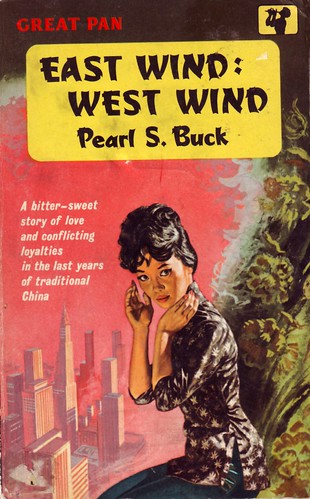
East Wind: West Wind was Pearl S. Buck's first novel. It's set in China. Our selfless heroine, Kwei-lan, finds herself in a troubling position. She's been raised in a very traditional home. She's been raised--some might even say trained--from a very, very young age to please her future family--her future mother-in-law, her future husband. As a daughter, her mother has always, always kept in mind that she is not truly of their family. Kwei-lan's marriage has been arranged--set in place--since the time she was a baby. The first few chapters chronicle her childhood, her bringing up. Readers get a glimpse of the culture. How women lead very separate lives from the men. How women are to be silent and obedient and always willing to please their husbands, their masters. Readers get a glimpse of this culture. Of what made a woman beautiful, attractive, desirable. And one of the things that made a woman beautiful are incredibly tiny feet which led of course to the practice of binding feet. (Being able to cook well also helped a woman please her husband. And you HAVE to know how to pour tea for your elders.)

But our heroine, our narrator, is in for quite a shock. For her husband has spent time in the West. He has become educated; he's a doctor. He prefers to break with some of the traditions, to live a more modern life. He wants his wife to be more of an equal and less of a slave. He wants his wife to be his companion. He wants to share his life with someone. He doesn't want a silent shadow, an obedient slave. He wants more. The first step may just be the hardest--for he is asking his wife to unbind her feet.

East Wind: West Wind is all about tension and drama. For though our heroine wants to please her husband, although she is fascinated by some of these new ideas, she finds it difficult to forget everything she's grown up believing. It's not something that can be done in one week, one month, or one year.

But. This isn't her story alone. No. Some of the most dramatic scenes in the novel focus on her brother. Like her husband, her brother has been educated in the West, he has spent time in foreign countries. He's learned to adapt to new ways of life. And he does NOT want to return to China to marry the woman he's been betrothed to since he was a young child. He wants to marry for love. He wants to marry an American girl, Mary. He wants to live life on his terms--not having to obey every decree of his father and mother. He does marry the girl of his dreams. He does bring her back to China. But can he make anyone in his family accept her? love her? Will he regret marrying for love? Will she? Can they find a place for themselves in China? 

East Wind: West Wind is an intense family drama. It's simple yet emotional. I loved the style of this one. How it's told in story format. She's telling her story directly to "My Sister." It's a beautiful, beautiful novel. Bittersweet, in a way, yet very compelling.

I would definitely recommend this one!!!

Have you read Pearl S. Buck? Do you have a favorite novel? Which would you recommend?!

Other reviews: Hot Cup of Coffee. The Wu Way.


© 2011 Becky Laney of Becky's Book Reviews


The Murder at the Vicarage


Murder at the Vicarage. A Miss Marple Mystery. Agatha Christie. 1930/2006. Black Dog & Leventhal. 288 pages.

It is difficult to know quite where to begin this story, but I have fixed my choice on a certain Wednesday at luncheon at the Vicarage. The conversation, though in the main irrelevant to the matter in hand, yet contained one or two suggestive incidents which influenced later developments.

Murder at the Vicarage is the first Agatha Christie novel starring Miss Marple. And it was a delight. A pure and simple delight. It is narrated by the vicar, a Mr. Clement. His narrative was just right--for me. It was a perfect blend of humor and charm. And, of course, suspense! Mr. Clement is shocked to discover a dead man in his study. Colonel Protheroe had his moments--he's a man most would find difficult to live with. But no one *really* expected him to be murdered! He was supposed to be having a private meeting with the vicar that evening. But a phone call changes all that...

Inspector Slack is the "official" detective on the case. The man responsible for solving this crime and bringing the murderer to justice....

Miss Marple, one of the elderly women in the community, tells Mr. Clement that there are seven people she suspects capable of the murder. But she's not naming names--at least not yet. Which leaves Mr. Clement trying to guess the identity of the murderer as well.

Chapter by chapter, readers find clues. Can they guess the identity of the murderer before Miss Marple's big reveal?

I found both Mr. Clement and Miss Marple charming. I just LOVED the characterization in this one. The humor, the wit, the drama. It was just a satisfying read.

Here are some of my favorite lines:

"Dear Vicar," said Miss Marple, "you are so unworldly. I'm afraid that, observing human nature for as long as I have done, one gets not to expect very much from it. I daresay idle tittle-tattle is very wrong and unkind, but it is so often true, isn't it?" (23)


Thursday started badly. Two of the ladies of my parish elected to quarrel about the church decorations. I was called in to adjudicate between two middle-aged ladies, each of whom was literally trembling with rage. If it had not been so painful, it would have been quite an interesting physical phenomenon. (40)


"Ah!" said Miss Marple. "But I always find it prudent to suspect everybody just a little. What I say is, you really never know, do you?" (154)


"I remember a saying of my Great Aunt Fanny's. I was sixteen at the time and thought it particularly foolish."
"Yes?" I inquired.
"She used to say, "The young people think the old people are fools--but the old people know the young people are fools!" (282)


At that moment Anne Protheroe entered the room.
She was dressed very quietly in black. She carried in her hand a Sunday paper, which she held out to me with a rueful glance.
"I've never had any experience of this sort of thing. It's pretty ghastly, isn't it? I saw a reporter at the inquest. I just said that I was terribly upset and had nothing to say, and then he asked me if I wasn't anxious to find my husband's murderer, and I said 'Yes.' And then whether I had any suspicions and I said 'No.' And where I didn't think the crime showed local knowledge, and I said it seemed to, certainly. And that was all. And now look at this!"
In the middle of the page was a photograph, evidently taken at least ten years ago--Heaven knows where they had dug it out. There were large headlines.

WIDOW DECLARES SHE WILL NEVER REST TILL SHE HAS HUNTED DOWN HUSBAND'S MURDERER.

Mrs. Protheroe, the widow, of the murdered man, is certain that the murderer must be looked for locally. She has suspicions but no certainty. She declared herself prostrated with grief, but reiterated her determination to hunt down the murderer.

"It doesn't sound like me, does it?" said Anne.
"I daresay it might have been worse," I said handing back the paper. (201-02)


© 2011 Becky Laney of Becky's Book Reviews


Strong Poison

Strong Poison. Dorothy L. Sayers. 1930/1995. HarperCollins. 272 pages.

There were crimson roses on the bench; they looked like splashes of blood.

I loved this one. I just LOVED, LOVED, LOVED this one! It is a mystery starring Lord Peter Wimsey. And it introduces a new character, Harriet Vane, a novelist. She writes detective novels. Which may not be to her benefit, since when readers first meet her she's on trial for murder, accused of poisoning her ex-boyfriend, Philip Boyes. Since arsenic poisoning happened to be the subject of her latest book, well, they're saying she has all the know-how and a motive to match. One of the last places he was seen--before he took ill--was her place.


But. Hope is not lost. For Lord Peter Wimsey believes wholeheartedly in her innocence. And though he has only a month to prove it, he's determined to find all the proof and evidence needed to clear her name. In Strong Poison, it is more than curiosity motivating him to act. For he has fallen in love with Harriet--heart and soul, truly, deeply, madly in love with her. I *knew* that a romance between these two was coming. I just didn't expect the proposal to be so soon! And it's a little swoon-worthy, I think!
"Such a Victorian attitude, too, for a man with advanced ideas. He for God only, she for God in him, and so on. Well, I'm glad you feel like that about it."
"Are you? It's not going to be exactly helpful in the present crisis."
"No; I was looking beyond that. What I mean to say is, when all this is over, I want to marry you, if you can put up with me and all that."
Harriet Vane, who had been smiling at him, frowned, and an indefinable expression of distaste came into her eyes.
"Oh, are you another of them? That makes forty-seven."
"Forty-seven what?" asked Wimsey, much taken aback.
"Proposals. They come by in every post..." (44)

and
"Why? Oh, well--I thought you'd be rather an attractive person to marry. That's all. I mean, I sort of took a fancy to you. I can't tell you why. There's no rule about it, you know."
"I see. Well, it's very nice of you."
"I wish you wouldn't sound as if you thought it was rather funny. I know I've got a silly face, but I can't help that. As a matter of fact, I'd like somebody I could talk sensibly to, who would make life interesting. And I could give you lots of plots for your books, if that's any inducement."
"But you wouldn't want a wife who wrote books, would you?"
"But I should; it would be great fun. So much more interesting than the ordinary kind that is only keen on clothes and people. Though of course, clothes and people are all right too, in moderation. I don't mean to say I object to clothes." (45)
It was inevitable really. How could I not love Harriet Vane and Lord Peter Wimsey?!

Can Wimsey find the real murderer? Can he free the woman he loves? And if he does free her, will he win her heart?

I would definitely recommend this one. I loved so many things about it--the characters, the writing style, the dialogue, the humor, the suspense.

More of my favorite quotes:
"What a clear mind you have," said Miss Climpson.
"When I die you will find 'Efficiency' written on my heart." (53)
"If anybody ever marries you, it will be for the pleasure of hearing you talk piffle," said Harriet, severely.
"A humiliating reason, but better than no reason at all." (128)

© 2011 Becky Laney of Becky's Book Reviews


Twitter Delicious Facebook Digg Favorites More