Showing posts with label 2007. Show all posts

Genrefied Classics: A Guide to Reading Interests in Classic Literature

Genrefied Classics: A Guide to Reading Interests in Classic Literature. Tina Frolund. 2007. Libraries Unlimited. 392 pages.

Genrefied Classics is essentially a reference book. A book of bookish lists. There are ten genres explored in the book. Each chapter of genres is broken into sub-genres or categories. Each sub-genre has a list of recommended reads. Each entry lists the author, the title, the year and country of initial publication, details about more recent publications, and information about if the title has been done as a movie or an audio book. Each entry also features 'similar reads' and subject headings for that title.

Classics can be interpreted differently by people--depending on each person's definition of what a classic is and is not. This book only includes "classics" published before 1985. (Ender's Game would be an example of a more recent classic included in this one, the oldest examples would be The Iliad, Aesop's Fables, The Aeneid, etc.)

While the intended audience of this one may be adults who work with kids and teens (fifth grade on up through twelfth grade)--in other words librarians, teachers, etc., I think other readers can benefit from browsing this one. I don't think you have to be looking for a classic to put in the hands of a teenager to benefit from it.


There are categories or subcategories within this one which I wish were a bit longer because I would love even more suggestions. I would have LOVED it if the chapter on romance had been longer. I would have thought there would be more categories too. This section just felt a little uninspired, if that makes sense. Because while it's nice to include Jane Austen and Charlotte Bronte, it's not like those aren't oh-so-obvious choices. And to list only one Georgette Heyer?! I also think it would have been nice for Eugenia Price to get a mention or two either in this section or the historical fiction section. And Grace Livingston Hill, for that matter, either here or in inspirational fiction. And it just felt wrong, wrong, wrong for Elizabeth Gaskell not to be included in the romance section or the historical fiction section. Surely North and South and Wives and Daughters and Cranford are more than worthy to be included!!! I mean North and South is absolute must-must-must read in my opinion.

I was pleased to see some of my favorite authors included: Agatha Christie, Dorothy Sayers, Josephine Tey, Ray Bradbury, Orson Scott Card, John Steinbeck, L.M. Montgomery, etc. Some of the authors recommended were unfamiliar, which is a GOOD thing in my opinion. I picked this one up wanting to discover new-to-me-authors in my genres of choice. Unfortunately, some of them might be a bit tricky to find at the library. 

Because of my familiarity with some of the subjects (sub-categories), their recommended reading lists seemed too short, too incomplete, as you might expect. If you come to the book wanting new-to-you authors, new-to-you-books, the more you've read of the basics, the more that will be the case. But these lists aren't supposed to be comprehensive, they're supposed to be more basic than that.

One thing that also GREATLY annoyed me (I have low tolerance for this, don't laugh) is when they used the WRONG, WRONG, OH-SO-WRONG listing for the Chronicles of Narnia. Publication order. Publication order. Publication order. That's all I have to say about that.

As you might expect, the longest chapter is devoted to historical fiction. Over sixty pages worth of recommended reading. The shortest chapter is definitely the one devoted to inspirational fiction.
The ten genres are:

Adventure
  • Espionage
  • Journey
  • Lost World
  • Nature and Animals
  • Sea Stories
  • Survival
  • Swashbucklers
Historical Fiction
  • Ancient Egypt
  • Ancient Greece
  • The Roman Empire
  • The Middle Ages (A.D. 500-1500)
  • Sixteenth, Seventeenth, Eighteenth Century Europe and England
  • The Spanish Colonies
  • Colonial America
  • American Revolution
  • American Civil War 1861-1865
  • Slavery
  • Settlers and Pioneers
  • Westerns
  • Gilded Age
  • Jazz Age
  • The Great Depression
  • Urban Realism and the Growth of City Life
  • World War I
  • World War II
  • Victorian England
  • Russian Novels Nineteenth Century
  • Russia Twentieth Century
Science Fiction
  • Aliens
  • Dystopias and Alternative Futures
  • Science Gone Awry
  • Space Travel, Adventure, and Life in Other Worlds
  • Time Travel
Fantasy
  • General Fantasy
  • High Fantasy
  • Mythology
  • Epic and Legend
  • Arthurian Fiction
  • Folktales
  • Fairy Tales
  • Animal Fantasy and Fables
  • Humorous Fantasy
Horror
  • Ghost Stories
  • Haunted Houses
  • Gothic Horror
  • Vampires
  • Supernatural and Weird Stories
  • Psychological Horror
  • Science Gone Awry
Mystery and Suspense
  • Detectives
  • Hard-Boiled Private Eyes
  • Crime and True Crime
  • Suspense
Coming of Age and Other Life Issues
  • Coming of Age
  • Relationships
  • Family
  • Extreme Mental States (Mental Illness and Drug Addiction)
  • Death
  • Social Conflict
Romance Fiction
  • Gothic Romance
  • Historical
  • Regency Romance
Inspirational Fiction
  • Religious Scriptures
  • Early Christianity
  • Christian Literature
  • Other Inspirational Stories
Humor


© 2011 Becky Laney of Becky's Book Reviews


Oscar Wilde and the Death of No Importance

Oscar Wilde and a Death of No Importance. Gyles Brandreth. 2007. Simon & Schuster. 368 pages.

From the prologue: My name is Robert Sherard, and I was a friend of Oscar Wilde. We met in Paris in 1883, when he was twenty-eight and already famous, and I was twenty-two and quite unknown. "You must not call me, 'Wilde,'" he said to me at that first encounter. "If I am your friend, Robert, my name to you is Oscar. If we are only strangers, I am Mr. Wilde." We were not strangers. Nor were we lovers. We were friends. And, after his death, I became his first--and his most faithful--biographer. I knew Oscar Wilde and I loved him. 

I was curious about this mystery series starring Robert Sherard, Oscar Wilde, and Arthur Conan Doyle. The novel is set in 1889-1890, in London, for the most part. Oscar Wilde discovers the body of a young boy, Billy Wood, a male prostitute of his acquaintance. Wilde was his tutor, of course. This murder angers him and he turns to his friends, Robert and Arthur, for help. (Arthur, if I remember correctly, is a new acquaintance.) Arthur suggests that they go to his friend Inspector Aidan Fraser for help. Surely this Inspector of Scotland Yard will take on the case and see that justice is done. But sadly no, to everyone's surprise, Billy Wood's death just isn't "big enough" to investigate. But Oscar Wilde is determined and inspired by the fictional Sherlock Holmes, he decides to solve the case himself. He'll follow each and every clue, he'll get the help of some of his friends, and, using his logic and intuition, he'll solve the case. Robert, our narrator, is a little skeptical. How can Wilde solve this one? It's not like they even have a dozen clues to follow. Just a clean floor in a clean room and a missing body. Will that be enough?

I am not sure I liked this one. In fact, there were elements of this one that I didn't really like at all. It is one thing for a murder mystery to have clues hidden subtly and not-so-subtly throughout so that when the big reveal does happen, you feel like you should have seen it coming. Or to admit that though you didn't see it coming, it all makes perfect sense now that all the dots have been connected. But with this one...I don't know if surprise is a strong enough word. Even though Oscar Wilde was quite proud of himself for piecing it all together, even though his version of events, we're led to believe, proved true, I'm still unsatisfied. I don't know if that is because Oscar Wilde did not share ANY of the clues, any of the leads, any of the theories, with our narrator so that Robert remains completely clueless from the first chapter to the last chapter. Or if Robert just didn't have his eyes and ears open. Or if Robert was so obsessed with the Inspector's fiancee that he wasn't thinking at all--let alone thinking logically. Was Robert clueless on purpose so the reader would stay clueless so the big reveal would hold one surprise after another? Or were readers supposed to be solving this case along with Oscar Wilde? Because if readers were supposed to pick up on the 'clues' left by the author...well, I'm only one reader, but it didn't work for me.

I did like the writing, for the most part. There were passages that I really enjoyed. I just wasn't satisfied enough with the mystery of this one.

It is curious how little we remember--even of experiences that seemed so vivid at the time. The mind's eye is not a camera: it is an artist's brush. It provides no photographic record, alas. It can bring back the colour of the day, the feeling of the moment, but the detail is all gone. It's an adequate instrument for poets and painters, but for detectives--useless! (215)

For most of the journey home his nose was buried in a book. We all read--or pretended to. I leafed slowly through my vade mecum--my annotated edition of the maxims of La Rochefoucauld. Veronica pored over a scientific journal devoted to Louis Pasteur's work on immunisation against anthrax. Aidan Fraser read Jerome K. Jerome's Three Men In A Boat--but not, I think, with close attention. He did not laugh once. (270)

It is important to understand others if one is to understand oneself. (295)

© 2011 Becky Laney of Becky's Book Reviews


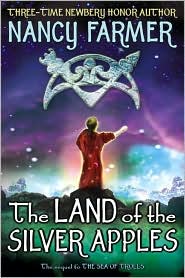
The Land of the Silver Apples (MG/YA)

The Land of the Silver Apples. Nancy Farmer. 2007. Simon & Schuster. 512 pages.

It was the middle of the night when the rooster crowed.

The Land of the Silver Apples is the sequel to Nancy Farmer's The Sea of Trolls. And I must admit that I loved it. I just loved, loved, loved it! Even more than the first book. Perhaps because I already loved our hero Jack! Perhaps because I already cared for Thorgil, Brother Aiden, and the Bard (Dragon Tongue to some.) Perhaps because I really, really came to care for the new characters we're introduced to in this second novel! Or maybe it was just perfect timing--the right book at the right time! Lucy, Jack's younger sister, Jack's all-too-spoiled younger sister, has been acting very, very, very strange! Turns out there is a good reason! For their father has been keeping a HUGE secret from the family. A secret about Lucy. But this secret is forced into the open, as a new quest begins, a new adventure begins.

In The Land of Silver Apples, readers journey along with Jack into dangerous new worlds. We'll encounter hobgoblins (including the Hobgoblin king, Bugaboo) and elves (beware, beware!) and that's just the beginning.

If you enjoy a blending of mythology and fantasy, then you should definitely read these books! They're good fun. Plenty of action and adventure. Some humor. And I love the writing! It's just a satisfying novel!

© 2011 Becky Laney of Becky's Book Reviews


Miss Spitfire (MG)

Miss Spitfire: Reaching Helen Keller. Sarah Miller. 2007. Simon & Schuster. 240 pages.

"Ticket, please."
I wipe at my eyes and thrust the wretched thing at him. I've already had to change trains six times since Boston. On top of that, I have to take this train north to Knoxville to catch yet another train south to Alabama.

I love Miss Spitfire. I just LOVE, LOVE, LOVE Miss Spitfire. It's such a feel-good, oh-so-magical, ultimate-comfort read--at least for me. It's a novel about Annie Sullivan and Helen Keller. A novel about a teacher who wouldn't accept failure, who kept persevering, no matter how big the challenge, no matter how big the tantrum, Sullivan was NOT going to be beaten by a child.

Annie Sullivan is a young woman on a mission. Her job? To teach a child--a six year old child--who is blind, deaf, and dumb. It won't be easy. There has only been one successful case in the past to base their hopes and dreams on: Laura Bridgman. But Annie is strong-minded and determined. She'll need every ounce of stubbornness she has if she's going to master the willfulness of Helen. Used to getting her own way, Helen runs wild. And as Annie soon points out, the family expects better behavior from the dogs than they do their young daughter. Helen has never been disciplined a day in her life--at least since an illness left her blind and deaf. This journey from despair to hope, from chaos to communication, is an important one. It is full of emotion--as day by day Annie struggles to teach and love a child who fails to comprehend the meaning of words altogether. Anger. Frustration. Rage. Joy. Happiness. Fear. Hope. Despair. It's all here. Annie and Helen. This is their story.

If you've seen The Miracle Worker, you'll know the basic plot of this one. But it is Sarah Miller's writing that impressed me the most. I loved how she told this story.

After years of being blind myself, I can understand a mind without pictures, but I can hardly comprehend a mind without words. Words, songs, stories--they were the things I craved most before my sight was restored, for words explained the things my eyes couldn't show me. When I was blind, words were as vital as breath. (7)
"I'm not sure I can do this job. Yet a part of me understands Helen better than she does herself. I'm no stranger to frustration, anger, isolation. I wonder, though, how Helen can be content to deprive herself of my affection? The thought of her indifference makes my throat sting, yet I can't help feeling drawn to her. If I could only touch her heart, I know I could reach her mind. But she won't even let me hold her hand." (43)
"It seems nothing I do comes out right. But in my heart I know what's right for Helen: obedience, love, and language. Come what may and hell to pay, I'll find a way to give her all three." (64)
All these words, do they linger in her fingers after her lessons are through? (125)

And for the record, I loved, loved, loved the ending. It was oh-so-magical.

© 2011 Becky Laney of Becky's Book Reviews


Bloom (YA)

Bloom. Elizabeth Scott. 2007. Simon & Schuster. 240 pages.

I guess I kept hoping some kind of miracle would happen.

Little did I know when I first read Bloom almost four years ago that Elizabeth Scott would become one of my favorite, favorite authors. (Her other romances include: The Unwritten Rule, Stealing Heaven, Perfect You, and Something Maybe. Her dramas include: Love You Hate You Miss You, Living Dead Girl, and Grace.) All I knew was that I'd discovered a giddy-making romance that reminded me of Valley Girl. And that was enough, more than enough, to keep me interested, to keep me wanting more.

Lauren, our heroine, is unhappy. She knows she should be happy, be content, with her life. Her boyfriend, Dave, is perfect. Everyone says so, so it must be so. But their romance has no sizzle. It's as exciting as watching grass grow. Remembering their early days, Lauren isn't sure if it was ever love--if there was ever a spark of passion, of love, between them. It was just so new, so exciting, to be wanted by someone, and not just anyone, but someone so popular, so loved.

Katie, her best friend, is someone she doesn't trust to listen to her problems. Perhaps because she knows that Katie's boyfriend is such good friends with Dave. Or perhaps because Katie monopolizes what time they do have together by talking about her boyfriend, her life, her problems. Would Katie listen if Lauren tried to speak up? We'll never know. It's certainly not Katie's fault--as a friend--that Lauren never makes the attempt to be open and honest.

For Lauren is not being open and honest with anyone in her life--not her boyfriend, not her best friend, not her dad. But there is one guy in her life, a new guy who is no stranger, Evan Kirkland. For a few months, these two were childhood friends. He being the son of her father's girlfriend, Mary. But when that relationship fell apart--as all her father's relationships fell apart--the two lost touch. Evan, all grown-up, takes Lauren's breath away. He's swoon-worthy in a non-traditional way. He's someone that for better or worse, Lauren can't help wanting and needing. With him, she can be real, she can be herself, she can be open and honest, she can be vulnerable and needy. Dave and Evan are complete opposites. Only one guy is right for her, but will she be brave enough to make the right choice? Or will she let what 'everyone else thinks' keep her from finding what her heart wants most: unconditional love.

I suddenly realize that he's nervous, just like me, but he went ahead and took a chance. People don't usually do that. I mean, I know people think teenagers hang naked out of cars and whatever, but you know, high school isn't an environment that encourages you to do anything other than exactly what everyone else is doing. (51)

"Are you late to work?" I ask.
"A little. They offered me extra hours this week, and I can take them so..."
"I'm sorry," I say. "You didn't have to drive me home."
"I know. I wanted to."
He wanted to. I may be sitting in his car, but really I'm floating. (56)
I would definitely recommend this one! I'd recommend all of Elizabeth Scott's books!


© 2011 Becky Laney of Becky's Book Reviews


Cupid (YA)

Cupid. Julius Lester. 2007. Houghton Mifflin Harcourt. 208 pages.

A long time ago, when Time was still winding its watch and Sun was trying to figure out which was east and which was west, there was a king and queen. I don't know what country they were were king and queen of. That information was not in the story when it came down to me. Sometimes, stories don't understand; what may not be important to them is very important to us.
Now I'm sure there are people who can tell this particular story without having a name for the kingdom this king and queen ruled. Jupiter bless them. I guess I'm not that good of a storyteller, because I need a name for the kingdom. I asked the story if it would mind my giving the place a name. It didn't see any harm in it, so I am going to call it the Kingdom-by-the-Great-Blue-Sea.
The story also does not have names for the king and queen. I know they had names, but nobody would say to them, "What's up, Chuck?" or say, "Looky here, Liz," if those happened to be their names. I am in agreement with the story this time. If nobody could use their names, there is no need to have them in the story. As for what the king and queen called each other, they were probably like any other married couple and he called her "Honey" and "Sweetheart," and she called him "Good Lips" and things like that, which we don't need to pursue any further.
The king and queen had three daughters. I know what you are thinking: the daughters didn't have names, either. That is partly true. Two of the girls were name-naked. I'm not even into the story yet and already we have four people that the Internal Revenue Service could not send a letter to. (1-2)
I absolutely LOVE the narrator of Cupid. Lester rewrote this classic tale of Cupid and Psyche (a tale originally found in Apuleius' The Golden Ass) in the voice of a Southern black storyteller. I'm not sure it works for every reader--I've found a handful of negative reviews--but for me it worked well. I just fell in love with it, and stayed in love with it! I would recommend listening to this one--there is a great audio production of it!

I thought the storytelling was lyrical. The story focuses on the not name-naked daughter of the king and queen, Psyche, the most beautiful girl in the world--most beautiful mortal girl anyway.
I tried to write something that would give you an idea of how beautiful she was, but the letters of the alphabet got so confused and jumbled up trying to arrange themselves into words to describe someone for whom there were no words, they ended up crying in frustration. I hate trying to make words out of letters that have been crying and are so wet they can't stay on the page. Later on in the story, after the letters dry off, I'll try again to arrange them into enough words so you'll have some idea of what Psyche looked like. For now you'll just have to believe me when I say she was the most beautiful woman in the world (3).
Who should be jealous of our young princess other than the great goddess of love herself, Venus.

Yes, Venus is jealous. She wants revenge. She wants it now. And who better to deliver it than her winged son, Cupid? Cupid's mission? To make Psyche fall in love with someone she shouldn't. Someone ridiculously ugly or inappropriate. Or some inanimate object, perhaps. Anything to bring shame on the mortal girl will do in Venus' opinion.

Cupid is the story of what happens when this "god of love" falls madly in love himself, falls for the one girl his mother would NEVER approve of! 

Cupid did not understand what had happened to him. If you think about it, that's kind of funny. He was the god of love, but he had never been in love. Love had been a game to him, a game that he controlled with his bow and arrows. But after he saw Psyche, his life would never be again what it had been. (30) 

Like me and like you, Cupid accepted that it was not only possible but rational to love someone to whom he had not spoken--to love someone whose voice he had heard, whose face he had seen for, what? Five minutes? Ten? Certainly no more than that. Yet, this was all it took for him to feel as if he could lift mountains, polish stars, and hold the sun in his hands (35).

But love is never easy. Especially if it's true. One thing is clear. Cupid must choose between his mother and his new love. Who will he choose? What will he do to prove himself to his new love?

© 2011 Becky Laney of Becky's Book Reviews


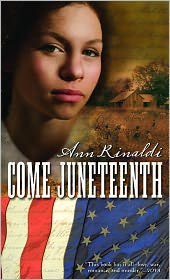
Come Juneteenth (YA)

Come Juneteenth. Ann Rinaldi. 2007. Houghton Mifflin Harcourt. 256 pages.

From the prologue: Last night when the fire burned low, when the last of the sweet potatoes under the logs was just a crisp fragrance left of our supper, long after my brother Gabriel had taken his last swig from the flask in his haversack and wiped his mouth with the back of his hand and turned over in his bedroll on the other side of the fire and grunted his good night, last night I lay awake long and unblinking in the spark-filled distance above me. 

From chapter one: I was in the pumpkin patch, counting the ones that were good enough for Old Pepper Apron, our cook, to make into bread.

Secrets. Lies. Lives torn apart. Not by the Freedom War, the War Between the States, the Civil War. But by lies told during those years by masters to their slaves. Come Juneteenth is set in Texas in 1865. Texas slaveholders--like our heroine's father--were able to keep Lincoln's Emancipation Proclamation secret. For two years. Out of necessity? Out of greed? Out of fear? Out of hate or anger? Perhaps we'll never know all the reasons. Luli, our heroine, has struggled with this secret. So has her brother, Gabriel, for both care--in VERY different ways--for Sis Goose, a slave woman who is legally a slave--owned by the family's aunt, but someone who has been raised--since she was a baby--as a member of the family. Luli considers her a sister--an older sister. The two have been very close at times. Though growing up has changed some things. And Gabriel? Well, he's very much in love with Sis Goose. He plans on marrying her and living happily ever after. After, you know, he gets back from fighting the Indians. So when the truth does come out, when the slaves are freed, when the Yankees arrive, well, Sis Goose feels hurt and betrayed and very angry by the family she's loved. 

Come Juneteenth is dramatic and intense. The story is told in flashes by Luli. The transitions between past and present can be tricky, but, for the most part, I liked it.

© 2011 Becky Laney of Becky's Book Reviews


The Moving Finger

The Moving Finger. Agatha Christie. 1942/2007. Black Dog & Leventhal. 208 pages.

I have often recalled the morning when the first of the anonymous letters came.

Jerry Burton, our hero, has taken a house in the country with his sister, Joanna. He's recuperating from an injury, and his doctor has definitely suggested some rest and relaxation. As for Joanna, she's recuperating from a broken heart. But rural village life isn't as uneventful and peaceful as he expected. For soon after his arrival, an anonymous "poison pen" begins a nasty letter campaign. Which is unpleasant enough, he supposes, but things turn deadly after a woman's "suicide" after receiving a vile letter. The victim leaves behind two young sons, an older daughter from her first marriage, a husband, and a rather pretty governess. Megan, the daughter from the first marriage, soon becomes a major player in this Miss Marple mystery. This "suicide" becomes a bit suspicious when a second death occurs--that of a maid--within the home. The question becomes did this maid--on her day off--see something?

I loved this one. I just LOVED it. It wasn't a purely pleasant read for me. I wouldn't exactly say I was praying throughout, but I was certainly wishful with my repeated pleas, please don't let it be Megan, please don't let it be Megan, please don't let it be Megan. Never have I gotten that involved with a mystery. Who is Megan? For better or worse, she's the young woman our hero described thusly, "She looked much more like a horse than a human being. In fact, she would have been a very nice horse with a little grooming" (17). She's largely ignored not only by the village but by her family as well. But there is something about her that Jerry, our hero, can't ignore. He goes out of his way--time and time and time again--to include her. He even invites her to stay with him and his sister after her mother's death. He is the one person, she's found, willing to listen to her.

While Jerry is making friends with Megan--not always an easy task--Joanna, his sister, is trying to make friends with the local doctor. That is an uphill battle. Joanna has never, ever had to work this hard to get a guy to like her.

So this mystery has a romantic element to it which I just loved. It also stars Miss Marple, though she doesn't enter the case until after the second death occurs. Miss Marple finds Jerry Burton a great help in this one! The details he's observed through his stay, makes solving this one so much easier for her! It gives her quite the lead. But she still has to *prove* it.

The Moving Finger is very compelling! I loved it for so many different reasons.

My favorite quotes:

Emily Barton, I think, has a mental picture of men as interminably consuming whisky-and-sodas and smoking cigars, and in the intervals dropping out to do a few seductions of village maidens, or to conduct a liaison with a married woman.
When I said this to Joanna later, she replied that it was probably wishful thinking, that Emily Barton would have liked to come across such a man, but alas, had never done so. (85)

"The police are doing their best."
"If Agnes could be killed yesterday, their best isn't good enough."
"So you know better than they do?"
"Not at all. I don't know anything at all. That's why I'm going to call in an expert."
I shook my head. "You can't do that. Scotland Yard will only take over on a demand from the chief constable of the county. Actually they have sent Graves."
"I don't mean that kind of an expert. I don't mean someone who knows about anonymous letters or even about murder. I mean someone who knows people. Don't you see? We want someone who knows a great deal about wickedness!"
It was a queer point of view. But it was, somehow, stimulating. (141)

"Yes, it was dangerous, but we are not put into this world, Mr. Burton, to avoid danger when an innocent fellow creature's life is at stake. You understand me?"
I understood. (199)

© 2011 Becky Laney of Becky's Book Reviews


The Lost Memoirs of Jane Austen


The Lost Memoirs of Jane Austen by Syrie James. 2007. HarperCollins. 352 pages.

Why I feel the sudden urge to relate, in pen and ink, a relationship of the most personal nature, which I have never before acknowledged, I cannot say. Perhaps it is this maddening illness which has been troubling me now and again of late--this cunning reminder of my own mortality--that compels me to make some record of what happened, to prevent that memory from vanishing into the recesses of my mind, and from there to disappear for ever from history, as fleeting as a ghost in the mist.

Last year, I LOVED Syrie James' The Secret Diaries of Charlotte Bronte. I didn't love, love, love The Lost Memoirs of Jane Austen. I'm not even sure I liked it. But. I found it an entertaining read. The book is a fictionalized autobiography, the supposed "last writing project" of a dying Jane. In her "memoir" she reveals her true love. How her brief relationship with him changed her--for the better. (For the record, this relationship is NOT physical or intimate.)

This love is Mr. Ashford. And he seems to be Jane's perfect match in many, many ways. He's able to hold his own in conversation with her. He is intelligent and handsome and seems to genuinely care for Jane. But Jane's true love, well, he's got a few secrets. And his behavior, well, that "inspires" the messy romances of Sense & Sensibility. For Jane's Mr. Ashford is one part Edward, one part Willoughby.

And Mr. Ashford isn't the only person "inspiring" Austen's fiction. (For example, Mr. Collins is inspired by Mr. Morton.) These "inspirational" scenes can be a bit risky. How many are really needed? How much is too much? I'm not one of those that think every single character in every single book needs to have been "inspired" by a real person. (One of the reasons I hated--yes, HATED, Searching for Pemberley by Mary Lydon Simonsen.)

This memoir blends truth with fiction. We do know some things about Austen's life, for example, especially about her family life. And James does a nice job in adding a bit of romance to that life. And for most of the novel--the second half at least--readers get the chance to see Austen hard at work writing and revising.

I liked to see Austen writing. I liked to see her close friendship with her sister. But. I didn't love the romance. Not really. Because even though Mr. Ashford isn't Tom Lefroy, it still felt similar enough to Becoming Jane for me to not quite like it. Not to the same degree, perhaps, which is good. And I did like this book better than Miss Austen Regrets.

Would reading The Lost Memoirs of Jane Austen make readers want to read more Austen? I'm not sure. The only Austen I've not read (or reviewed) is Mansfield Park. I've read Sense and Sensibility, Northanger Abbey, Persuasion, Emma, Lady Susan, Pride and Prejudice. Have you read this one? What did you think? 

© Becky Laney of Becky's Book Reviews


The Plain Janes (YA)

The Plain Janes. Cecil Castellucci. Jim Rugg. Minx. 176 pages. 

Metro City. Last spring. When it happened, I fell. There was a pop and then nothing. I didn't know what was happening. 

I was surprised by how much I really enjoyed The Plain Janes. I didn't expect to like it so much. I didn't expect it to be so compelling. I was surprised by the depth, the substance, of the characterization.

Jane, our heroine, is just one of many Janes in her new school, new town. And at first, she finds her new world to be uninviting. But. After meeting the other Janes, she finds hope and makes a plan. A plan that will include bending a few rules. She'll start a club--a secret club--called P.L.A.I.N. People Loving Art in Neighborhoods. Her role--while anonymous--brings some great people into her life. But it isn't without some risk.

The focus is on family, friends; life at home and school. I would definitely recommend The Plain Janes.

© Becky Laney of Becky's Book Reviews


Beowulf by Gareth Hinds

Beowulf. Gareth Hinds. 2007. Candlewick Press. 128 pages

In the days of old, the House of the Scyldings ruled in Denmark.

The good news? It was a quick read. The bad news? I was disappointed with this graphic novel adaptation. There are many pages that are all action and no text. The fight scenes between Beowulf and Grendel, Beowulf and Grendel's mother, and Beowulf and the dragon. For those that enjoy graphic novels, that enjoy illustrated fight scenes, then Beowulf may not disappoint. The lack of text might even be considered a good thing by many readers. It may make Beowulf more reader-friendly.

After loving Gareth Hinds adaptation of The Odyssey, I was hoping to find something similar. I loved how he adapted the text for the format. The Odyssey is a thicker graphic novel. It's a long story; yet I was never bored. Beowulf, though shorter, though action-packed, never made me care. I didn't connect with the characters, the story.

While I love, love, loved the art for The Odyssey, I just didn't care about the art in Beowulf. 

© Becky Laney of Becky's Book Reviews


Twitter Delicious Facebook Digg Favorites More