Showing posts with label adult romance. Show all posts

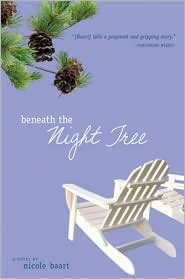
Beneath the Night Tree

Beneath the Night Tree by Nicole Baart. 2011. Tyndale. 400 pages.

Daniel hummed in his sleep. It was an unconscious song, a midnight lullaby, as familiar to me as the sigh of my own breath. I fell asleep at night listening to the cadence of his dreams, and when I woke in the morning, his quiet melody was a prelude to birdsong. 

Julia DeSmit, our heroine, is a single mom essentially raising two kids. One, Simon, is her half-brother, who's now ten. The second, Daniel, is her son. She isn't all on her own. She lives with her grandmother--the woman who raised her.

Julia DeSmit is used to feeling a bit lost, a bit of a wanderer--though that isn't really the case. She has strong family roots and unlike her mother she knows how to be responsible and loving and compassionate. Still, she has certain dreams of her own, a vague idea on how she wants her life to go. And so when one of those dreams seemingly starts to come true--a marriage proposal from Michael, her boyfriend, well, you'd think she'd be happier.

But Julia is learning that love isn't always simple, that some people are worth giving second chances. Parker, the biological father of her son, contacts her and wants to know if their one night together resulted in a child. And slowly--one or two words at a time--she catches him up on all he's been missing. But the decision to allow him into their son's life isn't automatic.

Parker may be just what Simon and Daniel need. A strong, smart father figure who gives his time and attention...he is the exact opposite of Michael in oh-so-many ways.

And that's just the beginning...

This is the third novel in the series and I enjoyed it very much. The first two are After the Leaves Fall and Summer Snow.

© 2011 Becky Laney of Becky's Book Reviews


The Doctor's Lady

The Doctor's Lady. Jody Hedlund. 2011. Bethany House. 384 pages.


"Indians!"

The Doctor's Lady is a fictionalized account of a missionary couple. The hero/heroine of this one is based on Marcus and Narcissa Whitman. Some of the names have been changed--though not all according to the author's note--but many of the events of the novel really happened.

The Doctor's Lady stars Priscilla White a woman oh-so-eager to be a missionary--to India--who is very reluctant to marry anyone. But when she learns that she won't be able to serve as a missionary--anywhere--if she remains single, she accepts the marriage proposal of a man in somewhat similar circumstances. Dr. Eli Ernest longs to return to Oregon territory to start a mission. But he's just learned that he'll need to take a wife. To answer God's call, these two may just have to wed...

The Doctor's Lady is a detailed accounting of the wagon trip west. For those that love pioneer stories, it's a good read! I definitely enjoyed it.

© 2011 Becky Laney of Becky's Book Reviews


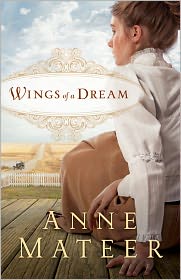
Wings of A Dream

Wings of a Dream. Anne Mateer. 2011. Bethany House. 319 pages.

"Rebekah Grace, if you don't hurry we'll be late for the lecture."

 I had my doubts about Wings of a Dream after reading the first chapter. But. I kept reading. And it didn't take me long to realize that I had judged it much, much too soon. This one hooked me. I ended up loving this sweet historical romance. Was it predictable? Yes. I won't lie. If you demand that your romance, your historical romance, be absolutely original and unpredictable...then you may be disappointed with this one. But if what you're looking for is a feel-good story, a satisfying read that is oh-so-cozy, then Wings of a Dream may just be for you.

This historical romance is set in Texas in 1918 during the last months of World War I. Our heroine, Rebekah Grace, travels to a small Texas town to care for her sick aunt. She arrives just in time--to meet the woman she barely knew, to make a difficult promise, to care for the children in her aunt's care. Rebekah is forced to grow up as she becomes the caregiver of four young children--one just a baby. (Their father is in the army, their mother is dead.)

There is plenty of drama in Wings of a Dream, and I must say that I liked it much more than I thought I would. I wouldn't say it is the best, best book I've ever read. But it was certainly enjoyable!

© 2011 Becky Laney of Becky's Book Reviews


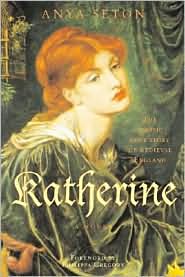
Katherine

Katherine. Anya Seton. 1954/2004. Chicago Review Press. 512 pages.

In the tender green time of April, Katherine set forth at last upon her journey with the two nuns and the royal messenger.

Katherine is the third Anya Seton novel I've read, and it is probably my favorite so far. It is the 'love story' of Katherine de Roet and John of Gaunt (Duke of Lancaster). It's definitely a 'love story' with complications!

The book opens with Katherine traveling with several nuns to visit her sister, Philippa, who is in the service of the Queen. Her arrival catches the attention of at least two guys. The most persistent being Hugh Swynford. Her sister just hopes that her sister has enough sense to know that these men are after one thing and only one thing. And Katherine does know that. But she can't protect herself from unseen dangers.

One day, Katherine takes a walk in the garden thinking that she is alone, that she is safe, only to discover that Hugh Swynford is there and he means to get his way. They struggle. And only fate in the form of John Gaunt, the Duke, saves her. He demands to know what is going on and Hugh stammers something about how he really truly means to marry the penniless girl. The Duke takes the poor woman home to his wife, Blanche, who takes pity on the girl and offers her friendship and kindness.

But within days Katherine learns her fate. She will be the wife of Hugh Swynford. For better or worse, she'll be stuck with him. But it's not like she has much of a say in her future. And a good match is a good match.

Katherine is a novel of medieval England. Readers get more than a quick and easy 'love story.' It's a novel about war and politics and social class. The novel follows the lives of Katherine and John through four decades. The 1360s through the 1390s.

There are plenty of characters to love and hate in this one. And it's a pleasant read. Not too dry, not too boring. But not completely romance either. There is history and politics and talk of war and riots, etc. If you're just looking for romance, this may not be the one for you. But if you want substance to your romance, then you should give it a try.

© 2011 Becky Laney of Becky's Book Reviews


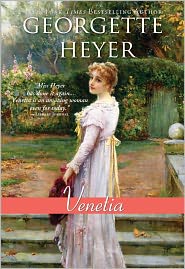
Venetia

Venetia. Georgette Heyer. 1955/2011. Sourcebooks. 368 pages.


'A fox got in amongst the hens last night, and ravished our best layer,' remarked Miss Lanyon. 'A great grand-grandmother, too! You'd think he would be ashamed!'

 I treated myself to a reread of Georgette Heyer's Venetia this week. And if you've read this one--or any Georgette Heyer's historical romances--you'll understand why it's a treat. For there is something oh-so-delightful, oh-so-satisfying about reading one of Heyer's romances. She has a way with her characters, and a way with dialogue.

If Heyer's romances have a flaw--and I don't really think of them as flawed--it would be that they require a bit of patience. You can't rush Heyer. Or, if you do try to rush Heyer, you end up missing the point. For it's all about the journey.

You can skim romances by contemporary authors. You can skim entire paragraphs or entire pages and not miss a thing. You can almost read an entire romance novel of several hundred pages without engaging any thought, any attention to the book in hand. That's why you can read several a day if you're an addict. But you can't skim Georgette Heyer. Not really. Not if you want to really enjoy it. And why bother if you don't want to enjoy yourself?

I've read almost all of Heyer's romances--all but seven, I believe. And Venetia is definitely one of my favorites, one of those in my top five. Now don't ask me to name my absolute favorite and best because I couldn't. I wouldn't even try.

Venetia, our heroine, has spent all of her life in the country having very little to do with society. She's known to two or three families in the neighborhood, perhaps, but for the most part her life has been secluded. She keeps company with her younger brother, Aubrey, whom she adores despite his flaws. He always, always, always has his nose in a book. But her lonely days are about to come to an end...

One day while taking a walk, she meets Lord Damerel. A man with an oh-so-dreadful reputation. He enters the novel in a spectacular way--for better or worse. For he sees the heroine strolling along on his land and impulsively grabs her and kisses her. Leaving her a bit shocked to say the least. They argue. They enjoy arguing. Readers know that Venetia won't be forgetting Damerel any time soon, and vice versa.

But the two really don't get to know one another--and I mean nothing improper by the word know--until her brother, Aubrey, is injured. Aubrey is taking to Damerel's home to recover, and Venetia, good sister that she is, must be near his side. Damerel and Venetia have plenty of time to talk--to really talk--and it's oh-so-obvious that these two are meant to be. That the two are soul mates. But his reputation, his past, is something he can't forget. She knows he's been a bad, bad boy, but she just knows that she loves him, that she accepts him as he is.

Of course, Lord Damerel isn't the only man in love with Venetia. She suffers through two suitors Oswald Denny and Edward Yardley. These two are laughable really. And if you take the time to appreciate them for what they are, for what they add to the novel, then you won't find their scenes boring.

Of course I haven't even mentioned the plot of this one, not really, but I'm not sure that matters so much. For it is the characters that are the heart and soul of this one. I loved, loved, loved the characters in this one. The dialogue of this one is so much fun!!!
"Who are you?" he demanded abruptly. "I took you for a village maiden--probably one of my tenants."
"Did you indeed? Well, if that is the way you mean to conduct yourself amongst the village maidens you won't win much liking here!"
"No, no, the danger is that I might win too much!" he retorted. "Who are you? Or should I first present myself to you? I'm Damerel, you know."
"Yes, so I supposed, at the outset of our delightful acquaintance. Later, of course, I was sure of it."
"Oh, oh--! My reputation, Iago, my reputation!" he exclaimed laughing again. "Fair Fatality, you are the most unusual female I have encountered in all my thirty-eight years!"
"You can't think how deeply flattered I am!" she assured him. "I daresay my head would be quite turned if I didn't suspect that amongst so many a dozen or so may have slipped from your memory."
"More like a hundred! Am I never to learn your name? I shall, you know, whether you tell me or no!" (33)
He released her hands, but only to pull her into his arms. "When you smile at me like that, it's all holiday with me! O God, I love you to the edge of madness, Venetia, but I'm not mad yet--not so mad that I don't know how disastrous it might be to you--to us both! You don't realize what an advantage I should be taking of your innocence!" He broke off suddenly, jerking up his head as the door opening on to the passage from the ante-room slammed. (235)


© 2011 Becky Laney of Becky's Book Reviews


A Most Unsuitable Match

A Most Unsuitable Match. Stephanie Grace Whitson. 2011. Bethany House. 336 pages.

Kneeling before the tombstone, eighteen-year-old Fannie Rousseau retrieved the scrub brush from the water bucket she'd just settled in the grass. First, she attacked the dried bird droppings on the back side of the stone, then moved on to the deep grooves carving the name Rousseau into the cool gray surface. She'd just finished cleaning out the second s when a familiar voice sounded from across the cemetery.

I just LOVED, LOVED, LOVED Stephanie Grace Whitson's Sixteen Brides which I reviewed last year. So I was super-excited to read her newest novel, A Most Unsuitable Match. And I must say it did not disappoint! It was just as wonderful.

The heroine of this historical romance is Miss Fannie Rousseau of St. Charles, Missouri. The novel opens soon after her mother's death. Though her mother's death is more recent, it is the loss of her father that has broken her heart or spirit. Now with her mother's death, she's being forced to wake up a bit, to realize that she needs to start taking charge of her life, to start managing the house--or managing the staff--and looking into her financial situation. The family lawyer isn't one for talking--or at least not talking honestly and openly with her. His advice has been--for months and months--just get married, when you get married your husband will take care of you and your finances, I'll work with him about your estate. Needless to say, Miss Fannie does NOT want to take his advice. And she doesn't want him to pick out her husband for her.

After a failed burglary attempt, Miss Fannie is urged to gather her mother's jewels to put in a safe under her lawyer's keeping. While going through her mother's things, she discovers a secret. She finds over twenty letters from a woman, Edith LeClerc, and a photograph. It seems her mother has a twin sister. Why didn't her mother ever tell her about her aunt? Why keep something so big a secret? She takes the photograph and the letters to her lawyer, and his advice is whatever you do, don't try to contact her. She may want your money if she finds out her sister is dead. And besides there is probably a good reason your mother wanted nothing to do with her. So leave it alone.

While she went into the lawyer's office wanting to write her aunt a letter at her last known address, she leaves his office almost determined to do something more! What if she were to go looking for her aunt herself....

So Miss Fannie Rousseau and Hannah, her faithful servant, a woman who has almost always been dearer to her than her mother, decide to travel by steamship. On the ship, they meet a young man, Mr. Samuel Beck, and thus this romance begins. He is on a quest as well. He's looking for someone too.

I loved this one. I just LOVED this one. I loved the characters. I loved the story. I though Miss Fannie was just a lovely heroine. And I loved seeing her grow up a bit on her journey. I loved seeing her deepen her faith as she gave up her comfortable life and trusted God to lead her. I loved Sam Beck (or Brother Sam). I loved seeing him grow into his mission and discover his gift for reaching people right where they are with the gospel. And I also loved so many of the characters we meet along the way, Lamar, Doctor Lamotte and his son, Patrick, Honest Abe Valley, etc.

This one is set in 1869/1870.

© 2011 Becky Laney of Becky's Book Reviews


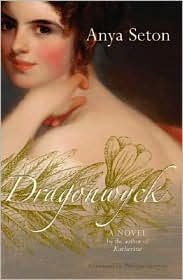
Dragonwyck

Dragonwyck. Anya Seton. 1944/2005. Chicago Review Press. 352 pages.

It was on an afternoon in May of 1844 that the letter came from Dragonwyck. 

Miranda Wells is the foolish heroine of Anya Seton's Dragonwyck. This farm girl has much to learn, and her trusting nature combined with her restlessness is just asking for trouble. The novel opens with Miranda being invited to visit her cousin, Nicholas, and his wife, Johanna, and their daughter, Katrine, in their home, Dragonwyck. Though cousins, the two have never met. For the Van Ryn's are quite wealthy, and the Wells are at best poor relations. But the couple appears--at first--to be looking for a companion for their daughter. Someone not quite a servant, but not quite a real guest either. The wealth and luxury of their lifestyle--especially in comparison to the only lifestyle she's ever known--life on a farm has Miranda thoroughly charmed. Everything that Nicholas says and does just wows her. He seems to be so perfectly, perfect. She just can't help herself, she finds herself falling for him. On her part, I do feel it's just silliness, with more innocence to it than real intent to break up a marriage. But the wife, well, she is unhappy and uncomfortable with Miranda being there. She didn't expect her to be so young, so beautiful, so ready to be charmed by her husband.

How does Nicholas feel about Miranda? How does Nicholas feel about his wife? his daughter? How does Nicholas feel about anyone else? Well. Readers can draw their own conclusions, perhaps. But needless to say, this reader was NOT charmed by Nicholas. He didn't seem all that swoon-worthy to me. And AFTER his wife's oh-so-convenient-death, well, my impressions changed even more--but not in his favor. A true romantic hero, in my opinion, would NEVER EVER propose marriage to a young woman while his dead wife was still in the room.

So do you think Miranda lives happily ever after with Nicholas?!

It's true I was never bored with Dragonwyck. But I also never found true satisfaction with it. Miranda was a frustrating heroine, to me, because she was just too stupid immature. She wasn't all that smart, and she wasn't all that good. (With goodness being a virtue.) There was very little to love in Miranda. That being said, I definitely felt something for her. I pitied her. Miranda's choices weren't all that smart. But NO WOMAN deserves to be treated the way she was treated. And I definitely wanted Miranda to be saved--to either save herself or to be rescued by some good soul. Nicholas. Well, what can I really say about him?! I didn't find him appealing at all. It was just so easy for me to hate him. His flaws are too many to even begin to list. And his strengths? Well, I can't think of any!

Have you read Dragonwyck? What did you think of it? Did you like it? love it? hate it? Do you think it's fair to compare it to Jane Eyre and Rebecca? I definitely see how Dragonwyck is a gothic romance.

Here's how Philippa Gregory's afterword begins, "At the very opening of this far-fetched, romantic novel, Anya Seton takes a great risk with her readers: she shows a foolish young woman reading a far-fetched, romantic novel and gently mocks both the genre and the readers."

Here's the part where I disagree with her:
Johanna is a wonderful thumbnail portrait of a woman whose death we are not going to mourn. Her greed, illustrated in the first moment we meet her when she demands to know if her husband has brought her pastries from town, is wonderfully described. Seeing Johanna, with crumbs on her gown and half-eaten dishes in her room, puts us neatly on the side of Nicholas and the guilty lovers. We are prepared for Johanna's death, and we don't mind when it happens.
By the time Nicholas comes to marry Miranda, Seton has so arranged our sympathies that we are as keen for the marriage to proceed as is Miranda. And so we forgive Nicholas for our suspicion of murder and Miranda for her desire for Nicholas and cupidity for his life. In addition, we agree with Miranda that the farm is a poor place. We forgive both Nicholas and Miranda because we are as bad as they. We don't mind that Johanna is dead, and we want to see Miranda live the high life. (339-340)
It is Nicholas who dominates the book, of course, and it is he who lingers in the mind after the book is finished. What a wonderfully gothic, nightmarish hero-villain he is! He is handsome and beautifully dressed; he is stylish and wealthy. He is absolutely exceptional, and we know this before he even enters the pages of the novel because Seton has the crowd murmur his name before he arrives. He delights us at once. He circumvents Miranda's father, which pleases us since we want to see her freed. He sweeps her away to his home, and his home is a wonder. We think, like Miranda, that he could be saved by true love. We despise his fat wife; we have hopes for his future. (341)
I don't only disagree with her a little, I disagree a LOT. (I might have exchanged a few words with the book.)

© 2011 Becky Laney of Becky's Book Reviews


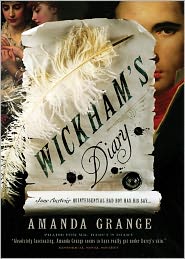
Wickham's Diary

Wickham's Diary. Amanda Grange. 2011. Sourcebooks. 208 pages.


11th July 1784, 
Fitzwilliam and I rode out early this morning. We raced down to the river and I won, beating him by a good two lengths, at which I laughed and called him a sluggard. He was annoyed and challenged me to a race back to the house. 

Amanda Grange's latest Austen-inspired novel gives voice to George Wickham. Wickham's Diary is a prequel to Jane Austen's Pride and Prejudice. Readers get a glimpse of Wickham as a boy and young man. As someone who is playfully mischievous and ambitious, as someone who is plotting and manipulative, and, of course, someone who is selfish! Grange presents a Wickham who knows just what to say to women to get what he wants, what he needs. A confident Wickham who loves being wicked. And oh how Wickham can justify himself!

Did I enjoy this one? Yes. Would it have been my first choice for her next book? Probably not! I've never seen the appeal of George Wickham. And I would love to see Amanda Grange do all the *real* heroes before tackling the so-called bad-boys of Austen! I would LOVE to see, for example, Mr. Tilney's Diary. Then, perhaps, she can continue her series. I would be thrilled to see Mr. Crawford's Diary!!! He is my *one* exception to Austen's "bad boys." For as I mentioned in my review of Mansfield Park, I think he's been misunderstood! And then there's Mr. Willoughby, of course.

See also my reviews of Mr. Knightley's Diary and Colonel Brandon's Diary.


© 2011 Becky Laney of Becky's Book Reviews


Twitter Delicious Facebook Digg Favorites More