Showing posts with label 1939. Show all posts

Grapes of Wrath

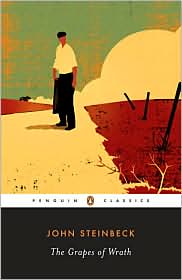
Grapes of Wrath. John Steinbeck. 1939. Penguin. 619 pages.

To the red country and part of the gray country of Oklahoma, the last rains came gently, and they did not cut the scarred earth. 

It is finished! After three or four false starts, after two library editions and two paperback editions, it is finished. If one word could sum up my experience with this one, it would be sluggish. Of course, I can think of a few other words to describe it. But I'll share just one more: bleak. (Or perhaps bleakity-bleak.)

To sum this one as quickly as possible: The Joad family, devastated by losses in Oklahoma, are forced to pack it all up and head to California where they find that life is just as hard if not harder than they could have ever imagined. There is no happy welcome awaiting them, they are viewed--at best--as mere animals. The only way out of the harsh ugly reality is death. And even death doesn't come easy. The end.

I'm not going to try to convince you that The Grapes of Wrath is a horrible book. I'm not going to try to convince you that The Grapes of Wrath is a wonderful book. I can--at best--only share with you why we're not a good match for one another.

The language. There are certain words that offend me each and every time they're used. It doesn't matter the circumstances. It doesn't matter who or where or why. The Grapes of Wrath uses a great many of these words. (Or should I say repetition of the same word.) Are the words realistic? Probably. But that doesn't change my reaction to those words.

I had big, big, big problems with the character of Jim Casy. This "former preacher" annoyed me every time he opened his mouth. Though annoy isn't quite the right word. I'm not sure offended is the right word either. Simply because people can't use the word offended without people judging them. It's just that his language is so crude, so vulgar. That his "story" is so vulgar--how every time he got worked up "in the spirit" preaching, he had to find sexual release with young women from his church (or audience or wherever). Yes, that was mostly in the past, and yes, this "sin" is what led him to eventually give up faith and religion. Casy, when we meet him, doesn't believe in God, doesn't believe in the church or religion, doesn't believe in prayer, doesn't believe in sin, doesn't believe in the concept of right or wrong, or heaven and hell. Casy doesn't believe in anything at all really. There are no answers, there will never be any answers. Suffer, suffer, suffer, why have hope at all that you will ever do anything but suffer. Any time Casy talked about matters of faith or matters of the heart or anything remotely connected to spirituality or religion or even morals and ethics, I just wanted to yell at him. It doesn't help that according to "experts" Jim Casy is a "Christ figure." I read this on Wikipedia and Spark Notes. There are almost no words for how that makes any sense whatsoever. How someone so foul, so crude, so vulgar, so given-over-to-sin, someone who doesn't believe ANYTHING at all, someone who has no hope, no love, no peace, whose only message is now is all we got, and now is ugly is a "Christ figure." In what way at all--does he resemble Christ? Now, I'm not saying that everyone should hate Jim Casy. I am saying that as a reader I could not stand him.

Another big issue I had with The Grapes of Wrath has to do with style. The narrative style of this one is a bit odd. You have chapters that are clearly narrated by members of the Joad family, chapters that carry this story forward. Then you have chapters that read more like an out of body experience. These may focus on turtles or waitresses or car salesmen. But. They are clearly not like the other chapters in the novel. I never could quite figure out if the people in these chapters were the Joads--as seen from the outside perspective--or if the people (when the focus was on people not trees or turtles, etc.) were meant to represent any family facing this crisis, any family who had been devastated. I don't know that it matters. I just felt a great big disconnect every time we lost the main story, the real story. However, there were a couple of exceptions. There were times when these chapters were beautifully done and the text is richer for them--for the perspective they add to it. (Chapter fourteen comes to mind.)

I struggled with the first sixteen chapters. I did. I wasn't liking it. I wasn't liking it at all. But things began to shift a little with chapter seventeen. I don't know if the story truly improves once the family crosses into California, or if I just was in a better mood that day, but something changed. From that point on, the story while not always pleasant was more compelling. There was still violence to deal with, still some harsh realities to endure, but the second half definitely improved my impressions of the novel.

I am SO GLAD that this wasn't my first introduction to John Steinbeck. If it was, I never would have picked up any of his other books. I would have walked away knowing that I was right, that Steinbeck was not for me. The truth is, that Steinbeck was a good writer--at times great. That he wrote in many, many styles. That he had MANY stories to share with readers. Not just one story over and over and over again. Some of the stories he tells are very funny, very true-to-life, and even in their earthiest moments, there's something there worth reading. His stories can be very raw, very perceptive. The Grapes of Wrath was not for me. Perhaps the message was some things in life are so ugly that no amount of imagination can make them beautiful. I found the lack of hope and the vulgar language to be too much for me. But the very things that I dislike about it--the realistic portrayal of humanity at its weakest and worst--may be the very things some one else loves about it.

I read this book for the Classics Circuit tour. 

© 2011 Becky Laney of Becky's Book Reviews


Heidi's Children

Heidi's Children. Charles Tritten. 1939. 255 pages. 

Dorfli was still enveloped in a mantle of snow, but the baker, returning from Maienfeld in his wagon, reported that down in the valley it was already spring. 

Heidi's Children is, I believe, the third and final Heidi book. Heidi Grows Up, the second novel, ended triumphantly with Heidi wedding Peter, the goat herding boy she first met when she was just five. This third novel opens with Heidi just a few months away from giving birth to her first child.

Heidi and Peter live with Heidi's grandfather and Peter's mother in the village of Dorfli. (During the summer months, they retreat higher up in the mountains, though the grandfather's original hermit-hut is no more.) As they have the largest house in the village, they also have the local school teacher, Heidi's old school chum, Jamy, living with them. The novel opens with Jamy making a request of Heidi and Peter. She wants them to welcome her younger sister, Marta, into their home. It seems Marta is too difficult for her own parents to handle, and they essentially don't want to have her around...at all. Marta, of course, has figured all this out. Peter has his doubts initially, let the reader never forget how jealous and possessive he can be with Heidi, but eventually he agrees to the plan.

So Marta is the "first" of Heidi's "children" to arrive. A few months later Heidi welcomes twins into the world. A baby boy. A baby girl. And grandfather is there to welcome this next generation. He even suggests the names for both the babies.

This naming scene is funny, in my opinion. For it sees just about everyone from the village coming into their home to give advice and share gossip.
"Well, what do you think of them, Peterli?" his mother asked after he had studied their features for some time without making any comment.
"As alike as two strawberries," he answered, "and just as red. How long will it be before their eyes open?"
"They aren't kittens," laughed Heidi, looking up from her pillows. "Their eyes have already opened and they're as blue as the sky itself. They're sleeping now. Little babies have to sleep."
"Has the Alm-Uncle seen them?" asked Peter his face still thoughtful.
"Oh, yes," answered Heidi. "He was so pleased but he escaped to his own room again as soon as the neighbors came. Their chatter bothers him as it does me, but I can't ask them to leave."
"I'll ask them if you want me to," announced Marta, her eyes still fiery. "They're out there in the living room saying horrid things about everybody in the family and suggesting the most dreadful names for the babies. You won't name them anything they suggest, will you?"
"I swear it!" said Peter, raising his hand as though taking an oath. "Whatever they suggest, the babies shall surely be named something different."
Old age had not affected the Alm-Uncle's hearing, for suddenly he called out so loudly that those in Heidi's bedroom and even the neighbors in the living room beyond could hear it, "If they're her surprise, why not name the girl baby after the child?"
"After me?" said Marta, hardly believing her ears, for the Alm-Uncle had never once spoken her name all the time she had been there.
"As you say, Grandfather!" Heidi called back. "But what shall we name the boy?"
"Your father was an upright man, Heidi. It might be well to remember him."
Heidi had not thought of naming the boy anything but Peter. But since Peter objected to that, why not Tobias? She called again, "Very well, Grandfather. He shall be our little Tobi. The neighbors shall hear at the church what names we have chosen." (84-85)
Marta, Jamy's younger sister, is the real heroine of Heidi's Children. It is her story--her emotional and spiritual journey--that is told within the pages of the book. Her developing relationship with the grandfather, her love for Heidi and Peter, her finding a place to belong, etc. Her story isn't always a happy one. For she's still broken. She's mourning the loss of her grandmother. And she definitely hasn't healed from being completely rejected and abandoned by her parents.

The grandfather also plays a big part in this one. Though I don't want to spoil anything by sharing those details here. Let's just say that this is the first Heidi book where the reader catches glimpses of his past.

I did like Heidi's Children. I liked Marta. I liked how she was able to form a good relationship with the Grandfather. I liked how he was able to help her and reach her in a way that her own parents couldn't or wouldn't. It was nice to see him sharing Bible stories with her, for example. And it was nice how he helped fix her cross necklace.

I have enjoyed all three Heidi books! I do wish I'd read them sooner!


© 2011 Becky Laney of Becky's Book Reviews


And Then There Were None

And Then There Were None. Agatha Christie. 1939/2000. Buccaneer Books. 192 pages.

In the corner of a first-class smoking carriage, Mr. Justice Wargrave, lately retired from the bench, puffed at a cigar and ran an interesting eye through the political news in the Times. He laid the paper down and glanced out of the window. They were running now through Somerset. He glanced at his watch--another two hours to go.

Ten men and women arrive on Indian island never suspecting the dangers and thrills that are to come. None will leave the island alive. Mr. Justice Wargrave, Vera Claythorne, Captain Philip Lombard, Emily Brent, General MacArthur, Dr. Armstrong, Anthony Marston, Mr. Blore, Mr. and Mrs. Rogers. It seems each has been lured to the island without really knowing their host or hostess. Mr. and Mrs. Rogers being engaged as servants. Miss Vera Claythorne being engaged as a temporary secretary. The others all received letters of invitation. It soon becomes clear that not everything is as it appears.

There are some not-so-hidden clues embodied within a nursery rhyme poem, "Ten Little Indians" (found on pages 21-22 of my edition; you can get an idea of it from this site, though it's not an easy read, it seems it's a combination of two poems, one from 1868 and the other from 1869).  There are also ten little figurines--as each guest dies, a figurine from the table vanishes as well.

Readers get a chance to learn a little about each character. Especially the ones that survive the first few deadly days. None of the characters are particularly likable--none so delightful that you'd want to know them--especially not under these circumstances.

I would say this Christie novel comes the closest to inspiring fear and horror in its readers. There isn't anything particularly cozy or delightful or charming about this one. There are no clever detectives--arrogant or not--to counterbalance the violence. Almost everything that I love about Christie's mysteries seems to be missing in this one. But even though I don't especially "like" this one, I can't deny that it was cleverly written.

© 2011 Becky Laney of Becky's Book Reviews


Sad Cypress

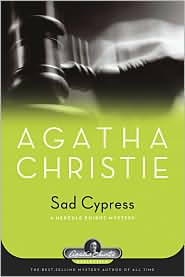
Sad Cypress. Agatha Christie. 1939/2007. Black Dog & Leventhal. 256 pages.

"Elinor Katharine Carlisle. You stand charged upon this indictment with the murder of Mary Gerrard upon the 27th of July last. Are you guilty or not guilty?"

Harriet Vane had Lord Peter Wimsey, and Elinor Katharine Carlisle has Peter Lord. Though her hero is not an amateur detective, but a country doctor. Still, Peter Lord, who fell in love with Elinor at first sight, has the wisdom to seek the best of the best to clear her name: Hercule Poirot. He wants Poirot to find evidence that will acquit her of murder. Is love blinding him? Is the woman he loves guilty of murder? It seems that she had opportunity to kill her aunt (supposedly out of greed) and Mary (supposedly out of jealousy). But Lord and Poirot doubt the supposed motives. They see other possibilities. 

I loved this one. I just LOVED it. I loved the characterization! I loved the story! While Peter Lord is no Lord Peter, I did enjoy him very much! I was quite surprised by how pleased I was that Elinor had someone on her side. Not that Elinor was completely lovable. She was flawed--very flawed. But still. By the end, I was seeing her through Peter Lord's eyes, I was seeing her with love.

"One does not practice detection with a textbook! One uses one's natural intelligence." (196)
"One must understand with the cells of one's brain before one uses one's eyes."(196)
"One always likes to know exactly what lies have been told one."
"Did Welman tell you a lie?"
"Definitely."
"Who else has lied to you?"
"Everybody. I think: Nurse O'Brien romantically; Nurse Hopkins stubbornly; Mrs. Bishop venomously; You yourself--"
"Good God!" Peter Lord interrupted him unceremoniously. "You don't think I've lied to you, do you?"
"Not yet," Poirot admitted.
Dr. Lord sank back in his chair. He said, "You're a disbelieving sort of fellow, Poirot." (198)

© 2011 Becky Laney of Becky's Book Reviews


Twitter Delicious Facebook Digg Favorites More