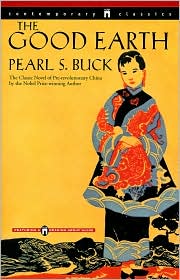
The Good Earth. Pearl S. Buck. 1931/2004. Simon & Schuster. 368 pages.
It was Wang Lung's marriage day. At first, opening his eyes in the blackness of the curtains about his bed, he could not think why the dawn seemed different from any other. The house was still except for the faint, gasping cough of his old father, whose room was opposite to his own across the middle middle room. Every morning the old man's cough was the first sound to be heard. Wang Lung usually lay listening to it and moved only when he heard it approaching nearer and when he heard the door of his father's room squeak upon its wooden hinges. But this morning he did not wait.The Good Earth was Pearl S. Buck's second novel. (Her first novel was
East Wind: West Wind, a novel that I just LOVED AND ADORED!)
The Good Earth is very different from East Wind: West Wind. Though both books are, of course, set in China. East Wind: West Wind focused on a changing China and the tension between the East and West and how that change impacted family life and added drama and stress to family dynamics. How the new way of life threatened centuries-old traditions. The Good Earth is more about the haves and have-nots. It's a novel about poverty and riches.
Wang Lung, our hero, is a humble farmer. He works the land. Slaves on it really. Has barely enough food to feed himself and his father. Most days they can't even afford to have tea leaves in their hot water. Yet he's managed to arrange himself a marriage with a hand-me-down woman, a slave from a rich household--one of the richest households in the village, the House of Hwang. O-lan, his wife, is ugly but hardworking. (For example, she joins her husband in the fields just hours after giving birth to their son.)
The early years of their marriage--the first three to four years of their marriage--are happy. Wang Lung is able to save up money to buy some land--land formerly owned by the House of Hwang. He's working harder than ever. He's got his wife by his side--most of the time. And she's given birth to two sons and one daughter. Things seem to be going well for them. Wang Lung is hopeful that things will keep looking up, that the land will keep producing, etc.
But then drought and famine come and devastate the region. And because he's done better than his neighbors in the past, they don't feel bad for robbing what little he has now in this distress. Things begin to look very bleak indeed. How will Wang-Lung support his father, his wife, his three children, himself, and the new little one on the way?! He can't. Not if he stays where he is.
So the family travels and begins to beg. It's a tough, tough life. A life that calls for HORRIBLE decisions to be made.
Through chance--through morally ambiguous opportunities you might say--their fortunes are reversed. The family goes from being a day away from starvation to being rich enough to return to their former home, rich enough to buy more land, to plant more seed, to hire workers for the land. But does money buy happiness? Does money buy contentment? Does money buy security?
Wang Lung is still a man from humble beginnings. A man who prefers to work his lands himself, a man who prefers to smell of the earth, the land. But he's wealthy enough that he's now beginning to think that his sons could have a different life, a different lifestyle. A lifestyle that begins with education. A lifestyle enhanced by *good* arranged marriages.
If Wang Lung had come to love and appreciate his ugly self-sacrificing wife. (I mean more besides feeling regret or remorse that he doesn't love her as he should. Which is
something at least. But not quite the same thing.) If Wang Lung had been a better father to
all his children,
all the time. (But then again is any father
that perfect?) If Wang Lung hadn't had a midlife crisis and become involved with Lotus, a younger woman, a prostitute, whom Wang Lung "buys" to be his own special concubine. Then I'd have an easier time "liking" Wang Lung. Did I hate him? No. Not really. I didn't respect him on each and every page. There were times I wanted to yell at him. But then there were moments where he showed gratitude and loyalty and affection. In particular his relationship with Ching, a neighboring farmer, and Pear Blossom, a young slave girl "raised" in part by Lotus.

The Good Earth is a good novel. But it's a bit uneven at times. It's complex in that it addresses many issues. The tension between fathers and sons. How misunderstandings occur between the generations. How fathers frustrate and/or disappoint their children. How children frustrate/disappoint their parents. Wang Lung is ALL about the land. It is his first and last love. When it comes to his three sons, well, the land means practically nothing. It's just something to be sold after their father dies. Class issues. How the rich get richer--unless they become addicted to opium--how the poor get poorer--unless they starve to death. Why are the rich so wealthy? Why are the poor so poor? Circumstance has just as much to do with it as wisdom and hard work. Society and culture. But in particular gender roles for women. Wives, concubines, slaves. How women are property to be bought, sold, used, discarded. Fortune. Good or bad. Many events in this book appear to depend on chance or luck or circumstance. There are also hints of political unrest--rumors of war and revolution--in this one. But that issue isn't fully explored--though there is a cousin-soldier that comes bringing chaos to the family for a chapter or two.
But while the novel is complex in many ways. It's uneven in its characterization. Besides Wang Lung very few, if any, are well-developed. Some characters remain nameless--including his three sons and daughter, and his two daughters-in-law--others are given names, but we really see very little development beyond "she's ugly" or "she's pretty" or "she's fat" or "she's thrifty." We get a little bit of insight into his three sons and into his wives/concubines. But I'd not really say that they are completely well-developed.
Still. Even though I wouldn't say I loved this one--or even especially liked it--I can't say that it's poorly written. The style is simple and straightforward. Perhaps not quite as beautiful (to me) as East Wind: West Wind. But compelling nonetheless. I'm not exactly sure why but this one reminds me of some of the John Steinbeck I've read. (Not all of them mind you.)
© 2011 Becky Laney of
Becky's Book Reviews 7:36 AM
 Nikki
 Posted in
1931
,
adult fiction
,
adult mystery
,
book I bought
,
Dorothy Sayers
,
Lord Peter Wimsey
,
mystery