Showing posts with label mystery. Show all posts

Book Review: The Forgotten Garden by Kate Morton

The Forgotten Garden by Kate Morton
Publisher: Atria Books

Publication date: April 2007
Pages: 560

Source: Library
For: Book Group

Nell was abandoned on a ship to Australia when she was only a little girl.  Found by the dockmaster with only some clothes and a book of fairy tales, she remains ignorant of her past until he tells her on her twenty-first birthday.  This launches Nell on a quest to find out about her real parents, a journey that lasts through decades and into her granddaughter's life after Nell's death.  Will they ever know the truth of their past?

Things I Liked:
This was one of those books that intrigues you with family mysteries.  I was really interested in the family history and the processes Nell and Cassandra took to find out about their family.  I must admit, though, that I was more interested in reading the first hand stories of Eliza and Rose than in Nell or Cassandra.  The historical details and the crazy family secrets drew me in more than the other stories.  I also really enjoyed the fairy tale aspect - several stories weaving in and out.  I thought the Frances Hodgson Burnett detail was fun too, what with a bit of secret garden going on.  A complex and interesting story from beginning to end.  I liked this detail:

He was a scribble of a man.  Frail and fine and stooped from a knot in the center of his knobbled back.  Beige slacks with grease spots clung to the marbles of his knees, twiglike ankles rose stoically from oversized shoes, and tufts of white floss sprouted from various fertile spots on an otherwise smooth scalp.  He looked like a character from a children's story.  A fairy story.  p 101
Things I Didn't Like:
I have to admit that about 1/3 of the way in, I had already figured Nell's history out.  Perhaps not to the precise details, but I knew a few of the key facts.  That made it slightly less interesting for me, not to mention I wanted to smack Nell and Cassandra for being so blind.  I did not like how much the story jumped around, what with flashbacks right in the middle of backstories during current stories.  I don't mind duel history viewpoints, but when they jump so much, I find it distracting.  There were only a few places in the book that made me want to stop reading because of it, though.  A good story, but not one of my favorites.

Read-alikes:
The Thirteenth Tale by Diane Setterfield
Arcadia Falls by Carol Goodman
A little The Secret Garden by Frances Hodgson Burnett tie-in too

BOOK CONTENT RATINGS:
s-factor: !@

scattered here and there, nothing too strong

mrg-factor: X
a bit of implied stuff, not much on page

v-factor: -> 
just a little bit

Overall rating: *** 


Do you find yourself liking fewer adult books if you usually read YA or does it still have a draw for you?

If you buy through my Amazon linkage, I will get a very small percentage


Book Review: Clarity by Kim Harrington

Clarity by Kim Harrington
Publisher: Point
Publication date: March 2011

ISBN: 9780545230506
Source: Library


Clarity and her family have always been the freaks in town - a family of psychics or other strange abilities.  Clare's ability lets her see things other people don't, just by touching objects.  But when a murder in town points to her brother as the main suspect, she must use her ability to find out the truth and protect him.  But will she be able to?

Things I Liked:
This was a fun, somewhat unusual paranormal story!  I was rather happy that the main focus of the book was not the romance (though I love a good romance).  Instead, the mystery takes the front seat of the book and that made it more enjoyable to me.  There was less focus on the hot boys and how much she'd like to kiss them (there was some kissing though).  I liked that Clarity and her family were open about their abilities and even made a living off of them.  It was nice not to have the whole secretive paranormal stuff.  All of this is to say that it was unique enough to keep me reading despite the general distaste I have for paranormal lately.  Also, the mystery, while not complex or terribly hard to figure out, was still intriguing.  True mystery fans will probably be bored, but those who like a little bit here and there will enjoy it. 


Things I Didn't Like:
I guess I don't have anything really specific that I didn't like, just that it didn't wow me much.  I think the characters are a bit flat and forgettable, despite some of their quirks.  While I liked Justin for being both vulnerable and sweet, he was a little annoying as well.  The mystery was, as I mentioned, rather simplistic but I was entertained while reading.

Read-alikes:
Paranormalcy and Supernaturally by Kiersten White
The Mark by Jen Nadol

BOOK CONTENT RATINGS:
s-factor: !@

scattered throughout


mrg-factor: X
mentioned but not described

v-factor: ->->
some gruesome things

Overall rating: ***


What do you think of books that you wish you liked more, but just couldn't?

If you buy through my Amazon linkage, I will get a very small percentage


Retro Friday Review & Classics Circuit Tour: The Mysteries of Udolpho by Ann Radcliffe

Doing double duty today with the Classics Circuit Tour of Gothic Lit and a Retro Friday review:

Retro Friday is a weekly meme hosted by Angie of Angieville and "focuses on reviewing books from the past. This can be an old favorite, an under-the-radar book you think deserves more attention, something woefully out of print, etc."

The Mysteries of Udolpho by Ann Radcliffe
Publisher: Various
Publication date: 1794
ISBN: Various
Source: Library


Emily has lived an ideal life with her loving parents, until sorrow is thrust upon her when first one and then the other parent dies. Left alone in the care of an unfeeling aunt, she soon finds herself in the power of the merciless man her aunt marries. Shut away in the gloomy and haunted castle of Udolpho, she suffers afflictions of all kinds. Will she escape from her wicked uncle and the unwholesome company he keeps?

Things I Liked:
This is my first experience with a serious Gothic book (ok, I read Frankenstein and Northanger Abbey, but I'm excluding those).  I admit it was hard getting back into reading a classic, since I'm used to less archaic language.  What totally surprised me was just how creepy the story was!  When it finally got to the interesting stuff (see below for more on that) I was completely enthralled and creeped out!  No wonder young ladies read these with abandon.  All the dreadful and mysterious and unearthly things that could possibly happen to one heroine do.  I really wanted to read this in conjunction with Northanger Abbey, but ran out of time.  But I could see why if Cathy was reading all these Gothic romances she might start imagining and suspecting everyone around her.  It was lurid and disturbing and completely not what I expected.  Which made it quite an enjoyable Halloween read!

Things I Didn't Like:
As I mentioned above, the book really had a slow beginning.  If I hadn't been reading it for the Classics Tour, I'd have given up, which would have been a shame.  But it was about 150-200 pages in before I finally became interested in what was happening.  Enough with descriptions of pastoral scenes and natural beauty!  The story also kind of jumped around weirdly in places, randomly taking us to other characters very briefly to see what they did.  It is definitely a book to be enjoyed by those who aren't daunted by archaic phrasing and pages of description.  A nice abridged version would be great, or even a good movie version!

Read-alikes:
Definitely Northanger Abbey by Jane Austen
Anything else by Ann Radcliffe

BOOK CONTENT RATINGS:
s-factor: !
perhaps one or two


mrg-factor: none
only some obliquely implied stuff

v-factor: ->
it has a touch of some disturbing stuff

Overall rating: ***


Thoughts on Gothic lit or this book in particular?

If you buy through my Amazon linkage, I will get a very small percentage 


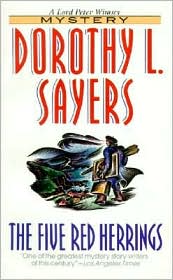
The Five Red Herrings

The Five Red Herrings. Dorothy L. Sayers. 1931. HarperCollins. 325 pages.

If one lives in Galloway, one either fishes or paints. "Either" is perhaps misleading, for most of the painters are fishers also in their spare time. To be neither of these things is considered odd and almost eccentric. 

The Five Red Herrings is the seventh mystery starring Lord Peter Wimsey. Lord Peter is a character that I just love and adore. He's just one of my favorite, favorite, favorite characters ever. So I was so happy to read another mystery in this series.

In The Five Red Herrings, Lord Peter Wimsey is on vacation in Scotland. Though he neither paints or fishes, he is accepted--for the most part--by the community. It's hard to not like him, after all! Early in the novel--though I'm not sure if it's early in his holiday--a murder is committed. The "victim" is someone EVERYONE hates; threats against this guy were so common that they were hardly worth taking seriously. I mean Campbell, the victim, was just impossible to get along with. But now that he's dead, it is up to the police (the constables and detectives, etc.) to solve the crime. And since Lord Peter just happens to be very, very good at detecting, he offers to help them out.

There are six suspects--all artists. Hugh Farren, Henry Strachan, Matthew Gowan, Jock Graham, Michael Waters, and Ferguson. All had motive, all had opportunity. All of them are lying, all of them are hiding things from the police. Since there are so many suspects, since they all appear equally capable of committing the crime, it's just a matter of discerning the truth. Which theory--which plausible theory--is the truth? Which is most likely? Which uses all the clues that have been left behind?

Five Red Herrings is set in Scotland. And, for me, it was a delightful mystery.

Lord Peter Wimsey:

I was born looking foolish and every day in every way I am getting foolisher and foolisher. (52)

One of these days I shall write a book in which two men are seen to walk down a cul-de-sac, and there is a shot and one man is found murdered and the other runs away with a gun in his hand, and after twenty chapters stinking with red herrings, it turns out that the man with the gun did it after all. (114)

The essence of detection is secrecy. It has no business to be spectacular. But you can watch me if you like. (218)

© 2011 Becky Laney of Becky's Book Reviews


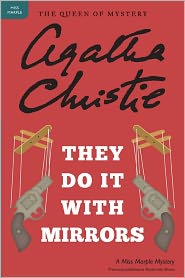
They Do It With Mirrors

They Do It With Mirrors. (Miss Marple). Agatha Christie. 1952/2011. HarperCollins 224 pages.

Mrs. Van Rydock moved a little back from the mirror and sighed. 

Ruth Van Rydock wants her good friend, Jane Marple, to do her a favor. She's worried about their mutual friend Carrie Louise Serrocold. She has a feeling that Carrie Louise is in trouble or in danger. And so she's arranged a visit for Miss Marple. After a few small lies are told to smooth the way, Carrie Louise is happy to welcome her old friend into her home. Miss Marple is introduced to the STRANGE, STRANGE bunch of folks living or working on the estate. Her husband, Lewis. Her daughter, Mildred. Her granddaughter, Gina, and her husband, Walter. Her stepsons from her second marriage, Stephen and Alex Restarick. Her companion-caretaker, Juliet Bellever. Her husband's assistant, Edgar Lawson. (Carrie Louise has been married three times--and it shows. She's carried over wealth and property, but, also children and grandchildren, etc.) Her husband's pet project has him working with juvenile delinquents with part of the estate being converted into a school of sorts. I won't lie, it was a bit confusing at first to see how these characters connect to one another--if they connect to one another. It helps that almost every character seeks out Miss Marple in the days after her arrival. One by one they "unburden" themselves and complain freely about anything and everything.

Of course, it turns out that Ruth had VERY good reason to worry about her friend. And Miss Marple it seems arrived just in time for the drama. Soon there's a murder to be solved...can she solve it in time before more lives are lost?

I enjoy Miss Marple. I do. There is just something satisfying about reading Agatha Christie. While They Do It With Murders isn't my new favorite or anything, it is an enjoyable mystery. Not perfect. But definitely enjoyable enough to recommend.

Ruth to Miss Marple:
"You've always been a sweet innocent looking creature, Jane, and all the time underneath nothing has ever surprised you, you always believe the worst."
"The worst is so often true," murmured Miss Marple.
"Why you have such a poor idea of human nature, I can't think--living in that sweet peaceful village of yours, so old world and pure."
"You have never lived in a village, Ruth. The things that go on in a pure peaceful village would probably surprise you."
"Oh I daresay. My point is that they don't surprise you." (9)

Inspector Curry and Miss Marple:
"This is all very distressing I know. But we've just got to get the facts clear. Get it all clear."
"Oh yes, I know," said Miss Marple. "So difficult, isn't it? To be clear about anything, I mean. Because if you're looking at one thing, you can't be looking at another. And one so often looks at the wrong thing, though whether because one happens to do so or because you're meant to, it's very hard to say. Misdirection, the conjurers call it. So clever, aren't they?" (90)

© 2011 Becky Laney of Becky's Book Reviews


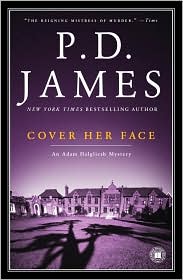
Cover Her Face

Cover Her Face. P.D. James. 1962. 254 pages.

Exactly three months before the killing at Martingale Mrs Maxie gave a dinner party. Years later, when the trial was a half-forgotten scandal and the headlines were yellowing on the newspaper lining of cupboard drawers, Eleanor Maxie looked back on that spring evening as the opening scene of tragedy. Memory, selective and perverse, invested what had been a perfectly ordinary dinner party with an aura of foreboding and unease. It became, in retrospect, a ritual gathering under one roof of victim and suspects, a staged preliminary to murder. 

I enjoyed P.D. James' Cover Her Face. This mystery is the first novel starring detective Adam Dalgliesh. I'm guessing that I'll love other titles in the series even more.

As is the case in any mystery series, I think readers only grow in appreciation as they read on. There's a big difference, in my opinion, between reading your first Miss Marple or your first Rex Stout, and reading your sixth. You just grow to appreciate the little things more and more as you go on. So I do have high hopes for the series. I enjoyed it enough that I'd WANT to read more in the series.

I never know quite how much to say about any murder mystery I review. I could tell you a little bit about the victim, a little bit about the suspects, a little bit about the detectives on the case. But when it comes down to it, it's not those elements that will "sell" you on the novel itself. You either like mysteries or you don't.

Cover Her Face is a nice cozy mystery set in England. The Maxie family is at the center of this mystery. For it is their somewhat-newly-hired-maid, Sally Jupp, that is the victim. The opening chapters show just how many within the family, within the community, disliked her. Some thought this single mom had a bad attitude, an inappropriate smugness perhaps. The Maxie family definitely isn't perfect--it doesn't take the detective, Adam Dalgliesh, long to figure that one out! So many people within the family--or connected to the family--are lying! But what are they lying about? what are they concealing?

For me, what makes ANY mystery novel enjoyable is the investigative process. I LOVE to witness the suspects being interviewed and interrogated. I love to hear the detectives talk about their theories as to who did it and why. And I did enjoy Adam Dalgliesh, I did.

While I wouldn't say this novel is my favorite mystery that I've read this year, it was a good read, very enjoyable, a nice beginning.

© 2011 Becky Laney of Becky's Book Reviews


Elephants Can Remember

Elephants Can Remember. Agatha Christie. (Hercule Poirot). 1972. 212 pages.
Mrs. Oliver looked at herself in the glass. 

While I tend to prefer Miss Marple to Hercule Poirot most of the time, when Christie's Poirot novels feature Ariadne Oliver, it becomes trickier to play favorites. For Ariadne Oliver is a writer, a writer of detective fiction or mysteries. And her perspective on the genre--and on writing in general--which is shared with readers is just fun. In Elephants Can Remember, Mrs. Oliver is approached by a woman who is memorable for all the wrong reasons:
 A large woman. Ample proportions, large white champing teeth. What in French could have been called une femme formidable, but who definitely had not only the French variety of being formidable, but the English one of being supremely bossy. Obviously she either knew Mrs. Oliver, or was intent on making her acquaintance there and then. The last was how it happened to go. (8)
 Mrs. Burton-Cox is "concerned" about her son who is contemplating marrying Mrs. Oliver's goddaughter. Now, Mrs. Oliver has had many goddaughters through the decades, and this particular one has slipped her mind completely. Well, until forced to remember by Burton-Cox's persistence. Celia Ravenscroft is the goddaughter in question, the "inappropriate" young woman, that Burton-Cox does not want for her daughter-in-law. Why? Well, there was a family tragedy when Celia was just a girl. Her parents died in an apparent suicide. No one knows if her father shot her mother or if her mother shot her father. No one knows what provoked this murder-suicide. Was her mother involved with another man? Was her father involved with another woman? And though it seems almost everyone has forgotten this tragedy except Mrs. Burton-Cox, she's convinced that Celia is not good for her son.

Mrs. Oliver is annoyed by Mrs. Burton-Cox. But she is also curious. She was out of the country when the tragedy happened all those years ago, and, well, part of her wants to know the truth--or as much of the truth can be discerned or concluded--herself. So she decides that if Celia will give her blessing, she'll begin to snoop around. And she'll even call her old friend, Hercule Poirot. He may be able to connect the dots and solve this one.


I enjoyed this one. I did. I don't know that it is my favorite Agatha Christie, but it is a good read.


Favorite quote:
"Human curiosity," said Poirot. "Such a very interesting thing." He sighed. "To think that we owe to it throughout history. Curiosity. I don't know who invented curiosity. It is said to be usually associated with the cat. Curiosity killed the cat. But I should say really that the Greeks were the inventors of curiosity. They wanted to know. Before them, as far as I can see, nobody wanted to know much. They just wanted to know what the rules of the country they were living in were, and how they could avoid having their heads cut off or being impaled on spikes or something disagreeable happening to them. But they either obeyed or disobeyed. They didn't want to know why. But since then a lot of people have wanted to know why and all sorts of things have happened because of that. Boats, trains, flying machines and atom bombs and penicillin and cures for various illnesses. A little boy watches his mother's kettle raising its lid because of the steam. And the next thing we know is we have railway trains, leading on in due course to railway strikes and all that. And so on and so on." (25)
"As one journeys through life," said Poirot, "one finds more and more that people are often interested in things that are none of their business. Even more so than they are in things that could be considered their business." (117)


© 2011 Becky Laney of Becky's Book Reviews


The Unpleasantness at the Bellona Club

The Unpleasantness at the Bellona Club. Dorothy L. Sayers. 1928/1995. HarperCollins. 256 pages.

"What in the world, Wimsey, are you doing in this Morgue?" demanded Captain Fentiman, flinging aside the "Evening Banner" with the air of a man released from an irksome duty.

Lord Peter Wimsey's skills will be tested in The Unpleasantness at The Bellona Club. For a great deal of money depends on his preciseness, his thoroughness. General Fentiman, a ninety-year-old man, died at his club (and Peter's club). No one thought anything of it at all.

Until they learned that the General's sister, Lady Dormer, had also died that morning. Until they learned that there was some question as to inheritance.

If the General died first, then Ann Dorland would inherit most of Lady Dormer's money, Major Robert Fentiman and Captain George Fentiman would receive a little money. If Lady Dormer died first, then the General would have inherited most of his sister's money. And with the General being dead too, well, that leaves his two sons quite a bit wealthier.

But who died first? The Lady's death was discovered first. But that doesn't necessarily mean she died first. For nobody is quite sure when the General died. No one suspected him of being dead. He was just sitting still in his chair holding a newspaper for hours and hours.

So Lord Peter Wimsey is asked to help 'solve' this mystery. And at first, it is just a matter of determining when he died naturally. But some of the clues just don't make sense unless he died by unnatural causes.

Was it murder? Can Lord Peter Wimsey solve this case?

I love Lord Peter Wimsey. I do. I love him. And I enjoyed The Unpleasantness at The Bellona Club. I thought it was an interesting mystery.

Lord Peter Wimsey to Mr. Murbles:
"Acid man you are," said Wimsey. "No reverence, no simple faith or anything of that kind. Do lawyers ever go to heaven?"
"I have no information on that point," said Mr. Murbles dryly. (15)

Marjorie Phelps to Lord Peter:

"Peter Wimsey! You sit there, looking a perfectly well-bred imbecile, and then in the most underhand way you twist people into doing things they ought to blush for. No wonder you detect things. I will not do your worming for you!" (162)

"Moral certainty is not the same thing as proof." (205)
Other books in the series:
  • Whose Body (1923)
  • Clouds of Witness (1926)
  • Unnatural Death (1927)
  • The Unpleasantness at the Bellona Club (1928)
  • Strong Poison (1931)
  • Five Red Herrings (1931)
  • Have His Carcase (1932)
  • Murder Must Advertise (1933)
  • The Nine Tailors (1934)
  • Gaudy Night (1935)
  • Busman's Honeymoon (1937)
  • Complete Stories of Lord Peter (1972)
  • Thrones, Dominations (Dorothy Sayers and Jill Paton Walsh) (1998)
  • A Presumption of Death (Jill Paton Walsh) (2002)
  • The Attenbury Emeralds (Jill Paton Walsh) (2010)


© 2011 Becky Laney of Becky's Book Reviews


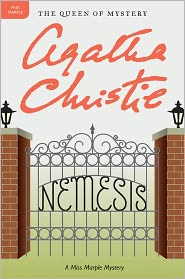
Nemesis

Nemesis. Agatha Christie. 1971/2011. HarperCollins. 304 pages.

In the afternoons it was the custom of Miss Jane Marple to unfold her second newspaper.

I wouldn't say that it's essential that you read A Caribbean Mystery before reading Nemesis. But. If you have read it, you might appreciate Nemesis more.

Nemesis opens with Miss Marple reading about the death of Mr. Rafiel in the newspaper. She met him in the Caribbean, and he was her greatest ally there when she was busy solving that mystery. She liked him a good deal, even though they never reconnected in England afterward. And Mr. Rafiel had great respect for Miss Marple!

One day Miss Marple is contacted by Rafiel's lawyers. They have something important to tell her. It seems that Mr. Rafiel left her a final challenge, a final mystery to solve.

Have you read the book of Daniel? Do you remember when King Nebuchadnezzar dreamed something disturbing and wanted help interpreting that dream. He asked all the wise men for help. But. He refused to tell them the dream. They must come up with the dream and the interpretation. If they weren't able to do both, then they'd be killed.

Nemesis reminded me of this Bible story. For Mr. Rafiel has not provided Miss Marple with any details. Not a where. Not a when. Not a how. Not a who. Not a why. Her greatest chance for solving this one and earning the money he's left her, is for her to go on the vacation he's planned for her: a tour group traveling by bus through England visiting beautiful, historic homes and gardens.

Can Miss Marple do the seemingly impossible?

I enjoyed this one. I wouldn't say it is my favorite Miss Marple mystery. But I'm very glad my library got a copy of this one! (And very happy that HarperCollins has recently published such lovely editions of the Miss Marple mysteries.) If you don't mind a couple of small spoilers, I have something to discuss at the end of this post.

Professor Wanstead and Miss Marple:
"I don't think I know exactly what you mean."
"You are being careful. You are quite right to be careful."
"I have made it a habit," said Miss Marple.
"To be careful?"
"I should not put it exactly like that, but I have made a point of being always ready to disbelieve anything that is told to me." (127)
S
P
O
I
L
E
R

I was disappointed with the way rape was presented in Nemesis. The discussions about rape in the novel were unsettling to say the least. Now, these words weren't coming from Miss Marple herself. So I don't blame the character of Miss Marple for these careless and harmful words.

Professor Wanstead:
"That told against him, of course. Not in the jury's mind, because of course they did not hear about that until after the judge's summing up, but certainly in the judge's mind. It told against him, but I made a few enquiries myself afterwards. He had assaulted a girl. He had conceivably raped her, but he had not attempted to strangle her and in my opinion--I have seen a great many cases which come before the Assizes--it seemed to me highly unlikely that there was a very definite case of rape. Girls, you must remember, are far more ready to be raped nowadays than they used to be. Their mothers insist, very often, that they should call it rape. The girl in question had had several boyfriends who had gone further than friendship. I did not think it counted very greatly as evidence against him." (136)
Mr. Broadribb:
"Well, we all know what rape is nowadays. Mum tells the girl she's got to accuse the young man of rape even if the young man hasn't had much chance, with the girl at him all the time to come to the house while mum's away at work or dad's gone on holiday. Doesn't stop badgering him until she's forced him to sleep with her. Then, as I say, mum tells the girl to call it rape." (165)
These passages made me angry! They did. I wanted to shout at the book. So it's only rape if the woman is a virgin? So the fact that a woman says yes to one man means that she doesn't have the right to say no to any other man...ever? So women are "ready" to be raped? In fact they are out pursuing it?! They are "badgering" and "forcing" them to have sex. Yes, that's right, these poor guys are the victims. Accusing someone of rape is SO MUCH FUN that the women just can't help themselves. They're just begging to be assaulted and raped so they can tell their story to anyone and everyone dumb enough to believe them. What kind of crazy logic is this? It's just wrong on SO MANY levels.


© 2011 Becky Laney of Becky's Book Reviews


Clouds of Witness

Clouds of Witness. Dorothy L. Sayers. 1927/1966. Avon. 224 pages.

Lord Peter Wimsey stretched himself luxuriously between the sheets provided by the Hotel Meurice. After his exertions in the unraveling of the Battersea Mystery, he had followed Sir Julian Freke's advice and taken a holiday.

Lord Peter's holiday is disrupted by shocking news! His sister's fiance, Captain Denis Cathcart, has been murdered, and his brother, the Duke of Denver, Gerald, is the number one suspect. He was spotted standing over the dead body at 3AM outside his home. Lady Mary Wimsey, the sister, was too shocked to make much sense in her statements to the authorities.  Lord Peter Wimsey (and Bunter) arrive to help decipher the clues in this case, in this investigation.

His family isn't exactly helping him. His brother won't say a word in his own defense. Won't let anyone--not even his brother--know where he was on the night of the murder. And his sister? Well, Lord Peter has his suspicions--as does Parker (Scotland Yard)--that she's not telling the whole truth. In fact, her story is a string of lies. So Lord Peter begins to expand his search to the surrounding neighborhood...

Can Lord Peter find a way to free his brother? Can he find a way to help his sister? Can he solve the case so that justice prevails?

I love Lord Peter Wimsey. I do. I just LOVE him. (Just don't ask me to choose between Archie Goodwin and Lord Peter Wimsey--because at the moment, I don't know that I could!!!!) I would have loved to read all the Lord Peter Wimsey books in order, but, I didn't own them all when I first began my adventure into vintage mysteries. So I'm catching up now! According to Wikipedia, the proper order of the books are:
While I wouldn't say that Clouds of Witness is as good as say Strong Poison or Gaudy Night, I must say it is still a fun read!

Lord Peter to Inspector Charles Parker:
"True, O King. Well, you've sat on all my discoveries so far. Never mind. My head is bloody but unbowed. Cathcart was sitting here--"
"So your brother said."
"Curse you, I say he was; at least, somebody was; he's left the impression of his sit-me-down-upon on the cushion."
'That might have been earlier in the day."
"Rot. They were out all day. You needn't overdo this Sadducee attitude, Charles. I say Cathcart was sitting here..." (38)
Lord Peter to Inspector Charles Parker:
"I say, I don't think the human frame is very thoughtfully constructed for this sleuth-hound business. If one could go on all-fours, or had eyes in one's knees, it would be a lot more practical." (48)

Lord Peter to Inspector Charles Parker:
"Did you ever read The Lay of the Last Minstrel?"
"I learnt a good deal of it at school," said Parker. "Why?"
"Because there was a goblin page-boy in it," said Lord Peter, "who was always yelling 'Found! Found! Found!' at the most unnecessary moments. I always thought him a terrible nuisance, but now I know how he felt. See here." (52)

Sir Impey Biggs to the Dowager Duchess:
"Lawyers enjoy a little mystery, you know. Why, if everybody came forward and told the truth, the whole truth, and nothing but the truth straight out, we should all retire to the workhouse." (62)
A solemn Peter...
With that instinct which prompts one, when depressed, to wallow in every circumstance of gloom, Peter leaned sadly upon the hurdles and abandoned himself to a variety of shallow considerations upon (1) The vanity of human wishes; (2) Mutability; (3) First love; (4) The decay of idealism; (5) The aftermath of the Great war; (6) Birth-control; (7) The fallacy of free-will. (71)

Lord Peter to Inspector Charles Parker:
"Mother said--well, I told you what she said. By the way, how do you spell ipecacuanhna?"
Mr. Parker spelt it.
"Damn you!" said Lord Peter. "I did think I'd stumped you that time. I believe you went and looked it up beforehand. No decent-minded person would know how to spell ipecacuanha out of his own head. Anyway, as you were saying, it's easy to see which side of the family has the detective instinct."
"I didn't say so--"
"I know. Why didn't you? I think my mother's talents deserve a little acknowledgment. I said so to her, as a matter of fact, and she replied in these memorable words: 'My dear child, you can give it a long name if you like, but I'm an old-fashioned woman, and I call it mother-wit, and it's so rare for a man to have it that if he does you write a book about him and call him Sherlock Holmes.'" (97)

© 2011 Becky Laney of Becky's Book Reviews


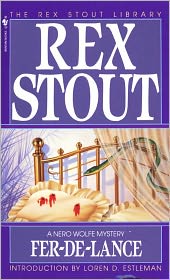
Fer-de-lance

Fer-de-lance. A Nero Wolfe Mystery. Rex Stout. 1934/1997. Random House. 304 pages.

There was no reason why I shouldn't have been sent for the beer that day, for the last ends of the Fairmont National Bank case had been gathered in the week before and there was nothing for me to do but errands, and Wolfe never hesitated about me running down to Murray Street for a can of shoe polish if he happened to need one. But it was Fritz who was sent for the beer.  

Fer-de-lance is the first Nero Wolfe mystery. It introduces readers to two private detectives, Nero Wolfe, and Archie Goodwin. I'm tempted to add in two of the BEST DETECTIVES in the world. But, I suppose that's just my opinion!

In Fer-de-lance, Fred Durkin introduces a woman to Nero Wolfe, Maria Maffei. This woman is worried about her brother, Carlo Maffei, who has gone missing. Archie Goodwin is sent to investigate. First he interviews those in the boarding house where Carlo lived--those that overheard Carlo's phone conversation; he then looks at Carlo's room, goes through his room looking for clues. He learns from Miss Anna Fiore that Carlo often gave her his newspaper after he was finished with it. The newspaper she got that Monday afternoon had a big hole in it--an entire article had been cut out. Nero Wolfe wants to know what article it was Carlo took such an interest in. After discovering the article was about the death of a golfer, Peter Oliver Barstow, he becomes interested in that death. Soon after Carlo Maffei is no longer missing at all--his body has been found. Though there is no obvious reason to link the two deaths together, to investigate them at the same time--especially since Barstow's death has been accepted as natural--Wolfe is convinced that the two are related. That Barstow was murdered. That his body should be exhumed and tested for poison. He's convinced that finding the murderer of one will lead him to solving the other murder. Who killed Peter Oliver Barstow? Was it poison? Who had motive and opportunity? And did Carlo know it was murder? Did Carlo know who killed Mr. Barstow? Is that how he ended up dead?

So Archie and Nero have plenty of work to do, plenty of clues to follow!

I enjoyed Fer-de-lance. It was fun to read the first mystery in this series. Archie and Nero are great fun in this one. Their dialogue still satisfies me. It's just so delightful to spend time with these two!

Nero Wolfe:

"A pessimist gets nothing but pleasant surprises, an optimist nothing but unpleasant." (3)

Nero Wolfe:

"Some day, Archie, when I decide you are no longer worth tolerating, you will have to marry a woman of very modest mental capacity to get an appropriate audience for your wretched sarcasms." (54)

Nero Wolfe:

"People often find it difficult to think in my presence, I do not leave enough space." (96)

Archie Goodwin:

"Everything that the doctor could tell me I had read three days earlier in the newspapers except for a bunch of medical terms which the papers hadn't tried to print for fear of a typesetters' strike." (139)

Archie Goodwin:

"You know what my boss says? He says that skepticism is a good watchdog if you know when to take the leash off." (143)

Nero Wolfe and Archie Goodwin:

"Tell Fritz there will be guests at lunch. What do boys that age eat?"
"They eat everything."
"Tell Fritz to have that." (165)


© 2011 Becky Laney of Becky's Book Reviews


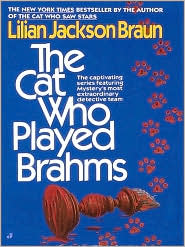
The Cat Who Played Brahms

The Cat Who Played Brahms. Lilian Jackson Braun. 1987. Penguin. 256 pages.

For Jim Qwilleran, veteran journalist, it was one of the most appalling moments of his career.

Jim Qwilleran has had many jobs at The Daily Fluxion, and when the novel opens, he's on his way to being offered a new job as an investigative reporter. But. For Jim that might not be enough. For he's a little unsettled. And what he wants, what he really wants, is time away. He asks for three months vacation. He wants to spend some quiet time in the country at his aunt's cabin by the lake. He may even do a little writing. So he says. But the country may not prove all that quiet and peaceful. And, no, it's not because Koko and Yum Yum, his Siamese, are too lively. (Though to see them in action is something! For example, when someone tries to break into Jim's place, Koko can hold his own and then some!) No, there's something strange going on in this lake community.

For starters, the not-so-hidden messages on cassette tapes...

Even on vacation it seems Qwill and Koko are in demand to solve a mystery! I am enjoying these Cat Who books so much!!! I would definitely recommend them to cat-lovers or mystery lovers!


© 2011 Becky Laney of Becky's Book Reviews


The Cat Who Saw Red

The Cat Who Saw Red. Lilian Jackson Braun. 1986. Penguin. 250 pages.

Jim Qwilleran slumped in a chair in the Press Club dining room, his six-feet-two telescoped into a picture of dejection and his morose expression intensified by the droop of his oversized mustache.

Jim Qwilleran has just been designated the paper's food critic. Unfortunately, Jim has just been placed on a diet by his doctor. When he gets the news that the paper is going to be paying him to eat at all the local restaurants, he's reading over his diet sheet.
No potatoes
No bread
No cream soups
No fried foods
No gravy
No sour cream
No desserts
No wonder Jim is feeling down! His first assignment takes him to Maus Haus where he crosses paths with an old girlfriend--now married, now a potter. He also learns that there's an apartment to rent. True, Maus Haus houses some very eccentric people, but there's also a great cook and housekeeper. (I'm not quite sure how to feel about Jim moving in every book!) His two Siamese cats, Koko and Yum Yum seem to like this move. And his two cats especially love all the food he's bringing home--since Qwill is on a diet, since he's restricting himself to three bites per dish.

But it isn't long before Jim and Koko are back at work solving another mystery. His ex, Joy Graham, has gone missing, and though her husband claims she's run off--again--this time to Florida--a state Jim knows she hates--it may take him a while to really discover the truth.

I enjoyed this one. I did. I am just loving the Cat Who mysteries. I love Koko and Jim. (I still don't feel like I "know" Yum Yum.) These books are just very satisfying, very cozy.

Qwilleran tried to entertain the group with tales about Koko and Yum Yum. "They can smell through the refrigerator door," he said. "If there's lobster in there, they won't eat chicken, and if there's chicken, they won't eat beef. Salmon has to be a nationally advertised brand; don't ask me how they know. In the morning Koko rings for his breakfast; he steps on the tabulator key of the typewriter, which jerks the carriage and rings the bell. One of these days I think he'll learn to type." (40-41)


© 2011 Becky Laney of Becky's Book Reviews


The Cat Who Could Read Backwards

The Cat Who Could Read Backwards. Lilian Jackson Braun. 1966. Compass Press. 227 pages.

Jim Qwilleran, whose name had confounded typesetters and proofreaders for two decades, arrived fifteen minutes early for his appointment with the managing editor of the Daily Fluxion. 

Jim Qwilleran is a new reporter in town. His days of working at a big paper in a big city are behind him--at least for now. And his new assignment, well, it wouldn't be his first choice, or second, or third. For his new job will have him covering artists. And Jim, well, he knows very little about art--especially "modern" art. Since there is already an art critic on staff, one who writes "reviews," he's a little confused about what this new job would require of him. Turns out, he's supposed to focus on the human-interest side of the art scene. So even though he'd rather be writing bigger stories, better stories, money is money is money.

Qwilleran only thought the local art scene would be boring. For within weeks of his taking the job, the owner of a local art gallery is murdered! And this murder is soon followed by an "accidental" death of another local artist. And then by the art critic himself! Can Jim Qwilleran, with a little help from a Siamese cat, solve these crimes?!

I loved this one. I did. I just loved it. I enjoyed Jim Qwilleran right from the start. And as soon as Qwilleran began taking care of his landlord's cat--his landlord having gone out of town for the week--well, I knew it was love. I loved Koko. I did. I thought the mystery was well written and playful and fun. Just something cozy and satisfying about it cover to cover.

Cats have many gifts that are denied humans, and yet we tend to rate them by human standards. To understand a cat, you must realize that he has his own gifts, his own viewpoint, even his own morality. A cat's lack of speech does not make him a lower animal. Cats have a contempt of speech. Why should they talk when they can communicate without words? They manage very well among themselves, and they patiently try to make their thoughts known to humans. But in order to read a cat, you must be relaxed and receptive. (69)

© 2011 Becky Laney of Becky's Book Reviews


Three At Wolfe's Door

Three at Wolfe's Door. Rex Stout. 1960. Viking. 186 pages.

First sentence from Poison a la Carte: I slanted my eyes down to meet her big brown ones, which were slanted up.
First sentence from Method Three for Murder: When I first set eyes on Mira Holt, as I opened the front door and she was coming up the seven steps to the stoop, she was a problem, though only a minor one compared to what followed.
First sentence from The Rodeo Murder: Cal Barrow was standing at the tail end of the horse with his arm extended and his fingers wrapped around the strands of the rope that was looped over the horn of the cowboy saddle.

Three At Wolfe's Door--a Nero Wolfe Threesome--contains three novellas: Poison A La Carte, Method Three for Murder, The Rodeo Murder. Two of the three entertained me: Poison A La Carte and Method Three For Murder. (The third, well, let's just say that Rex Stout's blending of cowboys and cowgirls into New York City wasn't quite to my liking.)

In Poison A La Carte, Archie Goodwin and Nero Wolfe set out to solve which one of the twelve waitresses (or servers) poisoned Vincent Pyle. The evening was supposed to be pure pleasure. A gourmet meal served by lovely young ladies. Each young woman assigned to a guest. But this evening turned deadly, and it is up to these detectives to find out which woman had the greatest motive to commit murder. It's quite a puzzle, but if anyone can solve it...you can trust Nero Wolfe and Archie Goodwin!

Method Three for Murder is perhaps my favorite of this threesome. For it begins with a heated argument of sorts between Archie Goodwin and Nero Wolfe. An argument that ends with Archie leaving Wolfe's employment! On his way out the door, Archie meets a young woman, Mira Holt, who wants to consult with him. She has this question. She tries to make it hypothetical. What if a woman cab driver came back to her cab and discovered a dead body? Of course, Archie, even before seeing the taxi parked in front had his suspicions. But. He takes the case anyway--rushed into a decision perhaps by the arrival of some cops! Can Archie--with the help of Nero Wolfe--solve this mystery?

Rodeo Murder is my least favorite not only of this collection but of all the novels I've read so far. I'm not sure it's worth mention at all.

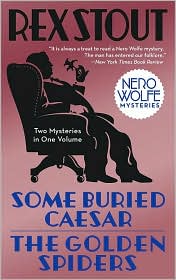
I enjoyed this one. I'm not sure I loved any of the novellas. Not when comparing them with the other Nero Wolfe novels I've read. Like The Golden Spiders. Like Some Buried Caesar. But I am glad I read it!

My favorite quote from Method Three For Murder:
Over the years at least a thousand people have asked me what the police think, and I appreciate the compliment though I rarely deserve it. Life would be much simpler if I always knew what the police think at any given moment. It's hard enough to know what I think. (95)
My favorite quote from Poison A La Carte:

A young woman to Archie Goodwin:
"I've seen you and I've seen your picture. You like yourself. Don't you?"
"Certainly. I string along with the majority. We'll take a vote. How many of you like yourselves? Raise your hands." (7)


© 2011 Becky Laney of Becky's Book Reviews


Death of a Doxy

Death of a Doxy. A Nero Wolfe Mystery. Rex Stout. 1966/1996. Chivers Press. 202 pages.

I stood and sent my eyes around. It's just routine, when leaving a place where you aren't supposed to be, to consider if and where you have touched things, but that time it went beyond mere routine. I made certain. 

Orrie Cather asked Archie Goodwin to 'sneak' into his mistress' apartment to see if he could 'find' certain items that she is holding against him. She is demanding marriage; he is refusing. He is not only in love with another woman, he is going to marry this other woman, a flight attendant named Jill Hardy. But when Archie Goodwin enters the apartment--using Cather's key--he discovers a body. Isabel Kerr has been murdered. Of course, Archie makes a hasty exit, not wanting to be 'the one' who discovered the body. For how could he justify being there without making a mess of things? (This isn't the first time Archie has let others be the one to take credit for finding a body he's already found.)

So a few days later when Orrie Cather is arrested, it is time for Nero Wolfe, Archie Goodwin (along with a few other associates) to make a decision. How likely is it that their friend, their associate, committed this murder? How likely is it that he is innocent? If they believe he is innocent, they must do what they can to help their friend. They must find enough evidence to stop their friend from being convicted or even from going to trial. The police have stopped looking for other suspects, but Nero Wolfe and Archie Goodwin, well their search for other suspects is just beginning! And so it begins...

I enjoyed Death of a Doxy. The more of these Nero Wolfe mysteries I read, the more I love them. I am just loving these characters. And I am finding Rex Stout's writing style to be completely delightful and charming. A near-perfect cozy mystery.

Archie waiting to speak with Isabel's sister and brother-in-law:

There are a lot of interesting things to do while you're waiting in an upper hall of an apartment house for four hours and twenty minutes. You can count spots and decide which has more, the left wall or the right wall. You can try to sort out smells and decide how many different flavors there are in the over-all effect. You can listen to the wails coming through the door of 7B and decide whether the little lamb is male or female and how old it is, and what steps you would take if you were inside. When people arrive or leave you can look straight at them and notice which ones look back and which ones pretend they haven't seen you. When a hefty, broad-shouldered woman turns after inserting a key into the lock of 7C and asks, "Are you waiting for someone?" you can say pleasantly and distinctly, "Yes," and see how she reacts. On the whole, it was time well spent. My one regret was that I hadn't brought along a chocolate bar, five or six bananas, and a quart of milk. (49)

Archie contemplating the 'nothingness' of his searching:

Of course anything is possible. It was possible that one of the women had thought that Isabel had pinched her lipstick and had gone to get it and got mad and bopped her, or that one of the men hated Rudyard Kipling and couldn't stand a woman who had him bound in leather, but you need something better than ten billion possibles to get your teeth into. Any little piece of straw will do, but you have to have something. For instance, statistics. There are two kinds of statistics, the kind you look up and the kind you make up. (95-96)

Archie on Nero Wolfe's "battle" with the TV:

I had had a long walk. Wolfe had had the Times and a book, and probably, while I was out, his weekly battle with television. That may occur almost any evening, when he has got disgusted with a book, but usually it's a Sunday afternoon, because that's when TV is supposed to be dressed for company. He turns on one channel after another, getting grimmer and grimmer, until he is completely assured that it's getting worse instead of better, and quits. (168)
Other Nero Wolfe mysteries that I've enjoyed: Some Buried Caesar. The Silent Speaker.  The Black Orchid. The Golden Spiders. 

© 2011 Becky Laney of Becky's Book Reviews


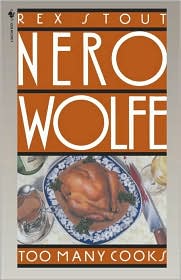
Too Many Cooks

Too Many Cooks. A Nero Wolfe Mystery. Rex Stout. 1938/1993. Bantam. 240 pages.

Walking up and down the platform alongside the train in the Pennsylvania Station, having wiped the sweat from my brow, I lit a cigarette with the feeling that after it had calmed my nerves a little I would be prepared to move the Pyramid of Cheops from Egypt to the top of the Empire State Building with my bare hands, in a swimming suit; after what I had just gone through. But as I was drawing in the third puff I was stopped by a tapping on the window I was passing, and, leaning to peer through the glass, I was confronted by a desperate glare from Nero Wolfe, from his seat in the bedroom which we had engaged in one of the new-style Pullmans, where I had at last got him deposited intact. He shouted at me through the closed window: "Archie! Confound you! Get in here! They're going to start the train! You have the tickets!"
I yelled back at him, "You said it was too close to smoke in there! It's only 9:32! I've decided not to go! Pleasant dreams!"
I sauntered on. Tickets my eye. It wasn't tickets that bothered him; he was frantic with fear because he was alone on the train and it might begin to move. He hated things that moved, and was fond of arguing that nine times out of ten the places that people were on their way to were no improvement whatever on those they were coming from. (1-2)
Too Many Cooks starts off great. The first chapter provides so many laughs! As readers witness Archie and Nero Wolfe at their absolute best. Nero being made so vulnerable through his fear of the train ride ahead. Nero being so pathetic as he pleads for the recipe of his favorite-and-best sausage. And, of course, readers witness Archie's weakness as well--as he meets a beautiful young woman. (The daughter of a famous chef, the chef Nero is pleading with so enthusiastically!) Both Nero Wolfe and Archie Goodwin are on their way to a West Virginian spa. Nero Wolfe is even the guest of honor. He'll have the privilege of making a speech on American cuisine.

Ten of the world's greatest chefs will be gathering at Kanawha Spa. These chefs are elected members of Les Quinze Maitres. Among the celebrating, the speech-making, the tasting, the drinking, the dancing, the gossiping, they'll be electing three new members to replace those that have died since the last big gathering. (I believe they meet every five years?) There is much jesting, much teasing, much quarreling between members. And this leads to one making a boast and setting up a game--a test. It seems to be all in fun.

But then, this chef ends up dead.

Nero Wolfe and Archie Goodwin are on vacation. And at first Nero has no interest at all in 'helping' solve this one. But when this investigation complicates his plans to return to New York, his return to routine, he becomes more cooperative. Can Archie and Nero solve this one before anyone else gets hurt?

I liked this one. I just LOVED the first chapter or two. But this one has its squirmy moments, its awkward moments. You could say it shows its age in race relations. The use of the n-word, for example. The way African Americans are treated with hostility, disrespect, and mistrust by the local police and with condescension and kindness by Nero Wolfe. The way Archie is shocked or startled by the appearance of fourteen African-Americans outside Wolfe's door, they are there to be "questioned" by Wolfe as he tries to solve this one. He doesn't trust the police to do it right. And the way the murderer uses blackface as a disguise when he commits the crime. But it isn't only the treatment of one race or ethnicity that makes this one squirmy. The matter-of-fact way they speak about the Chinese wife of one of the chefs, an eyewitness to the crime. (The police may or may not believe her story. She is Chinese after all.)

There are many things about Too Many Cooks that I did enjoy. There were many things that made it a pleasant read, a satisfying read. It's a good mystery. And the dialogue between Archie and Nero is not to be missed. These two are so much fun! They are two of my favorite characters ever created. But I can't say that it's a perfect read.

Some of my favorite quotes:

Archie Goodwin to Nero Wolfe:
"I am not deaf, sir. And while you can beef as much as you want to, because it's your own breath if you want to waste it, I do object to your implying either in word or tone that I am in any way responsible for your misery. I made this speech up last night, knowing that I would need it. This is your idea, this trip. You wanted to come--at least, you wanted to be at Kanawha Spa. Six months ago you told Vukcic that you would go there on April 6th. Now you regret it. So do I. As far as our engine is concerned, they use only the newest and best on these crack trains, and not even a child--" (3)
Archie on love at first sight:
It takes a long time to know people. How are you going to tell about anyone until you know them? Take love at first sight, for instance, it's ridiculous. That's not love, it's just an acute desire to get acquainted. (23)
Archie being surprised by Nero:
For ten years I had been accustomed to being as sure of finding Nero Wolfe where I had left him as if he had been the Statue of Liberty, unless his house had burned down, and it was upsetting, not to mention humiliating, to find him flitting around like a humming bird for a chance to lick the boots of a dago sausage cook. (34)

© 2011 Becky Laney of Becky's Book Reviews


The Golden Spiders

The Golden Spiders. Rex Stout. 1953. Random House. 206 pages.

When the doorbell rings while Nero Wolfe and I are at dinner, in the old brownstone house on West Thirty-fifth Street, ordinarily it is left to Fritz to answer it. But that evening I went myself, knowing that Fritz was in no mood to handle a caller, no matter who it was.

I loved The Golden Spiders very much! Is it because I am absolutely loving Nero Wolfe and Archie Goodwin? Is it because I have found Rex Stout's books to be so charming, so satisfying? Perhaps! Since I seem to be loving each new book I read a little bit more than those I've read before. (Though I'm not sure I could *really* choose between Some Buried Caesar and The Golden Spiders.) I love the characters. I love the writing--the style of it. I love the mystery too. I love how Goodwin and Wolfe *solve* their cases.

In this mystery, Archie Goodwin interrupts Nero Wolfe's dinner to tell him that there is a child at the door--Pete Drossos. This Pete has a case to present to Wolfe. He has witnessed something--a possible crime--and he wants Wolfe to team up with him. While he was washing the windows of stopped cars in traffic--he saw (not heard) a woman ask him to get the police. She had a scratch on her face. And her earrings were quite unique--golden spiders. There was a man with her in the car--and the boy believed (though he didn't see with his own eyes) the man had a gun and was threatening the woman. Being distrustful of cops, the boy sought this famous man's help. Wolfe is interested--mainly because he knows that his interest will annoy Archie--and offers his advice on how to be a good private investigator. He also promises to call the police and let them know about the alleged crime leaving the boy's name out of it. A few days later, well, Goodwin and Wolfe learn that this boy has been the victim of another crime--a murder. The boy's mother insists on fulfilling her son's last request--to give all his money--four dollars and some change--to Wolfe. Wolfe then feels obligated to do something for the boy. True, that amount of money isn't his usual rate for clients, but this is a special case. Archie then suggests they place an ad in the paper looking for the woman with golden spider earrings...

This mystery is compelling! I enjoyed it very much. I would definitely recommend this one.

Nero Wolfe to Fritz on the matter of his starlings:

When the platter was brought in steaming, and placed before him, he sniffed, ducked his head and sniffed again, and straightened to look up at Fritz.
"The sage?"
"No, sir."
"What do you mean, no, sir?"
"I thought you might like it once in a style I have suggested, with saffron and tarragon. Much fresh tarragon, with just a touch of saffron, which is the way--"
"Remove it!"
Fritz went rigid and his lips tightened.
"You did not consult me," Wolfe said coldly. "To find that without warning one of my favorite dishes has been radically altered is an unpleasant shock. It may possibly be edible, but I am in no humor to risk it. Please dispose of it and bring me four coddled eggs and a piece of toast." (2)

Archie on Nero Wolfe:

As I went across to the office, to my desk, and dialed the number of Manhattan Homicide West, I was reflecting that of all Wolfe's thousand techniques for making himself obnoxious the worst was when he thought he was being funny. (9)

© 2011 Becky Laney of Becky's Book Reviews


Crocodile on the Sandbank

Crocodile on the Sandbank. Amelia Peabody Mystery #1. Elizabeth Peters. 1975/2002. Hachette Books. 272 pages.


When I first set eyes on Evelyn Barton-Forbes she was walking the streets of Rome. 

Amelia Peabody is intelligent, wealthy, stubborn, and ambitious. Not one to be bossed around by just anyone. So when she goes traveling in Egypt with her companion, Evelyn Barton-Forbes, expect some trouble, some conflict. Then again, to be fair, trouble seems to have followed HER to Egypt--or more precisely followed her companion. For Evelyn Barton-Forbes has secrets--not from Amelia Peabody--but from others in their company. And these secrets may be the needed clue to solve the trouble to come.

The real fun begins when Amelia and Evelyn meet two brothers--the Emerson brothers. Radcliffe and Walter. Both Egyptologists, though one likes to get his hands dirty and one wouldn't mind staying inside and just translating texts as opportunities arise. For Walter and Evelyn, well, it's love at first sight. But for Radcliffe (almost always called Emerson) and Amelia (almost always called Peabody), it's anything but love! Or is it?!

So these four meet early in the novel, but the two really have no plans of joining the others on their expedition. Amelia Peabody has detailed plans of her own--but her wandering leads her straight to Emerson and his latest find. Among his discoveries--a mummy. So her intense interest in his work persuade her to change her plans. And when the mystery starts, well, she could hardly walk away from him then....

I'm not sure that I loved this one. I liked it. I really liked it in some places. The tension between Peabody and Emerson is interesting--how their relationship develops from hate to respect to love. (Similar to Elizabeth and Darcy, I think.) I liked the Egyptian setting. And the mystery is nice enough. But I wasn't as charmed as I wanted to be. I enjoyed it. I found it an entertaining read. But I can't really say that Amelia Peabody is my new favorite heroine.

© 2011 Becky Laney of Becky's Book Reviews


Black Orchids

Black Orchids. A Nero Wolfe Mystery. Rex Stout. 1941/1942. Random House. 208 pages.

First sentence of Black Orchids: "Monday at the Flower Show, Tuesday at the Flower Show, Wednesday at the Flower Show. Me, Archie Goodwin. How's that? I do not deny that flowers are pretty, but a million flowers are not a million times prettier than one flower. Oysters are good to eat, but who wants to eat a carload?"

First sentence of Cordially Invited to Meet Death: "That wasn't the first time I ever saw Bess Huddleston."

Black Orchids was my first introduction to Rex Stout's Nero Wolfe and Archie Goodwin. And oh how I loved them! The book was narrated by Archie Goodwin, and he had me practically at hello! (While I wouldn't say I loved him *more* than Miss Marple or Lord Peter Wimsey, I can definitely say that I love, love, love him as a narrator!)

So in this book, readers have two novellas. The first, Black Orchids, concerns a murder at a flower show. Archie has been made to go to this flower show day after day after day by his boss who is a little obsessed with orchids. And on the final day (or one of the final days of the show) they go together. And it just so happens that that is the day a dead body is found in one of the exhibits! Archie is the one who makes this discovery--that the "sleeping" man is REALLY not going to be waking up. The police are on the case, of course, as they usually are in detective stories. But Nero Wolfe with some help from Archie and a few others in his employ--may just solve the case first. This botany-themed mystery didn't wow me for its subject--but I did enjoy meeting Nero and Archie.

The second novella, Cordially Invited to Meet Death, is my favorite of the two. In this mystery, we meet Bess Huddleston, a snobbish party planner for the wealthy elite of society. She comes to Nero Wolfe looking for help. Someone is sending out nasty letters--in her name, on her stationary. This "poison-pen" must be stopped! But who is the one behind this unpleasantness? And do they want merely to embarrass her--or is her life at risk?! Archie, our narrator, begins to investigate the case by trying to get close to those who are closest to her, namely: two female assistants, a nephew, a brother, and a local doctor. Can Archie and Nero solve this one before it turns deadly?

Black Orchids is an enjoyable read! I found it very satisfying! I'm not sure how Black Orchids compares with others in the series--so I'm not going to say that this is my favorite or best, it's just too soon to say. But. I enjoyed it and would recommend it!


© 2011 Becky Laney of Becky's Book Reviews


Twitter Delicious Facebook Digg Favorites More