Showing posts with label 2008. Show all posts

Huge (YA)

Huge. Sasha Paley. 2008. Simon & Schuster. 272 pages.

"Faster, faster!" Wil Hopkins's trainer, Heather, yelled over the sound of crashing waves.

Huge is the story of two girls at fat camp. Wil Hopkins who is understandably angry, bitter, rebellious, and generally unpleasant to be around, and April Adams whose issues may be a little less obvious. Both girls are at Wellness Canyon for the summer. Wil against her will; April because she has worked and worked and saved and saved. The two, of course, are roommates. Their "success" at the camp depends on their ability to work together as a team, to work through any issues, to learn to trust one another, etc. But how do you do that when you can't stand the other person?!

The cover reads, "at fat camp even the drama is huge," and that gives you a fair description of what to expect. Two teen girls who are first brought together when they compete for the attention of a guy, Colin, and then brought together by the need for revenge when that guy turns out to be a big jerk. Perhaps because of the "boy drama" going on, Wil forgets temporarily that she desperately wants to gain weight at fat camp so her parents can't have the satisfaction of her success. So by the end of camp, Wil has lost weight too.

Huge has two narrators. And to be completely honest I had a hard time liking either of them. Wil, the richer of the two, seems to be the biggest pain. She's angry, bitter, rebellious. She acts out--speaks out--in anger a good deal of the time. And she seems to like being rude and hurting people. But her pain is obvious to anyone who's ever been there. Her parents have hurt her repeatedly--hurt her with their words, their actions, etc. What she's hearing is that she's not good enough as she is, that they are ashamed of her, embarrassed of her, etc. She feels that her parents just don't love her, accept her, understand her. I think the more her parents force the issue, force her to try to feel ashamed about her body, the worse it will be for her. I think FORCING her to go to fat camp against her will, forcing her to deal with her weight when she's clearly not ready to deal with it,  may not be the best in the long term. Losing weight is a LOT more complicated than it might appear.

If you're expecting "Biggest Loser" insights--break down moments where they get it, they really get it...then you'll be disappointed.

As for April, I think she's lost in her own dream world. She's equated being skinny with being perfect, being popular, being happy. She doesn't really seem to realize that she'll still be herself when she's lost the weight. She can't escape her issues just by losing weight. I think she desperately wants to be someone else. I think her shallowness may be hidden by her cheerfulness. I think she's able to hide her issues easier than Wil. But April has her own troubles, and they are revealed to a certain extent by the end of the novel.

The drama didn't exactly wow me. It was light and fluffy, a bit silly. The "conflict" over the jerk--to see which girl he liked best. The answer--he loves ONLY himself, and any girl with a pulse is good for a few minutes of attention, but not much else. And while I'm glad the two girls were able to bond over their plans for revenge, I thought that was silly too.


© 2011 Becky Laney of Becky's Book Reviews


Ways To Live Forever (MG)

Ways to Live Forever. Sally Nicholls. 2008. Scholastic. 224 pages.

List NO. 1 - Five Facts about Me


1. My name is Sam.
2. I am eleven years old.
3. I collect stories and fantastic facts.
4. I have leukemia.
5. By the time you read this, I will probably be dead. 

Sam is dying of leukemia. Sam is also writing a book; a book about himself, a book with stories, a book with lists. One of his lists, for example, is about all the things he'd like to do before he dies. Another lists ways to live forever. Which includes things like "Become a vampire. Hope you don't meet Buffy" and "Find a Greek goddess and make her fall in love with you. Have her get Zeus the king of the gods to make you immortal" (92-93)

Sam isn't facing this alone. He's got his mom and dad, parents who are supportive of him when they're not busy arguing. He's got his sister, Ella, who's nice to be with...some of the time, if only she didn't throw baby tantrums. He's got his best friend, Felix, too. Felix is also dying, though not of leukemia. The two can be oh-so-honest with each other. One of the things they discuss is how Sam's book should end. Since it would be impossible for Sam to write about his own death before it happened. But it's not like they're talking all death, all the time. They enjoy living life too. Like trying to sneak in a cigarette so they know what it's like to smoke. Like trying to watch an R rated movie without getting caught by their parents.

How do you live life knowing your dying? How do you write about it when you're eleven?

This novel is a quick read, but it's a heavy one. It deals with death and dying in a raw, honest way.


© 2011 Becky Laney of Becky's Book Reviews


The Dead and the Gone (YA)

the dead & the gone. Susan Beth Pfeffer. 2008. Houghton Mifflin Harcourt. 321 pages.

At the moment when life as he had known it changed forever, Alex Morales was behind the counter at Joey's Pizza, slicing a spinach pesto pie into eight roughly equal pieces.

The dead & the gone is the companion novel to Susan Beth Pfeffer's Life As We Knew It. While Miranda's story--set in Pennsylvania--chronicles her life from May through March of that decisive year, Alex's story--set in New York City--chronicles his life from May through December. Both are family-oriented. Miranda's life being closely tied to her mom and two brothers; Alex's life being closely tied to his two younger sisters, Brianna and Julie. But Alex's story is stronger in many ways. For Alex is the head of the family--for better or worse. Alex is the one making life-and-death decisions. His mom vanished on May 18th--the day the asteroid struck the moon. His dad may or may not have survived the first terrible week. Having been in Puerto Rico for a funeral, he's unable to make contact with his family. And, well, the coasts were hit hard--again and again. So even surviving the first tsunamis might not mean much in the long term. His older brother, Carlos, is in the Marines. He was far from home when it happened, and while he's able to send word--by phone or mail--a few times throughout the book. He's not the one in charge. He's not the one responsible for making the tough decisions on how to best survive. So while Miranda has to grow-up, it is a gradual growing into adulthood. She still has her relaxed moments. There is never one moment for Alex to relax. He carries a heavy weight day and night.

I enjoyed rereading Life As We Knew It and the dead & the gone back to back. There are things I love about both books. Things I appreciate about both books. One thing that makes the dead & the gone a very different story is the focus on faith and community. The dead & the gone is faith-oriented. Alex and his family are Catholics. They all attend Catholic school. They all regularly attend mass. They take their faith, their spirituality, their religion very seriously. The words mean something. The faith means something to them. Something real. Something personal. While each of the siblings has their own reaction--response--to the crisis, none loses their faith, none lose hope completely. I loved seeing this Catholic community in action. I loved seeing the Catholic church reaching out in love and compassion--with great hope and faith--to their community, to their parishioners. There were so many great scenes of this faith-in-action. Where people were responding with their hearts in faith as opposed to acting out of fear and anxiety. It's courageous and wonderful.

The dead & the gone has a broader outlook as well. While the electricity isn't reliable on a day-by-day basis in the dead & the gone, it is certainly more stable than in Life As We Knew It. Alex is connected to the larger world. He hears--for better or worse--more about the world at large. He is more aware of what is going on in other states. While Miranda and her family may go weeks or months without contact to other survivors, Alex is out of the house most days--at least before the flu epidemic comes. He's not as isolated as Miranda. Does not being so isolated help him cope? Maybe. But every day, every week is a struggle. Alex does things he'd NEVER thought he'd be doing.

Is Alex more of a hero than Miranda? I'm not sure that is exactly fair. Miranda has her courageous moments too. (I'm thinking of the woodstove mishap.) But. Alex's story has power no doubt about it.
I would definitely recommend both books.

"Give the scientists some time and they'll figure out what to do."
"This is too big for the scientists," Lorraine said. "Only God can save us now."
"Then He will," Alex said. (13)

God save their souls, Alex prayed. God save ours. It was the only prayer he could think of, no matter how inadequate it might be. It offered him no comfort, but he repeated it unceasingly. As long as he prayed he didn't have to think. He didn't have to remember. He didn't have to decide. He didn't have to acknowledge he was entering a world where no one had laid out the rules for him to follow, a world where there might not be any rules left for any of them to follow. (65)

"She says you've been having bad dreams."
"Aren't you?" Julie asked. "Isn't everyone?"
Alex burst out laughing. "Only sane people," he said. "Okay, maybe not Bri. But everyone else is."
"Are things going to get better?" Julie asked. "Is that why you listen to the news all the time, because someday things are going to get better?"
Alex shook his head. "That's not why I listen," he replied. "That's why I pray but not why I listen."
"Do you think God listens?" she asked.
"Bri thinks so," Alex said. "Father Franco thinks so." (81)

It was hard being alone in the apartment staring at an unringing phone, haunted by the food in the kitchen, which he wouldn't allow himself to touch, haunted even more by the image of his mother drowning in the subway that very first night. He tried reading. He tried praying. He tried push-ups. He tried counting the cans of soup. He listened to the radio, using up the twenty-dollar batteries. The world was coming to an end. Well, that was nothing new. (123)

"And what's so special about you that you deserve compassion?" Father Mulrooney said. "You have shelter. You have food. You have family and friends. I'm supposed to feel pity for you because of a cut cheek?"
"You don't understand at all," Alex said. "I have shelter for as long as no one thinks about it. Once they do, once they realize my father is gone, they can throw us out. I have food only if I get lunch here. We're down to almost nothing at home, and I have to make sure my kid sister eats. She is my family right now, because my parents are both gone and my older brother is in the Marines somewhere and I sent my other sister to live at a convent with strangers. My cheek was cut because I got caught in a food riot, with my kid sister, and we ended up with no food anyway. I'm not asking you to pity me. I pity me enough for the two of us. But when one of your students asks you for food, you shouldn't say no and feel righteous about it. That's not what Christ would have done, and you know it." (133)

"What do you have planned for tomorrow?"
Alex shrugged. "The usual," he said. "Checking on the elderly, studying theology, fighting for survival. Same old, same old." (151)

"I know it's wrong to feel that way about God and I know it's wrong to not feel anything. I hate it. I don't hate God. I hate not loving Him." (184)


© 2011 Becky Laney of Becky's Book Reviews


The Matters at Mansfield

The Matters at Mansfield: Or The Crawford Affair. A Mr. & Mrs. Darcy Mystery. Carrie Bebris. 2008. Tor. 288 pages. 

It is a truth less frequently acknowledged, that a good mother in possession of a single child, must be in want of sleep. 

Who has killed Henry Crawford, and why should Elizabeth and Darcy care?! In The Matters at Mansfield, readers see a different side of Anne de Bourgh, the 'weak' daughter of Lady Catherine. With a little encouragement from Elizabeth Darcy, Miss de Bourgh has decided to follow her heart and disobey the command of her mother. For better or worse. Literally. The book sees Anne running away with her lover! Who's her lover? Three guesses! The scoundrel from Jane Austen's Mansfield Park, Henry Crawford. Has Carrie Bebris redeemed Mr. Crawford? Read for yourself and see all the excitement unfold...you can imagine, no doubt, what Lady Catherine will make of this affair...

I am just LOVING these mystery novels by Carrie Bebris. I love the writing, the style, the language, the witty dialogue, the just-right characterizations. I would definitely recommend these books! They are so well-written.

See also: Pride and Prescience and North by Northanger.

© 2011 Becky Laney of Becky's Book Reviews


Chains (MG/YA)

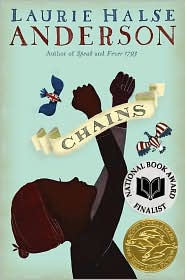
Chains. Laurie Halse Anderson. 2008. Simon & Schuster. 320 pages.

The best time to talk to ghosts is just before the sun comes up. That's when they can hear us true, Momma said. That's when ghosts can answer us. The eastern sky was peach colored, but a handful of lazy stars still blinked in the west. It was almost time.

When the novel opens, Isabel, our heroine, is seeking help from her (dead) mother one last time. But it's to no avail, her mother's ghost does not answer her pleas, can provide no further guidance to her two daughters, Isabel and Ruth.

Their mistress has died. Isabel knows that her mistress freed her and her sister before she died; it's in her will. But her mistress's nephew--Mr. Robert Finch--as her only living relative refuses to believe that consulting a will is even necessary. Naturally, all her aunt's property is his. And since Isabel and Ruth are nothing but property, they are his by right. The fact that there's a will, a lawyer, who could say otherwise? Irrelevant. Mr. Robert sells both girls at the first opportunity. Their buyer? The Locktons of New York. Isabel is even given a new name. One that is "easy" to remember. Sal. But Isabel can never be comfortable wearing a new name, being the property of someone else. Isabel dreams of so much more. She dreams of freedom. What keeps her from acting on impulse? Of running away? Her sister, Ruth. But the actions of a cruel mistress--selling her younger sister--means that Isabel has nothing left to lose. Will Isabel believe the British who are promising freedom to some slaves? Or will Isabel believe the Patriots who claim the same thing--freedom to slaves who help their side.

A nation at war. A young country seeking freedom, justice, liberty. Set in New York City during circa 1776-1777, the story is vibrant and heartbreaking. It's a story rich in detail and emotional and powerful in nature. Isobel's story--her struggles--resonates so deeply that I think this one is a must-read.

I first reviewed Chains in November of 2008. I reread it so I'd be ready for the release of the sequel, Forge.


© Becky Laney of Becky's Book Reviews


Twitter Delicious Facebook Digg Favorites More