Showing posts with label book I bought. Show all posts

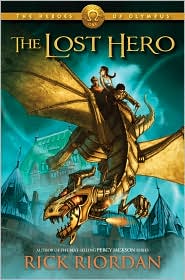
The Lost Hero (MG)

The Lost Hero by Rick Riordan (#1 Heroes of Olympus) 2010. Hyperion. 576 pages.


Even before he got electrocuted, Jason was having a rotten day.

I had my doubts. Even though it's Rick Riordan, I had my doubts. How could The Lost Hero hope to compete with The Lightning Thief. It could be good, it could even be really good. But how could it really compare with such a great book?! For me, that was THE best book, the one that was the best of them all. Yes, the series as a whole was a good adventure, but the first one? Well it was OH-SO-MAGICAL!

I was surprised by how much I loved this one. I thought it was a great read. Compelling, exciting, and magical!!! It has multiple narrators. Now practically every book with multiple narrators has me sharing with you how much I really don't like that element in books, but with this one it WORKED and worked well. It didn't feel awkward or silly like it does in Rick Riordan's other series--The Kane Chronicles, The Red Pyramid and The Throne of Fire.

Our narrators, our heroes and heroines, are Jason, Piper, and Leo. Two have been under the protection of Coach Hedge, the third appears out of nowhere on a school field trip. The mist effecting everyone's memories--even Piper and Leo. (Piper just KNOWS that Jason has been her boyfriend for weeks. She can almost remember every moment they've ever shared.) But trouble is coming and the three will have to fight to survive long enough to reach the safety of Camp Half-blood. To complicate matters, Jason has NO MEMORY at all of who he is or where he came from.

So the book does feature a quest, and it is EXCITING. I won't go into the details of this one. Chances are if you're familiar with Percy Jackson and his series, then you'll want to read this new series anyway. And if you haven't read Percy Jackson yet, if you've yet to discover the joys of The Lightning Thief, then this is NOT the place to start your journey with Rick Riordan.

© 2011 Becky Laney of Becky's Book Reviews


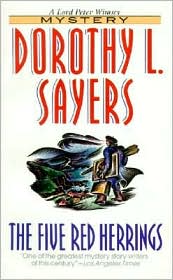
The Five Red Herrings

The Five Red Herrings. Dorothy L. Sayers. 1931. HarperCollins. 325 pages.

If one lives in Galloway, one either fishes or paints. "Either" is perhaps misleading, for most of the painters are fishers also in their spare time. To be neither of these things is considered odd and almost eccentric. 

The Five Red Herrings is the seventh mystery starring Lord Peter Wimsey. Lord Peter is a character that I just love and adore. He's just one of my favorite, favorite, favorite characters ever. So I was so happy to read another mystery in this series.

In The Five Red Herrings, Lord Peter Wimsey is on vacation in Scotland. Though he neither paints or fishes, he is accepted--for the most part--by the community. It's hard to not like him, after all! Early in the novel--though I'm not sure if it's early in his holiday--a murder is committed. The "victim" is someone EVERYONE hates; threats against this guy were so common that they were hardly worth taking seriously. I mean Campbell, the victim, was just impossible to get along with. But now that he's dead, it is up to the police (the constables and detectives, etc.) to solve the crime. And since Lord Peter just happens to be very, very good at detecting, he offers to help them out.

There are six suspects--all artists. Hugh Farren, Henry Strachan, Matthew Gowan, Jock Graham, Michael Waters, and Ferguson. All had motive, all had opportunity. All of them are lying, all of them are hiding things from the police. Since there are so many suspects, since they all appear equally capable of committing the crime, it's just a matter of discerning the truth. Which theory--which plausible theory--is the truth? Which is most likely? Which uses all the clues that have been left behind?

Five Red Herrings is set in Scotland. And, for me, it was a delightful mystery.

Lord Peter Wimsey:

I was born looking foolish and every day in every way I am getting foolisher and foolisher. (52)

One of these days I shall write a book in which two men are seen to walk down a cul-de-sac, and there is a shot and one man is found murdered and the other runs away with a gun in his hand, and after twenty chapters stinking with red herrings, it turns out that the man with the gun did it after all. (114)

The essence of detection is secrecy. It has no business to be spectacular. But you can watch me if you like. (218)

© 2011 Becky Laney of Becky's Book Reviews


Grapes of Wrath

Grapes of Wrath. John Steinbeck. 1939. Penguin. 619 pages.

To the red country and part of the gray country of Oklahoma, the last rains came gently, and they did not cut the scarred earth. 

It is finished! After three or four false starts, after two library editions and two paperback editions, it is finished. If one word could sum up my experience with this one, it would be sluggish. Of course, I can think of a few other words to describe it. But I'll share just one more: bleak. (Or perhaps bleakity-bleak.)

To sum this one as quickly as possible: The Joad family, devastated by losses in Oklahoma, are forced to pack it all up and head to California where they find that life is just as hard if not harder than they could have ever imagined. There is no happy welcome awaiting them, they are viewed--at best--as mere animals. The only way out of the harsh ugly reality is death. And even death doesn't come easy. The end.

I'm not going to try to convince you that The Grapes of Wrath is a horrible book. I'm not going to try to convince you that The Grapes of Wrath is a wonderful book. I can--at best--only share with you why we're not a good match for one another.

The language. There are certain words that offend me each and every time they're used. It doesn't matter the circumstances. It doesn't matter who or where or why. The Grapes of Wrath uses a great many of these words. (Or should I say repetition of the same word.) Are the words realistic? Probably. But that doesn't change my reaction to those words.

I had big, big, big problems with the character of Jim Casy. This "former preacher" annoyed me every time he opened his mouth. Though annoy isn't quite the right word. I'm not sure offended is the right word either. Simply because people can't use the word offended without people judging them. It's just that his language is so crude, so vulgar. That his "story" is so vulgar--how every time he got worked up "in the spirit" preaching, he had to find sexual release with young women from his church (or audience or wherever). Yes, that was mostly in the past, and yes, this "sin" is what led him to eventually give up faith and religion. Casy, when we meet him, doesn't believe in God, doesn't believe in the church or religion, doesn't believe in prayer, doesn't believe in sin, doesn't believe in the concept of right or wrong, or heaven and hell. Casy doesn't believe in anything at all really. There are no answers, there will never be any answers. Suffer, suffer, suffer, why have hope at all that you will ever do anything but suffer. Any time Casy talked about matters of faith or matters of the heart or anything remotely connected to spirituality or religion or even morals and ethics, I just wanted to yell at him. It doesn't help that according to "experts" Jim Casy is a "Christ figure." I read this on Wikipedia and Spark Notes. There are almost no words for how that makes any sense whatsoever. How someone so foul, so crude, so vulgar, so given-over-to-sin, someone who doesn't believe ANYTHING at all, someone who has no hope, no love, no peace, whose only message is now is all we got, and now is ugly is a "Christ figure." In what way at all--does he resemble Christ? Now, I'm not saying that everyone should hate Jim Casy. I am saying that as a reader I could not stand him.

Another big issue I had with The Grapes of Wrath has to do with style. The narrative style of this one is a bit odd. You have chapters that are clearly narrated by members of the Joad family, chapters that carry this story forward. Then you have chapters that read more like an out of body experience. These may focus on turtles or waitresses or car salesmen. But. They are clearly not like the other chapters in the novel. I never could quite figure out if the people in these chapters were the Joads--as seen from the outside perspective--or if the people (when the focus was on people not trees or turtles, etc.) were meant to represent any family facing this crisis, any family who had been devastated. I don't know that it matters. I just felt a great big disconnect every time we lost the main story, the real story. However, there were a couple of exceptions. There were times when these chapters were beautifully done and the text is richer for them--for the perspective they add to it. (Chapter fourteen comes to mind.)

I struggled with the first sixteen chapters. I did. I wasn't liking it. I wasn't liking it at all. But things began to shift a little with chapter seventeen. I don't know if the story truly improves once the family crosses into California, or if I just was in a better mood that day, but something changed. From that point on, the story while not always pleasant was more compelling. There was still violence to deal with, still some harsh realities to endure, but the second half definitely improved my impressions of the novel.

I am SO GLAD that this wasn't my first introduction to John Steinbeck. If it was, I never would have picked up any of his other books. I would have walked away knowing that I was right, that Steinbeck was not for me. The truth is, that Steinbeck was a good writer--at times great. That he wrote in many, many styles. That he had MANY stories to share with readers. Not just one story over and over and over again. Some of the stories he tells are very funny, very true-to-life, and even in their earthiest moments, there's something there worth reading. His stories can be very raw, very perceptive. The Grapes of Wrath was not for me. Perhaps the message was some things in life are so ugly that no amount of imagination can make them beautiful. I found the lack of hope and the vulgar language to be too much for me. But the very things that I dislike about it--the realistic portrayal of humanity at its weakest and worst--may be the very things some one else loves about it.

I read this book for the Classics Circuit tour. 

© 2011 Becky Laney of Becky's Book Reviews


Heidi's Children

Heidi's Children. Charles Tritten. 1939. 255 pages. 

Dorfli was still enveloped in a mantle of snow, but the baker, returning from Maienfeld in his wagon, reported that down in the valley it was already spring. 

Heidi's Children is, I believe, the third and final Heidi book. Heidi Grows Up, the second novel, ended triumphantly with Heidi wedding Peter, the goat herding boy she first met when she was just five. This third novel opens with Heidi just a few months away from giving birth to her first child.

Heidi and Peter live with Heidi's grandfather and Peter's mother in the village of Dorfli. (During the summer months, they retreat higher up in the mountains, though the grandfather's original hermit-hut is no more.) As they have the largest house in the village, they also have the local school teacher, Heidi's old school chum, Jamy, living with them. The novel opens with Jamy making a request of Heidi and Peter. She wants them to welcome her younger sister, Marta, into their home. It seems Marta is too difficult for her own parents to handle, and they essentially don't want to have her around...at all. Marta, of course, has figured all this out. Peter has his doubts initially, let the reader never forget how jealous and possessive he can be with Heidi, but eventually he agrees to the plan.

So Marta is the "first" of Heidi's "children" to arrive. A few months later Heidi welcomes twins into the world. A baby boy. A baby girl. And grandfather is there to welcome this next generation. He even suggests the names for both the babies.

This naming scene is funny, in my opinion. For it sees just about everyone from the village coming into their home to give advice and share gossip.
"Well, what do you think of them, Peterli?" his mother asked after he had studied their features for some time without making any comment.
"As alike as two strawberries," he answered, "and just as red. How long will it be before their eyes open?"
"They aren't kittens," laughed Heidi, looking up from her pillows. "Their eyes have already opened and they're as blue as the sky itself. They're sleeping now. Little babies have to sleep."
"Has the Alm-Uncle seen them?" asked Peter his face still thoughtful.
"Oh, yes," answered Heidi. "He was so pleased but he escaped to his own room again as soon as the neighbors came. Their chatter bothers him as it does me, but I can't ask them to leave."
"I'll ask them if you want me to," announced Marta, her eyes still fiery. "They're out there in the living room saying horrid things about everybody in the family and suggesting the most dreadful names for the babies. You won't name them anything they suggest, will you?"
"I swear it!" said Peter, raising his hand as though taking an oath. "Whatever they suggest, the babies shall surely be named something different."
Old age had not affected the Alm-Uncle's hearing, for suddenly he called out so loudly that those in Heidi's bedroom and even the neighbors in the living room beyond could hear it, "If they're her surprise, why not name the girl baby after the child?"
"After me?" said Marta, hardly believing her ears, for the Alm-Uncle had never once spoken her name all the time she had been there.
"As you say, Grandfather!" Heidi called back. "But what shall we name the boy?"
"Your father was an upright man, Heidi. It might be well to remember him."
Heidi had not thought of naming the boy anything but Peter. But since Peter objected to that, why not Tobias? She called again, "Very well, Grandfather. He shall be our little Tobi. The neighbors shall hear at the church what names we have chosen." (84-85)
Marta, Jamy's younger sister, is the real heroine of Heidi's Children. It is her story--her emotional and spiritual journey--that is told within the pages of the book. Her developing relationship with the grandfather, her love for Heidi and Peter, her finding a place to belong, etc. Her story isn't always a happy one. For she's still broken. She's mourning the loss of her grandmother. And she definitely hasn't healed from being completely rejected and abandoned by her parents.

The grandfather also plays a big part in this one. Though I don't want to spoil anything by sharing those details here. Let's just say that this is the first Heidi book where the reader catches glimpses of his past.

I did like Heidi's Children. I liked Marta. I liked how she was able to form a good relationship with the Grandfather. I liked how he was able to help her and reach her in a way that her own parents couldn't or wouldn't. It was nice to see him sharing Bible stories with her, for example. And it was nice how he helped fix her cross necklace.

I have enjoyed all three Heidi books! I do wish I'd read them sooner!


© 2011 Becky Laney of Becky's Book Reviews


Heidi Grows Up

Heidi Grows Up. Charles Tritten. 1938. 190 pages. 

At nine o'clock one evening a very shy-appearing little girl stepped off the train at the big station in Lausanne.

Heidi Grows Up is the sequel to Heidi by Johanna Spyri written by Spyri's translator, Charles Tritten. The novel covers Heidi's teen years, for the most part. Readers briefly see a fourteen-year-old Heidi attend a French school. She meets other girls her own age and makes a few good friends. Her best friend being a girl named Jamy. The focus is on her first semester at school and her first summer vacation back home. The novel then speeds ahead to when Heidi has finished her schooling and is ready to teach school in the local village school. There readers are treated to learning about her first year as a teacher. We see her successes and failures as a teacher. We see her stand up to the school warden, and battle some of the bigger problems in the education department.

But Heidi Grows Up is still very much a sweet family story. We see a tender, loving Heidi who always knows what is most important in life. We see Heidi devoted and loyal as ever to her grandfather, to the doctor, to Peter, and even to the goats. One cute scene--early on in the novel--is when Heidi is praying. She's lifting her concerns for God and praying for those she loves best. And...at the end...she mentions each of the village goats by name. Yes, there's something very simple--and very pleasant--about this story.

I did like this one. I am still liking the characters very much. I am liking Heidi. And Peter seems to have grown out of some of his issues. Enough that by the ending, I was pleased with the development!


© 2011 Becky Laney of Becky's Book Reviews


Heidi (MG)

Heidi. Johanna Spyri. 1880/2009. Puffin Classics/Penguin.  320 pages.

The pretty little Swiss town of Mayenfeld lies at the foot of a mountain range, whose grim rugged peaks tower high above the valley below.

If the cover to Heidi had looked this pretty, this inviting, this appealing, when I was a kid, there's a good chance I wouldn't have spent most of my life avoiding it. (It didn't help that the cover of the Heidi we had was AWFUL.) What I discovered was that Heidi is a nice, satisfying read. One that may just improve upon a reread. I can easily see why Eva Ibbotson, who wrote the introduction to this edition, described reading this one as feeling like you're coming home. There's just something cozy-and-comfortable about it.

So Heidi is an orphan, she's been one since the age of one. She has spent the next four years with her Aunt Detie. But at the start of the novel, at age five, she's being "given" to her grandfather. Detie has decided that enough is enough. She's not the only relative this kid has, and, well, she wants to live her own life without being a mother to her dead sister's kid. If my description is blunt and ugly, it's because Detie is. The way she speaks of the child--of Heidi--well it made me take an instant disliking to her. (And nothing in the book makes me change my opinion of her.) So Heidi and Detie are on their way up the mountain. The grandfather has a moment or two of doubt, but, Heidi erases his fears early on. He takes an instant liking to his granddaughter. And he notices how bright and wonderful she really is. Readers see this bond grow and grow as the two spend time together. No one could love grandfather more than Heidi, and no one could love Heidi more than her grandfather. Heidi has found her a home at last. And all seems right with the world. Heidi loves her grandfather, loves her new home, loves the mountains, loves the flowers, loves the goats, loves the goat herder, Peter, loves Peter's Grannie. Here is a girl that has a love of life, who doesn't want for anything.

But. All that changes with (boo, hiss) the arrival of Aunt Detie who seems to think that Heidi will be better off away from her grandfather. It has been arranged for Heidi to become the companion of a sickly little girl, Clara. Heidi has no choice in the matter. And is told that she can't have an opinion about it--essentially. Now, Heidi does like Clara well enough. It's not like she HATES Clara. I'm not sure it's in Heidi's nature to HATE anybody. But Heidi is definitely upset that she's been taken from everybody she loves, the home she loves, etc. And city life just isn't the same. Heidi doesn't feel like she belongs there.

The highlight of her time in the city may just be when Clara's grandmother comes to visit. This grandmother takes the time to get to know Heidi. She comes to love Heidi and care deeply about her. She encourages Heidi and gives her attention. She says you can learn to read and write. You are smart, you are capable, you can do it. Which is just the message this little girl needs to hear! When Heidi does learn to read, she is given a lovely picture book by this grandmother. But perhaps even more important than that gift is the gift of faith. For this grandmother--Mrs. Sesemann--talks to Heidi of God and prayer. She encourages the young girl to pray to God, to seek Him. She teaches Heidi that when God doesn't answer prayers right away--in the way we expect, in the time period we expect--that doesn't mean God hasn't heard. It's just that God knows what is best for us, he knows what we need, and when we need it. God may seem to be delaying his promises, or slow to working his promises, but God is a God who makes all things beautiful in HIS time.

So does Heidi get to return to her grandfather? What do you think?! Would it be so satisfying and happy-making if she didn't?

While I'm not quite sure that Heidi herself is flawed--she seems to represent everything pure and innocent and good in the world--the rest of the characters within the novel are flawed. And many--though not all--are lovable. Two of my favorites are Heidi's Grandfather (Uncle Alp) and Dr. Classen.

One of my favorite scenes with Dr. Classen:
"When you can do no more yourself," said Heidi confidently, "tell God."
"Those are good words, my dear," said the doctor, "but suppose it was God Himself who sent the sorrow."
Heidi sat pondering for a while. She was sure God could always help, but was trying to find the answer out of her own experiences. "I think you have to wait," she said at last, "and keep on thinking that God has something good which He's going to give you out of the sad thing, but you have to be patient. You see, when something's awfully bad, you don't know about the good bit coming, and you think it's going on for ever."
"I hope you will always feel like that, Heidi," he said, and fell silent, drinking in the scene before him.  (202)
And my favorite scene with the Grandfather--well, there are many, many scenes that I love between these two--is when she reads him the story of the prodigal son from her picture story book. The quote comes from an online edition of Heidi, not the exact same translation as the Puffin classic. (And I liked the Puffin classic better. In the book this comes from pages 172-175.)
"If God had let me come at once, as I prayed, then everything would have been different, I should only have had a little bread to bring to grandmother, and I should not have been able to read, which is such a comfort to her; but God has arranged it all so much better than I knew how to; everything has happened just as the other grandmother said it would. Oh, how glad I am that God did not let me have at once all I prayed and wept for! And now I shall always pray to God as she told me, and always thank Him, and when He does not do anything I ask for I shall think to myself, It's just like it was in Frankfurt: God, I am sure, is going to do something better still. So we will pray every day, won't we, grandfather, and never forget Him again, or else He may forget us."
"And supposing one does forget Him?" said the grandfather in a low voice.
"Then everything goes wrong, for God lets us then go where we like, and when we get poor and miserable and begin to cry about it no one pities us, but they say, You ran away from God, and so God, who could have helped you, left you to yourself."
"That is true, Heidi; where did you learn that?"
"From grandmamma; she explained it all to me."
The grandfather walked on for a little while without speaking, then he said, as if following his own train of thought: "And if it once is so, it is so always; no one can go back, and he whom God has forgotten, is forgotten for ever."
"Oh, no, grandfather, we can go back, for grandmamma told me so, and so it was in the beautiful tale in my book--but you have not heard that yet; but we shall be home directly now, and then I will read it you, and you will see how beautiful it is." And in her eagerness Heidi struggled faster and faster up the steep ascent, and they were no sooner at the top than she let go her grandfather's hand and ran into the hut. The grandfather slung the basket off his shoulders in which he had brought up a part of the contents of the trunk which was too heavy to carry up as it was. Then he sat down on his seat and began thinking.
Heidi soon came running out with her book under her arm. "That's right, grandfather," she exclaimed as she saw he had already taken his seat, and in a second she was beside him and had her book open at the particular tale, for she had read it so often that the leaves fell open at it of their own accord. And now in a sympathetic voice Heidi began to read of the son when he was happily at home, and went out into the fields with his father's flocks, and was dressed in a fine cloak, and stood leaning on his shepherd's staff watching as the sun went down, just as he was to be seen in the picture. But then all at once he wanted to have his own goods and money and to be his own master, and so he asked his father to give him his portion, and he left his home and went and wasted all his substance. And when he had nothing left he hired himself out to a master who had no flocks and fields like his father, but only swine to keep; and so he was obliged to watch these, and he only had rags to wear and a few husks to eat such as the swine fed upon. And then he thought of his old happy life at home and of how kindly his father had treated him and how ungrateful he had been, and he wept for sorrow and longing. And he thought to himself, "I will arise and go to my father, and will say to him, 'Father, I am not worthy to be called thy son; make me as one of thy hired servants.'" And when he was yet a great way off his father saw him . . . Here Heidi paused in her reading. "What do you think happens now, grandfather?" she said. "Do you think the father is still angry and will say to him, 'I told you so!' Well, listen now to what comes next." His father saw him, and had compassion, and ran, and fell on his neck and kissed him. And the son said to him, "Father, I have sinned against heaven and in thy sight, and am no more worthy to be called thy son." But the father said to his servants, "Bring forth the best robe, and put it on him; and put a ring on his hand and shoes on his feet: and bring hither the fatted calf and kill it; and let us eat and be merry, for this my son was dead and is alive again; he was lost and is found." And they began to be merry.
"Isn't that a beautiful tale, grandfather," said Heidi, as the latter continued to sit without speaking, for she had expected him to express pleasure and astonishment.
"You are right, Heidi; it is a beautiful tale," he replied, but he looked so grave as he said it that Heidi grew silent herself and sat looking quietly at her pictures. Presently she pushed her book gently in front of him and said, "See how happy he is there," and she pointed with her finger to the figure of the returned prodigal, who was standing by his father clad in fresh raiment as one of his own sons again.
A few hours later, as Heidi lay fast asleep in her bed, the grandfather went up the ladder and put his lamp down near her bed so that the light fell on the sleeping child. Her hands were still folded as if she had fallen asleep saying her prayers, an expression of peace and trust lay on the little face, and something in it seemed to appeal to the grandfather, for he stood a long time gazing down at her without speaking. At last he too folded his hands, and with bowed head said in a low voice, "Father, I have sinned against heaven and before thee and am not worthy to be called thy son." And two large tears rolled down the old man's cheeks.
Early the next morning he stood in front of his hut and gazed quietly around him. The fresh bright morning sun lay on mountain and valley. The sound of a few early bells rang up from the valley, and the birds were singing their morning song in the fir trees. He stepped back into the hut and called up, "Come along, Heidi! the sun is up! Put on your best frock, for we are going to church together!"
Not that Heidi is free from some oddities! I read somewhere that Johanna Spyri didn't really "like" school. And perhaps that shows in Heidi and Peter's reluctance to go to school and learn to read. Peter especially seems angry about it. Heidi, well, initially hers was thinking that she was too stupid to ever learn anything. So when Heidi does return to the mountain, to her grandfather, to Peter, she wants to help him learn to read. But as a modern reader, I can't really say I *like* her method of teaching the alphabet! Was this little rhyme something she learned from Clara's tutor? Perhaps. But maybe she should have recalled how it was the kind, encouraging, you-can-do-it words of Clara's grandmother that inspired her the most in her own learning.
If A B C you do not know
Before the judge you'll have to go

If D E F you cannot say
Bad luck is sure to come your way

If you forget your H J K
You'll have misfortune all the day

If L and M you can't say clear
You'll have to pay a fine, I fear.

Trouble will be in store for you
If you can't say N O P Q

If you get stuck at R S T
A dunce's cap your lot will be

If you confuse a V with U,
You'll find yourself in Timbuctoo

If over W you fall,
Beware the rod upon the wall

If letter X you can't recall,
You'll get no food today at all

If you find Y is hard to say,
They'll laugh at you at school today.

If Z should tie you up in knots
They'll send you to the Hottentots.
Heidi seems to be an optimistic hope-filled novel about brokenness. There were some very touching moments--very human moments--and then there were the purely satisfying sweet moments. And I definitely enjoyed it!!! 

© 2011 Becky Laney of Becky's Book Reviews


The Story of the Amulet (MG)

The Story of the Amulet. E. Nesbit. 1906. 228 pages.

First Sentence: There were once four children who spent their summer holidays in a white house, happily situated between a sandpit and a chalkpit. 

I believe that this is the final adventure of Cyril, Robert, Anthea, and Jane. The first adventure, Five Children and It, and the second adventure, The Phoenix and the Carpet, were both delightful. The novel has a sad beginning. Their father is off to Manchuria to be a war correspondent, and their mother and Lamb are recovering their health in Madeira. (Their mother has been sick, Lamb has not.) They have been left in the care of Nurse, they have been left in London.

One of the children has the idea that if they leave the house and go explore the city--on their own, with proper permission, of course--that it would cheer everyone up. And that works, in a way. For in their exploring they discover an old, old friend of theirs. Someone that they'd not seen since that oh-so-magical summer. Yes, the four children happen to find Psammead caged up and for sale in a shop. Of course, they have to rescue him. And he is thankful--to a certain extent. But though he may be grateful to be out of the shop, out of the cage, he does NOT want to become a toy for the children, a wish-granter. But not wanting to be completely mean and unsociable, he tells them of an amulet with magical powers. This amulet is also for sale, and if the children purchase it, well, they can have their heart's desire.

Sound too good to be true? Well, if they want their heart's desire they are going to have to prove themselves worthy--or clever. For the amulet they buy is only half of the magical charm. They'll have to find the second half of the charm and the pin that binds these two together in order for this charm to grant their heart's desire. What good is half a charm? Well, it's still plenty powerful! Especially if you like to travel through time! For this amulet--when magical words are spoken, when held in a certain way, in a certain direction, becomes a doorway to the past. The children can step through the amulet to the past on their quest to find the missing half.

And these time travel adventures are fun! They go to Babylon, Egypt, Tyre, Atlantis, etc. Will they ever find the missing half? Will their amulet ever be whole? While the four children may have slightly different ideas on how to go about the quest, they agree on what their wish will be, they know their heart's desire.

I enjoyed this one. I've enjoyed all three of the books very much. I'm so glad that I decided to read E. Nesbit!!!

 © 2011 Becky Laney of Becky's Book Reviews


To Dream in The City of Sorrows

To Dream in the City of Sorrows. (Babylon 5: Book #9). Kathryn M. Drennan. Based on the series by J. Michael Straczynski. 1997. Random House. 352 pages.

From the prologue: Marcus Cole walked with a limp, a fact that did not go unnoticed by the young Minbari acolyte as Marcus entered the small temple. Marcus didn't recognize the rather chubby Minbari and briefly wondered where Sech Turval was, but as he was not in the mood for conversation, he simply made a note to seek out the venerable Minbari teacher at a later time.

From chapter one: "Alpha 7 to Alpha Leader, I'm hit!" 

I almost don't know where to start with this review. I could start by asking you if you've discovered how wonderful a show Babylon 5 is. I could mention that at the moment, at least, you can watch the first season online at the WB. (Though I discovered--the hard way--that these moments of "generosity" (aka availability) aren't to be taken for granted. What is available for a few weeks at a time, may disappear suddenly leaving folks a bit disgruntled.) Amazon also offers individual episodes for download--for a price, of course. If you're a fan, I'd be curious to know how many episodes it took for you to get hooked, for me, it was five. Once I saw Parliament of Dreams, well, I knew that it was the start of a beautiful friendship. Or obsession. You know, whichever you prefer.

So the framework of To Dream In The City of Sorrows--the prologue and epilogue--take place shortly after season three's "Grey 17 is Missing," and are narrated by Marcus Cole. (I just LOVE, LOVE, LOVE Marcus Cole!) But most of the book focuses on what was happening with Jeffrey Sinclair after he left Babylon 5. (The gap between the last episode of season one, "Chrysalis," and the incredibly intense two-part episode "War Without End" of season three.)

IN the first episode of season two, viewers learn that Jeffrey Sinclair has been suddenly removed from his position on Babylon 5 and reassigned to Minbar. Officially he is the "ambassador from Earth" on Minbar. The FIRST human ambassador to Minbar. Unofficially, well, he's out of favor with Earth Alliance. But that may just prove to everyone's advantage.   


In the introduction, J. Michael Straczynski writes, "What you hold in your hand is an official, authorized chapter in the Babylon 5 story line. This is the definitive answer to the Sinclair question, and should be considered as authentic as any episode in the regular series."

Read To Dream in the City of Sorrows
  • If you want to know what Sinclair was doing in season two and three
  • If you want to know what became of Catherine Sakai, to learn if these two were able to make their troubled relationship work...with the added drama of Shadows and Rangers
  • If you want to know more even more about the Shadows' movements during this time
  • If you want to learn about how Sinclair became Ranger One and re-energized the Rangers (first started by Valen)
  • If you want to learn more about Minbari prophecies (also their culture and caste system)
  • If you want to learn more about the Vorlons; in particular readers are introduced to Ulkesh. (Loved Sinclair's first impression of him! And his insights about the Vorlons in general. How Kosh may not be the most representative of his race.)
  • If you want to learn more about Marcus. Readers meet William Cole AND Marcus Cole. Two brothers with an imperfect relationship. William is an eager ranger-in-training trying to get Marcus to join him, but, things don't always go as planned. Viewers get some of this story--was it in "Ceremonies of Light and Dark?"
I just LOVED this book. I loved learning more of Sinclair's story. I loved the introduction to Marcus Cole. Granted, I already loved him, but learning more of his story, well, it makes me love him even more! It's just a GREAT book.

© 2011 Becky Laney of Becky's Book Reviews


The Unpleasantness at the Bellona Club

The Unpleasantness at the Bellona Club. Dorothy L. Sayers. 1928/1995. HarperCollins. 256 pages.

"What in the world, Wimsey, are you doing in this Morgue?" demanded Captain Fentiman, flinging aside the "Evening Banner" with the air of a man released from an irksome duty.

Lord Peter Wimsey's skills will be tested in The Unpleasantness at The Bellona Club. For a great deal of money depends on his preciseness, his thoroughness. General Fentiman, a ninety-year-old man, died at his club (and Peter's club). No one thought anything of it at all.

Until they learned that the General's sister, Lady Dormer, had also died that morning. Until they learned that there was some question as to inheritance.

If the General died first, then Ann Dorland would inherit most of Lady Dormer's money, Major Robert Fentiman and Captain George Fentiman would receive a little money. If Lady Dormer died first, then the General would have inherited most of his sister's money. And with the General being dead too, well, that leaves his two sons quite a bit wealthier.

But who died first? The Lady's death was discovered first. But that doesn't necessarily mean she died first. For nobody is quite sure when the General died. No one suspected him of being dead. He was just sitting still in his chair holding a newspaper for hours and hours.

So Lord Peter Wimsey is asked to help 'solve' this mystery. And at first, it is just a matter of determining when he died naturally. But some of the clues just don't make sense unless he died by unnatural causes.

Was it murder? Can Lord Peter Wimsey solve this case?

I love Lord Peter Wimsey. I do. I love him. And I enjoyed The Unpleasantness at The Bellona Club. I thought it was an interesting mystery.

Lord Peter Wimsey to Mr. Murbles:
"Acid man you are," said Wimsey. "No reverence, no simple faith or anything of that kind. Do lawyers ever go to heaven?"
"I have no information on that point," said Mr. Murbles dryly. (15)

Marjorie Phelps to Lord Peter:

"Peter Wimsey! You sit there, looking a perfectly well-bred imbecile, and then in the most underhand way you twist people into doing things they ought to blush for. No wonder you detect things. I will not do your worming for you!" (162)

"Moral certainty is not the same thing as proof." (205)
Other books in the series:
  • Whose Body (1923)
  • Clouds of Witness (1926)
  • Unnatural Death (1927)
  • The Unpleasantness at the Bellona Club (1928)
  • Strong Poison (1931)
  • Five Red Herrings (1931)
  • Have His Carcase (1932)
  • Murder Must Advertise (1933)
  • The Nine Tailors (1934)
  • Gaudy Night (1935)
  • Busman's Honeymoon (1937)
  • Complete Stories of Lord Peter (1972)
  • Thrones, Dominations (Dorothy Sayers and Jill Paton Walsh) (1998)
  • A Presumption of Death (Jill Paton Walsh) (2002)
  • The Attenbury Emeralds (Jill Paton Walsh) (2010)


© 2011 Becky Laney of Becky's Book Reviews


Clouds of Witness

Clouds of Witness. Dorothy L. Sayers. 1927/1966. Avon. 224 pages.

Lord Peter Wimsey stretched himself luxuriously between the sheets provided by the Hotel Meurice. After his exertions in the unraveling of the Battersea Mystery, he had followed Sir Julian Freke's advice and taken a holiday.

Lord Peter's holiday is disrupted by shocking news! His sister's fiance, Captain Denis Cathcart, has been murdered, and his brother, the Duke of Denver, Gerald, is the number one suspect. He was spotted standing over the dead body at 3AM outside his home. Lady Mary Wimsey, the sister, was too shocked to make much sense in her statements to the authorities.  Lord Peter Wimsey (and Bunter) arrive to help decipher the clues in this case, in this investigation.

His family isn't exactly helping him. His brother won't say a word in his own defense. Won't let anyone--not even his brother--know where he was on the night of the murder. And his sister? Well, Lord Peter has his suspicions--as does Parker (Scotland Yard)--that she's not telling the whole truth. In fact, her story is a string of lies. So Lord Peter begins to expand his search to the surrounding neighborhood...

Can Lord Peter find a way to free his brother? Can he find a way to help his sister? Can he solve the case so that justice prevails?

I love Lord Peter Wimsey. I do. I just LOVE him. (Just don't ask me to choose between Archie Goodwin and Lord Peter Wimsey--because at the moment, I don't know that I could!!!!) I would have loved to read all the Lord Peter Wimsey books in order, but, I didn't own them all when I first began my adventure into vintage mysteries. So I'm catching up now! According to Wikipedia, the proper order of the books are:
While I wouldn't say that Clouds of Witness is as good as say Strong Poison or Gaudy Night, I must say it is still a fun read!

Lord Peter to Inspector Charles Parker:
"True, O King. Well, you've sat on all my discoveries so far. Never mind. My head is bloody but unbowed. Cathcart was sitting here--"
"So your brother said."
"Curse you, I say he was; at least, somebody was; he's left the impression of his sit-me-down-upon on the cushion."
'That might have been earlier in the day."
"Rot. They were out all day. You needn't overdo this Sadducee attitude, Charles. I say Cathcart was sitting here..." (38)
Lord Peter to Inspector Charles Parker:
"I say, I don't think the human frame is very thoughtfully constructed for this sleuth-hound business. If one could go on all-fours, or had eyes in one's knees, it would be a lot more practical." (48)

Lord Peter to Inspector Charles Parker:
"Did you ever read The Lay of the Last Minstrel?"
"I learnt a good deal of it at school," said Parker. "Why?"
"Because there was a goblin page-boy in it," said Lord Peter, "who was always yelling 'Found! Found! Found!' at the most unnecessary moments. I always thought him a terrible nuisance, but now I know how he felt. See here." (52)

Sir Impey Biggs to the Dowager Duchess:
"Lawyers enjoy a little mystery, you know. Why, if everybody came forward and told the truth, the whole truth, and nothing but the truth straight out, we should all retire to the workhouse." (62)
A solemn Peter...
With that instinct which prompts one, when depressed, to wallow in every circumstance of gloom, Peter leaned sadly upon the hurdles and abandoned himself to a variety of shallow considerations upon (1) The vanity of human wishes; (2) Mutability; (3) First love; (4) The decay of idealism; (5) The aftermath of the Great war; (6) Birth-control; (7) The fallacy of free-will. (71)

Lord Peter to Inspector Charles Parker:
"Mother said--well, I told you what she said. By the way, how do you spell ipecacuanhna?"
Mr. Parker spelt it.
"Damn you!" said Lord Peter. "I did think I'd stumped you that time. I believe you went and looked it up beforehand. No decent-minded person would know how to spell ipecacuanha out of his own head. Anyway, as you were saying, it's easy to see which side of the family has the detective instinct."
"I didn't say so--"
"I know. Why didn't you? I think my mother's talents deserve a little acknowledgment. I said so to her, as a matter of fact, and she replied in these memorable words: 'My dear child, you can give it a long name if you like, but I'm an old-fashioned woman, and I call it mother-wit, and it's so rare for a man to have it that if he does you write a book about him and call him Sherlock Holmes.'" (97)

© 2011 Becky Laney of Becky's Book Reviews


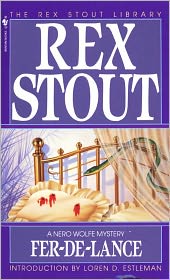
Fer-de-lance

Fer-de-lance. A Nero Wolfe Mystery. Rex Stout. 1934/1997. Random House. 304 pages.

There was no reason why I shouldn't have been sent for the beer that day, for the last ends of the Fairmont National Bank case had been gathered in the week before and there was nothing for me to do but errands, and Wolfe never hesitated about me running down to Murray Street for a can of shoe polish if he happened to need one. But it was Fritz who was sent for the beer.  

Fer-de-lance is the first Nero Wolfe mystery. It introduces readers to two private detectives, Nero Wolfe, and Archie Goodwin. I'm tempted to add in two of the BEST DETECTIVES in the world. But, I suppose that's just my opinion!

In Fer-de-lance, Fred Durkin introduces a woman to Nero Wolfe, Maria Maffei. This woman is worried about her brother, Carlo Maffei, who has gone missing. Archie Goodwin is sent to investigate. First he interviews those in the boarding house where Carlo lived--those that overheard Carlo's phone conversation; he then looks at Carlo's room, goes through his room looking for clues. He learns from Miss Anna Fiore that Carlo often gave her his newspaper after he was finished with it. The newspaper she got that Monday afternoon had a big hole in it--an entire article had been cut out. Nero Wolfe wants to know what article it was Carlo took such an interest in. After discovering the article was about the death of a golfer, Peter Oliver Barstow, he becomes interested in that death. Soon after Carlo Maffei is no longer missing at all--his body has been found. Though there is no obvious reason to link the two deaths together, to investigate them at the same time--especially since Barstow's death has been accepted as natural--Wolfe is convinced that the two are related. That Barstow was murdered. That his body should be exhumed and tested for poison. He's convinced that finding the murderer of one will lead him to solving the other murder. Who killed Peter Oliver Barstow? Was it poison? Who had motive and opportunity? And did Carlo know it was murder? Did Carlo know who killed Mr. Barstow? Is that how he ended up dead?

So Archie and Nero have plenty of work to do, plenty of clues to follow!

I enjoyed Fer-de-lance. It was fun to read the first mystery in this series. Archie and Nero are great fun in this one. Their dialogue still satisfies me. It's just so delightful to spend time with these two!

Nero Wolfe:

"A pessimist gets nothing but pleasant surprises, an optimist nothing but unpleasant." (3)

Nero Wolfe:

"Some day, Archie, when I decide you are no longer worth tolerating, you will have to marry a woman of very modest mental capacity to get an appropriate audience for your wretched sarcasms." (54)

Nero Wolfe:

"People often find it difficult to think in my presence, I do not leave enough space." (96)

Archie Goodwin:

"Everything that the doctor could tell me I had read three days earlier in the newspapers except for a bunch of medical terms which the papers hadn't tried to print for fear of a typesetters' strike." (139)

Archie Goodwin:

"You know what my boss says? He says that skepticism is a good watchdog if you know when to take the leash off." (143)

Nero Wolfe and Archie Goodwin:

"Tell Fritz there will be guests at lunch. What do boys that age eat?"
"They eat everything."
"Tell Fritz to have that." (165)


© 2011 Becky Laney of Becky's Book Reviews


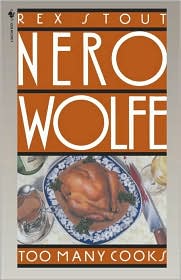
Too Many Cooks

Too Many Cooks. A Nero Wolfe Mystery. Rex Stout. 1938/1993. Bantam. 240 pages.

Walking up and down the platform alongside the train in the Pennsylvania Station, having wiped the sweat from my brow, I lit a cigarette with the feeling that after it had calmed my nerves a little I would be prepared to move the Pyramid of Cheops from Egypt to the top of the Empire State Building with my bare hands, in a swimming suit; after what I had just gone through. But as I was drawing in the third puff I was stopped by a tapping on the window I was passing, and, leaning to peer through the glass, I was confronted by a desperate glare from Nero Wolfe, from his seat in the bedroom which we had engaged in one of the new-style Pullmans, where I had at last got him deposited intact. He shouted at me through the closed window: "Archie! Confound you! Get in here! They're going to start the train! You have the tickets!"
I yelled back at him, "You said it was too close to smoke in there! It's only 9:32! I've decided not to go! Pleasant dreams!"
I sauntered on. Tickets my eye. It wasn't tickets that bothered him; he was frantic with fear because he was alone on the train and it might begin to move. He hated things that moved, and was fond of arguing that nine times out of ten the places that people were on their way to were no improvement whatever on those they were coming from. (1-2)
Too Many Cooks starts off great. The first chapter provides so many laughs! As readers witness Archie and Nero Wolfe at their absolute best. Nero being made so vulnerable through his fear of the train ride ahead. Nero being so pathetic as he pleads for the recipe of his favorite-and-best sausage. And, of course, readers witness Archie's weakness as well--as he meets a beautiful young woman. (The daughter of a famous chef, the chef Nero is pleading with so enthusiastically!) Both Nero Wolfe and Archie Goodwin are on their way to a West Virginian spa. Nero Wolfe is even the guest of honor. He'll have the privilege of making a speech on American cuisine.

Ten of the world's greatest chefs will be gathering at Kanawha Spa. These chefs are elected members of Les Quinze Maitres. Among the celebrating, the speech-making, the tasting, the drinking, the dancing, the gossiping, they'll be electing three new members to replace those that have died since the last big gathering. (I believe they meet every five years?) There is much jesting, much teasing, much quarreling between members. And this leads to one making a boast and setting up a game--a test. It seems to be all in fun.

But then, this chef ends up dead.

Nero Wolfe and Archie Goodwin are on vacation. And at first Nero has no interest at all in 'helping' solve this one. But when this investigation complicates his plans to return to New York, his return to routine, he becomes more cooperative. Can Archie and Nero solve this one before anyone else gets hurt?

I liked this one. I just LOVED the first chapter or two. But this one has its squirmy moments, its awkward moments. You could say it shows its age in race relations. The use of the n-word, for example. The way African Americans are treated with hostility, disrespect, and mistrust by the local police and with condescension and kindness by Nero Wolfe. The way Archie is shocked or startled by the appearance of fourteen African-Americans outside Wolfe's door, they are there to be "questioned" by Wolfe as he tries to solve this one. He doesn't trust the police to do it right. And the way the murderer uses blackface as a disguise when he commits the crime. But it isn't only the treatment of one race or ethnicity that makes this one squirmy. The matter-of-fact way they speak about the Chinese wife of one of the chefs, an eyewitness to the crime. (The police may or may not believe her story. She is Chinese after all.)

There are many things about Too Many Cooks that I did enjoy. There were many things that made it a pleasant read, a satisfying read. It's a good mystery. And the dialogue between Archie and Nero is not to be missed. These two are so much fun! They are two of my favorite characters ever created. But I can't say that it's a perfect read.

Some of my favorite quotes:

Archie Goodwin to Nero Wolfe:
"I am not deaf, sir. And while you can beef as much as you want to, because it's your own breath if you want to waste it, I do object to your implying either in word or tone that I am in any way responsible for your misery. I made this speech up last night, knowing that I would need it. This is your idea, this trip. You wanted to come--at least, you wanted to be at Kanawha Spa. Six months ago you told Vukcic that you would go there on April 6th. Now you regret it. So do I. As far as our engine is concerned, they use only the newest and best on these crack trains, and not even a child--" (3)
Archie on love at first sight:
It takes a long time to know people. How are you going to tell about anyone until you know them? Take love at first sight, for instance, it's ridiculous. That's not love, it's just an acute desire to get acquainted. (23)
Archie being surprised by Nero:
For ten years I had been accustomed to being as sure of finding Nero Wolfe where I had left him as if he had been the Statue of Liberty, unless his house had burned down, and it was upsetting, not to mention humiliating, to find him flitting around like a humming bird for a chance to lick the boots of a dago sausage cook. (34)

© 2011 Becky Laney of Becky's Book Reviews


The Last Chronicle of Barset

The Last Chronicle of Barset. Anthony Trollope. 1867.  928 pages. 

'I can never bring myself to believe it, John.' said Mary Walker, the pretty daughter of Mr. George Walker, attorney of Silverbridge. 

I love Anthony Trollope. I do. You know I do. So finishing The Last Chronicle of Barset was bittersweet for me. On the one hand, I loved it. It was such a great book. There are so many old friends to be found within it. So many characters that I've come to know and love through the first five books--The Warden, Barchester Towers, Doctor Thorne, Framley Parsonage. The Small House At Allington. And it was great to visit with them again. To reconnect with them. There were many new characters to love as well. So I loved it cover to cover. On the other hand, perhaps because it was so wonderful, it made it all the more difficult to say goodbye.

When Mr. Crawley, the curate of Hogglestock, is accused of stealing a cheque, everyone in Barsetshire begins to take sides. Some feel that he couldn't possibly have meant to steal the money, there has to be a valid excuse as to why his wife tried to spend another man's cheque to pay her bill. Others feel that he's guilty. What valid excuse could any man have for having another man's cheque in his possession? This Mr. Crawley may be a clergyman, but he also must be a thief. You might think that the church would stand by him. At least until he's been found guilty and punished by the courts. But the bishop and his wife, Mrs. Proudie, are his harshest critics. She is demanding (or should I say commanding) that he resign. She would call for his resignation because he looks guilty. Even if the courts were to clear him, I think she would want him gone. (Not that every clergyman agrees with the bishop and his wife. In fact, some lean more towards believing Crawley to be innocent because Mrs. Proudie is so sure of his guilt. And they wouldn't want to agree with her on any subject.)

Many people are upset by the Crawley's misfortune. Especially Grace Crawley, his beautiful daughter, and her suitor, Major Henry Grantley, the second son of Archdeacon Grantly. His father has been very firm in opposing this match. Yet Major Grantley can't turn his back on the woman he loves. And speak to her he must. If she'll agree to marry him, then he'll be truly happy. Of course, she is refusing to answer yes or no until her father's trial is over. If her father is found guilty, we're led to believe she would never ever consent to be his wife. (One of my favorite scenes in the entire novel is when Archdeacon Grantley goes to visit Grace Crawley. He approaches her full of anger and wrath, determined that he'll speak bluntly and forcefully with her. Yet by the end of the scene who has won the day?!) So I loved this romance, I did.

The other romance--of sorts--is Lily Dale and Johnny Eames, a non-couple we first met in Small House at Allington, he's still madly in love with his Lily. And she's still stubbornly refusing to even hear him speak of love and marriage. She will never, ever, ever, ever, ever marry. He's not convinced that his love is hopeless. And he's not alone in thinking that his romance is hopeless--there are so many supporters on his side, so many hoping that Lily will one day say yes. But who is more stubborn? Readers learn the answer to that in this final volume.

Of course, those are just some of the stories within The Last Chronicle of Barset. I wish I had some quotes to share. But I've probably marked over a hundred pages--and I couldn't begin to pick and choose from that many. But trust me. Trollope is Trollope and his writing is wonderful like always!

© 2011 Becky Laney of Becky's Book Reviews


Jubilee

Jubilee. Margaret Walker. 1966. 512 pages.

"May Liza, how come you so restless and uneasy? You must be restless in your mind."
"I is. I is. That old screech owl is making me nervous."
"Wellum, 'tain't no use in your gitting so upsot bout that bird hollering. It ain't the sign of no woman nohow. It always means a man."
"It's the sign of death."

Jubilee chronicles Vry's life. As a child. As a woman. As a daughter. As a mother. As a wife. As a slave. As a freedwoman. Before, during, and after the Civil War. During Reconstruction. It is a story of survival, of endurance, of incredible strength, of incredible integrity, of hope and despair, of fear and courage.

It's not an easy read. Because Vry's life was not an easy life. There's a necessary harshness, cruelty, and pain to it. For Vry was a slave. She may have been biracial. She may have looked white even. But she was a slave and her mistress NEVER let her forget it for a moment. The picture readers get of slavery is not pretty, not romanticized. The language is strong.

I thought Jubilee was wonderfully written. It's a powerful read, a compelling one. Very emotional. Very memorable. I would definitely recommend this one!

Vry's advice to a new slave:

Don't never grin in that white woman's face. She don't know what you mean. I was borned here, and I been here all my life, and you don't see me grinning bout nothing, now does you? Well, they ain't nothing here to grin about, that's how come I ain't grinning. (131)

Vry's prayer:

Lawd, God-a-mighty, I come down here this morning to tell you I done reached the end of my rope, and I wants you to take a-hold. I done come to the bottom of the well, Lord, and my well full of water done run clean dry.
I come down here, Lord, cause I ain't got no where else to go. I come down here knowing I ain't got no right, but I got a heavy need. I'm suffering so, Lord, my body is heavy like I'm carrying a stone. I come to ask you to move the stone, Jesus. Please move the stone! I come down here, Lord, to ask you to come by here, Lord. Please come by here!
We can't go on like this no longer, Lord. We can't keep on a-fighting, and a-fussing, and a-cussing, and a-hating like this, Lord. You done been too good to us. We done wrong, Lord, I knows we done wrong. I ain't gwine say we ain't done wrong, and I ain't gwine promise we might not do wrong again cause, Lord, we ain't nothing but sinful human flesh, we ain't nothing but dust. We is evil peoples in a wicked world, but I'm asking you to let your forgiving love cover our sin, Lord.
Let your peace come in our hearts again, Lord, and we's gwine try to stay on our knees and follow the road You is laid before us, if You only will.
Come by here, Lord, come by here, if you please. And Lord, I wants to thank You, Jesus, for moving the stone! (454-55)

Vry's advice to her son:

Keeping hatred inside makes you git mean and evil inside. We supposen to love everybody like God loves us. And when you forgives you feels sorry for the one what hurt you, you returns love for hate, and good for evil. And that stretches your heart and makes you bigger inside with a bigger heart so's you can love everybody when your heart is big enough. Your chest gets broad like this, and you can lick the world with a loving heart! Now when you hates you shrinks up inside and gets littler and you squeezes your heart tight and you stays so mad with peoples you feel sick all the time like you needs the doctor. Folks with a loving heart don't never need no doctor. (457)

© 2011 Becky Laney of Becky's Book Reviews


Small House At Allington

The Small House at Allington. Anthony Trollope. 1864. 752 pages.

Of course there was a Great House at Allington. How otherwise should there have been a Small House? Our story will, as its name imports, have its closest relations with those who lived in the less dignified domicile of the two; but it will have close relations also with the more dignified, and it may be well that I should, in the first instance, say a few words as to the Great House and its owner. 

The Small House at Allington is the fifth in the Chronicles of Barsetshire series by Anthony Trollope, my favorite bearded Victorian. It follows The Warden, Barchester Towers, Doctor Thorne, and Framley Parsonage. Did I love it? Yes! I just LOVED it. After my less than enthusiastic reading of Framley Parsonage, I was needing this one to be incredible, and it was! From start to finish, it was love--true love.

The Dales are the stars of this one. We're primarily focused on the two Dale sisters, Lily and Bell, and the men who for better or worse fall in love with them, John Eames, Adolphus Crosbie, Bernard Dale (cousin), and Dr. Crofts. Bernard brings his new acquaintance, Adolphus Crosbie, home one autumn, which changes their lives forever. Soon he's declared himself truly, madly, deeply in love with the young practically penniless girl, Lily. She's his soul mate and nothing will keep them apart. But is he worthy of her love? her respect? Or is he good for nothing? John Eames is also in love with Lily. Though he's never professed it privately or publicly. His love for her is sure and steady. If only she would see him as more than a friend...

As for Bell, there are two men who would have her for a wife. Bernard, her cousin, who has only recently discovered that his feelings are so in line with his uncle's wishes. If she says yes, they'll inherit nicely. But despite the promise of monetary gain, I do believe that Bernard is sincere in his devotion to Bell. Her other would-be suitor is Dr. Crofts, Trollope spends less time (at least as far as I can remember) with him, but Bell, unlike readers, is able to know him much better...

I loved this one. I loved the characters, the storytelling, the writing. It was charming. It was satisfying. It was entertaining. It was just a great, great read! There were characters that I just loved and adored. And there were characters that I loved to hate!
If the question was ever asked plainly, Bernard Dale had asked it plainly. Shall we be man and wife? Few men, I fancy, dare to put it all at once in so abrupt a way, and yet I do not know that the English language affords any better terms for the question. (75)

'Don't you like the moon?' she said, as she took his arm, to which she was now so accustomed that she hardly thought of it as she took it.
'Like the moon--well; I fancy I like the sun better. I don't quite believe in moonlight. I think it does best to talk about when one wants to be sentimental.'
'Ah; that is just what I fear. That is what I say to Bell when I tell her that her romance will fade as the roses do. And then I shall have to learn that prose is more serviceable than poetry, and that the mind is better than love. It's all coming, I know; and yet I do like the moonlight.'
'And the poetry--and the love?'
'Yes. The poetry much, and the love more. To be loved by you is sweeter even than any of my dreams--is better than all the poetry I have read.'
'Dearest Lily,' and his unchecked arm stole round her waist.
'It is the meaning of the moonlight, and the essence of the poetry,' continued the impassioned girl. 'I did not know then why I liked such things, but now I know. It was because I longed to be loved.'
'And to love.'
'Oh, yes. I would be nothing without that. But that, you know, is your delight--or should be. The other is mine. And yet it is a delight to love you; to know that I may love you.'
'You mean that this is the realization of your romance.'
'Yes; but it must not be the end of it, Adolphus. You must like the soft twilight, and the long evenings when we shall be alone; and you must read to me the books I love, and you must not teach me to think that the world is hard, and dry, and cruel--not yet. I tell Bell so very often; but you must not say so to me.'
'It shall not be dry and cruel, if I can prevent it.'
'You understand what I mean, dearest. I will not think it dry and cruel, even though sorrow should come upon us, if you--I think you know what I mean.'
'If I am good to you.'
'I am not afraid of that--I am not the least afraid of that. You do not think that I could ever distrust you? But you must not be ashamed to look at the moonlight, and to read poetry, and to--'
'To talk nonsense, you mean.'
But as he said it, he pressed her closer to his side, and his tone was pleasant to her.
'I suppose I'm talking nonsense now?' she said pouting. 'You liked me better when I was talking about the pigs, didn't you?'
'No; I like you best now.' (87-8)


'We all try, my dear, but many of us fail to try with sufficient energy of purpose. It is only by doing our duty that we can hope to be happy, whether in single life or in married.' (119)

We constantly talk of the thoughtlessness of youth. I do not know whether we might not more appropriately speak of its thoughtfulness. It is, however, no doubt, true that thought will not at once produce wisdom. It may almost be a question whether such wisdom as many of us have in our mature years has not come from the dying out of the power of temptation, rather than as the results of thought and resolution. (133)

Love does not follow worth, and is not given to excellence;--nor is it destroyed by ill-usage, nor killed by blows and mutilation. (306)

A sermon is not to tell you what you are, but what you ought to be, and a novel should tell you not what you are to get, but what you'd like to get. (422)

'I hate books I can't understand,' said Bell. 'I like a book to be clear as running water, so that the whole meaning may be seen at once.'
'The quick seeing of the meaning must depend a little on the reader, must it not?' said Mrs. Dale.
'The reader mustn't be a fool, of course,' said Bell.
'But then so many readers are fools,' said Lily. 'And yet they get something out of their reading.' (445)


© 2011 Becky Laney of Becky's Book Reviews


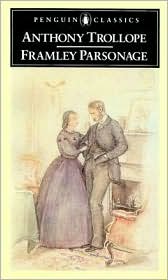
Framley Parsonage

Framley Parsonage. Anthony Trollope. 1861. 576 pages.

First sentence: When young Mark Robarts was leaving college, his father might well declare that all men began to say all good things to him, and to extol his fortune in that he had a son blessed with so excellent a disposition. 


 Framley Parsonage is the fourth in the Chronicles of Barsetshire series by Anthony Trollope, one of my favorite bearded Victorians. The first three are The Warden, Barchester Towers, and Doctor Thorne. I wish I could say that I absolutely loved it. That Trollope didn't disappoint in any way. But. I can't quite say that. Not this time around. I enjoyed Framley Parsonage. I enjoyed visiting some of my favorite characters from previous novels--Mr. and Mrs. Proudie, Mr. and Mrs. Grantley, Lady Arabella, Miss Dunstable, Dr. Thorne, Mr. and Mrs. Gresham, etc. I enjoyed meeting Mark Robarts, his wife, Fanny, and his sister, Lucy. (Lucy was my favorite new character.) I found Lady Lufton to be quite a character. And her son, Lord Lufton, had his moments. There were some great scenes in this one. Some very dramatic. Some very romantic. Some very comedic. But despite how much I almost loved this one, it stayed an almost throughout. I did like it. I am glad I read it.

Mark Robarts should have known better. That's the truth. He should have NEVER signed his name to his friend's bill. For Mr. Sowerby is no friend of his. You would think that after watching his friend, Lord Lufton, be cheated out of money by Mr. Sowerby that he would have known better, would not have been so gullible, so foolish, so silly. But. Mark Robarts does not always make wise decisions. In fact, he can be very foolish. Good thing his wife and sister are so wise, so compassionate, so forgiving. I enjoyed spending time with Fanny and Lucy. I thought they were great characters. I spent most of the time wanting to scold Mark, however. (Though his transformation by the end into a man of character did help me like him better.)

When the novel wasn't talking about financial messes, it alternated between being political and romantic. It focused on several romances: that of Lucy, that of Griselda Grantley, and that of Miss Dunstable! These sections kept me reading. These sections kept me happy.

"It is no doubt very wrong to long after a naughty thing. But nevertheless we all do so. One may say that hankering after naughty things is the very essence of the evil into which we have been precipitated by Adam's fall. When we confess that we are all sinners, we confess that we all long after naughty things." (37)

"A man's own dinner is to himself so important that he cannot bring himself to believe that it is a matter utterly indifferent to every one else. A lady's collection of baby-clothes, in early years, and of house linen and curtain-fringes in later life, is so very interesting to her own eyes, that she cannot believe but what other people will rejoice to behold it." (123)

"A man always can do right, even though he has done wrong before. But that previous wrong adds so much difficulty to the path--a difficulty which increases in tremendous ratio, till a man at last is choked in his struggling, and is drowned beneath the waters." (150)

"If the ears be too delicate to hear the truth, the mind will be too perverse to profit by it." (181)

"I think it is more proper-looking, and better suited, too, for the world's work, when it goes about with some sort of a garment on it. We are so used to a leaven of falsehood in all we hear and say, nowadays, that nothing is more likely to deceive us than the absolute truth." (290)

"A man does not wish to marry a statue, let the statue be ever so statuesque." (301)

"A man may be very imperfect and yet worth a great deal. A man may be as imperfect as Lord Lufton, and yet worthy of a good mother and a good wife. If not, how many of us are unworthy of the mothers and wives we have!" (367)

"All unmarried women are necessarily in the market; but if they behave themselves properly they make no signs." (451)

"It would be a terrible curse to have to talk sense always." (458)

"Think about the happiness of those around you, and your own will come without thinking." (480)


© 2011 Becky Laney of Becky's Book Reviews


Mrs. Mike

Mrs. Mike: "The Heartwarming Classic Story of the Boston Girl Who Married A Rugged Canadian Mountie." by Benedict & Nancy Freedman. 1947. 284 pages.

The worst winter in fifty years, the old Scotsman had told me. I'd only been around for sixteen, but it was the worst I'd seen, and I was willing to take his word for the other thirty-four.

I enjoyed Mrs. Mike. It's a rugged historical romance novel set in the early twentieth century. It stars Katherine Mary O'Fallon and Seargeant Mike Flannigan of the Canadian Mounted Police. When Katherine Mary goes to visit her uncle in Canada, she didn't expect to fall in love with anyone. But when she meets this Mountie, well, it's love. Her love for him will be demanding, will require much sacrifice on her part. For this city girl will be forced into the wilderness, away from everything she's ever known and loved. She'll endure the harshest circumstances, the cruelest hardships. But because of love--her deep love--for her husband, life is good. But their love will face challenges. Realistic challenges, I believe, but heartbreaking ones.

As I said, I enjoyed this one. I enjoyed the historical aspects of this one. I also liked the romance of it. It was a good, clean read. A book that almost anyone of any age could enjoy--if historical romance is their genre of choice. (I know not everyone *loves* historical romance as much as I do!)

My favorite quote:
But death does not stand at the end of life, it is all through it. It is the fear of losing, the knowledge of losing that makes love tender. (276)

© 2011 Becky Laney of Becky's Book Reviews


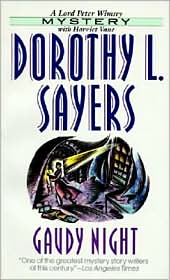
Gaudy Night

Gaudy Night. Dorothy L. Sayers. 1936/1995. HarperCollins. 512 pages.

Harriet Vane sat at her writing-table and stared out into Mecklenburg Square. The late tulips made a brave show in the Square garden, and a quartet of early tennis-players were energetically calling the score of a rather erratic and unpracticed game. But Harriet saw neither tulips nor tennis-players.

This is the third novel starring Lord Peter Wimsey and Harriet Vane. The first two being Strong Poison and Have His Carcase. Both featured Lord Peter prominently. In the first, he "rescued" an accused murderess, Harriet Vane, she stood accused of poisoning her former lover. In a little under a month, he proved his love by proving her innocence. Upon their first meeting, he proposed. It was--for him--love at first sight. In the second, Lord Peter proves helpful once again when Harriet discovers a dead body on the beach. He doesn't even wait for there to be a sign of trouble, he's there on the spot to do what he does best.

In the third novel, Lord Peter is strangely absent for the first half of the novel. At first, this irritated me. I mean, I want LORD PETER to be appearing in every chapter--if not on every page. I mean, I just can't get enough of him. I LOVE AND ADORE him. But. I think his absence serves at least two purposes. First, I think it reflects the times surprisingly well. Sayers has Lord Peter working for the Foreign Office; she has Lord Peter off in Europe trying to be a peacemaker. There are a few conversations that reflect that all is not as it should be in Europe, in the world, that there are tremors of political turmoil and uprising. That another war may be coming. Second, I think it's for Harriet's benefit. With Peter gone, she realizes--perhaps a little too slowly for this reader--just how much she needs him. Needs him not to "rescue" her perhaps though he has a way of doing just that. But needs him--as in needs his company, his humor, his wit, his strength, his intelligence. She almost aches for him. If that makes sense. So Harriet and I were both in the same place (for a change), we were both wanting Lord Peter, longing to hear his voice again.

So what is Gaudy Night about? Well, Harriet Vane has returned to Oxford, to her college (Shrewsbury College). At first this return is just for the "Gaudy" reunion. But. After the women's college experiences a series of pranks and other (small) crimes, she's called back to lend a hand in the investigation. They don't want to go to the police. They don't want outsiders to know that there is someone writing obscene letters and destroying college property. Since these letters are anti-feminist--the person writing them obviously feels that women should not be educated or work outside the home. A large part of this one is set in an academic environment. It features a handful of women discussing big issues of the day. It was hard, for me, to keep track of all the new characters introduced. All the women professors, tutors, dons, and students. But there was one new character that was unforgettable: Lord Peter's nephew, Lord St. George! (I really, really liked him!) As the months go by, the crimes start to change. The case may prove a little too challenging to solve all on her own, but Lord Peter can't stay away forever. And together, they may just do more than solve the case...

I enjoyed the romance in Gaudy Night. I enjoyed seeing Lord Peter through different eyes. (For example, Wimsey is discussed by a good many women at the college. Sometimes in a flattering way, sometimes not. But it is interesting to see Harriet's reaction to other people's opinion of Lord Peter. When she sees that Lord Peter is a desirable man in other women's eyes, well, it doesn't hurt the situation any!) I loved the characterization too. I loved Lord St. George and Reggie Pomfret, for example.  I wasn't such a big fan of the mystery plot in this one--it wasn't much of a surprise to me who was at fault. But overall, the writing still worked well for me.

Favorite quotes:

"How all occasions do inform against me!" muttered Harriet to herself. One would have thought that Oxford at least would offer a respite from Peter Wimsey and the marriage question. But although she herself was a notoriety, if not precisely a celebrity, it was an annoying fact that Peter was a still more spectacular celebrity, and that, of the two, people would rather know about him than about her. As regards marriage--well, here one certainly had a chance to find out whether it worked or not. Was it worse to be a Mary Atwood (nee Stokes) or a Miss Schuster-Slatt? Was it better to be a Phoebe Bancroft (nee Tucker) or a Miss Lydgate? And would all these people have turned out exactly the same, married or single? (46)

"Do you know any man who sincerely admires a woman for her brains?"
"Well, said Harriet, "certainly not many."
"You may think you know one," said Miss Hillyard, with a bitter emphasis. "Most of us think at some time or other that we know one. But the man usually has some other little axe to grind." (55)

"Peter" said Harriet. And with the sound of her own voice she came drowsing and floating up out of the strong circle of his arms, through a green sea of sun-dappled beechleaves into darkness. "Oh damn," said Harriet softly to herself. "Oh, damn, I didn't want to wake up." The clock in the New Quad struck three musically. "This won't do," said Harriet. "This really will not do. My sub-conscious has a most treacherous imagination." She groped for the switch of her bedside lamp, "It's disquieting to reflect that one's dreams never symbolize one's real wishes, but always something Much Worse." She turned the light on and sat up. "If I really wanted to be passionately embraced by Peter,  I should dream of something like dentists or gardening." (113)

If you learn how to tackle one subject--any subject--you've learnt how to tackle all subjects. (171)

"But what's Mock Turtle about?" inquired Harriet? On this point the authors were for the most part vague; but a young man who wrote humorous magazine stories, and could therefore afford to be wide-minded about novels, said he had read it and thought it rather interesting, only a bit long. It was about a swimming instructor at a watering place, who had contracted such an unfortunate anti-nudity complex through watching so many bathing-beauties that it completely inhibited all his natural emotions. So he got a job on a whaler and fell in love at first sight with an Eskimo, because she was such a beautiful bundle of garments. So he married her and brought her back to live in a suburb, where she fell in love with a vegetarian nudist. So then the husband went slightly mad and contracted a complex about giant turtles, and spent all his spare time staring into the turtle tank at the Aquarium, and watching the strange, slow monsters swimming significantly round in their encasing shells. But of course a lot of things into it--it was one of those books that reflect the author's reaction to Things in General. Altogether, significant was, he thought, the word to describe it. (233)

"He's a precocious little monkey," said his uncle, without enthusiasm. "Though I can't blame him for that; it runs in the blood. But it's characteristic of his impudence that he should have gate-crashed your acquaintance, after you had firmly refused to meet any of my people."
"I found him for myself, you see, Peter."
"Literally, or so he says. I gather that he nearly knocked you down, damaged your property and generally made a nuisance of himself, and that you instantly concluded he must be some relation to me."
"That's--If he said that, you know better than to believe it. But I couldn't very well miss the likeness."
"Yet people have been known to speak slightingly of my personal appearance! I congratulate you on a perception worthy of Sherlock Holmes at his keenest." (308)

How fleeting are all human passions compared with the massive continuity of ducks... (325)

"Do you find it easy to get drunk on words?"
"So easy that, to tell you the truth, I am seldom perfectly sober. Which accounts for my talking so much." (330)

"Something worried you about this room. What was it?"
"You don't need to be told."
"No, I am convinced that our two hearts beat as one. But tell Miss Martin." (345)

"Just exercise your devastating talent for keeping to the point and speaking the truth."
"That sounds easy."
"It is--for you. That's what I love you for. Didn't you know?" (365)

"I don't know. I have a reputation for flippant insincerity. You think I'm honest?"
"I know you are. I couldn't imagine your being anything else." (382)

It is said that love and a cough cannot be hid. (427)

© 2011 Becky Laney of Becky's Book Reviews


Twitter Delicious Facebook Digg Favorites More