Showing posts with label Penguin USA. Show all posts

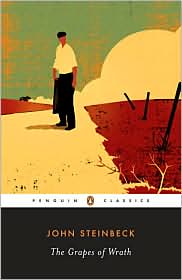
Grapes of Wrath

Grapes of Wrath. John Steinbeck. 1939. Penguin. 619 pages.

To the red country and part of the gray country of Oklahoma, the last rains came gently, and they did not cut the scarred earth. 

It is finished! After three or four false starts, after two library editions and two paperback editions, it is finished. If one word could sum up my experience with this one, it would be sluggish. Of course, I can think of a few other words to describe it. But I'll share just one more: bleak. (Or perhaps bleakity-bleak.)

To sum this one as quickly as possible: The Joad family, devastated by losses in Oklahoma, are forced to pack it all up and head to California where they find that life is just as hard if not harder than they could have ever imagined. There is no happy welcome awaiting them, they are viewed--at best--as mere animals. The only way out of the harsh ugly reality is death. And even death doesn't come easy. The end.

I'm not going to try to convince you that The Grapes of Wrath is a horrible book. I'm not going to try to convince you that The Grapes of Wrath is a wonderful book. I can--at best--only share with you why we're not a good match for one another.

The language. There are certain words that offend me each and every time they're used. It doesn't matter the circumstances. It doesn't matter who or where or why. The Grapes of Wrath uses a great many of these words. (Or should I say repetition of the same word.) Are the words realistic? Probably. But that doesn't change my reaction to those words.

I had big, big, big problems with the character of Jim Casy. This "former preacher" annoyed me every time he opened his mouth. Though annoy isn't quite the right word. I'm not sure offended is the right word either. Simply because people can't use the word offended without people judging them. It's just that his language is so crude, so vulgar. That his "story" is so vulgar--how every time he got worked up "in the spirit" preaching, he had to find sexual release with young women from his church (or audience or wherever). Yes, that was mostly in the past, and yes, this "sin" is what led him to eventually give up faith and religion. Casy, when we meet him, doesn't believe in God, doesn't believe in the church or religion, doesn't believe in prayer, doesn't believe in sin, doesn't believe in the concept of right or wrong, or heaven and hell. Casy doesn't believe in anything at all really. There are no answers, there will never be any answers. Suffer, suffer, suffer, why have hope at all that you will ever do anything but suffer. Any time Casy talked about matters of faith or matters of the heart or anything remotely connected to spirituality or religion or even morals and ethics, I just wanted to yell at him. It doesn't help that according to "experts" Jim Casy is a "Christ figure." I read this on Wikipedia and Spark Notes. There are almost no words for how that makes any sense whatsoever. How someone so foul, so crude, so vulgar, so given-over-to-sin, someone who doesn't believe ANYTHING at all, someone who has no hope, no love, no peace, whose only message is now is all we got, and now is ugly is a "Christ figure." In what way at all--does he resemble Christ? Now, I'm not saying that everyone should hate Jim Casy. I am saying that as a reader I could not stand him.

Another big issue I had with The Grapes of Wrath has to do with style. The narrative style of this one is a bit odd. You have chapters that are clearly narrated by members of the Joad family, chapters that carry this story forward. Then you have chapters that read more like an out of body experience. These may focus on turtles or waitresses or car salesmen. But. They are clearly not like the other chapters in the novel. I never could quite figure out if the people in these chapters were the Joads--as seen from the outside perspective--or if the people (when the focus was on people not trees or turtles, etc.) were meant to represent any family facing this crisis, any family who had been devastated. I don't know that it matters. I just felt a great big disconnect every time we lost the main story, the real story. However, there were a couple of exceptions. There were times when these chapters were beautifully done and the text is richer for them--for the perspective they add to it. (Chapter fourteen comes to mind.)

I struggled with the first sixteen chapters. I did. I wasn't liking it. I wasn't liking it at all. But things began to shift a little with chapter seventeen. I don't know if the story truly improves once the family crosses into California, or if I just was in a better mood that day, but something changed. From that point on, the story while not always pleasant was more compelling. There was still violence to deal with, still some harsh realities to endure, but the second half definitely improved my impressions of the novel.

I am SO GLAD that this wasn't my first introduction to John Steinbeck. If it was, I never would have picked up any of his other books. I would have walked away knowing that I was right, that Steinbeck was not for me. The truth is, that Steinbeck was a good writer--at times great. That he wrote in many, many styles. That he had MANY stories to share with readers. Not just one story over and over and over again. Some of the stories he tells are very funny, very true-to-life, and even in their earthiest moments, there's something there worth reading. His stories can be very raw, very perceptive. The Grapes of Wrath was not for me. Perhaps the message was some things in life are so ugly that no amount of imagination can make them beautiful. I found the lack of hope and the vulgar language to be too much for me. But the very things that I dislike about it--the realistic portrayal of humanity at its weakest and worst--may be the very things some one else loves about it.

I read this book for the Classics Circuit tour. 

© 2011 Becky Laney of Becky's Book Reviews


No Passengers Beyond This Point (MG)

No Passengers Beyond This Point. Gennifer Choldenko. 2011. Penguin. 256 pages.

My mom says worry is like a leaky faucet--every drip makes you imagine something bad on the way...trouble...trouble...trouble...do something...do something...do something. But when you're twelve and the only guy in the house, you're responsible for an awful lot. It isn't just the heavy lifting and taking out the garbage either. You've got to be aware.

India, Finn, and Mouse are three children on their way--by plane--to their Uncle Red's house. They're not going on vacation, this won't be a short stay. No, the three will be there to stay. Their mom has every intention of joining them when the school year is through, but for now, they'll need to stick together and take care of one another. This move is sudden and not-so-sudden. It's definitely a surprise to the three kids. To the mom? Well, she's been fighting to save her home from foreclosure for the past six months. And then the fight is over, and she's lost. Now she has to tell her kids they'll be going to stay with Uncle Red in Colorado, they'll be leaving the next day. No time to say goodbye to their friends. No time to pack up their belongings properly. No, one suitcase a piece is all they'll be taking with them. This move seems so crazy, so weird. Yet it's the sanest part of the book, perhaps?!

After the first fifty pages, well, No Passengers Beyond This Point reads like an episode of The Twilight Zone. For those that love realistic fiction--and only realistic fiction--this may be an unpleasant surprise. For those that love a bit of fantasy and mystery, well, this change may be quite welcomed. (Is it a difficult mystery to solve? I'm not a good judge of that. I certainly began putting the pieces together early on, BUT that doesn't mean it won't be suspenseful to kids. And even though I had a good idea on where this one was going, it didn't take the fun out of reading it.)

No Passengers Beyond This Point is narrated by Finn (middle child), India (oldest child), and Mouse (youngest child). And I don't always love appreciate it when authors do this. Multiple narrators can be a big disappointment at times. They can keep me from connecting with a book. They can keep me from getting to know any of the characters well enough. BUT. I didn't have a problem with it in No Passengers Beyond This Point. In fact, it was one of the novel's greatest strengths. Which narrator would I want to give up??? NONE OF THEM!!! I just loved and adored Mouse and her invisible friend, Bing. I loved seeing the world through her eyes. I loved her observations. And Finn, well, he was responsible--though worried--and was able to think things through without giving into panic. I definitely think he's a good brother for these two to have! And India, well, I might have struggled to like her at first. (Though I wouldn't say I see her exactly the same way Mouse does...) But her chapters--especially towards the end--are so INTENSE and compelling. And when it comes down to it, ALL the narrators are so important to the story itself.

So I definitely enjoyed No Passengers Beyond This Point. I loved the characters. I loved the family dynamics. I thought Choldenko did a great job with developing relationships between siblings. And, for me, the atmosphere, the setting--strange as it was--worked very well. I can't say that every reader will love it. But then again, the same is true for ANY book I review!

Some of my favorite Mouse observations:

Ever since I found out they kicked Pluto out of the planets, I have not been feeling so sure about a lot of things. If they can decide Pluto is not a planet all of a sudden like that, things are not being run the right way up top. Pluto is a planet in My Solar System on page one, page six, and all of chapter three.
My brother, Finn, who has no pimples, says that's because Pluto is a dwarf star, but Finn is wrong about this. Finn is wrong about a lot of things, but I keep quiet about how many. He is a nice big brother and I don't want to ruin him.
My sister, India, is fourteen and she's only nice when Mommy makes her. (26-27)

I do not like being way back here with Bing and Marvin. What is Marvin going to ask? I try to think of every answer I know.
"Name?" Marvin asks.
"Geneva Tompkins, but everybody calls me Mouse on account of I'm good at squeaking. Want to hear?"
Marvin shakes his head. "You're traveling with your mother."
"No," I say. "We've used up all our money. Mommy has to work because that's how she gets more. Is that how you get more, Marvin?"
Marvin writes this down on his clipboard. "Who exactly are you traveling with?"
"My sister, India, and my brother, Finn. India, Geneva, and Finland. Two countries and a city. That's me." I raise my hand. "My mother wanted to travel, but instead she had kids."
This is my grown-up joke. I got it from India. Marvin doesn't laugh.
"And your father?" Marvin asks.
"He died when I was in Mommy's tummy. I couldn't see him on account of there was skin in the way. But Bing saw him. He took a picture for me."
"Who is Bing?"
"He's my friend."
"Did you pack your own suitcase?"
"My mom and India did, only I made a few corrections."
"Which means?"
"I added the explosives," I whisper.
His face looks suddenly the color of my snot when Mommy says I have to stay home from school. "Explosives?"
"Have you ever seen mints explode? You put them in soda and Pfffffff." I make my best explosion noise, but it's not as good as Finn's.
"This is some kind of science experiment?" His voice squeaks.
"Oh, no. I don't have science yet. Not until third grade."
Marvin shakes his head and makes grunting noises. "Do you understand you aren't allowed to bring liquids on the plane? Liquids like vinegar, liquids like soda."
"I would have understood if Finn let me read the whole sign, but he said we had to--"
"You stay here," he snaps before I even finish explaining.
When Marvin comes back, Mommy, Finn, and India are with him. Marvin hands me my suitcase. It's very light. He's taken all the good stuff out. (31-32)

Now I have to go to the bathroom. But I don't want to go in a strange bathroom, so I hold it like at school. I will hold it until we get back from Uncle Red's. I only like the toilet paper at home. (42)

I'm used to knowing more than everyone else on account of Bing. He has in some knee-a, you know. You can find out a lot of things when you're awake at night. In the morning, Bing tells me everything he found out the night before. (86)


© 2011 Becky Laney of Becky's Book Reviews


Legend (YA)

Legend by Marie Lu. 2011. November 2011. Penguin. 336 pages.

My mother thinks I'm dead. Obviously I'm not dead, but it's safer for her to think so. At least twice a month, I see my Wanted poster flashed on the JumboTrons scattered throughout downtown Los Angeles. It looks out of place up there. Most of the pictures on the screens are of happy things: smiling children standing under a bright blue sky, tourists posting before the Golden Gate Ruins, Republic commercials in neon colors. There's also anti-Colonies propaganda. "The colonies want our land," the ads declare. "They want what they don't have. Don't let them conquer your homes! Support the cause!"

Legend is YA dystopia. Perhaps not YA dystopia at the very, very best. But it is definitely one of the better dystopias I've read this year.  Legend is compelling; it is exciting; it is just a great read.

The novel has two narrators: a guy named Day (Daniel) and a girl named June. Both underwent the "trials" at age 10. June received a perfect, perfect score earning her not only the right to higher education (high school and college) but the right to the best education possible, the kind of education that will prepare her for serving the Republic. Day, well, he didn't pass his trials. And like all other low-scoring 10 year olds, he was sent away to labor camp. Once a 10 year old is sent to labor camp, they're never ever heard from again.

When the novel opens, both teens are about 15. Day is a wanted criminal, an outlaw. He doesn't legally exist in the Republic database, in the Republic records. The authorities don't even know what he looks like--what race or ethnicity he may be. So their wanted posters change quite often allowing for every possibility. (It's the occasional finger print on the crime scene that links Day to particular crimes.) Day is in Los Angeles spying on his family. His older brother, John, is the only one in the neighborhood who still knows he's alive. And it is to John he delivers gifts--food, clothes, medicine, money, etc.  Day becomes worried when his family's home is marked with a red X--a symbol that someone within the home has the plague. This is very bad news indeed.

June, on the other hand, is at the top of her class. Though she's just fifteen, she's almost finished with her training, her education. June is anxious to start working for the Republic, to start serving in the military, to start tracking down criminals like Day. Her wish comes true--but not in the way she expected. She wanted to start working with her older brother, Metias. Instead, she takes his place after he is murdered. And it appears that Day is the one responsible for his stabbing. Metias was trying to stop Day from escaping from the hospital after a break in. (Day was hoping to find plague cures for his family.) June is on a mission, and it is personal. She'll track down Day and bring him to justice no matter what.

The chapters alternate in narrators, and for once I think this is a great idea. Usually, I'm not a big fan of this in novels, but in this case, it not only works, it works well! I was able to care about Day and June--almost from the start!

Legend is action-packed. It's an intense read. But an enjoyable one! I'd definitely recommend it!!!


*My review is based on an ARC.
**Have you seen this list of YA dystopias?!


© 2011 Becky Laney of Becky's Book Reviews


As I Wake (YA)

As I Wake. Elizabeth Scott. 2011. September 2011. Penguin. 224 pages.

Wake up.
I'm in bed. Sheets and blankets tucked around me, my legs sprawled out like I've fallen. No light in the room except faint yellow and a darker, colder gleam shining through the window, its curtains only partly closed.
Where I am?
I don't know these sheets, this bed, this room.
I look down at myself, see soft fabric wrapping me from neck to knees. My feet are bare.
There are dark shapes all around.

You never quite know what you're going to get with an Elizabeth Scott novel. This certainly wasn't Bloom or Perfect You or Living Dead Girl or Grace. Then again, that's one of the things that I love about Elizabeth Scott. She never stops surprising me.

As I Wake is part mystery, part science fiction novel. Ava, our heroine, wakes up one day without her memory. There's a woman, Jane, claiming to be her mom. There's a group of teens claiming to be her best friends--Greer, Sophy, Olivia. There's a cute guy, Ethan, whom her friends tell her is her crush. But Ava remembers nothing. There's not a single memory to match her with the life she's supposedly lived. But it's not just that she has no memories of being Ava, it's that she has memories of being a different Ava. The memories that come to her, well, they just don't fit in with what she knows about Ava. Certain people are triggering memories--just not the right memories. So what's going on? That's the mystery Ava and readers have to solve...

I enjoyed this one. I can't say I understood it all while I was reading. I can't even say I'm sure that I understand it now after finishing it and thinking about it for a couple of hours. But was it a compelling read? Yes.

© 2011 Becky Laney of Becky's Book Reviews


What Happened To Goodbye (YA)

What Happened To Goodbye. Sarah Dessen. 2011. Penguin. 416 pages.

The table was sticky, there was a cloudy smudge on my water glass, and we'd been seated for ten minutes with no sign of a waitress. Still, I knew what my dad would say. By this point, it was part of the routine. 

I love Sarah Dessen. I do. I just LOVE, LOVE, LOVE her work. I love her characters, her stories, her writing. I love how easy it is to love her books. She makes it easy to love reading. There's just something wonderful about them. I've never once been disappointed. So it shouldn't really surprise anyone that I loved What Happened to Goodbye.

Mclean Sweet sometimes wishes things could be as simple as loving her dad and hating her mom. Since her parents have divorced, Mclean has had to reinvent herself again and again and again and again. Her dad has a job that requires him to move around a lot. He's been hired by a company to "fix" problem restaurants. (Think Kitchen Nightmares with less yelling!) Sometimes he's able to "save" the restaurant, and they move on to the next place, the next town or state. Sometimes he's not able to save a place--no matter how much time and energy he puts into a place--and they move on. In each town, Mclean gives herself a new name--a new personality, a new identity. Knowing that she can recreate herself into someone new--if only for a few months--gives her a sense of peace. Temporary peace, perhaps, but it helps her cope with what her life has become since the divorce. The divorce that she totally blames her mom for. I mean how could HER mom have an affair with the head coach of her dad's favorite basketball team? How could she become pregnant and leave them both behind? Why doesn't her mom get why she is so angry? Mclean feels she just doesn't belong in this new family with her half-siblings and her stepfather.

But she does find herself belonging here in this town, in this school, with her wonderfully strange friends, with her wonderfully strange neighbor, Dave. For the first time in a long time, Mclean can practice being honest--with herself, with her boyfriend, with her friends, with her dad, with her mom. Perhaps it's just as difficult for her to be honest with her parents as it is to be honest with herself. For in all her inventing, Mclean has lost pieces of herself. She's lost herself and buried her pain deep, deep inside. But it may just be time for Mclean to heal. In Lakeview, she may just find the support she needs.

I enjoyed this one. I liked Mclean. I liked her parents. I liked how complex these relationships are. How life can't be as simple as hating her mom and loving her dad. I liked how challenging these relationships are. I liked how we get Mclean's perspective--but not so blindly that readers can't see things from the other side. And it was great to see her relationship with her dad. How much she loves him and takes care of him. But also how he's there for her when she needs him. He's not perfect, but I do think he cares very much for his daughter. Her friends. I also liked them. Especially Deb and Dave. I love how eccentric yet believable her characters are! And I liked Dave as the love interest!

© 2011 Becky Laney of Becky's Book Reviews


Matched (YA)

Matched. Ally Condie. 2010. Penguin. 369 pages.

Now that I've found the way to fly, which direction should I go into the night? My wings aren't white or feathered; they're green, made of green silk, which shudders in the wind and bends when I move--first in a circle, then in a line, finally in a shape of my own invention. The black behind me doesn't worry me; neither do the stars ahead.

Cassia, the heroine of this dystopian YA novel, is on her way to her Match banquet. This is THE night where she will learn the identity of the man she'll spend the rest of her life with. It's also the day Cassia turns seventeen. Just one of many coincidences, perhaps, of Ally Condie's Matched.

For it is revealed that her match is her best friend, Xander. Usually, one's match is a complete stranger. The fact that she knows him--that she knows and loves him--well, it's a strange coincidence. But that's just the beginning. For when she looks on her microcard, a microcard that should be full of pictures and background information on her match--she catches a glimpse of another friend, Ky. For a moment, only a moment, it appears that Cassia has two matches. This kind of mistake should NEVER happen. And it's corrected by a visiting Official who tries her best to convince Cassia that it was a mistake, nothing more. Ky could never, ever, ever be her real match. Because he's not good enough to be anyone's match.

Any guesses which young man Cassia starts to fall in love with?

I enjoyed Matched. I wouldn't say that I loved it absolutely. But I enjoyed it. I found it entertaining and satisfying. I liked Cassia. I liked Ky. I liked Xander. I liked Cassia's family. Her brother, Bram, her father and mother, her grandfather. I was interested in the world Condie created. I liked the role poetry played in this one. How forbidden poems were used to help reveal some of the mysteries. It just worked for me.

Favorite quotes:
The almost-snow reminds me of a line from a poem we studied this year in Language and Literacy: "Stopping by Woods on a Snowy Evening." It is one of my favorites of all the Hundred Poems, the ones our Society chose to keep, back when they decided our culture was too cluttered. They created commissions to choose the hundred best of everything: Hundred Songs, Hundred Paintings, Hundred Stories, Hundred Poems. The rest were eliminated. Gone forever. For the best, the Society said, and everyone believed because it made sense. How can we appreciate anything fully when overwhelmed with too much? (29)
Every minute you spend with someone gives them a part of your life and takes part of theirs. (65)


© 2011 Becky Laney of Becky's Book Reviews


XVI (YA)

XVI. Julia Karr. 2011. Penguin. 272 pages.

"Nina, look." Sandy jabbed me in the ribs.

XVI is a new dystopian novel. I love dystopian novels, usually. But I wasn't loving this one. I didn't connect to the characters. I didn't believe the romance. I failed to connect with the story, with this new world Karr created.

Nina Oberon is the star of this one. Her best friend, Sandy, is unbelievably annoying--though still a few weeks from her sixteenth birthday, she's acting like a sex-teen already. In other words, she's stopped thinking and has bought into the media's belief system completely. Why is Nina best friends with Sandy? Well, it's hard for readers to know for sure. I can only assume that a few years ago, Sandy, had to be less annoying and more likable.

Nina also has a younger sister, Dee. Since their mother is murdered fairly early in the novel, it becomes Nina's responsibility to protect Dee from her father, Ed. So Nina's life is getting crazier by the day, and trying to make sense of her life, her world, what everything means, well, it could be a full time job. Nina does make a few new friends, friends that are actually capable of thinking, to help her in this difficult time, this dangerous time.

One of these new friends is a guy named Sal. Though Nina is convinced she is not ready for a boyfriend, she can't help wanting Sal in her life. She can't stop thinking about him, wanting him, needing him. Will Sal help her solve some of the big mysteries in her life? Will Sal help keep her safe?

So why didn't I love this one? Why didn't I like it? Why didn't I like Nina and Sal? I'm not sure. It just felt a little lacking. I just felt disappointed with it. It could be just bad timing. You may love this one. (I hope you do enjoy it more than I did.)

© 2011 Becky Laney of Becky's Book Reviews


Rules of the Road (YA)

Rules of the Road. Joan Bauer. 1998/2005. Penguin. 208 pages.

I leaped onto the sliding ladder in the back room of Gladstone's Shoe Store of Chicago, gave it a shove, and glided fast toward the end of the floor to ceiling shelves of shoeboxes.

I love Rules of the Road. I think it is my favorite and best Joan Bauer book. (In case you haven't read her, you should! You really should! She's fabulous!) I read this one in pre-blog days, so this is my first opportunity to gush about how wonderful it is.

Jenna Boller, our heroine, has a part-time job selling shoes. And it's a job that she enjoys very much--especially on days when her drunk father doesn't show up at the store to embarrass her. So Jenna is quite surprised when Mrs. Gladstone, the owner of the Gladstone company, asks her to drive her across country to visit all her stores before the big meeting in August. Surprised because Jenna is relatively a new driver. Surprised because she could have hired anyone, confided in anyone. But these two have a way of bringing out the best in one another. And a wonderfully odd friendship begins. Together these two will cover many, many miles. They'll have many opportunities to discuss the meaning of life. (Not that they'd ever call it that, mind you!) Each woman has their own battle to fight. Mrs. Gladstone struggling to hold onto her company, fighting her greedy son and stockholders. Jenna struggling to deal with her life, her father. Does he have any place in her life? Should she work at forgiving him so she can move on with her life? Is the anger and anxiety worth it? How do you stop worrying though? How do you stop hating? How can you turn your feelings off and on? She has a dad-shaped hole in her life, and it's a hole that is hard to ignore...

I loved this one. I loved the characters. I loved the writing. I would definitely recommend it!

I thought of all the good drivers I'd ever seen, and I couldn't for the life of me figure out what made them that way. They just got behind the wheel, drove, and didn't run into things. The not running into things was important. (25)

Opal couldn't cope with my dateless state and kept trying to fix me up with sub-par guys like Morris, her second cousin twice removed, who, believe me, you want to be removed from at least twice. (31)

My grandma always said that people who snored were sleeping with enthusiasm. I tried to remember this, but there's just so much enthusiasm a person can handle in close quarters. (49)

I learned great road truths that teenagers aren't always exposed to.
Never go into a restaurant with a sign that says GOOD EATS.
Never eat at a place called MOM'S, because it's a safe bet Mom's been dead for years and whoever's in the kitchen didn't have a working relationship with her.
If you see four or more pickups in front of a diner, chances are you'll get a good meal. (113-4)

"I thought people in Texas were laid back," I shouted as two mega-trucks thundered by.
"They are," Mrs. Gladstone said happily, "except on the road." (121)

My grandma always said that God made libraries so that people didn't have any excuse to be stupid. Close to everything a human being needed to know was somewhere in the library. There was plenty I needed to know. (142)

It's the little things, not just in selling, but in life that make the difference. The small moments when you can touch another person. Harry Bender was always looking for them and he found more than any person I'd ever met. (146)

You know the thing about hope, how it sneaks up behind you when you're sure everything's in the toilet, and starts whispering to you that maybe, just maybe, things could turn around. That's the gift Harry gave us that night. Some people, all you have to do is stand next to them and you feel protected. Mrs. Gladstone said he was always like that, too, a presence of hope, even after all he'd been through, able to laugh darkness in the face. I wondered if that came from knowing the darkness so well, he'd figured out how to beat it. (153)

You never know where the road's going to take you. I think sometimes it's less important that you get to your destination than the sidetrips you take along the way. (165)
© 2011 Becky Laney of Becky's Book Reviews


The Teacher's Funeral (MG)

The Teacher's Funeral. Richard Peck. 2004. Penguin. 208 pages.


If your teacher has to die, August isn't a bad time of year for it. You know August. The corn is earring. The tomatoes are ripening on the vine. The clover's in full bloom. There's a little less evening now, and that's a warning. You want to live every day twice over because you'll be back in the jailhouse of school before the end of the month. Then our teacher, Miss Myrt Arbuckle, hauled off and died. It was like a miracle, though she must have been forty. You should have seen my kid brother's face. It looked like Lloyd was hearing the music of the spheres. Being ten that summer, he was even more willing to believe in miracles than I was. 

I love this book. I am CRAZY in love with this book. It is in my opinion one of those practically-perfect-in-every-ways books. It's a funny historical novel--set in 1904 in Indiana--and it has heart! (Though not *too* much sentiment! It is narrated by a fifteen year old boy after all!) So Russell Culver, our narrator, is thrilled when his teacher dies just days before school was to start. (Who could they ever find to replace her?!) But his joy is short lived, for the answer to that question is his very own sister. Now, he doesn't hate his sister. He's quite fond of her cooking--it being SO MUCH better than his aunt's cooking which they try to live on doing the school year when the sister is away from home. But as his teacher?! It's too unbelievable. It's just SO unfair!!!

The Teacher's Funeral is a funny novel set in rural Indiana at the turn of the century. It draws quite the picture of country life--both at home and school. We get to know each of the eight students in this one-room school house. (Russell, Lloyd, Charlie, Pearl, Glenn, Floyd, Lester, Little Britches). And, of course, we get to know their teacher, Tansy, too! It's just a charming book, a funny book. One of those rare books that I love completely. I wouldn't change a thing!

This was the night me and Lloyd always went to the crick and camped out. It was a sacred part of our year. After the Case Special came through, we always spent that night at the crick, and hung on till morning, no matter what. It was how we kissed the summer goodbye before the darkness of learning fell about us. (13)

"Who died?" I inquired.
"Take a guess," Charlie said. "Go ahead."
"Somebody we know?"
"You can believe that."
"Somebody old or young?"
"Old," Charlie said, "as the hills."
Lloyd was looking back and forth between us, clutching J.W. He was on the hook again, and I was getting there.
"Old as Old Man Lichtenberger?"
"Nobody's that old," Charlie said.
"Man or woman?"
"That'd be tellin' too much."
"Somebody we like?"
"Not hardly," Charlie said.
"Somebody who's been feeling poorly late?" I was wracking my brains.
Charlie shrugged his big shoulders. "She must of felt pretty poorly tonight. She died."
"So it's a woman!"
"More or less," Charlie said.
The truth burst over me. "You don't mean Miss Myrt Arbuckle!" (24)

Nobody would miss Miss Myrt, so Preacher Parr got them to miss the good old days when the winters were worse and the kids were better. At a funeral you want to miss something. (39)

When Pearl came back, she had a grip on the little kid who didn't want to be anywhere near here. Her bonnet hung by its strings. Her dinner pail scraped the floor. She kept setting her bare heels. "Turn me loose," she squawked. "I don't wanna, and I'm not gonna!"
Pearl pushed her toward Tansy and resumed her seat.
Tansy pulled the small girl's skirttails free of her drawers and settled her skirts for her. But it was too late. Forever more, she was known as "Little Britches." Even unto the distant day of her wedding. Besides, come to find out her real name was Beulah.
"Who are you?" Tansy asked with an arm around her.
"I ain't sayin'," said Little Britches. "I ain't stayin'."
"Then whisper who you are in my ear before you go."
Little Britches whispered. It would turn out that she was a Bradley. They were a family who hadn't had anybody in school for some years. Little Britches was an afterthought. "I'm goin' on home now." She wiggled free of Tansy. "Pleased to meetcha."
"Well, you can go home at noon, Tansy told her. "Till then just wait up there at my desk. You can...help me be teacher." (80-1)

"Tansy, how come the female sex think they know more than the male sex?"
"Because we do. What's the capital of Delaware?"
"I don't know."
"Know by tomorrow," Tansy warned. "I'm the teacher, and I won't have dumb brothers." (107)

I thought we'd need a block and tackle to lift her. But getting Aunt Fanny Hamline out of the ditch became one of Tansy's most famous days of teaching. It was a lesson in engineering too. It should have been studied at Purdue University. (127)

© 2011 Becky Laney of Becky's Book Reviews


Close to Famous (MG)

Close to Famous. Joan Bauer. 2011. Penguin. 240 pages.

The last place I thought I'd be when this day began is where I am, which is in a car. Mama's car to be exact, and she's driving headstrong through downtown Memphis with an Elvis impersonator on our tail. I know the Elvis; his name is Huck. 

Foster and her mom are on the run from an abusive boyfriend when the novel opens. They end up in Culpepper, West Virginia. At first Foster isn't sure of this new town, this new place. Small is small and the opportunities seem a bit limited. Foster has big dreams of being a baker, and in Memphis she'd had the opportunity to 'help' at a local bakery. And well, there are only three restaurants in town--an Arby's, a Pizza Hut, and a local place called Angry Wayne's. Her mom, a back-up singer, may manage to find a job at the local hardware store. But Culpepper doesn't seem to be a town with much promise. Then again, Foster doesn't appear to be a kid with much promise. Not until you know her, not until you've tasted one of her delicious cupcakes. Not until you find out about her incredible memory--she cooks everything by memory. And most of her recipes come from the Food Network.

Foster is dreaming of fame, dreaming of her own cooking show, while her neighbor Miss Charleena is recovering from fame. She's had it all. A big movie career in Hollywood, a marriage to a beautiful guy, but it left a sour taste in her mouth. Now she's hiding away in a small town at times dreaming of a big comeback and at other times too depressed to even want to leave her bedroom. Miss Charleena comes to care for Foster, discovers her secret, and is determined to help her young friend. Foster may just give Miss Charleena some unexpected help as well.

I liked this one. It was well written. The characters were wonderfully developed. The small town is given a chance to shine. It's a great little novel with a couple of great messages. It deals with economic struggles, abusive homes, and illiteracy, yet it does it in a natural way, for the most part. I'm not sure I completely believe the big showdown where cupcakes save the day. But there were so many things I liked about it, that it is easy for me to recommend.

"Waiting," he told me, "is a powerful thing. Most folks today just rush off to get something done. You learn to wait, my young friend. You learn to wait and listen and not be afraid of the quiet. Too much noise in this old world. On a battlefield when you're getting shot at, you don't have time to think things through. You've just got to do as you've been trained and follow your best instincts. It's here in the quiet waiting for a fish that you can fill up for when the tough times come."
I knew I'd heard something important. I wondered if he'd taken me fishing to tell me that. (181)


© 2011 Becky Laney of Becky's Book Reviews


Small Persons With Wings (MG)

Small Persons with Wings. Ellen Booraem. 2011. Penguin. 304 pages.


Last June, my parents jumped off a roof because of a pinky ring.

Small Persons With Wings is an interesting fantasy novel. It stars a young girl, Mellie Turpin, who is tired of being teased. Her nickname? Fairy Fat. It came about like this. In kindergarten, she told one of her classmates that she had a fairy living in her house. His name? Fidius. Those that didn't laugh, believed her. Until she didn't make good on her promise--to bring him for show and tell the next week. Months later, still "troubled" by the aftereffects of this social mess, the school counselor has a conference with her parents to talk about imaginary friends. Mellie never doubted that he was real until her parents called Fidius imaginary. She's been a skeptic ever since.

This overweight teen is still struggling with body issues, with social issues many years later. But. These problems are about to become trivial when her family moves to her grandfather's inn. For there Mellie discovers the truth. Fairies do exist. Fidius was real. And their new home doesn't just have a few fairies--it has a whole colony of fairies living in the basement. It seems her family has quite the legacy. Generations of secrets for one girl to uncover and explore. Mellie's "new" reality has dangers of its own. (Mellie may just end up a frog?!) But with it comes a chance for redemption...

I liked Small Persons With Wings. The story isn't flawless. It was a complex story, and it didn't always flow perfectly. The pacing was a little uneven at times. But it was enjoyable.

© 2011 Becky Laney of Becky's Book Reviews


My Forever Friends

My Forever Friends (Friends for Keeps #4) Julie Bowe. 2011. July 2011. Penguin. 224 pages.

I'm Ida May and I'm feeling a little squished. That's because I'm sitting on a piano bench between Jenna Drews and Brooke Morgan. I was saving half of the bench for my best friend, Stacey Merriweather, but Jenna budged in before Stacey could. Jenna is my sometimes friend. Then Brooke budged in on the other side of me. Brook is my sometimes-not friend.

The first three books in this series are: My Last Best Friend , My New Best Friend, and My Best Frenemy. Ida May is still one of seven girls in Mr. Crow's fourth grade class. Tension is still high among the girls--Jenna, Brooke, Stacey, Ida May, Randi, Meeka, and Jolene--since Brooke and Jenna's big, big fight. And poor Ida May is feeling the pressure most of all. For Brooke is clinging to Stacey more than ever. And Jenna, well, Jenna is always around. Jenna and Rachel have been coming over after school every day since their mom, Mrs. Drews, is having a very difficult pregnancy. And Ida May is becoming really good at getting along with both. She's comfortable with Jenna, and she's losing that with Stacey. It's not always easy for Ida May to accept the changes. There are still times when she thinks Jenna is WAY too bossy, too much of a know-it-all. But she's beginning to love her unconditionally which is super-sweet. How can I not love Ida May having a big heart? Ida May realizes that she may be the only one able to repair the broken friendships tearing her class apart.

I loved this one. I did. I am still loving Ida May and her friends and classmates. Bowe has brought this fourth-grade class to life. Each of the students has been developed--of course, some more than others. But even the boys have a little individuality, a little personality. I am loving Jenna too. I really felt for her in this one. I was so glad she found a champion in Ida May. Not that Jenna wants to admit she needs one. But still. You know I loved the characters. But I also LOVED the writing. Julie Bowe knows how to tell a good story. She definitely has a way with words. There was something special about this book.

There are things about Jenna I'd like to change. Her bossiness. The way she treats Rachel sometimes. Her grudge against Brooke. But there's one thing I wouldn't change. Jenna knows her talents and she isn't afraid to tell you. (37)

I think about Brooke. And Jenna. And how their talents fit together.
Jenna knows how to cook things up.
Brooke knows how to to add the sprinkles. (63)

"You can't unditch someone," I say to George. "All you can do is say you're sorry and hope they yank you back in." (128)


© 2011 Becky Laney of Becky's Book Reviews


Across the Universe (YA)

Across the Universe. Beth Revis. 2011. January 2011. Penguin. 416 pages.

Daddy said, "Let mom go first."

I found Across the Universe a compelling read. It's narrated by Amy, a teen girl who was awakened fifty years too soon from her frozen sleep, and Elder, a teen guy, who was born to be a leader to an as-yet unborn generation of colonists on the Godspeed. He's being trained by Eldest, the leader of the space ship. The ship manages itself, but it is his job, his responsibility, to manage the people on the ship.

The novel opens with Amy. She's in a difficult position. Her parents are determined to be part of this colony ship. They're both "essential" to the mission. They've got the necessary skills, the needed skills, to plant a colony on an alien planet. True, they won't arrive for three hundred years, if everything goes according to plan. But then they'll have a new life. Amy has been given a choice, by her father, she can remain on Earth, stay with the rest of her family, stay with her boyfriend, and have a comfortable life--not a perfect life, not a problem-free life. But a chance to continue living life as she knows it. Or. She can be frozen like her parents. She can choose to take a chance on a new life, a challenging life, an uncertain life. She's scared, no doubt about it. Because there is no easy answer.

When readers first meet Elder, he's stumbled upon something that he's not quite ready for. This accident proves beneficial--for Eldest realizes that he's been failing at his job. He's not been taking his responsibilities seriously enough. He's ignored Elder for too long. And it's time for Elder to start learning many, many things. But he's not ready to tell his secrets--the ship's secrets--all at once. No, Elder will have to continue proving himself. But Elder has shown great potential.

One of the things Elder discovers is the storage room with all the frozen people. He NEVER knew that the ship carried these passengers. He always assumed that the feeders were the future colonists. (They are the workers on the ship.) His curiosity leads him to this room where he stumbles across a frozen Amy. But she won't be frozen for long...

Amy is just the first in a handful of attempts to tamper with the frozen passengers. Some they find in time, they're able to plug them back in before any damage is done. Others they don't find in time. Others die. It's all unsettling. Especially for Amy. For this "new" society is unreal, bizarre. She's surprised that this new world is mono-ethnic, animalistic, mindless. 

Together, Amy and Elder try to solve some of the great mysteries of the Godspeed.

There are no easy answers in this one. And I liked that. Decisions matter in this one. I found this book fascinating and compelling. It had danger and mystery. It had a little romance too. It's a complex world Beth Revis has created. And I enjoyed spending time in it. I found some elements quite clever. (Like the scene with the Gettysburg Address.)

Favorite lines:

I miss, more than the sound of my own beating heart, the sound of a ticking clock. Time passes, it must pass, but I have no more assurance of moving through time than I have that I am moving through space. In a way, I'm glad: this means perhaps 300 years and 364 days have passed, and tomorrow I will wake up. Sometimes after a cross-country meet or a long day at school, I'd fall into bed with all my clothes on and be out before I knew it. When I'd finally open my eyes, it would feel like I'd just shut them for a minute, but really, the whole rest of the day and half the night was gone. But. There were other times when I'd collapse onto my mattress, and shut my eyes, and dream, and it felt like I'd lived a whole lifetime in that dream, but when I woke up, it had only been a few minutes.
What if only a year has gone by? What if we haven't even left yet? That is my greatest fear. (67)

Everything is wrong here. Shattered. Broken.
Like the light.
Like me.
I never thought about how important the sky was until I didn't have one.
I am surrounded by walls.
I have just replaced one box for another. (125)


© 2011 Becky Laney of Becky's Book Reviews


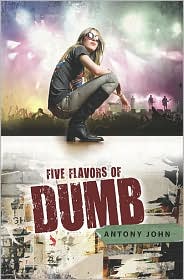
Five Flavors of Dumb (YA)

Five Flavors of Dumb. Antony John. 2010. [November 2010] Penguin. 352 pages.

For the record, I wasn't around the day they decided to become Dumb. If I'd been their manager back then I'd have pointed out that the name, while accurate, was not exactly smart. It just encouraged people to question the band's intelligence, maybe even their sanity. And the way I saw it, Dumb didn't have much of it. But they weren't in the mood to be reasoned with. They'd just won Seattle's annual Teen Battle of the Bands, and they were milking their fifteen minutes for all it was worth.

I loved this one. I just loved it. One of the reasons why I loved it so much was the narration. I loved our narrator, Piper. She's a (beautiful) girl who is accustomed to not being heard. Most people--if they notice her at all--notice her for the wrong reasons. Something that will be challenged through the course of the novel. Piper is practically daring people to take notice of her now. For this deaf girl is about to take on a big challenge: she's going to be a manager of a rock band. She's determined to make this band a real band--a band that earns money. But the band, for better or worse, seems to be clashing in all the wrong ways. (Original band members: Tash, Will, and Josh.) In impossible-to-ignore ways. It certainly doesn't help matters that two new band members have joined Dumb since it won the Teen Battle of the Bands (Ed, Kallie). Can Piper do the impossible? Can she be the brains of Dumb?

Another reason I loved Five Flavors of the Dumb was the richness of its characters, the depth of the relationships, particularly family relationships. Piper has complex relationships with her mother, her father, her younger brother, Finn, and her baby sister, Grace. Especially since Grace has just had her cochlear implant turned on. And the operation was paid for with Piper's college fund. So, you can imagine, some of the difficulties Piper is facing as the novel opens.

I also loved how surprising the novel was--for me. I found it warm and satisfying, in all the right places, as the relationships develop and the plot unfolds. But it's more than that. Yes, it's got heart and soul. But it's more than that. It's got humor. It's got drama.

Five Flavors of Dumb is a great coming-of-age story set in Seattle. I'm happy to recommend it!

Winner of the 2011 Schneider Family Teen Book Award.

© 2011 Becky Laney of Becky's Book Reviews


Restoring Harmony (YA)

Restoring Harmony. Joelle Anthony. 2010. May 2010. Penguin. 320 pages.

When the plane's engine took on a whining roar, my grip tightened on my fiddle case.

Molly McClure has led a good life, a sheltered life. Her family hasn't suffered terribly since the Collapse of 2031. They've lived well--or at least well enough--on a small farming island in Canada. Molly has heard stories about her American family--her grandparents--but she's about to meet them for the first time. Her parents are sending her away. Why? Well, her mom has heard--quite incompletely--that her mother has had a stroke. Is she dead or alive? We just don't know. Either way, Molly's grandfather might need her. And the truth is that they might just need him. He's a doctor and Molly's mom is pregnant. If all goes well, Molly should not be returning alone.

Restoring Harmony is about her journey, her experience, leaving the only life she's ever known. It's a story about growing up, being brave, and facing the unknown. What does Molly think of 'the real world'? What does she think of this 'new reality'? It's nice that readers see this collapsed world through her eyes--not as someone who has lived it for a decade--but as someone realizing for the first time, perhaps, how lucky she is. Most people are struggling just to provide the basic necessities--food, shelter, etc. Not everyone Molly meets is struggling, however. There is one mystery guy--just call him Spill--who seems to have all the right connections. And since he's fond of "Handsome Molly" her luck may just continue during her trip. But. She may never be the same...

I really enjoyed Restoring Harmony. I'm not sure that I LOVED it. (The last two sentences didn't quite work for me.) But I really enjoyed it. I liked Molly. But I loved Spill. It has its dark, dangerous moments that make it interesting.

© Becky Laney of Becky's Book Reviews


Twitter Delicious Facebook Digg Favorites More