Showing posts with label 1941. Show all posts

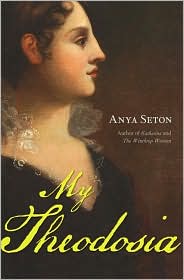
My Theodosia

My Theodosia. Anya Seton. 1941/2007. Chicago Review Press. 432 pages.

At six o'clock on the morning of Midsummer Day, 1800, Aaron Burr's estate, Richmond Hill, was already well into the day's bustle of preparation for the gala dinner to be given that evening in honor of Theodosia's birthday.

My Theodosia was Anya Seton's first novel. When possible I like to begin at the beginning with a new-to-me author. Saving the first book for the end, well, it can end in disappointment. Because if an author keeps improving, then each book will show it.

The heroine, Theodosia Burr, is the daughter of Aaron Burr. At his greatest, her father was Vice President of the United States of America. At his worst, he was a wanted man accused of murder and treason, etc. His greatest fan, by far, was always his daughter. I think he could have done anything, said anything, and she still would have been there standing by him, supporting him with every breath in her body.

I think it is important for readers to know exactly what to expect from My Theodosia. It is NOT historical romance. That is while the novel focuses on Theodosia and the men in her life--her first kiss which came from Washington Irving on her seventeenth birthday, her husband, Joseph Alston, her 'true love', Meriweather Lewis, the novel isn't love and romance and passion. And it most certainly is not about happily ever afters.

My Theodosia is historical fiction. Some who have read it might even call it "historical" FICTION. I'm not one to judge the historical accuracy--or historical inaccuracy--of a novel when I haven't read any nonfiction at all about the subject. I don't have a clue if Anya Seton's characters resemble the people they're supposed to faithfully represent. I do know that in the author's note she claims that the novel is "historically accurate in every detail." And she claims to have read all the Burr biographies, and the published letters of Aaron Burr, and some of the unpublished letters of Aaron Burr. And she claims to have had three sources for the romance between Meriwether Lewis. There are certainly plenty of reviews that say differently. That claim this novel is 100% fiction with no truth in it at all.

The historical time period covered is 1800 to 1812. And for those interested in this period in American history, the novel may prove interesting. I certainly found it fascinating. I read it in two days. And I wasn't bored at any point during the narrative. I can't say that I loved the characters exactly--they were too flawed for that. Aaron Burr being very charismatic and manipulative. But I can say that I found the story compelling and tragic. Maybe I found it fascinating because I didn't know that much. Yes, I knew about the duel. But I didn't know much else. And I certainly didn't know about Mexico. So it definitely held my attention.

© 2011 Becky Laney of Becky's Book Reviews


Black Orchids

Black Orchids. A Nero Wolfe Mystery. Rex Stout. 1941/1942. Random House. 208 pages.

First sentence of Black Orchids: "Monday at the Flower Show, Tuesday at the Flower Show, Wednesday at the Flower Show. Me, Archie Goodwin. How's that? I do not deny that flowers are pretty, but a million flowers are not a million times prettier than one flower. Oysters are good to eat, but who wants to eat a carload?"

First sentence of Cordially Invited to Meet Death: "That wasn't the first time I ever saw Bess Huddleston."

Black Orchids was my first introduction to Rex Stout's Nero Wolfe and Archie Goodwin. And oh how I loved them! The book was narrated by Archie Goodwin, and he had me practically at hello! (While I wouldn't say I loved him *more* than Miss Marple or Lord Peter Wimsey, I can definitely say that I love, love, love him as a narrator!)

So in this book, readers have two novellas. The first, Black Orchids, concerns a murder at a flower show. Archie has been made to go to this flower show day after day after day by his boss who is a little obsessed with orchids. And on the final day (or one of the final days of the show) they go together. And it just so happens that that is the day a dead body is found in one of the exhibits! Archie is the one who makes this discovery--that the "sleeping" man is REALLY not going to be waking up. The police are on the case, of course, as they usually are in detective stories. But Nero Wolfe with some help from Archie and a few others in his employ--may just solve the case first. This botany-themed mystery didn't wow me for its subject--but I did enjoy meeting Nero and Archie.

The second novella, Cordially Invited to Meet Death, is my favorite of the two. In this mystery, we meet Bess Huddleston, a snobbish party planner for the wealthy elite of society. She comes to Nero Wolfe looking for help. Someone is sending out nasty letters--in her name, on her stationary. This "poison-pen" must be stopped! But who is the one behind this unpleasantness? And do they want merely to embarrass her--or is her life at risk?! Archie, our narrator, begins to investigate the case by trying to get close to those who are closest to her, namely: two female assistants, a nephew, a brother, and a local doctor. Can Archie and Nero solve this one before it turns deadly?

Black Orchids is an enjoyable read! I found it very satisfying! I'm not sure how Black Orchids compares with others in the series--so I'm not going to say that this is my favorite or best, it's just too soon to say. But. I enjoyed it and would recommend it!


© 2011 Becky Laney of Becky's Book Reviews


Five Little Pigs

Five Little Pigs. (Hercule Poirot) Agatha Christie. 1941/2006. Black Dog & Leventhal. 256 pages.

Hercule Poirot looked with interest and appreciation at the young woman who was being ushered into the room. 

I've enjoyed a couple of other Hercule Poirot stories this past month--including The Mysterious Affair at Styles, Murder on the Orient Express, and ABC Murders--but, I must say that Five Little Pigs is my favorite so far. In this one, Hercule Poirot is investigating a sixteen-year-old murder--a case of poisoning. He's doing this at the request of a young woman, the child of the victim and convicted murderer. Before Caroline Crale's death, she wrote her daughter--then just a child--a letter saying that she was innocent of the crime. Now that the child is all grown up, now that she's twenty-one and has read that letter for herself, well, she needs to know one way or another before she can move on with her life, before she can get married and have kids of her own. Is her mother guilty of the crime of which she's been convicted? If she is innocent, was it suicide like the defense argued? Or was the crime committed by someone else?

Poirot's investigations will lead him to five people: Philip Blake (the best friend who proclaims his hatred for the wife a little too loudly), Meredith Blake (Philip's brother who had a fondness for growing poisonous plants in his lab at the time of the crime), Elsa Greer (the adulteress who announced the affair to the wife the day before), Angela Warren (the half-sister of Mrs. Caroline Crale, she was being 'raised' by her older sister), and Cecilia Williams (the governess hired to teach Angela). These were the people closest to the victim, Amyas Crale, on the last two days of his life. Could one of them be guilty of the crime?

I loved this one. I loved how this one was told. I loved the characters. I loved the narration. I loved how we learn about the crime, how the clues are revealed. Poirot is interviewing these people, but he's also urging them to write their own accounts of the crime.

My favorite lines:

"M. Poirot, you--you don't look exactly the way I pictured you."
"And I am old, am I not? Older than you imagined?"
"Yes, that too." She hesitated. "I'm being frank, you see. I want--I've got to have--the best."
"Rest assured," said Hercule Poirot, "I am the best!"
Carla said, "You're not modest....All the same, I'm inclined to take you at your word."
Poirot said placidly, "One does not, you know, employ merely the muscles. I do not need to bend and measure the footprints and pick up the cigarette ends and examine the bent blades of grass. It is enough for me to sit back in my chair and think. It is this"--he tapped his egg-shaped head--"this, that functions!" (6)

"It is inevitable," Hercule Poirot said. "Women will always see a private detective. Men will tell him to go to the devil."
"Some women might tell him to go to the devil too."
"After they have seen him--not before."
"Perhaps." (103)

© 2011 Becky Laney of Becky's Book Reviews


The Body in the Library

The Body in the Library. (Miss Marple) Agatha Christie. 1941/2006. Black Dog & Leventhal. 192 pages.


Mrs. Bantry was dreaming. 

The Bantrys are about to get a great shock when this novel opens. They're awakened by their maid, Mary, proclaiming that she's found a dead body in their library! The body is that of a young, beautiful woman--a blond. At first Colonel Bantry doesn't believe it could be true. But Mrs. Bantry handles the situation surprisingly well: with a quick phone call to Miss Marple. She is more than happy to 'help' the police detectives solve another case. Who is this dead woman? How did she come to be in their library? Who killed her and why?

I enjoyed this mystery very much. I am enjoying my time with Miss Marple. She's such a wonderful character! So many of the characters in these Agatha Christie novels are well done. I'm enjoying the descriptions and dialogue very much! There's just something so cozy, so charming about these stories.

"I like your friend," said Adelaide Jefferson to Mrs. Bantry. The two women were sitting on the terrace.
"Jane Marple's a very remarkable woman," said Mrs. Bantry.
"She's nice too," said Addie, smiling.
"People call her a scandalmonger," said Mrs. Bantry, "but she isn't really."
"Just a low opinion of human nature?"
"You could call it that." (124)
 "As I've told you, I've got a very suspicious mind. My nephew Raymond tells me, in fun, of course--that I have a mind like a sink. He says that most Victorians have. All I can say is that the Victorians knew a good deal about human nature." (184)

© 2011 Becky Laney of Becky's Book Reviews


Twitter Delicious Facebook Digg Favorites More