Showing posts with label romance. Show all posts

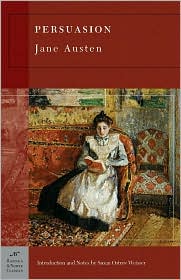
Persuasion

Persuasion. Jane Austen 1818/1992. Knopf Doubleday. 304 pages.

Sir Walter Elliot, of Kellynch-hall, in Sometsetshire, was a man who, for his own amusement, never took up any book but the Baronetage; there he found occupation for an idle hour, and consolation in a distressed one; there his faculties were roused into admiration and respect, by contemplating the limited remnant of the earliest patents; there any unwelcome sensations, arising from domestic affairs, changed naturally into pity and contempt, as he turned over the almost endless creations of the last century -- and there, if every other leaf were powerless, he could read his own history with an interest which never failed -- this was the page at which the favorite volume always opened: Elliot of Kellynch-Hall.

Oh how I love Persuasion. It's not every book I read that inspires this type of devotion, attention. A could-talk-for-hours-and-hours-and-never-tire-of-gushing love and devotion. In her younger days, Anne Elliot fell madly in love with (Captain) Frederick Wentworth. In chapter four, we read:
He was, at that time, a remarkably fine young man, with a great deal of intelligence, spirit and brilliancy; and Anne an extremely pretty girl, with gentleness, modesty, taste, and feeling. Half the sum of attraction, on either side, might have been enough, for he had nothing to do, and she had hardly any body to love; but the encounter of such lavish recommendations could not fail. They were gradually acquainted, and when acquainted, rapidly and deeply in love. It would be difficult to say which had seen highest perfection in the other, or which had been the happiest; she, in receiving his declarations and proposals, or he in having them accepted. (25)
But this happiness does not last. For a "wise" friend standing in the place of a mother, the only kind and caring person in young Anne's life, counsels her against the match. For Wentworth is penniless, at the moment, he has no way to support her. And, Anne is young. Maybe Wentworth is the love of her life, but what if he isn't? Wouldn't it be wiser to wait, to not marry so young? Two hearts are then broken by her decision to part.

The novel opens eight years later. Fate will bring Anne Elliot and Captain Wentworth into each other's lives again. What will happen when these two meet again? She's never stopped loving him. But how does he feel now? Does he love her still? Or did he forget her? Has he forgiven her? Is he angry? bitter?

Anne is taken advantage of by her family. Her father and older sister pay her no mind. They talk at her, mind you. Try to direct her so they can tell her how not to embarrass them.  But they've never listened to anything she's ever said. We read in chapter one:
Anne, with an elegance of mind and sweetness of character, which must have placed her high with any people of real understanding, was nobody with either father or sister: her word had no weight, her convenience was always to give way; she was only Anne. (5)
She's too intelligent, too wise, too observant, too kind, has too much common sense to do them any good. What her father loves best is his own reflection. And her older sister isn't that much better. No, it is their pride, vanity, selfishness, shortsightedness that has endangered their estate. They are moving to Bath to maintain appearances, but their estate will be rented to a naval officer. (But some people can't be humbled.)

Anne does have a second sister, Mary, who's married to Charles, a man who would have much preferred marrying her. (Mary is his second choice, at best, and though he may not act like it in their encounters, there are those in his family who can't forget that Anne is the better woman.) So is Mary better than Elizabeth?  She does have use for Anne. She does enjoy Anne's company. She just loves confiding in Anne. Everyone loves confiding in Anne. (Or should I say complaining to Anne?) Still, her time with the Musgroves isn't horrid. And if she wasn't there, who would love those nephews? They certainly receive no love or care from their mother!
To be claimed as a good, though in an improper style, is at least better than being rejected as no good at all; and Anne, glad to be thought of some use, glad to have any thing marked out as a duty, and certainly not sorry to have the scene of it in the country, and her own dear country, readily agreed to stay. (32)
While her father and sister have gone ahead to Bath, she remains behind. And it is while she's visiting the Musgroves--her sister Mary--that she sees Captain Wentworth again. He appears to have gotten over her. He appears to be falling in love with one of the Musgrove sisters. But. appearances can be deceiving. Will Anne get a second chance?

I love this one. I do. I love Anne. I love Captain Wentworth. I love so many of the secondary characters--maybe love isn't quite the right word. Since most are very flawed, each with his or her own quirks. But still. I enjoy spending time with this novel. I like visiting these characters again and again and again. And that letter!!!! I just LOVE, LOVE, LOVE Captain Wentworth's letter to Anne in which he declares how much he still loves her, wants her, needs her!
I can listen no longer in silence. I must speak to you by such means as are within my reach. You pierce my soul. I am half agony, half hope. Tell me not that I am too late, that such precious feelings are gone forever. I offer myself to you again with a heart even more your own than when you almost broke it eight years and a half ago. Dare not say that a man forgets sooner than woman, that his love has an earlier death. I have loved none but you. Unjust I may have been, weak and resentful I have been, but never inconstant. You alone have brought me to Bath. For you alone I think and plan. (234)
This romance is so wonderful, so giddy-making. I can't recommend it enough!!!

© 2011 Becky Laney of Becky's Book Reviews


Lovers' Vows

Lovers' Vows. Elizabeth Inchbald.1798/2007. Dodo Press. 84 pages*. [You can read the play online here.]
Landlord: No, no! no room for you any longer--It is the fair today in the next village; as great a fair as any in the German dominions. The country people with their wives and children take up every corner we have.
Agatha: You will turn a poor sick woman out of doors who has spent her last farthing in your house.
Landlord: For that very reason; because she has spent her last farthing.
Agatha: I can work.
Landlord: You can hardly move your hands.
Agatha: My strength will come again.
Landlord: Then you may come again.
Agatha: What am I to do? Where shall I go?
Landlord: It is fine weather--you may go any where.  
Lovers' Vows was the play being "acted" within the Bertram home in Jane Austen's novel, Mansfield Park. Fanny Price and Edmund Bertram disapprove of their selection, thinking Ms. Inchbald's play *most* improper. (Though they would most likely disapprove of any play being performed (or rehearsed) without the support and permission of Mr. Bertram.) Since the play was included in the Norton Critical edition of Mansfield Park, I thought I would read it myself and see what all the fuss was about!

Agatha is a fallen woman. As a teen girl, she worked for a time for a wealthy family. The son in the family--the man who would become Baron Wildenhaim--seduced her with pretty words and promises of marriage. She conceived a child and left in disgrace. She was able to support herself and her young son. But it was a constant struggle to survive. Since her son has grown up and joined the army, well, the struggle has become more severe. When the play opens, she is in great danger.

Frederick, Agatha's son, happens upon her. Never expecting to find his mother cast off in the street, sick, alone, starving. What little money he has, he will spend providing for his mother's most immediate needs. He is able to learn the truth about his past; he is able to learn his father's name. But the mother is under the impression that the man who abandoned her is far, far away with a wife and child. That isn't quite the case.

Baron Wildenhaim has recently returned with his grown daughter, Amelia. (His wife has died.) Count Cassel is the man who is determined to win Amelia's hand in marriage. But, Baron is not impressed with the man's character. There is something about him that makes him not like the Count. So he keeps asking Amelia how she feels about the Count. Does she like him? Does she respect him? Could she see herself marrying him? Baron would LOVE for the Count to have the kind of integrity and intelligence of Mr. Anhalt.

Anhalt is a close friend of the family; he has tutored Amelia in many subjects. Now she is asking him to tutor her in the art of love. For she is madly in love with him, and sees him as the only man she could happily marry. He's not of her social class, so he's hesitant at first. But he loves her too. And if Amelia can persuade her father to allow the marriage, he'll happily marry her.

So what happens when Frederick meets Baron Wildenhaim? Neither knows the identity of the other. And I'm afraid Frederick doesn't make the best impression on the Baron. No! Frederick is begging him for money--money to support his mother--and when the Baron isn't able to give him enough, well, Frederick threatens to kill him. He's then imprisoned by the Baron, what will be his fate?!

Will the Baron discover Agatha's present condition? How does he feel about her after all these years? Has he felt the guilt as she has? Will Frederick reveal himself to his father? Will his father welcome him home and forgive him? How will Amelia adapt to having a brother? Will Anhalt and Amelia be allowed to wed?

I enjoyed many things about this play. But I think probably my favorite character was Verdun the Butler. He was so funny! He loved to talk in poetry, in verse, and when the Baron (and the others) begged him to talk in prose, he had such difficulty that he always slipped up and went back to verse! Anyway, maybe you'd have to read it in context to think that was funny. But it worked well for me! 

The love scene between Amelia and Anhalt:
Amelia [Alone]: Why am I so uneasy; so peevish; who has offended me? I did not mean to come into this room. In the garden I intended to go. [going, turns back] No, I will not—yes, I will—just go, and look if my auriculas are still in blossom; and if the apple tree is grown which Mr. Anhalt planted.—I feel very low-spirited—something must be the matter.—Why do I cry?—Am I not well? [Enter Mr. Anhalt.] Ah! good morning, my dear Sir—Mr. Anhalt, I meant to say—I beg pardon.
Anhalt: Never mind, Miss Wildenhaim—I don't dislike to hear you call me as you did.
Amelia: In earnest?
Anhalt: Really. You have been crying. May I know the reason? The loss of your mother, still?—
Amelia: No—I have left off crying for her.
Anhalt: I beg pardon if I have come at an improper hour; but I wait upon you by the commands of your father.
Amelia: You are welcome at all hours. My father has more than once told me that he who forms my mind I should always consider as my greatest benefactor. [looking down] And my heart tells me the same.
Anhalt: I think myself amply rewarded by the good opinion you have of me.
Amelia: When I remember what trouble I have sometimes given you, I cannot be too grateful.
Anhalt [to himself]: Oh! Heaven!—[to Amelia] I.—I come from your father with a commission.—If you please, we will sit down. [He places chairs, and they sit] Count Cassel is arrived.
Amelia: Yes, I know.
Anhalt: And do you know for what reason?
Amelia: He wishes to marry me.
Anhalt: Does he? [hastily] But believe me, the Baron will not persuade you—No, I am sure he will not.
Amelia: I know that.
Anhalt: He wishes that I should ascertain whether you have an inclination—
Amelia: For the Count, or for matrimony do you mean?
Anhalt: For matrimony.
Amelia: All things that I don't know, and don't understand, are quite indifferent to me.
Anhalt: For that very reason I am sent to you to explain the good and the bad of which matrimony is composed.
Amelia: Then I beg first to be acquainted with the good.
Anhalt: When two sympathetic hearts meet in the marriage state, matrimony may be called a happy life. When such a wedded pair find thorns in their path, each will be eager, for the sake of the other, to tear them from the root. Where they have to mount hills, or wind a labyrinth, the most experienced will lead the way, and be a guide to his companion. Patience and love will accompany them in their journey, while melancholy and discord they leave far behind.—Hand in hand they pass on from morning till evening, through their summer's day, till the night of age draws on, and the sleep of death overtakes the one. The other, weeping and mourning, yet looks forward to the bright region where he shall meet his still surviving partner, among trees and flowers which themselves have planted, in fields of eternal verdure.
Amelia:Tell my father—I'll marry. [Rises.]
Anhalt [Rising.]: This picture is pleasing; but I must beg you not to forget that there is another on the same subject.—When convenience, and fair appearance joined to folly and ill-humour, forge the fetters of matrimony, they gall with their weight the married pair. Discontented with each other—at variance in opinions—their mutual aversion increases with the years they live together. They contend most, where they should most unite; torment, where they should most soothe. In this rugged way, choked with the weeds of suspicion, jealousy, anger, and hatred, they take their daily journey, till one of these also sleep in death. The other then lifts up his dejected head, and calls out in acclamations of joy—Oh, liberty! dear liberty!
Amelia: I will not marry.
Anhalt: You mean to say, you will not fall in love.
Amelia: Oh no! [Ashamed] I am in love.
Anhalt: Are in love! [starting] And with the Count?
Amelia: I wish I was.
Anhalt: Why so?
Amelia: Because he would, perhaps, love me again.
Anhalt [warmly]: Who is there that would not?
Amelia: Would you?
Anhalt: I—I—me—I—I am out of the question.
Amelia: No; you are the very person to whom I have put the question.
Anhalt: What do you mean?
Amelia: I am glad you don't understand me. I was afraid I had spoken too plain. [in confusion]
Anhalt: Understand you!—As to that—I am not dull.
Amelia: I know you are not—And as you have for a long time instructed me, why should not I now begin to teach you?
Anhalt:Teach me what?
Amelia: Whatever I know, and you don't.
Anhalt: There are some things I had rather never know.
Amelia: So you may remember I said when you began to teach me mathematics. I said I had rather not know it—But now I have learnt it gives me great deal of pleasure—and [hesitating] perhaps who can tell, but that I might teach something as pleasant to you, as resolving a problem is to me.
Anhalt: Woman herself is a problem.
Amelia: And I'll teach you to make her out.
Anhalt: You teach?
Amelia: Why not? none but a woman can teach the science of herself: and though I own I am very young, a young woman may be as agreeable for a tutoress as an old one.—I am sure I always learnt faster from you than from the old clergyman who taught me before you came.
Anhalt: This is nothing to the subject.
Amelia: What is the subject?
Anhalt: Love.
Amelia [going up to him] Come, then, teach it me—teach it me as you taught me geography, languages, and other important things.
Anhalt [turning from her]: Pshaw!
Amelia: Ah! you won't—you know you have already taught me that, and you won't begin again.
Anhalt: You miscontrue—you misconceive every thing I say or do. The subject I came to you upon was marriage.
Amelia: A very proper subject from the man who has taught me love, and I accept the proposal. [curtsying]
Anhalt: Again you misconceive and confound me.
Amelia: Ay, I see how it is—You have no inclination to experience with me "the good part of matrimony:" I am not the female with whom you would to go "hand in hand up hills, and through labyrinths"—with whom you would like to "root up thorns; and with whom you would delight to plant lilies and roses." No, you had rather call, "Oh liberty, dear liberty."
Anhalt: Why do you force from me, what it is villainous to own?—I love you more than life—Oh, Amelia! had we lived in those golden times, which the poets picture, no one but you—But as the world is changed, your birth and fortune make our union impossible—To preserve the character, and more the feelings of an honest man, I would not marry you without the consent of your father—And could I, dare I propose it to him.
Amelia: He has commanded me never to conceal or disguise the truth. I will propose it to him. The subject of the Count will force me to speak plainly, and this will be the most proper time, while he can compare the merit of you both.
Anhalt: I conjure you not to think of exposing yourself and me to his resentment.
Amelia: It is my father's will that I should marry—It is my father's wish to see me happy—If then you love me as you say, I will marry; and will be happy—but only with you.—I will tell him this.—At first he will start; then grow angry; then be in a passion—In his passion he will call me "undutiful"—but he will soon recollect himself, and resume his usual smiles, saying "Well, well, if he love you, and you love him, in the name of heaven, let it be."—Then I shall hug him round the neck, kiss his hands, run away from him, and fly to you; it will soon be known that I am your bride, the whole village will come to wish me joy, and heaven's blessing will follow.

*I read Lovers' Vows in the Norton Critical Edition of Jane Austen's Mansfield Park. Edited by Claudia L. Johnson. Published in 1998. As I didn't know *how* to cite that properly, I searched for an edition of the play on its own.

© 2011 Becky Laney of Becky's Book Reviews


A Heart Most Worthy

A Heart Most Worthy. Siri Mitchell. 2011. Bethany House. 384 pages.

On May 2, 1918, a short article appeared in the Boston Globe. It was only three sentences long; not an article really. Just a mention. It appeared on page twenty-four on the outside column, where most people hold onto a newspaper. I'm sure you wouldn't be very surprised to know that few people noticed it as they read the paper that morning and several people smeared jam on it as they turned the page. Only a very few read it. 

A Heart Most Worthy is the story of four women whose lives touch in Madame Fortier's dress shop. There is Madame Fortier herself, a woman with more than a few secrets. Then there are her three Italian assistants: each one quite different from the others.

Julietta Giordano, a young woman attracted to bad boys, a woman who should know better, but is content to live life in the moment--and oh the fun moments that can be stolen when she's away from her parents' watchful eyes. Her bad boy of the moment is Angelo Moretti, but he may be more than she can handle. 

Annamaria Rossi, a dutiful oldest daughter, a woman as obedient as can be on the outside, but on the inside she's longing to rebel. For what Annamaria wants more than anything is a life of her own, a family of her own. She's been told, been taught, that she cannot marry until her parents have died. For as the oldest, it is her job, her duty, her privilege, to care for her parents as long as they live. Why does she have to be the only responsible one in the family? So when she falls in love--with the boy from the wrong side of the street--she'll have a difficult choice to make!

Luciana Conti offers the most drama perhaps. For her father was murdered, and she knows his murderer, and he too has settled in Boston! Her life could be at danger if he discovers that she is there. She finds refuge in her work--for it is the first time she's had to work--what she didn't expect was to fall in love with one of the client's sons!

I loved this one. I just absolutely LOVED it. I loved each of our heroines. I enjoyed the three young narrators very much. While there were some dramatic moments, there were plenty of lighter moments as well. Moments that were sweet and satisfying and oh-so-right. (Personally, I loved Annamaria's romance the best. I loved how she fell for the boy on the wrong side of the street, a Sicilian shopkeeper's son, Rafaello Zanfini. I loved watching this romance blossom. It was just wonderful!!!) I also enjoyed learning more about Madame Fortier--a woman with a sad past doing the best she can.

I thought the book worked really well. I found it fascinating and satisfying. I would definitely recommend this one!!!

© 2011 Becky Laney of Becky's Book Reviews


Small House At Allington

The Small House at Allington. Anthony Trollope. 1864. 752 pages.

Of course there was a Great House at Allington. How otherwise should there have been a Small House? Our story will, as its name imports, have its closest relations with those who lived in the less dignified domicile of the two; but it will have close relations also with the more dignified, and it may be well that I should, in the first instance, say a few words as to the Great House and its owner. 

The Small House at Allington is the fifth in the Chronicles of Barsetshire series by Anthony Trollope, my favorite bearded Victorian. It follows The Warden, Barchester Towers, Doctor Thorne, and Framley Parsonage. Did I love it? Yes! I just LOVED it. After my less than enthusiastic reading of Framley Parsonage, I was needing this one to be incredible, and it was! From start to finish, it was love--true love.

The Dales are the stars of this one. We're primarily focused on the two Dale sisters, Lily and Bell, and the men who for better or worse fall in love with them, John Eames, Adolphus Crosbie, Bernard Dale (cousin), and Dr. Crofts. Bernard brings his new acquaintance, Adolphus Crosbie, home one autumn, which changes their lives forever. Soon he's declared himself truly, madly, deeply in love with the young practically penniless girl, Lily. She's his soul mate and nothing will keep them apart. But is he worthy of her love? her respect? Or is he good for nothing? John Eames is also in love with Lily. Though he's never professed it privately or publicly. His love for her is sure and steady. If only she would see him as more than a friend...

As for Bell, there are two men who would have her for a wife. Bernard, her cousin, who has only recently discovered that his feelings are so in line with his uncle's wishes. If she says yes, they'll inherit nicely. But despite the promise of monetary gain, I do believe that Bernard is sincere in his devotion to Bell. Her other would-be suitor is Dr. Crofts, Trollope spends less time (at least as far as I can remember) with him, but Bell, unlike readers, is able to know him much better...

I loved this one. I loved the characters, the storytelling, the writing. It was charming. It was satisfying. It was entertaining. It was just a great, great read! There were characters that I just loved and adored. And there were characters that I loved to hate!
If the question was ever asked plainly, Bernard Dale had asked it plainly. Shall we be man and wife? Few men, I fancy, dare to put it all at once in so abrupt a way, and yet I do not know that the English language affords any better terms for the question. (75)

'Don't you like the moon?' she said, as she took his arm, to which she was now so accustomed that she hardly thought of it as she took it.
'Like the moon--well; I fancy I like the sun better. I don't quite believe in moonlight. I think it does best to talk about when one wants to be sentimental.'
'Ah; that is just what I fear. That is what I say to Bell when I tell her that her romance will fade as the roses do. And then I shall have to learn that prose is more serviceable than poetry, and that the mind is better than love. It's all coming, I know; and yet I do like the moonlight.'
'And the poetry--and the love?'
'Yes. The poetry much, and the love more. To be loved by you is sweeter even than any of my dreams--is better than all the poetry I have read.'
'Dearest Lily,' and his unchecked arm stole round her waist.
'It is the meaning of the moonlight, and the essence of the poetry,' continued the impassioned girl. 'I did not know then why I liked such things, but now I know. It was because I longed to be loved.'
'And to love.'
'Oh, yes. I would be nothing without that. But that, you know, is your delight--or should be. The other is mine. And yet it is a delight to love you; to know that I may love you.'
'You mean that this is the realization of your romance.'
'Yes; but it must not be the end of it, Adolphus. You must like the soft twilight, and the long evenings when we shall be alone; and you must read to me the books I love, and you must not teach me to think that the world is hard, and dry, and cruel--not yet. I tell Bell so very often; but you must not say so to me.'
'It shall not be dry and cruel, if I can prevent it.'
'You understand what I mean, dearest. I will not think it dry and cruel, even though sorrow should come upon us, if you--I think you know what I mean.'
'If I am good to you.'
'I am not afraid of that--I am not the least afraid of that. You do not think that I could ever distrust you? But you must not be ashamed to look at the moonlight, and to read poetry, and to--'
'To talk nonsense, you mean.'
But as he said it, he pressed her closer to his side, and his tone was pleasant to her.
'I suppose I'm talking nonsense now?' she said pouting. 'You liked me better when I was talking about the pigs, didn't you?'
'No; I like you best now.' (87-8)


'We all try, my dear, but many of us fail to try with sufficient energy of purpose. It is only by doing our duty that we can hope to be happy, whether in single life or in married.' (119)

We constantly talk of the thoughtlessness of youth. I do not know whether we might not more appropriately speak of its thoughtfulness. It is, however, no doubt, true that thought will not at once produce wisdom. It may almost be a question whether such wisdom as many of us have in our mature years has not come from the dying out of the power of temptation, rather than as the results of thought and resolution. (133)

Love does not follow worth, and is not given to excellence;--nor is it destroyed by ill-usage, nor killed by blows and mutilation. (306)

A sermon is not to tell you what you are, but what you ought to be, and a novel should tell you not what you are to get, but what you'd like to get. (422)

'I hate books I can't understand,' said Bell. 'I like a book to be clear as running water, so that the whole meaning may be seen at once.'
'The quick seeing of the meaning must depend a little on the reader, must it not?' said Mrs. Dale.
'The reader mustn't be a fool, of course,' said Bell.
'But then so many readers are fools,' said Lily. 'And yet they get something out of their reading.' (445)


© 2011 Becky Laney of Becky's Book Reviews


Hearts Aglow

Hearts Aglow. (Striking a Match #2) Tracie Peterson. 2011. Bethany House. 368 pages.

"Deborah, wake up! Deborah hurry!"

Deborah, our heroine, has dreams of becoming a doctor. A dream encouraged and supported by Dr. Christopher Clayton, her love interest. But Deborah knows that this journey won't be an easy one, for there are many who believe that women should not be doctors. And that's not all her town is small-minded about. No, Deborah is shocked and angered by her town's lack of concern over racial violence. There are a group of men (in white sheets presumably) terrorizing local blacks--including the blacks that work for the family, that work in the family's lumber business. Sissy is part of the family--there's never been a time she wasn't considered such. So when her husband and son are murdered--lynched--and when she herself is beaten close to death,  the Vandermark family is rightly angered. But is there a way to bring the case to justice? It doesn't seem likely. Not that Deborah is willing to accept that as an answer. And that's just one of many injustices presented in the newest title in the series. There is plenty of conflict, plenty of drama.

Hearts Aglow is the sequel to Embers of Love. This historical romance is set in Texas in the 1880s.

I would say the jacket description/jacket summary is quite misleading! It's not that I didn't recognize it as the book I read--but it took a bit of stretching to get it there!

Did I love it? No. Do I have to love every book I read? No! I enjoyed it enough to keep reading. It may not be--for me--an oh-so-magical read, but for the right reader, this one may prove quite satisfying.

© 2011 Becky Laney of Becky's Book Reviews


Operation Bonnet

Operation Bonnet. Kimberly Stuart. 2011. David C. Cook. 272 pages.

I didn't set out to be the town luminary. True, there wasn't exactly a lot of competition in Casper. 

Set in Casper, Ohio, Nellie Monroe, an amateur private-detective, stars in Kimberly Stuart's Operation Bonnet. Her first client, Amos Shetler, is still getting adjusted to his new life. He left the Amish community because he felt he just didn't belong, but the truth is, he hasn't found exactly how to belong in the "English" community either. (Watching Gidget marathons probably isn't helping!) He is still in love with an Amish girl, Katie, but he fears that he'll never see her again. And even if she still loves him, how would their relationship ever be able to work? He's heard that Katie is being courted by John Yoder. And he's very jealous. He wants Nellie to learn if Katie is indeed going to marry this other guy. Nellie thrilled to have her very first case isn't quite sure how to go about it. But. Surely the first step is to try to find a way into the Amish community? But Nellie doesn't exactly "blend" well no matter her location. So expect a very messy comedy of misunderstandings...

The novel also spends a little time on Nellie's personal life. Primarily her loving relationship with her grandmother and her relationship with her best friend, Matt. As soon as Matt's name is mentioned, readers almost know with certainty, that he must surely be in love with her--that he has been in love with her for many, many years. And that Nellie is indeed truly clueless about love. But while there are certainly predictable elements within Operation Bonnet, this novel is so quirky that it almost works.

Operation Bonnet reminded me of Jane Austen's Emma. There is just something so clueless about Nellie. While many readers may enjoy Nellie's adventures (and misadventures), I found them slightly irritating. It wasn't so much that I disliked the book--its story, or its characters--I just felt a slight disconnect.

© 2011 Becky Laney of Becky's Book Reviews


Mrs. Mike

Mrs. Mike: "The Heartwarming Classic Story of the Boston Girl Who Married A Rugged Canadian Mountie." by Benedict & Nancy Freedman. 1947. 284 pages.

The worst winter in fifty years, the old Scotsman had told me. I'd only been around for sixteen, but it was the worst I'd seen, and I was willing to take his word for the other thirty-four.

I enjoyed Mrs. Mike. It's a rugged historical romance novel set in the early twentieth century. It stars Katherine Mary O'Fallon and Seargeant Mike Flannigan of the Canadian Mounted Police. When Katherine Mary goes to visit her uncle in Canada, she didn't expect to fall in love with anyone. But when she meets this Mountie, well, it's love. Her love for him will be demanding, will require much sacrifice on her part. For this city girl will be forced into the wilderness, away from everything she's ever known and loved. She'll endure the harshest circumstances, the cruelest hardships. But because of love--her deep love--for her husband, life is good. But their love will face challenges. Realistic challenges, I believe, but heartbreaking ones.

As I said, I enjoyed this one. I enjoyed the historical aspects of this one. I also liked the romance of it. It was a good, clean read. A book that almost anyone of any age could enjoy--if historical romance is their genre of choice. (I know not everyone *loves* historical romance as much as I do!)

My favorite quote:
But death does not stand at the end of life, it is all through it. It is the fear of losing, the knowledge of losing that makes love tender. (276)

© 2011 Becky Laney of Becky's Book Reviews


Serendipity

Serendipity. Cathy Marie Hake. 2011. Bethany House. 352 pages.

"Hoo-oo-ie, she's het up!"
Margaret Rose shook a spatula at the men in her kitchen.
"If you plan to eat supper, you'll not be egging him on."
All three bearded jaws dropped.
"I mean it." Never once had she made that threat. In her five years of cooking and caring for a baker's dozen ragtag of old men, Maggie managed to tolerate plenty. Love made it easy to dote on them and overlook blunders. Most often, her "uncles" showered her with affection, appreciation, and endless amusement. Today, however, was different. 
Why is Margaret Rose so bothered? Well, the subject of marriage has come up. One of her "uncles" wants her to know that when her "groom" shows up, it's okay for her to leave them behind. To make a new life for herself, to have a home of her own. Fact is, she's the only girl, the only woman, in her (small) community of Carver's Holler. And it's her "job" to take care of everyone. She doesn't believe that any potential "groom" will appear at her door, that they'll come a handsome stranger ready to propose marriage. But chapter two holds a few surprises.

A man, Todd Valmer, is on his way back home to his ranch in Gooding, Texas, with his mother when she gets sick. Margaret Rose is his mother's best chance--as unlikely as that seems--she is able to see that the woman has had a stroke. And she agrees to nurse her until the next train goes through. During that week, Todd sees just how amazing Margaret Rose is. And she has a chance to see just how swoon-worthy he is. But can he convince her that he's worth marrying in such a short amount of time? Will the potential of love, of happily ever after, be enough to convince Margaret Rose to leave her home, her family, her friends, to take a chance on a struggling rancher?

I liked this one. I liked this couple. I liked the struggles these two have with one another after their married. Among other things sharing a one-room house with the mother--the partially paralyzed, understandably bitter mother. She may be thankful (in her own way) for the temporary nursing of a stranger. But. She does not think that Margaret Rose is good enough for her son. She is angry, bitter, and scared. And if Margaret Rose can keep her temper when she's provoked time and time again, it might just be a miracle. But while caring for his mother--in such a small home--may be one big issue, it's not the only issue. The truth is Todd doesn't know Margaret that well. And she doesn't know him. And this getting-to-know-you business can be a little tricky. There are so many opportunities to be misunderstood. I liked the commitment these two made to one another. I liked how this romance focused on the marriage itself.

The novel is set in Arkansas and Texas in 1893. It's narrated by Todd, Margaret, and Helga (the mother).

© 2011 Becky Laney of Becky's Book Reviews


The Lost Memoirs of Jane Austen


The Lost Memoirs of Jane Austen by Syrie James. 2007. HarperCollins. 352 pages.

Why I feel the sudden urge to relate, in pen and ink, a relationship of the most personal nature, which I have never before acknowledged, I cannot say. Perhaps it is this maddening illness which has been troubling me now and again of late--this cunning reminder of my own mortality--that compels me to make some record of what happened, to prevent that memory from vanishing into the recesses of my mind, and from there to disappear for ever from history, as fleeting as a ghost in the mist.

Last year, I LOVED Syrie James' The Secret Diaries of Charlotte Bronte. I didn't love, love, love The Lost Memoirs of Jane Austen. I'm not even sure I liked it. But. I found it an entertaining read. The book is a fictionalized autobiography, the supposed "last writing project" of a dying Jane. In her "memoir" she reveals her true love. How her brief relationship with him changed her--for the better. (For the record, this relationship is NOT physical or intimate.)

This love is Mr. Ashford. And he seems to be Jane's perfect match in many, many ways. He's able to hold his own in conversation with her. He is intelligent and handsome and seems to genuinely care for Jane. But Jane's true love, well, he's got a few secrets. And his behavior, well, that "inspires" the messy romances of Sense & Sensibility. For Jane's Mr. Ashford is one part Edward, one part Willoughby.

And Mr. Ashford isn't the only person "inspiring" Austen's fiction. (For example, Mr. Collins is inspired by Mr. Morton.) These "inspirational" scenes can be a bit risky. How many are really needed? How much is too much? I'm not one of those that think every single character in every single book needs to have been "inspired" by a real person. (One of the reasons I hated--yes, HATED, Searching for Pemberley by Mary Lydon Simonsen.)

This memoir blends truth with fiction. We do know some things about Austen's life, for example, especially about her family life. And James does a nice job in adding a bit of romance to that life. And for most of the novel--the second half at least--readers get the chance to see Austen hard at work writing and revising.

I liked to see Austen writing. I liked to see her close friendship with her sister. But. I didn't love the romance. Not really. Because even though Mr. Ashford isn't Tom Lefroy, it still felt similar enough to Becoming Jane for me to not quite like it. Not to the same degree, perhaps, which is good. And I did like this book better than Miss Austen Regrets.

Would reading The Lost Memoirs of Jane Austen make readers want to read more Austen? I'm not sure. The only Austen I've not read (or reviewed) is Mansfield Park. I've read Sense and Sensibility, Northanger Abbey, Persuasion, Emma, Lady Susan, Pride and Prejudice. Have you read this one? What did you think? 

© Becky Laney of Becky's Book Reviews


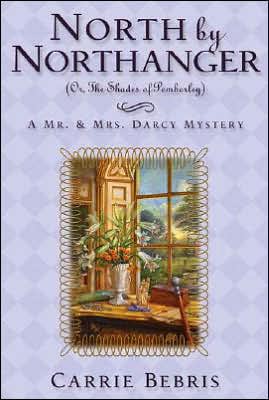
North by Northanger

North by Northanger: Or, The Shades of Pemberley. A Mr. & Mrs. Darcy Mystery. Carrie Bebris. 2006. Tor. 320 pages.

Less than a year into the marriage that made her mistress of one of England's finest houses, Elizabeth Darcy knew she still had much to learn about the place she now called home. Of one thing, however, she was certain. A ghost haunted Pemberley.
She was not a ghost in the traditional sense. She did not moan, or shriek, or rattle chains. She did cause rooms to grow cold, objects to fall, or fires to sputter. She did not manifest at midnight to pace on creaking floorboards, visiting in death the rooms she had occupied in life.
Yet the continued presence of Lady Anne Fitzwilliam Darcy was as real and pervasive as that of any spectre.

I definitely enjoyed Pride and Prescience, the first in Carrie Bebris' series of mysteries starring Elizabeth and Darcy. Sadly, my library does not have the second volume in this series, Suspense and Sensibility: Or, First Impressions Revisited, so I was unable to read it. (Though based on B&N's description, it unites characters from Sense & Sensibility with Pride and Prejudice. Specifically a Bennet sister with a Dashwood cousin.) But. I was delighted to pick the third one up!

Elizabeth is pregnant with their first child. And while she's not as nervous as her husband, she's not completely anxiety free. Distractions exist to keep her mind off of upcoming labor, however. She discovers a letter from Darcy's mother. It's addressed to her, to Mrs. Fitzwilliam Darcy. It was written the day of Lady Anne's death--the day Darcy's sister was born. She speaks of a charm, a statue, that she has hidden but could not find in her time of need. Something that she hoped would protect her and her unborn child. Elizabeth shares this with her husband, of course, and one mystery begins.

It is a mystery that will--for better or worse--lead them to Northanger Abbey and the questionable Tilney family.

This one is a mystery. It is intense in places--as Darcy is charged with a crime he did not commit. But it is also a charming read with plenty of wit and humor. In part, because Lady Catherine is (by necessity) on an extended visit to Pemberley (until Darcy's trial can be held). Can Elizabeth tolerate Lady Catherine during these difficult months? Can she tolerate her "advice"? Can she work with her husband to prove his innocence?

I enjoyed spending time with these characters. I'm still loving Bebris' interpretation of Darcy and Elizabeth. Still finding her characters, and her stories satisfying.

© Becky Laney of Becky's Book Reviews


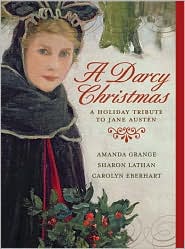
A Darcy Christmas

A Darcy Christmas: A Holiday Tribute to Jane Austen. By Amanda Grange, Carolyn Eberhart, and Sharon Lathan. Sourcebooks. 304 pages.

From Mr. Darcy's Christmas Carol by Carolyn Eberhart: Old Mr. Darcy was dead to begin with. There is no doubt whatsoever about that. The clergyman, the clerk, the undertaker, and the chief mourner had all signed the register of his burial. His son signed it. And Fitzwilliam Darcy's name was as good as his father's before him. Old Mr. Darcy was as dead as a doornail.

From Christmas Present by Amanda Grange: It is a truth universally acknowledged, that a married man in possession of a good fortune, must be in want of an heir, and Mr. Darcy of Pemberley was just such a man. Moreover, he was soon to have that want satisfied, for his wife, Elizabeth, was expecting their first child.

From A Darcy Christmas by Sharon Lathan: He set the painting onto the sofa, assuring it was well supported before stepping away. He gazed at the canvas, a smile spreading as he looked upon his family. His family. The family created by him and his wife, just as he had dreamt for so many lonely years. They stood on the portico of Pemberley flanked by their precious children on the steps. All of them were smiling at the artist. A sentimental man by nature, he silently examined the newest portrait of his family and lost himself in happy memories.

For the most part, I liked this one. I did. I really enjoyed two of these novellas! And while I wasn't impressed with "A Darcy Christmas" I would still recommend this collection.

"Mr. Darcy's Christmas Carol" was surprisingly fun. I had my doubts--as you might have your doubts about weaving these two stories together--but I thought it worked. It does a slight variation on the original. What if Jane and Charles Bingley got their happily ever after--after Lydia was "rescued" by Mr. Darcy's intervention--but Mr. Darcy's pride was still in the way of his declaring his love (the second time). This is what that first Christmas might have been like. If he'd been visited by the spirits of Christmas past, present, future.

"Christmas Present" was a great novella by Amanda Grange. I've enjoyed many of her Austen adaptations in the past. This one did not disappoint. She got the characters just right. It felt authentic like what a Darcy Christmas might have *really* been like. Elizabeth and Darcy are expecting their first child, and Charles and Jane just had their first child. So the families are coming together--the extended families--to celebrate. I really enjoyed this one!

"A Darcy Christmas" is a collection of holiday short stories following the Darcy family through twenty or so years of marriage. (I believe we see their twenty-third Christmas as a couple? Although I might have lost track of the last few stories.) Since we only catch glimpses of the family--on Christmas Eve/Christmas--it's hard to precisely follow these stories. We do know that (almost) every Christmas sees Elizabeth either with a new baby or pregnant. (Perhaps these stories do connect to Lathan's previous novels about Elizabeth and Darcy. If that is the case, then the stories might make more sense when it comes to keeping up with their family, friends, etc. Especially in the case of her children's love interests.)

© Becky Laney of Becky's Book Reviews


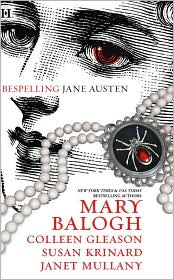
Bespelling Jane Austen

Bespelling Jane Austen. By Mary Balogh, Susan Krinard, Colleen Gleason, Janet Mullany. 2010. Harlequin. 377 pages.

From Almost Persuaded by Mary Balogh: Miss Jane Everett, middle daughter of Sir Horace Everett of Goodrich Hall in Hampshire, did not call as often as she ought at the vicarage in the village nearby. She called everywhere else--on tenants and laborers and others, on those who sick or elderly or in need of any sort. She took her duties very seriously.

From Northanger Castle by Colleen Gleason: Miss Caroline Merrill smoothed her ruffled-hem skirt as she settled into the chair against the wall. She quickly tucked her feet under the seat to keep them from being stepped upon or tripped over, and confirmed that the heavy, bulky reticule still dangled from her wrist. One never knew when one might need one of the accoutrements from within.

From Blood and Prejudice by Susan Krinard: It is a truth universally acknowledged that every decent straight guy who isn't dead broke, is in want of a good woman. As my dear Grandpa Bennet used to say...Bull.

From Little To Hex Her by Janet Mullany: "She turned me into a frog." I bit back the comment that he seemed to have recovered. "I can't tell you how sorry I am, Elton. I know it's no excuse, but it is almost full moon, and Harriet tends to be..." I paused and added a description of my assistant that seemed lame as soon as it was out of my mouth. "Difficult."

Bespelled By Austen is a collection of paranormal novellas "inspired by" four Jane Austen novels. Northanger Castle and Almost Persuaded are historical retellings of Persuasion and Northanger Abbey. (Names and situations have been altered.) Blood and Prejudice and Little To Hex her are modern day adaptations of Pride and Prejudice and Emma. Names have not changed though many aspects of the novel have been updated to reflect a contemporary setting. Each novella is by a different romance novelist. As you can imagine with reading any collection of novellas I have favorites and not so favorites. (My favorites may not be your favorites.)

My thoughts on "Almost Persuaded": I was not almost persuaded to believe in reincarnation. Unfortunately, that seemed to take precedence over the romantic aspects of this retelling of Persuasion. Much of the dialogue between our hero, Captain Mitford, and heroine, Jane Everett, seeming to be about past lives, soul mates, and such. You might not think it would be so intrusive to the text, but I found it to be so. When they weren't talking about the many times they got their love wrong in their past lives, they were doing things that seemed out of place with the historical time period. (Like shedding some clothes to go swimming together, and then getting intimate.) I did NOT like this one at all. Persuasion is my favorite Austen, and to see it "adapted" in this way irritated me.

My thoughts on "Northanger Castle": To be honest, I don't have many thoughts on this one. Unfortunately, I had a headache while reading this one, and I didn't feel a connection with this one. But. I think it was probably my fault. I think I would have been struggling to "enjoy" whatever I was reading at that time.

My thoughts on "Blood and Prejudice": This one was interesting. I thought I wouldn't like the modern-day adaptations. But I found both Blood and Prejudice and Little To Hex Her the best in the collection. Elizabeth, our heroine, finds out a secret about Mr. Darcy--and Mr. Wickham--they're vampires! But she's still doesn't have all her facts straight. Can Elizabeth discover the truth in time to find love for herself and her older sister, Jane? I liked this one.

My thoughts on "Little to Hex Her": This one was my favorite! Dare I say it? This one rivals Clueless for me on my favorite telling of Emma. (Emma is NOT my favorite Austen. I struggled through that one.) Emma, our heroine, is a matchmaker. That's her job. She runs a PARANORMAL dating service. Elton? Well, he's an Elf. Harriet? She's a werewolf. Frank Churchill? A vampire. Jane Fairfax? Well, she's a moody witch. Knightley? Well, he's a wizard. And her ex-boyfriend.  This adaptation was playful and flirty and fun. It worked really well--from the smallest details--"Missy" who can't stop talking about the emails she receives from Jane Fairfax--to the big declaration of love. I just loved this one. It would make a great movie!


© Becky Laney of Becky's Book Reviews


The Nonesuch

The Nonesuch. Georgette Heyer. 1962/2009. Sourcebooks. 352 pages.

There was a twinkle in the Nonesuch's eye as he scanned the countenances of his assembled relations, but his voice was perfectly grave, even a trifle apolegetic. 'I am afraid it is quite true, ma'am,' he said, addressing himself to his Aunt Sophia. 'I am the heir.'

Who is the Nonesuch? Waldo--or Sir Waldo perhaps--Hawkridge. A wealthy man in need of nothing (already owning several properties both in the country and in ton) who happens to inherit the estate of his cousin, Joseph Calver. The estate--a piece of property called Broom Hall--is in the country and is in need of much repair. Waldo takes one of his best friends, one of his relations (cousin? nephew?) with him: Julian Lindeth. Yet another relation (cousin? nephew?) will join the story later on, only this one not being one of his best friends--no he's more of the begging persuasion: Laurence ("Laurie") Calver. They come to this country estate--this country neighborhood. And while there, they interact with the locals.

The story focuses around a small group. Mrs. Underhill, her daughter, Charlotte, her son, Courtenay, her niece, Tiffany Wield, and the governess/companion Miss Trent. There are a few others in the circle--most notably a Patience Chartley. But those are the main players in the book.

The neighborhood is all excited by the entry of these two gentlemen. Both the mamas and the daughters. Tiffany is perhaps the most beautiful lady in their small country circle of acquaintances, but other girls--ladies I should say--eclipse her in matters of the heart and mind. Still, it's Tiffany's game to win or lose--at least as she sees it--as she sets out to capture the hearts of these two gentleman soon after they've arrived.

The novel is all about wooing and being wooed. And it was an enjoyable one for the most part. There were many characters developed. Many relationships developed. There isn't much "action" to speak of as far as plot is concerned until the very end--the last seventy-five pages or so--but for me I never found it boring. Then again, I'm a patient reader and I know the pay off can be big for Heyer novels. So others might not be so forgiving. 

© Becky Laney of Becky's Book Reviews


Bellfield Hall

Bellfield Hall: Or The Observations of Miss Dido Kent. Anna Dean. 2010. St. Martin's Press. 300 pages.

Bellfield Hall,
Monday 23rd September 1805


My dear Eliza,
I must begin another letter to you, although it is not six hours since I sent my last. I have some news to communicate which I think will surprise you not a little.

Miss Dido Kent hesitated, her pen suspended over the page. All her education and almost thirty years' experience of writing letters had not quite prepared her for this situation. As well as she could recall, the rules of etiquette said nothing about the correct way in which to convey the news that she now had to impart. However, her governess had once told her that the very best style of writing was that which gave information simply and clearly without any excess of sensibility.
She dipped her pen into the ink and continued.
There has been a woman found dead here -- in the shrubbery -- this evening. (13-14)
I really enjoyed this mystery novel set during one of my favorite time periods--the Regency. I enjoyed the narrator, Miss Dido Kent, very much. I found her pleasant company. This was one of those nice books to settle in with--perhaps not the most compelling read, when it comes to pace--but a pleasant, satisfying read all the same. 

Miss Dido Kent is visiting her niece, Catherine, who is distraught at the disappearance of her betrothed, Richard Montague. True, he sent her a note--a note begging her to break off their engagement. But she doesn't know why he wants to break it off. She doesn't know where he's gone. Until she knows why, she can't fathom breaking the engagement. Does he still love her? She needs to find him, to talk to him. But before that mystery can be solved, another begins. In fact, this dead body opens the novel.

Miss Dido didn't plan on solving a mystery--on trying to solve a murder case--but she happens to be in the right time and place. Who is the dead woman found in the shrubbery? How was she shot in the middle of the day with no one on the estate hearing it? Who among the house guests would have a motive for killing this mystery woman? Can Miss Dido solve this mystery while trying to comfort her niece? How many family secrets will she uncover in the process? 

I liked this one. I really liked it. I liked the setting. I liked the characters. It was interesting to meet all the different characters. I thought she did a great job with them! It was a very pleasant novel.

© Becky Laney of Becky's Book Reviews


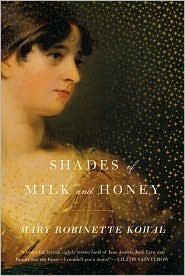
Shades of Milk and Honey

Shades of Milk and Honey. Mary Robinette Kowal. 2010. Tom Doherty. 304 pages.


The Ellsworths of Long Parkmead had the regard of their neighbours in every respect. The Honourable Charles Ellsworth, though a second son, through the generosity of his father had been entrusted with an estate in the neighborhood of Dorchester. It was well appointed and used only enough glamour to enhance its natural grace, without overlaying so much illusion as to be tasteless. His only regret, for the estate was a fine one, was that it was entailed, and as he had only two daughters, his elder brother's son stood next in line to inherit it. Knowing that, he took pains to set aside some of his income each annum for the provision of his daughters.

I really liked Shades of Milk and Honey. I'm not sure really liked equals love. But I'm not one that says you have to LOVE every book you read--or every book you recommend. Shades of Milk and Honey is an enjoyable novel. For the right reader, it is fun and playful. For the Austen fan, it's an enjoyable treat, readers can "see" what life might have been like in Regency England  if glamour, if magic, had been one of the "required" womanly arts. Chances are, you'll enjoy, seeing how Kowal pays tribute to Austen. (Of course, not every book is for every reader. So I can't promise that you'll be one of the readers who appreciates this one!)

Jane, our heroine, envies her younger sister, Melody, the beauty of the family. Her father notes that she is the one "with a face made for fortune." Meanwhile, Melody envies Jane because she is the "smart" one of the family. Jane has a gift--natural talent that has been practiced and refined--with glamour. Jane feels that Melody is the one with the best chances for marriage. Melody feels that Jane's talent will overshadow her beauty. That men (potential suitors) may appreciate her beauty for what it is--but what it is is passing. Whereas Jane's "gift" is lasting--she'll only improve upon further acquaintance. True, she's twenty-eight. But Melody feels Jane might still be some competition. There are several men in the neighborhood--including a few visitors new to the community--so Melody and Jane have opportunity to "find" a potential match.

Will Jane find a husband? Will Melody?

I liked this one. I liked the style, the writing. It may not be the most thrilling read--when it comes to pace--but it was an enjoyable one. I enjoyed this historical romance with fantasy elements. I liked that it was a clean read.

© Becky Laney of Becky's Book Reviews


While We're Far Apart

While We're Far Apart. Lynn Austin. 2010. October 2010. Bethany House. 416 pages.

Esther's father halted the lazy swaying of the porch swing. "Listen," he said. "There's something I need to tell all of you." The darkness in his voice made Esther's skin prickle. He had used the same phrase, the same tone, when he'd told her that Mama had gone to live up in heaven.

I loved While We're Far Apart. I wouldn't say it's my favorite-and-best Lynn Austin novel, but I wouldn't hold that against While We're Far Apart. Like her earlier novel, A Woman's Place, it is set during World War II. It's set in Brooklyn.

Once again, the story is told through alternating voices. Esther, a young girl coming-of-age at this difficult time, Penny, a young woman who is finally gaining her independence from her strict parents, Jacob, a Jewish landlord mourning the loss of his wife, a man deeply worried about the fate of his son, daughter-in-law, and granddaughter in Hungary, a man who is angry at God.

The novel opens with Eddie Shaffer making an announcement. He's enlisted in the army. He's looking for someone to take care of his two children--Peter and Esther--for the duration of the war. Since his mother is unwilling or unable, Penny, the girl-next-door, volunteers. She's had a big crush on Eddie for years. And now that he's a widower, he's "available" again. She knows it's a big commitment--a commitment that her own parents just don't understand no matter how many times she tries to explain it--but she's happy to be needed. She'll move--temporarily--into his apartment in Brooklyn so that his children won't need to change schools, so their lives won't be as disrupted by the sudden change.

Soon before Mr. Shaffer leaves, the Jewish synagogue across the street from his apartment burns down. Jacob Mendel happens to be the first on the scene. And as angry as he is with God, he can't allow the Torah scrolls to be destroyed. Not if there's a chance he can save them. So in he rushes into the burning building. The landlord Penny meets is a man very much in need of a friend. And it's friendship he finds...first with Peter and Esther...and later with Penny.

While the novel--for the most part--is set in America, it does present some of the horrors of the Holocaust through letters. As Sarah waits not knowing her fate, the fate of her husband and daughter, not knowing when Hitler will make his next big move to eliminate Jews. At first I wasn't sure if these narrative letters "fit" with the rest of the novel. But. I think it worked for the most part. I enjoyed learning that Raoul Wallenberg was a real hero.

Penny, Jacob, Esther, Peter, and Sarah (Jacob's daughter-in-law) are individuals in need. While We're Far Apart is very compelling, very dramatic (but not melodramatic), very human. I loved these characters. I loved how human they were, how complex they were. I loved their brokenness. I loved how they came together, how friendships developed slowly, how deep wounds began to heal.

I would definitely recommend this one. If you're interested in World War II, in historical fiction, then this one may work well for you.

© Becky Laney of Becky's Book Reviews


Embers of Love

Embers of Love (Striking a Match #1) Tracie Peterson. Bethany House. 352 pages.

"I won't let you go through with this," Deborah Vandermark declared.

This historical romance is set in Texas in the 1880s. It's the first in a new series. 

Wanting to save her friend, Lizzie, from a loveless marriage, our heroine, Deborah, invites her best friend to stay with her and her family in Texas. Deborah's brother, G.W., likes Lizzie quite a lot. And Lizzie is the first person who has been able to convince him that his father's death is not his fault. But this romance isn't without conflict. For Lizzie's mother--a suffragist--and her former fiance, Stuart, arrive to make everyone's lives miserable. They both insist that the marriage is legal--because she signed the paperwork--even if there were no vows or ceremony. They both insist that she accompany them back East, back to Philadelphia. But Lizzie knows that she could never go back. Even if she wasn't desperately in love with someone else.

Is this Lizzie's story? Partly. It also stars Deborah Vandermark. A well-educated woman returning to her home after several years away, after several years of education. She loves her family. But. She's having a hard time fitting back in the community as well. It's a good thing there is a new doctor in town to distract her. These two become good friends. He is one of the few men in town Deborah feels is smart enough to hold a real conversation with. But the doctor provides some conflict as well. Because he isn't accepted by the community--not at first. For this small Texas town is superstitious and foolish. It may take a major epidemic for him to prove himself worthy.

Plenty of conflict, plenty of drama. (Personally, I could have used a little less.) I liked it well enough, but didn't love it.


© Becky Laney of Becky's Book Reviews


Twitter Delicious Facebook Digg Favorites More