Showing posts with label friendship. Show all posts

Darth Paper Strikes Back (MG)

Darth Paper Strikes Back. Tom Angleberger. 2011. Harry N. Abrams. 176 pages.

It is a dark time at McQuarrie Middle School...when did it start? I can tell you exactly when it started.
The first day of school. The very first day of seventh grade. We didn't even get one good day. We got, like, five minutes.

Darth Paper Strikes Back is the sequel to The Strange Case of Origami Yoda. Sixth grade is over, seventh grade is just beginning. And it seems the wisdom of everyone's favorite origami Yoda isn't as revered or respected as in previous days. Teachers and administrators aren't so fond of the "disruptions" made by Dwight and his paper puppet. And there are some in the class who are oh-so-tired of it all. Or at least tired of Dwight getting all the attention. Harvey a student who can be a little mean at times--but isn't quite a complete bully at heart--comes to school with Darth Paper. And thus a NEW saga begins.

So the novel begins with bad news. Dwight has been kicked out of school. He may or may not be allowed to return after a few weeks. His case has to come before the school board. His friends want to help him, of course. And so they set about writing this casebook as to why Dwight and his origami Yoda are positive influences on the school, on the class. They're defending their friend.

So the book has multiple narrators. And there are many stories to tell. If you liked the first book, then you'll definitely want to read this one! It's an entertaining read!

© 2011 Becky Laney of Becky's Book Reviews


Five Children and It (MG)

Five Children and It. E. Nesbit. 1902/2004. Puffin Classics. 240 pages.

The house was three miles from the station, but before the dusty hired fly had rattled along for five minutes the children began to put their heads out of the carriage window and to say, 'Aren't we nearly there?' And every time they passed a house, which was not very often, they all said, 'Oh, is this it?' But it never was, till they reached the very top of the hill, just past the chalk-quarry and before you come to the gravel-pit. And then there was a white house with a green garden and an orchard beyond, and mother said, 'Here we are!'

It has been almost two years since I first discovered E. Nesbit. Five Children and It was the very first of her novels that I read, and it was definitely LOVE from the very beginning.

The five children are Robert, Cyril, Anthea, Jane, and Lamb. The 'it' is a sand fairy--a Psammead. The four children discover him one day during their summer vacation while they're digging in a nearby sand pit. They're quite delighted to learn that he can grant wishes. Though it's easy for anyone to see that he doesn't like granting wishes all that much. Still, the children are happy to think of one wish after another after another. A wish per day is what they're allowed. And oh the wishes they think up!!! But it doesn't take them very long to realize that they're not all that smart and clever with those wishes. For almost every day their wish leads them into TROUBLE. If wishing leads to trouble, why wish for anything? Well, even bad wishes make for a way to spend the day.

This book is so much fun! Just a delight to spend time with these characters. I'd definitely recommend it!

My favorite quotes:
Grown-up people find it very difficult to believe really wonderful things, unless they have what they call proof. But children will believe almost anything, and grown-ups know this. That is why they tell you that the earth is round like an orange, when you can see perfectly well that it is flat and lumpy; and why they say that the earth goes round the sun, when you can see for yourself any day that the sun gets up in the morning and goes to bed at night like a good sun as it is, and the earth knows its place, and lies as still as a mouse. (5)

I daresay you have often thought what you would do if you had three wishes given you, and have despised the old man and his wife in the black-pudding story, and felt certain that if you had the chance you could think of three really useful wishes without a moment's hesitation. These children had often talked this matter over, but, now the chance had come suddenly to them, they could not make up their minds. (17)

But the happening of strange things, even if they are not completely pleasant things, is more amusing than those times when nothing happens but meals, and they are not always completely pleasant, especially on the days when it is cold mutton or hash. (54)

Lending ears was common in Roman times, as we learn from Shakespeare; but I fear I am getting too instructive. (59)

When the frock was darned, the start for the gravel-pit was delayed by Martha's insisting on everybody's washing its hands -- which was nonsense, because nobody had been doing anything at all, except Jane, and how can you get dirty doing nothing? That is a difficult question, and I cannot answer it on paper. In real life I could very soon show you -- or you me, which is much more likely. (59)

It is very wise to let children choose exactly what they like, because they are very foolish and inexperienced, and sometimes they will choose a really instructive thing without meaning to. (85)

The people who decide what the weather is to be, and put its orders down for it in the newspaper every morning, said afterwards that it was the hottest day there had been for years. They had ordered it to be 'warmer -- some showers', and warmer it certainly was. In fact it was so busy being warmer that it had no time to attend to the order about showers, so there weren't any. (86)

'I was always generous from a child,' said the Sand-fairy. 'I've spent the whole of my waking hours in giving. But one thing I won't give --that's advice.'
'You see,' Anthea went on, 'it's such a wonderful thing -- such a splendid, glorious chance. It's so good and kind and dear of you to give us our wishes, and it seems such a pity it should all be wasted just because we are too silly to know what to wish for.'
Anthea had meant to say that -- and she had not wanted to say it before the others. It's one thing to say you're silly, and quite another to say that other people are.
'Child,' said the Sand-fairy sleepily, 'I can only advise you to think before you speak--'
'But I thought you never gave advice.'
'That piece doesn't count,' it said. 'You'll never take it! Besides it's not original. It's in all the copybooks.' (89-90)

© 2011 Becky Laney of Becky's Book Reviews


Heidi (MG)

Heidi. Johanna Spyri. 1880/2009. Puffin Classics/Penguin.  320 pages.

The pretty little Swiss town of Mayenfeld lies at the foot of a mountain range, whose grim rugged peaks tower high above the valley below.

If the cover to Heidi had looked this pretty, this inviting, this appealing, when I was a kid, there's a good chance I wouldn't have spent most of my life avoiding it. (It didn't help that the cover of the Heidi we had was AWFUL.) What I discovered was that Heidi is a nice, satisfying read. One that may just improve upon a reread. I can easily see why Eva Ibbotson, who wrote the introduction to this edition, described reading this one as feeling like you're coming home. There's just something cozy-and-comfortable about it.

So Heidi is an orphan, she's been one since the age of one. She has spent the next four years with her Aunt Detie. But at the start of the novel, at age five, she's being "given" to her grandfather. Detie has decided that enough is enough. She's not the only relative this kid has, and, well, she wants to live her own life without being a mother to her dead sister's kid. If my description is blunt and ugly, it's because Detie is. The way she speaks of the child--of Heidi--well it made me take an instant disliking to her. (And nothing in the book makes me change my opinion of her.) So Heidi and Detie are on their way up the mountain. The grandfather has a moment or two of doubt, but, Heidi erases his fears early on. He takes an instant liking to his granddaughter. And he notices how bright and wonderful she really is. Readers see this bond grow and grow as the two spend time together. No one could love grandfather more than Heidi, and no one could love Heidi more than her grandfather. Heidi has found her a home at last. And all seems right with the world. Heidi loves her grandfather, loves her new home, loves the mountains, loves the flowers, loves the goats, loves the goat herder, Peter, loves Peter's Grannie. Here is a girl that has a love of life, who doesn't want for anything.

But. All that changes with (boo, hiss) the arrival of Aunt Detie who seems to think that Heidi will be better off away from her grandfather. It has been arranged for Heidi to become the companion of a sickly little girl, Clara. Heidi has no choice in the matter. And is told that she can't have an opinion about it--essentially. Now, Heidi does like Clara well enough. It's not like she HATES Clara. I'm not sure it's in Heidi's nature to HATE anybody. But Heidi is definitely upset that she's been taken from everybody she loves, the home she loves, etc. And city life just isn't the same. Heidi doesn't feel like she belongs there.

The highlight of her time in the city may just be when Clara's grandmother comes to visit. This grandmother takes the time to get to know Heidi. She comes to love Heidi and care deeply about her. She encourages Heidi and gives her attention. She says you can learn to read and write. You are smart, you are capable, you can do it. Which is just the message this little girl needs to hear! When Heidi does learn to read, she is given a lovely picture book by this grandmother. But perhaps even more important than that gift is the gift of faith. For this grandmother--Mrs. Sesemann--talks to Heidi of God and prayer. She encourages the young girl to pray to God, to seek Him. She teaches Heidi that when God doesn't answer prayers right away--in the way we expect, in the time period we expect--that doesn't mean God hasn't heard. It's just that God knows what is best for us, he knows what we need, and when we need it. God may seem to be delaying his promises, or slow to working his promises, but God is a God who makes all things beautiful in HIS time.

So does Heidi get to return to her grandfather? What do you think?! Would it be so satisfying and happy-making if she didn't?

While I'm not quite sure that Heidi herself is flawed--she seems to represent everything pure and innocent and good in the world--the rest of the characters within the novel are flawed. And many--though not all--are lovable. Two of my favorites are Heidi's Grandfather (Uncle Alp) and Dr. Classen.

One of my favorite scenes with Dr. Classen:
"When you can do no more yourself," said Heidi confidently, "tell God."
"Those are good words, my dear," said the doctor, "but suppose it was God Himself who sent the sorrow."
Heidi sat pondering for a while. She was sure God could always help, but was trying to find the answer out of her own experiences. "I think you have to wait," she said at last, "and keep on thinking that God has something good which He's going to give you out of the sad thing, but you have to be patient. You see, when something's awfully bad, you don't know about the good bit coming, and you think it's going on for ever."
"I hope you will always feel like that, Heidi," he said, and fell silent, drinking in the scene before him.  (202)
And my favorite scene with the Grandfather--well, there are many, many scenes that I love between these two--is when she reads him the story of the prodigal son from her picture story book. The quote comes from an online edition of Heidi, not the exact same translation as the Puffin classic. (And I liked the Puffin classic better. In the book this comes from pages 172-175.)
"If God had let me come at once, as I prayed, then everything would have been different, I should only have had a little bread to bring to grandmother, and I should not have been able to read, which is such a comfort to her; but God has arranged it all so much better than I knew how to; everything has happened just as the other grandmother said it would. Oh, how glad I am that God did not let me have at once all I prayed and wept for! And now I shall always pray to God as she told me, and always thank Him, and when He does not do anything I ask for I shall think to myself, It's just like it was in Frankfurt: God, I am sure, is going to do something better still. So we will pray every day, won't we, grandfather, and never forget Him again, or else He may forget us."
"And supposing one does forget Him?" said the grandfather in a low voice.
"Then everything goes wrong, for God lets us then go where we like, and when we get poor and miserable and begin to cry about it no one pities us, but they say, You ran away from God, and so God, who could have helped you, left you to yourself."
"That is true, Heidi; where did you learn that?"
"From grandmamma; she explained it all to me."
The grandfather walked on for a little while without speaking, then he said, as if following his own train of thought: "And if it once is so, it is so always; no one can go back, and he whom God has forgotten, is forgotten for ever."
"Oh, no, grandfather, we can go back, for grandmamma told me so, and so it was in the beautiful tale in my book--but you have not heard that yet; but we shall be home directly now, and then I will read it you, and you will see how beautiful it is." And in her eagerness Heidi struggled faster and faster up the steep ascent, and they were no sooner at the top than she let go her grandfather's hand and ran into the hut. The grandfather slung the basket off his shoulders in which he had brought up a part of the contents of the trunk which was too heavy to carry up as it was. Then he sat down on his seat and began thinking.
Heidi soon came running out with her book under her arm. "That's right, grandfather," she exclaimed as she saw he had already taken his seat, and in a second she was beside him and had her book open at the particular tale, for she had read it so often that the leaves fell open at it of their own accord. And now in a sympathetic voice Heidi began to read of the son when he was happily at home, and went out into the fields with his father's flocks, and was dressed in a fine cloak, and stood leaning on his shepherd's staff watching as the sun went down, just as he was to be seen in the picture. But then all at once he wanted to have his own goods and money and to be his own master, and so he asked his father to give him his portion, and he left his home and went and wasted all his substance. And when he had nothing left he hired himself out to a master who had no flocks and fields like his father, but only swine to keep; and so he was obliged to watch these, and he only had rags to wear and a few husks to eat such as the swine fed upon. And then he thought of his old happy life at home and of how kindly his father had treated him and how ungrateful he had been, and he wept for sorrow and longing. And he thought to himself, "I will arise and go to my father, and will say to him, 'Father, I am not worthy to be called thy son; make me as one of thy hired servants.'" And when he was yet a great way off his father saw him . . . Here Heidi paused in her reading. "What do you think happens now, grandfather?" she said. "Do you think the father is still angry and will say to him, 'I told you so!' Well, listen now to what comes next." His father saw him, and had compassion, and ran, and fell on his neck and kissed him. And the son said to him, "Father, I have sinned against heaven and in thy sight, and am no more worthy to be called thy son." But the father said to his servants, "Bring forth the best robe, and put it on him; and put a ring on his hand and shoes on his feet: and bring hither the fatted calf and kill it; and let us eat and be merry, for this my son was dead and is alive again; he was lost and is found." And they began to be merry.
"Isn't that a beautiful tale, grandfather," said Heidi, as the latter continued to sit without speaking, for she had expected him to express pleasure and astonishment.
"You are right, Heidi; it is a beautiful tale," he replied, but he looked so grave as he said it that Heidi grew silent herself and sat looking quietly at her pictures. Presently she pushed her book gently in front of him and said, "See how happy he is there," and she pointed with her finger to the figure of the returned prodigal, who was standing by his father clad in fresh raiment as one of his own sons again.
A few hours later, as Heidi lay fast asleep in her bed, the grandfather went up the ladder and put his lamp down near her bed so that the light fell on the sleeping child. Her hands were still folded as if she had fallen asleep saying her prayers, an expression of peace and trust lay on the little face, and something in it seemed to appeal to the grandfather, for he stood a long time gazing down at her without speaking. At last he too folded his hands, and with bowed head said in a low voice, "Father, I have sinned against heaven and before thee and am not worthy to be called thy son." And two large tears rolled down the old man's cheeks.
Early the next morning he stood in front of his hut and gazed quietly around him. The fresh bright morning sun lay on mountain and valley. The sound of a few early bells rang up from the valley, and the birds were singing their morning song in the fir trees. He stepped back into the hut and called up, "Come along, Heidi! the sun is up! Put on your best frock, for we are going to church together!"
Not that Heidi is free from some oddities! I read somewhere that Johanna Spyri didn't really "like" school. And perhaps that shows in Heidi and Peter's reluctance to go to school and learn to read. Peter especially seems angry about it. Heidi, well, initially hers was thinking that she was too stupid to ever learn anything. So when Heidi does return to the mountain, to her grandfather, to Peter, she wants to help him learn to read. But as a modern reader, I can't really say I *like* her method of teaching the alphabet! Was this little rhyme something she learned from Clara's tutor? Perhaps. But maybe she should have recalled how it was the kind, encouraging, you-can-do-it words of Clara's grandmother that inspired her the most in her own learning.
If A B C you do not know
Before the judge you'll have to go

If D E F you cannot say
Bad luck is sure to come your way

If you forget your H J K
You'll have misfortune all the day

If L and M you can't say clear
You'll have to pay a fine, I fear.

Trouble will be in store for you
If you can't say N O P Q

If you get stuck at R S T
A dunce's cap your lot will be

If you confuse a V with U,
You'll find yourself in Timbuctoo

If over W you fall,
Beware the rod upon the wall

If letter X you can't recall,
You'll get no food today at all

If you find Y is hard to say,
They'll laugh at you at school today.

If Z should tie you up in knots
They'll send you to the Hottentots.
Heidi seems to be an optimistic hope-filled novel about brokenness. There were some very touching moments--very human moments--and then there were the purely satisfying sweet moments. And I definitely enjoyed it!!! 

© 2011 Becky Laney of Becky's Book Reviews


Withering Tights (YA)

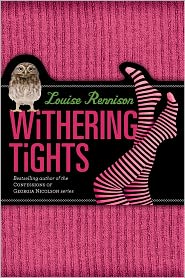
Withering Tights. Louise Rennison. 2011. HarperCollins. 288 pages.

Wow, this is it. This is me growing up. On my own, going to Performing Arts College. This is good-bye, Tallulah, you long, gangly thing, and helloooooo, Lullah, star of stage and ...owwwwooo. Ow and ow. The train lurched and I've nearly knocked myself out on the side of the door. I'm bound to get a massive lump. Oh good, I can start college with two heads...

Tallulah, our fourteen-year-old-heroine, is such a delight. She is on her way to a performing arts summer program in Yorkshire. As she was the last to sign up for the course, she won't be staying in the dorm, there wasn't enough room, but a local family, the Dobbins, has welcomed her into their home. As a reader, I must admit, I'm GLAD there wasn't room for her in the dorm. Else we would have missed out on this quirky family and the squirrel slippers. And Tallulah may not have caught so many glimpses of local bad boy, Cain, outside her window. Not that she likes him likes him.

So what is Withering Tights about? It's about her summer. It's about her going to summer school and taking all these classes. It's about her failing to make a great impression with the teachers, and making a funny impression on her classmates. It's about her making some GREAT friends: Jo, Vaisey, Flossie, Ruby, etc. It's about her meeting a couple of guys and getting her first and second kiss...not that either is perfect. Are the guys worth swooning over? Maybe. There's local bad boy, Cain, whom Tallulah does NOT like in that way, not even a little bit. There's Charlie and Ben, two friends of Jo's crush. There are a group of guys that like hanging around with this group of girls. (No one is exactly pairing up and getting serious.) And then there is Alex. He is THE ONE that makes Tallulah swoon the most. He turns her silly--or should that be sillier. He's also Ruby's older brother.

What did I love about Withering Tights? Well, I loved Tallulah. I just loved her. She was such a fun person to spend time with. I did enjoy Alex. And Cain. And Charlie. (Ben didn't thrill me all that much.) I loved Tallulah's friends. I think Ruby may just be my favorite--she is a bit younger than Tallulah. But there was just something about her that made me smile. The great thing was that none of these friends annoyed me. (One of my biggest annoyances with the Georgia Nicholson series was Georgia's friends. I'm not sure if I found them annoying because Georgia found them annoying. Or if they were just super-obnoxious all on their own.) I loved the humor! I did! For example, ONE of the assignments in this drama school was for them to put on a musical based on Emily Bronte's Wuthering Heights.

Here's one of the songs she writes:
I'm out on the moors, the wild moors,
Let's roll about in rockpools.
Oh, it gets lonely without you,
I hate you, I love you.
It's Cathy, trying to get in your Windoooooow ow ow ow... (171)

and
I'm out on the moors, the windy moors,
Let's roll about in mud pools,
Or sheep poo, I hate you, I love you, tooooo.
Heathcliff, it's me, tap-tapping on your windooooow. (220)
Of course, that's just a small part of the Bronte humor!

So I'd recommend Withering Tights for anyone who loves funny romances. Of course, anyone who loved and adored Georgia Nicholson should give Tallulah a try. I actually liked Withering Tights more than most of the more recent Georgia novels. There was nothing tired about it.

© 2011 Becky Laney of Becky's Book Reviews


Close to Famous (MG)

Close to Famous. Joan Bauer. 2011. Penguin. 240 pages.

The last place I thought I'd be when this day began is where I am, which is in a car. Mama's car to be exact, and she's driving headstrong through downtown Memphis with an Elvis impersonator on our tail. I know the Elvis; his name is Huck. 

Foster and her mom are on the run from an abusive boyfriend when the novel opens. They end up in Culpepper, West Virginia. At first Foster isn't sure of this new town, this new place. Small is small and the opportunities seem a bit limited. Foster has big dreams of being a baker, and in Memphis she'd had the opportunity to 'help' at a local bakery. And well, there are only three restaurants in town--an Arby's, a Pizza Hut, and a local place called Angry Wayne's. Her mom, a back-up singer, may manage to find a job at the local hardware store. But Culpepper doesn't seem to be a town with much promise. Then again, Foster doesn't appear to be a kid with much promise. Not until you know her, not until you've tasted one of her delicious cupcakes. Not until you find out about her incredible memory--she cooks everything by memory. And most of her recipes come from the Food Network.

Foster is dreaming of fame, dreaming of her own cooking show, while her neighbor Miss Charleena is recovering from fame. She's had it all. A big movie career in Hollywood, a marriage to a beautiful guy, but it left a sour taste in her mouth. Now she's hiding away in a small town at times dreaming of a big comeback and at other times too depressed to even want to leave her bedroom. Miss Charleena comes to care for Foster, discovers her secret, and is determined to help her young friend. Foster may just give Miss Charleena some unexpected help as well.

I liked this one. It was well written. The characters were wonderfully developed. The small town is given a chance to shine. It's a great little novel with a couple of great messages. It deals with economic struggles, abusive homes, and illiteracy, yet it does it in a natural way, for the most part. I'm not sure I completely believe the big showdown where cupcakes save the day. But there were so many things I liked about it, that it is easy for me to recommend.

"Waiting," he told me, "is a powerful thing. Most folks today just rush off to get something done. You learn to wait, my young friend. You learn to wait and listen and not be afraid of the quiet. Too much noise in this old world. On a battlefield when you're getting shot at, you don't have time to think things through. You've just got to do as you've been trained and follow your best instincts. It's here in the quiet waiting for a fish that you can fill up for when the tough times come."
I knew I'd heard something important. I wondered if he'd taken me fishing to tell me that. (181)


© 2011 Becky Laney of Becky's Book Reviews


My Forever Friends

My Forever Friends (Friends for Keeps #4) Julie Bowe. 2011. July 2011. Penguin. 224 pages.

I'm Ida May and I'm feeling a little squished. That's because I'm sitting on a piano bench between Jenna Drews and Brooke Morgan. I was saving half of the bench for my best friend, Stacey Merriweather, but Jenna budged in before Stacey could. Jenna is my sometimes friend. Then Brooke budged in on the other side of me. Brook is my sometimes-not friend.

The first three books in this series are: My Last Best Friend , My New Best Friend, and My Best Frenemy. Ida May is still one of seven girls in Mr. Crow's fourth grade class. Tension is still high among the girls--Jenna, Brooke, Stacey, Ida May, Randi, Meeka, and Jolene--since Brooke and Jenna's big, big fight. And poor Ida May is feeling the pressure most of all. For Brooke is clinging to Stacey more than ever. And Jenna, well, Jenna is always around. Jenna and Rachel have been coming over after school every day since their mom, Mrs. Drews, is having a very difficult pregnancy. And Ida May is becoming really good at getting along with both. She's comfortable with Jenna, and she's losing that with Stacey. It's not always easy for Ida May to accept the changes. There are still times when she thinks Jenna is WAY too bossy, too much of a know-it-all. But she's beginning to love her unconditionally which is super-sweet. How can I not love Ida May having a big heart? Ida May realizes that she may be the only one able to repair the broken friendships tearing her class apart.

I loved this one. I did. I am still loving Ida May and her friends and classmates. Bowe has brought this fourth-grade class to life. Each of the students has been developed--of course, some more than others. But even the boys have a little individuality, a little personality. I am loving Jenna too. I really felt for her in this one. I was so glad she found a champion in Ida May. Not that Jenna wants to admit she needs one. But still. You know I loved the characters. But I also LOVED the writing. Julie Bowe knows how to tell a good story. She definitely has a way with words. There was something special about this book.

There are things about Jenna I'd like to change. Her bossiness. The way she treats Rachel sometimes. Her grudge against Brooke. But there's one thing I wouldn't change. Jenna knows her talents and she isn't afraid to tell you. (37)

I think about Brooke. And Jenna. And how their talents fit together.
Jenna knows how to cook things up.
Brooke knows how to to add the sprinkles. (63)

"You can't unditch someone," I say to George. "All you can do is say you're sorry and hope they yank you back in." (128)


© 2011 Becky Laney of Becky's Book Reviews


Captivate (YA)

Captivate. Carrie Jones. 2010. Bloomsbury. 276 pages.  

Sometimes there are these bizarre people who actually like physical education class.

Captivate is the sequel to Need. Both Need and Captivate would be good for fans of Stephenie Meyer and Melissa Marr. (Wicked Lovely, Ink Exchange, and Fragile Eternity immediately come to mind.) It's YA fantasy with plenty of thrills--a dangerous romance. Zara, our heroine, is confused about many things. Her relationship with her father? Too complicated to fathom. Part of her hates the fact that she's had to lock him up so that the slaughtering of human boys would stop in her Maine town. But part of her realizes of course that while killing is never "good" it is sometimes necessary. She's also confused about pixies in general. After meeting--after rescuing--one pixie in particular, she's beginning to think for the first time that there may be a few good pixies out there. For this mysterious pixie--we don't learn his name (Astley) for quite a while--saves Zara time and time again. He seems to make it his business to keep her safe. (Which of course is threatening Nick's role in this drama.)

But there is one thing that Zara is NOT confused about. Her love for Nick. She loves him. Oh how she loves him. She needs him. She wants him. She can't stop thinking about him. He's her everything. He'd do anything to keep her safe. And she'd do anything to keep him safe.

Captivate is dramatic. For me, the highlight of this one was the introduction of Astley. I liked the scenes between Zara and Astley best.

© Becky Laney of Becky's Book Reviews


Touch Blue (MG)

Touch Blue. Cynthia Lord. 2010. August 2010. Scholastic. 192 pages.

"The ferry's coming!" High on the cliffs, my five-year-old sister, Libby, jumps foot to foot. "Come on, Tess! Mom says we can run down to meet it!"

To save their island school from closing, there is nothing the community of Bethsaida won't try--which is why five foster children are being welcomed into the neighborhood. Aaron is one of them. He'll be the big brother to Tess and Libby. If he stays. As much as Tess wants him to stay--so that she can stay, so that she won't have to move to the mainland, so she won't have to go to a new school--she's heard her father say time and time again that island life isn't for everyone. And Aaron--with his bright red hair and pale white skin--doesn't look like he'll be a good match. Tess wants to be friends with him. At least on friendly terms with him. But Aaron seems hesitant to reach out to anyone, to trust anyone. Can Tess and Aaron find common ground? What can these two learn from one another?

I loved this one. I loved it! Cynthia Lord has created such great characters! I enjoyed Tess very much. And Aaron. I liked the whole community really. I enjoyed spending time reading this one.

© Becky Laney of Becky's Book Reviews


Twitter Delicious Facebook Digg Favorites More