Showing posts with label Adult Science Fiction. Show all posts

To Dream in The City of Sorrows

To Dream in the City of Sorrows. (Babylon 5: Book #9). Kathryn M. Drennan. Based on the series by J. Michael Straczynski. 1997. Random House. 352 pages.

From the prologue: Marcus Cole walked with a limp, a fact that did not go unnoticed by the young Minbari acolyte as Marcus entered the small temple. Marcus didn't recognize the rather chubby Minbari and briefly wondered where Sech Turval was, but as he was not in the mood for conversation, he simply made a note to seek out the venerable Minbari teacher at a later time.

From chapter one: "Alpha 7 to Alpha Leader, I'm hit!" 

I almost don't know where to start with this review. I could start by asking you if you've discovered how wonderful a show Babylon 5 is. I could mention that at the moment, at least, you can watch the first season online at the WB. (Though I discovered--the hard way--that these moments of "generosity" (aka availability) aren't to be taken for granted. What is available for a few weeks at a time, may disappear suddenly leaving folks a bit disgruntled.) Amazon also offers individual episodes for download--for a price, of course. If you're a fan, I'd be curious to know how many episodes it took for you to get hooked, for me, it was five. Once I saw Parliament of Dreams, well, I knew that it was the start of a beautiful friendship. Or obsession. You know, whichever you prefer.

So the framework of To Dream In The City of Sorrows--the prologue and epilogue--take place shortly after season three's "Grey 17 is Missing," and are narrated by Marcus Cole. (I just LOVE, LOVE, LOVE Marcus Cole!) But most of the book focuses on what was happening with Jeffrey Sinclair after he left Babylon 5. (The gap between the last episode of season one, "Chrysalis," and the incredibly intense two-part episode "War Without End" of season three.)

IN the first episode of season two, viewers learn that Jeffrey Sinclair has been suddenly removed from his position on Babylon 5 and reassigned to Minbar. Officially he is the "ambassador from Earth" on Minbar. The FIRST human ambassador to Minbar. Unofficially, well, he's out of favor with Earth Alliance. But that may just prove to everyone's advantage.   


In the introduction, J. Michael Straczynski writes, "What you hold in your hand is an official, authorized chapter in the Babylon 5 story line. This is the definitive answer to the Sinclair question, and should be considered as authentic as any episode in the regular series."

Read To Dream in the City of Sorrows
  • If you want to know what Sinclair was doing in season two and three
  • If you want to know what became of Catherine Sakai, to learn if these two were able to make their troubled relationship work...with the added drama of Shadows and Rangers
  • If you want to know more even more about the Shadows' movements during this time
  • If you want to learn about how Sinclair became Ranger One and re-energized the Rangers (first started by Valen)
  • If you want to learn more about Minbari prophecies (also their culture and caste system)
  • If you want to learn more about the Vorlons; in particular readers are introduced to Ulkesh. (Loved Sinclair's first impression of him! And his insights about the Vorlons in general. How Kosh may not be the most representative of his race.)
  • If you want to learn more about Marcus. Readers meet William Cole AND Marcus Cole. Two brothers with an imperfect relationship. William is an eager ranger-in-training trying to get Marcus to join him, but, things don't always go as planned. Viewers get some of this story--was it in "Ceremonies of Light and Dark?"
I just LOVED this book. I loved learning more of Sinclair's story. I loved the introduction to Marcus Cole. Granted, I already loved him, but learning more of his story, well, it makes me love him even more! It's just a GREAT book.

© 2011 Becky Laney of Becky's Book Reviews


No Different Flesh

The People: No Different Flesh. (The New Chronicle of  THE PEOPLE) Zenna Henderson. 1967. Avon. 225 pages.

Meris watched the darkness rip open and mend itself again in the same blinding flash that closed her eyes.

No Different Flesh is the second People book by Zenna Henderson. It's a collection of loosely connected stories about The People. If you enjoy science fiction, I'd recommend both books. Both are well-written. Both are fantastic. (Much better than what you might think based on the book covers alone!)

The novel does begin on a dark and stormy night. Meris and Mark are a married couple grieving the loss of a child. After the storm, Mark discovers a young child. Where did this little one come from? Why are her clothes so out-of-this-world? Is she not talking because of shock? Or does she not speak English? One mystery is soon solved when the girl's father arrives within a few days. But for Mark and Meris, it's only the beginning of the wonder, of the mystery. For this child and her father are of The People. And soon they are joined by others of their Group. And the stories begin. And Mark and Meris are very happy to be included in these gatherings. The framework of this novel isn't as strong as in the first book. But the stories are just as fascinating, just as wonder-making.

The stories included in this one are: No Different Flesh, Deluge, Angels Unawares, Troubling of the Water, Return, and Shadow on the Moon.

My favorite would probably be "Deluge" and "Angels Unawares." In Deluge,  readers learn about The Home--the origin planet for The People, a planet that was dying, a planet The People were forced to leave; we witness everything through the eyes of one family. In Angels Unawares, readers follow one member of that family to her new home, Earth.

I enjoyed the stories. I enjoyed the characters. I even enjoyed the structure--how many stories we have, and how many different narrators we have.

© 2011 Becky Laney of Becky's Book Reviews


The Pilgrimage

The Pilgrimage: The Unforgettable SF Masterpiece of the Strangers Among Us: The First Book of The People. Zenna Henderson. 1961. 255 pages.

The window of the bus was a dark square against the featureless night.

I enjoyed this science fiction novel very much! The novel opens with a young woman, Lea, contemplating suicide. But fate--in the form of a woman--intervenes. Karen reaches out to Lea at her most vulnerable moment and persuades her to take the first baby step towards life, towards hope. She encourages her to wonder. Karen takes her home, takes her to The People. The People are gathering nightly--they have decisions of their own to make, decisions just as important perhaps--but they are gathering to tell stories, to record their stories, their histories, their journeys. Lea, an outsider, hears things that are almost to incredible to believe.

Who are The People? Where did they come from? How can they do the things they do? Read and see for yourself!

I enjoyed the stories. I enjoyed the characters. I enjoyed the storytelling. Many of these stories could be described as coming-of-age stories. I'd definitely recommend this one.

Another review: Necromancy Never Pays.

© 2011 Becky Laney of Becky's Book Reviews


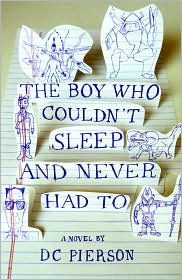
The Boy Who Couldn't Sleep and Never Had To

The Boy Who Couldn't Sleep and Never Had To. DC Pierson. 2010. Random House. 240 pages.

From the prologue: All the newspapers and TV pundits are calling this fall's freshman college class the "Symnitol Generation," but if the activity up and down my dorm hallway is any indication, this fall's freshman college class is the "Stand Around Each Other's Laptops and Play the First Thirty Seconds Of Every Song on the Hard Drive Generation." The noise makes it hard to sit and write this but not impossible.

From chapter one: I've got a system to keep people from seeing what I'm drawing.

I can't say I loved The Boy Who Couldn't Sleep And Never Had To. But I can say it was an interesting read: a coming-of-age novel with a science fiction twist. Our narrator, Darren Bennett, was a loner, a young guy trying to keep his life private. Not wanting anyone to know just how seriously he took his drawing, his stories. But then he meets Eric Lederer, a guy with an even bigger secret to keep, and it just happens that he shares his vision. The two begin working on the project together--creating stories and characters, outlining movies and books, etc. And the two become best friends. Even though Eric doesn't love everything about Darren--his bullying brothers, for example, and his friend's obsession with "his thing." And Darren doesn't love everything about Eric--his friend's reluctance to explore "his thing," and his way of disappearing for a day or two each month. What is Eric's "thing"? Well, it's what the call Eric's big secret: the fact that Eric doesn't ever sleep. He doesn't have to sleep. He has never slept in his entire life. Darren isn't the first person Eric's ever told. But he is the first person who has believed him. And he's the first person to become obsessed with it, to view it as a "super-power." But what Darren fails to realize is just how heavy a burden this "power" is for his friend.

As I said, it's a coming of age novel, so expect angst and rivalry. For what could separate these two friends? Could it be a girl? a drama queen?!

The Boy Who Couldn't Sleep And Never Had To has its moments. I enjoyed quite a few scenes in this one. But--for me--it wasn't quite love. The book had its light moments, its funny moments, it's social commentary. But. I had a hard time believing in the science fiction elements of this one. In Eric's power and ability. And the last third of the novel had me a bit confused--what was real? what was imagined? is Darren reliable as a narrator? are we supposed to like Darren? I do think other readers might like it more than I did.

© 2011 Becky Laney of Becky's Book Reviews


The Lost Gate (YA/Adult)

The Lost Gate. Orson Scott Card. 2011. January 2011. Tor. 384 pages.


Danny North grew up surrounded by fairies, ghosts, talking animals, living stones, walking trees, and gods who called up wind and brought down rain, made fire from air and drew iron out of the depths of the earth as easily as ordinary people might draw up water from a well.

I enjoyed The Lost Gate. It's a fantasy novel with mythological elements. Danny North is from one of powerful families--former gods, you might say--cut off for centuries from their home-world. But he's not the family's greatest hope--far from it. He's grown up being less-than. His aunts, his uncles, his cousins, his parents, everyone in his life has a gift, a calling. But Danny? Well, he runs fast and he's smart when it comes to book-learning, to languages especially. Not exactly magical, is it?

But Danny is about to learn just how special he is when the novel opens--and this knowledge puts him in great danger. He can't go home again--for the truth--if revealed--will lead to his death. So how does a young boy (12 or 13) survive in the real world? A world he's been kept separate from? How fast can Danny learn the necessary skills to survive? He won't be alone for long, but when there are people who want you dead, it's not easy to know who to trust.

Speaking of trust, there is a second story within The Lost Gate. Readers aren't quite sure (exactly) how these stories connect since they seem to be disconnected--separated by great time or distance.

The Lost Gate is a fantasy novel. Orson Scott Card crafts a new world (or two) within The Lost Gate. He's peopled the 'real' world with some fantastical beings--some more obvious than others. I enjoyed the world Card has created. I'm not sure I "love" this new world yet. But. I can say that The Lost Gate kept me reading. I found it compelling, enjoyable, satisfying. The time I spent with the book was happy. It felt right to be reading Card again.


© 2011 Becky Laney of Becky's Book Reviews


Blackout

Blackout. Connie Willis. 2010. Random House. 512 pages.

Oxford--April 2060
Colin tried the door, but it was locked.

How does Blackout compare to Doomsday Book and To Say Nothing of the Dog? Well. I'm not sure they can. While both books are about time traveling historians, there's an intensity to this one that can't quite be put into words. Not in a way that would do it justice.

In, Doomsday Book, it gets intense. Bad things are happening. And there's a mystery to be solved. There are unknowns, yes, but you see people hard at work solving the problem. Trying to at least. There's this urgency. Dunworthy is ever-anxious to save Kivrin--with a little help from Colin, of course.

Blackout is more of a mystery. The silence of those stories that are not being told weighs on the reader. At least this reader.

Let's start with what we do know. Blackout tells the story of three historians working on World War II. There's Merope Ward who is "Eileen" on this assignment. She's observing children evacuees. There's Polly Churchhill who is "Polly Sebastian" on this assignment. She's covering the first weeks of the London blitz, working as a shop girl on Oxford Street by day. There's Michael Davies (Mike) who is covering Dover, he's posing as an American reporter covering the Dunkirk evacuation. These three historians--working undercover, of course--are not supposed to have met. For their assignments were not supposed to overlap.

But. One after another these historians learn that their drops are not working. Each expecting a retrieval team at any moment to "rescue" them, to send them home back to where they belong. But no retrieval teams arrive. And each becomes increasingly alarmed. Why aren't the drops working? Is the Net down? But even if the Net was down, this is time travel, it wouldn't effect when they were rescued, right? Is the Net not working because they've changed history? That's supposed to be impossible. Historians (time-travelers) cannot change history. But what if it is possible? What if they have changed history? Why isn't Mr. Dunworthy sending anyone to help them? Where is Colin in all this? Do they even know that these historians are trapped?

Can three historians survive World War II?

Blackout captures the uncertainty, the anxiety, the frustrations of a war-time England. It's compelling, impossible to put down. But. it isn't quite as satisfying as Doomsday Book and To Say Nothing of the Dog because it's incomplete. This is only half the story. All Clear--published this October--completes the story.

© Becky Laney of Becky's Book Reviews


A Pleasure To Burn

A Pleasure To Burn: Fahrenheit 451 Stories. Ray Bradbury. 2010. Subterranean Press. 300 pages.

Have you read Fahrenheit 451 by Ray Bradbury? If you haven't, you should. It is one of those must-read novels, in my opinion. I've reviewed it several times now. If you have, you should consider picking up A Pleasure To Burn. It is a collection of Ray Bradbury's works--mainly short stories with a couple of novellas--that show the thematic evolution of the novel.

It includes
  • The Reincarnate (After awhile you will get over the inferiority complex. Maybe. There's nothing you can do about it. Just be careful to walk around at night. The hot sun is certainly difficult on you.)
  • Pillar of Fire (He came out of the earth, hating. Hate was his father; hate was his mother. It was good to walk again. It was good to leap up out of the earth, off of your back, and stretch your cramped arms violently and try to take a deep breath. He tried. He cried out. He couldn't breathe. He flung his arms over his face and tried to breathe. It was impossible. He walked on the earth, he came out of the earth. But he was dead.)
  • The Library (The people poured into the room. Health officials reeking of disinfectant, sprinklers in their hands. Police officials, fierce with blazing badges.)
  • Bright Phoenix (One day in April 2022, the great library door slammed flat shut. Thunder. Hello, I thought. At the bottom step glowering up at my desk, in a United Legion uniform which no longer hung as neatly upon him as it had twenty years before, stood Jonathan Barnes.)
  • The Mad Wizards of Mars (Their eyes were fire and the breath flamed from out the witches' mouths as they bent to probe the cauldron with greasy stick and bony finger.)
  • Carnival of Madness ("During the whole of a dull, dark and soundless day in the autumn of the year, when the clouds hung oppressively low in the heavens, I had been passing alone on horseback, through a singularly dreary tract of country, and at length found myself, as the shades of evening drew on, within view of the melancholy House of Usher..." Mr. William Stendahl paused in his quotation. There, upon a low black hill, stood the house, its cornerstone bearing the inscription: 2249 A.D.)
  • Bonfire (The thing that bothered William Peterson most was Shakespeare and Plato, and Aristotle, and Jonathan Swift and William Faulkner and the poems of Weller, Robert Frost perhaps and John Donne and Robert Herrick. All of these, mind you, tossed into the Bonfire.)
  • The Cricket on the Hearth (The door slammed and John Martin was out of his hat and coat and past his wife as fluently as a magician en route to a better illusion.)
  • The Pedestrian (To enter out into that silence that was the city at eight o'clock of a misty evening in November, to put your feet upon that buckling concrete walk, to step over grassy seams and make your way, hands in pockets, through the silences, that was what Mr. Leonard Mead most dearly loved to do.)
  • The Garbage Collector (This is how his work was: He got up at five in the cold dark morning and washed his face with warm water if the heater was working and cold water if it the heater was not working.)
  • The Smile (In the town square the queue had formed at five in the morning, while cocks were crowing far out in the rimed country and there were no fires. All about, among the ruined buildings, bits of mist had clung at first, but now with the new light of seven o'clock it was beginning to disperse. Down the road, in twos and threes, more people were gathering in for the day of marketing, the day of festival.)
  • Long After Midnight (Mr. Montag dreamed. He was an old man hidden with six million dusty books. His hands crawled, trembling, over yellow pages, and his face was a smashed mirror of wrinkles by candlelight. Then, an eye at the keyhole! In his dream, Mr. Montag yanked the door. A boy fell in.)
  • The Fireman (The four men sat silently playing blackjack under a green droplight in the dark morning. Only a voice whispered from the ceiling: "One thirty-five a.m. Thursday morning, October 4th, 2052 A.D. One forty a.m....one fifty..." Mr. Montag sat stiffly among the other firemen in the fire house, heard the voice-clock mourn out the cold hour and the cold year, and shivered.)
It also includes three bonus stories: The Dragon Who Ate His Tail, Sometime Before Dawn, and To The Future.

The two pieces most intimately connected with Fahrenheit 451 are "Long After Midnight" and "The Fireman." I found it fascinating to read these two. To see the progress of this novel-in-the-making. To see the creative process at work. To learn what was the same--stayed the same--and how Bradbury was refining and reshaping his story. (For example, these two have Montag "becoming" the book of Job!) It was also interesting to see who was the biggest influence on Montag--Faber or Clarisse.

I enjoyed this one. I liked reading all the stories. Yes, the two longer pieces--"Long After Midnight" and "The Fireman" were the most fascinating--but the other stories are interesting as well. All the stories are worth reading. Then again, all of Ray Bradbury is worth reading!

© Becky Laney of Becky's Book Reviews


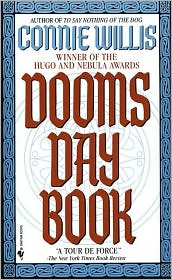
Doomsday Book

Doomsday Book. Connie Willis. 1992. Random House. 592 pages.

Mr. Dunworthy opened the door to the laboratory and his spectacles promptly steamed up.
"Am I too late?" he said, yanking them off and squinting at Mary.

I loved Connie Willis' To Say Nothing of the Dog. I just LOVED it. But I think I loved Doomsday Book a little bit more. It was incredibly compelling. It was intense, emotional, and impossible to put down.

The writing was as great as I expected. Willis does a wonderful job with her characters. They feel very real--very human. The setting--the world building--is also amazing. She does a great job building the past--the fourteenth century--and the "present" which is a time-traveling future. (The story alternates between past and present.) She blends mystery, science fiction, and historical fiction--and blends them well!

Doomsday Book is dramatic. Kivrin--our heroine--is a historian traveling to the Middle Ages--to 1320 to be exact. The fourteenth century has just been opened up to historians. And this is a dream come true for Kivrin. While, certain years will most likely remain "too dangerous" to visit--like the year 1348--the year the Black Death was first recorded in England--there is much to learn, to explore. And Kivrin is excited--thrilled--to be the one to go. She'll be spending two weeks in the past--in a small village--during Advent. Mr. Dunworthy, however, has his doubts. And he's not afraid to voice them. Kivrin thinks he's being too cautious. That he's just being silly, ridiculous. Of course, she'll take all the necessary precautions--like her vaccinations and such--but she's an educated woman capable of taking care of herself--no matter the century.

But. From the start, there is something wrong with the drop. It starts with the technician, Badri, becoming ill. Soon the whole area is quarantined. Cases start coming in--and soon medical staff are overwhelmed. What is this disease--this illness? How is it spread? Where did it come from? Is it fatal? Is there a cure? Is Badri the first case? Did he have a chance to pass this on to Kivrin before she went through the Net? What was Badri trying to communicate to Dunworthy at the last minute?

Readers meet dozens of characters in both centuries as this mystery unfolds. And while it is serious--dramatic--and emotional--people will die--it's not without its lighter moments of wit. I loved the narrative. I loved the way this story was told. This one I'll definitely be recommending!

© Becky Laney of Becky's Book Reviews


3 (More) Bradbury Stories; My Thoughts On A Movie

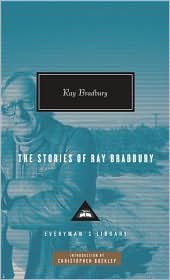
The Stories of Ray Bradbury. Introduction by Christopher Buckley. 2010. April 2010. Knopf, Doubleday. 1112 pages. [I've read 407/1112] 

I haven't read many short stories this week. But. What I have read, I've really enjoyed! See my first two posts on this short story collection: first twelve and next twenty-six.

The Great Wide World Over There
It was a day to be out of bed, to pull curtains and fling open windows.
My thoughts: Cora, the heroine, is fixated on the trivial matter of receiving mail--"real" letters in a "real" mailbox. Since she can't read or write, and since she doesn't know anyone--near or far--who can read or write, this dream seems out of touch with reality. (Not that you could convince her of that, mind you!) One summer, she has a nephew, Benjy, visit her and her husband. He can read and write. Is this the opportunity that she's been waiting for all these years?
This story is sad because Cora never realizes the true purpose of letters, of mail, to communicate. Cora misses out on connecting with those around her--her husband, her nephew, her neighbors--because she is too busy dreaming these silly dreams.

The Playground
A thousand times before and after his wife's death Mr. Charles Underhill ignored the Playground on his way to and from his commuters' limited train. He neither liked nor disliked the Playground; he hardly knew it existed.
My thoughts: Childhood is anything idyllic in Ray Bradbury's The Playground. This is a haunting story of a man who will do anything to save his young son from enduring the horrors, the hardships, common to childhood. In this case, the scrapes, bruises, and taunts which abound on the local playground.
Is our hero, Charles Underhill, imagining these horrors? Judge for yourself!

Skeleton
It was past time for him to see the doctor again.
My thoughts: Has Mr. Harris lost it? Or has Mr. Munigant played a foul trick on him? As Mr. Harris imagines his skeleton is out to get him, his life spirals out of control. Very creepy!

Have you read any of these? What did you think? Do you have a favorite Ray Bradbury story?

This past week I watched the 1966 film Fahrenheit 451. It is different from the book--very different. As a movie--all on its own--I think it worked fairly well. However, it is not timeless like the book. The movie is obviously dated. And some scenes don't work well--like the "jet pack" chase scene. But it wasn't painful--for me--to watch.

One of the ways the movie differs from the book is in the importance of Clarisse. In the book, she is a catalyst for Montag. She makes him question his life--his happiness. But their acquaintance is brief. Just a conversation or two. And then she dies. An accident?! Maybe, maybe not. In the movie, they make her several years older. They make her more of a rebel, a threat. They have her as a teacher whose job is threatened. Because of this change, viewers get a glimpse into the educational philosophy of such a society. She takes the additional role of Faber. It is Clarisse who tells Montag about the community of "books" living outside the city. It is where she is planning on going now that she is "wanted" by authorities. The fact that she lives and is able to be reunited with Montag didn't quite work for me.

I would have loved to see Faber in the film. I thought the conversations these two had in the book were so well done. Their dialogue was so important--so crucial--to the heart of the book. And it's something that can't be easily replaced by Montag's lighter-hearted conversations with a beautiful young woman.

In the book, Montag saves a Bible. He "becomes" the book of Ecclesiastes. In the movie, that changes. You'd almost expect it to change, wouldn't you? I think it is unfortunate. In the movie, he becomes a book that he had never even read before: Tales of Mystery and Imagination by Edgar Allan Poe. I would have preferred him to become David Copperfield. Because at least he read and loved that book. It is featured in at least two earlier scenes of the movie.

I liked seeing the "book" community. Like the brothers "Pride" and "Prejudice." But because the war--or the threat of war--was eliminated from the movie--for the most part. It doesn't have quite the same feel as the book. Yes, the society was bad. But it didn't seem so dark and hopeless. Mindless, yes, of course, given over to pleasure and happiness instead of thinking and learning. But hopeless? Not really. So I preferred the book to the movie.

© Becky Laney of Becky's Book Reviews


The Next Twenty-Six: More Ray Bradbury Stories

The Stories of Ray Bradbury. Introduction by Christopher Buckley. 2010. April 2010. Knopf, Doubleday. 1112 pages. [I've read 366/1112]

This past week I've read some great short stories by Ray Bradbury! I thought I would take some time to share my thoughts on the ones I read this week. [See also my post last weekend on the first twelve stories that I've read.]

The Earth Men
Whoever was knocking at the door didn't want to stop.
Mrs. Ttt threw the door open. "Well?"
"You speak English!" The man standing there was astounded.
"I speak what I speak," she said.
"It's wonderful English!" The man was in uniform. There were three men with him, in a great hurry, all smiling, all dirty.
The Off Season
Sam Parkhill motioned with the broom, sweeping away the blue Martian sand. "Here we are," he said. "Yes, sir, look at that!" He pointed. "Look at that sign. Sam's Hot Dogs! Ain't that beautiful, Elma?"
The Million Year Picnic
Somehow the idea was brought up by Mom that perhaps the whole family would enjoy a fishing trip. But they weren't Mom's words; Timothy knew that. They were Dad's words, and Mom used them for him somehow.
The Fox and the Forest
There were fireworks the very first night, things that you should be afraid of perhaps, for they might remind you of other more horrible things, but these were beautiful, rockets that ascended into the ancient soft air of Mexico and shook the stars apart in blue and white fragments.
Kaleidoscope
The first concussion cut the rocket up the side with a giant can opener. The men were thrown into space like a dozen wriggling silverfish. They were scattered into a dark sea; and the ship, in a million pieces, went on, a meteor swarm seeking a lost sun.
The Rocket Man
The electrical fireflies were hovering above Mother's dark hair to light her path. She stood in her bedroom door looking out at me as I passed in the silent hall. "You will help me keep him here this time, won't you?" she asked.
"I guess so," I said.
Marionettes, Inc.
They walked slowly down the street at about ten in the evening, talking calmly. They were both about thirty-five, both eminently sober.
No Particular Night or Morning
He had smoked a packet of cigarettes in two hours. "How far out in space are we?" "A billion miles."
The City
The City waited twenty thousand years.
The Fire Balloons
Fire exploded over summer night lawns.
The Last Night of the World
"What would you do if you knew that this was the last night of the world?"
"What would I do? You mean seriously?"
"Yes, seriously."
"I don't know. I hadn't thought."
The Veldt
"George, I wish you'd look at the nursery."
"What's wrong with it?"
"I don't know."
"Well, then."
"I just want you to look at it, is all, or call a psychologist in to look at it."
The Long Rain
The rain continued. It was a hard rain, a perpetual rain, a sweating and streaming rain; it was a mizzle, a downpour, a fountain, a whipping at the eyes, an undertow at the ankles; it was a rain to drown all rains and the memory of rains.
The Great Fire
The morning the great fire started, nobody in the house could put it out. It was Mother's niece, Marianne, living with us while her parents were in Europe, who was all aflame.
The Wildnerness
It was twilight, and Janice and Leonora packed steadily in their summer house, singing songs, eating little, and holding to each other when necessary. But they never glanced at the window where the night gathered deep and the stars came out bright and cold.
A Sound of Thunder
The sign on the wall seemed to quaver under a film of sliding warm water.
The Murderer
Music moved with him in the white halls. He passed an office door: "The Merry Widow Waltz." Another door: Afternoon of a Faun. A third: "Kiss Me Again." He turned into a cross corridor: "The Sword Dance" buried him in cymbals, drums, pots, pans, knives, forks, thunder, and tin lightning. All washed away as he hurried through an anteroom where a secretary sat nicely stunned by Beethoven's Fifth. He moved himself before her eyes like a hand; she didn't see him.
The April Witch
Into the air, over the valleys, under the stars, above a river, a pond, a road, flew Cecy.
Invisible Boy
She took the great iron spoon and the mummified frog and gave it a bash and made dust of it, and talked to the dust while she ground it in her stony fists quickly.
The Golden Kite, The Silver Wind
"In the shape of a pig?" cried the Mandarin.
The Fog Horn
Out there in the cold water, far from land, we waited every night for the coming of the fog, and it came, and we oiled the brass machinery and lit the fog light up in the stone tower.
The Big Black and White Game
The people filled the stands behind the wire screen, waiting.
Embroidery
The dark porch air in the late afternoon was full of needle flashes, like a movement of gathered silver insects in the light.
The Golden Apples of the Sun
"South," said the captain.
"But," said his crew, "there simply aren't any directions out here in space."
The Powerhouse
The horses moved gently to a stop, and the man and his wife gazed down into a dry, sandy valley. 
Hail and Farewell
But of course he was going away, there was nothing else to do, the time was up, the clock had run out, and he was going very far away indeed.
My favorite this week? Definitely "The Murderer". Have you read it? You should! It was written in 1953. Albert Brock's first victim? The telephone? His second victim? The television. Our hero in this short story has had it with technology. Has had enough of being connected--always connected--with everybody, with everything.  He's on a mission to deliver man from modern 'conveniences'.

I've got two favorite quotes to share. One is from "No Particular Night or Morning"
"We're all fools," said Clemens, "all the time. It's just we're a different kind each day. We think, I'm not a fool today. I've learned my lesson. I was a fool yesterday but not this morning. Then tomorrow we find out that, yes, we were a fool today too. I think the only way we can grow and get on in this world is to accept the fact that we're not perfect and live accordingly." (206)
The second is from "The Fire Balloons"
"Father Peregrine, won't you ever be serious?"
"Not until the good Lord is. Oh, don't look so terribly shocked, please. The Lord is not serious. In fact, it is a little hard to know just what else He is except loving. And love has to do with humor, doesn't it? For you cannot love someone unless you put up with him, can you? And you cannot put up with someone constantly unless you can laugh at him. Isn't that true? And certainly we are ridiculous little animals wallowing in the fudge bowl, and God must love us all the more because we appeal to His humor." (223)
I enjoyed what I read this week. For the most part. Some stories are more memorable--to me--than others. A few of these I had completely forgotten--even though it's only been a few days! But others I still remembered. Some I think will be with me a while!

Have you read any of these? What did you think? Do you have a favorite Ray Bradbury story?

© Becky Laney of Becky's Book Reviews


Twitter Delicious Facebook Digg Favorites More