Showing posts with label 1934. Show all posts

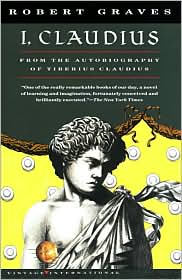
I, Claudius

I, Claudius. Robert Graves. 1934. 480 pages.

I, Tiberius Claudius Drusus Nero Germanicus This-that-and-the-other (for I shall not trouble you yet with all my titles) who was once, and not so long ago either, known to my friends and relatives and associates as “Claudius the Idiot,” or “That Claudius,” or “Claudius the Stammerer” or “Clau-Clau-Claudius” or at best as “Poor Uncle Claudius,” am now about to write this strange history of my life; starting from my earliest childhood and continuing year by year until I reach the fateful point of change where some eight years ago, at the age of fifty-one, I suddenly found myself caught in what I may call the “golden predicament” from which I have never since become disentangled.

This was an impulse read--or reread. I first read it in 2008 and I liked it. I didn't quite love it. I remember thinking at some point I want to read the sequel, one day I want to finish the story. But I wasn't in a rush. Obviously. But a few weeks ago, I saw it on the library shelf, and, well, I just HAD to read it. (I picked up both books because of course I wanted to read them both.)

What did I think the second time through this one? Well, I just LOVED it. I just loved, loved, loved it. Perhaps because I've changed as a reader. Perhaps because I knew the basic story and was free to enjoy the details more. I don't know why some books are just better the second time around. I would say the biggest difference--for me--was that there was no confusion the second time round. I wasn't lost with the names, I wasn't struggling with piecing together the story. The more I read, the more right it felt.

Anyway, the essentials remain:

Narrated by Claudius, I, Claudius is an often bloody memoir of the Roman empire under Augustus, Tiberius, and Caligula. (It might reference pre-Augustan Roman history, but it does so in a flashback kind of way.) What can I say about this one? The narration varies between being very witty and dry and sarcastic and just downright fun in that sort of way. But I won't lie either. There are hundreds of names from first to last. Some turn out to be key players, some disappear a page or two later--and it's hard to distinguish between the two. I did get lost in more than a few places trying to puzzle out who was who. But at the same time, it was enjoyable. Even though I didn't pick up on every single little detail, what I did pick up on and follow I enjoyed for the most part. The book is full of politics, plots, crimes, murders, and plenty of drama both small and grand in scale. Claudius had three wives and two main mistresses, for example, (one at a time though) and a few of them were truly scary. Livia, Claudius's grandmother, is one of the stars of the novel. She's a truly despicable character--poisoning and plotting to kill off most of the opposition even if the opposition were completely innocent and were her own flesh and blood.

© 2011 Becky Laney of Becky's Book Reviews


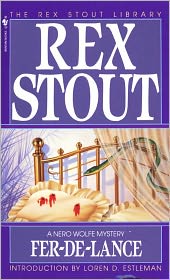
Fer-de-lance

Fer-de-lance. A Nero Wolfe Mystery. Rex Stout. 1934/1997. Random House. 304 pages.

There was no reason why I shouldn't have been sent for the beer that day, for the last ends of the Fairmont National Bank case had been gathered in the week before and there was nothing for me to do but errands, and Wolfe never hesitated about me running down to Murray Street for a can of shoe polish if he happened to need one. But it was Fritz who was sent for the beer.  

Fer-de-lance is the first Nero Wolfe mystery. It introduces readers to two private detectives, Nero Wolfe, and Archie Goodwin. I'm tempted to add in two of the BEST DETECTIVES in the world. But, I suppose that's just my opinion!

In Fer-de-lance, Fred Durkin introduces a woman to Nero Wolfe, Maria Maffei. This woman is worried about her brother, Carlo Maffei, who has gone missing. Archie Goodwin is sent to investigate. First he interviews those in the boarding house where Carlo lived--those that overheard Carlo's phone conversation; he then looks at Carlo's room, goes through his room looking for clues. He learns from Miss Anna Fiore that Carlo often gave her his newspaper after he was finished with it. The newspaper she got that Monday afternoon had a big hole in it--an entire article had been cut out. Nero Wolfe wants to know what article it was Carlo took such an interest in. After discovering the article was about the death of a golfer, Peter Oliver Barstow, he becomes interested in that death. Soon after Carlo Maffei is no longer missing at all--his body has been found. Though there is no obvious reason to link the two deaths together, to investigate them at the same time--especially since Barstow's death has been accepted as natural--Wolfe is convinced that the two are related. That Barstow was murdered. That his body should be exhumed and tested for poison. He's convinced that finding the murderer of one will lead him to solving the other murder. Who killed Peter Oliver Barstow? Was it poison? Who had motive and opportunity? And did Carlo know it was murder? Did Carlo know who killed Mr. Barstow? Is that how he ended up dead?

So Archie and Nero have plenty of work to do, plenty of clues to follow!

I enjoyed Fer-de-lance. It was fun to read the first mystery in this series. Archie and Nero are great fun in this one. Their dialogue still satisfies me. It's just so delightful to spend time with these two!

Nero Wolfe:

"A pessimist gets nothing but pleasant surprises, an optimist nothing but unpleasant." (3)

Nero Wolfe:

"Some day, Archie, when I decide you are no longer worth tolerating, you will have to marry a woman of very modest mental capacity to get an appropriate audience for your wretched sarcasms." (54)

Nero Wolfe:

"People often find it difficult to think in my presence, I do not leave enough space." (96)

Archie Goodwin:

"Everything that the doctor could tell me I had read three days earlier in the newspapers except for a bunch of medical terms which the papers hadn't tried to print for fear of a typesetters' strike." (139)

Archie Goodwin:

"You know what my boss says? He says that skepticism is a good watchdog if you know when to take the leash off." (143)

Nero Wolfe and Archie Goodwin:

"Tell Fritz there will be guests at lunch. What do boys that age eat?"
"They eat everything."
"Tell Fritz to have that." (165)


© 2011 Becky Laney of Becky's Book Reviews


A Man Lay Dead

A Man Lay Dead. Ngaio Marsh. 1934/1997. St. Martin's Press. 192 pages.

Nigel Bathgate, in the language of his own gossip column, was "definitely intrigued" about his weekend at Frantock. At twenty-five he had outgrown that horror of enthusiasm which is so characteristic of youth grown-up. 

A Man Lay Dead is the first mystery by Ngaio Marsh. It stars Roderick Alleyn as a detective, though it is narrated by Nigel Bathgate. Nigel's cousin, Charles Rankin, is quite good friends with Sir Hubert Handesley, a passionate collector, who enjoys throwing weekend parties for his closest friends. This weekend's guests includes: Charles, Nigel, Doctor Tokareff, Arthur and Marjorie Wilde, Angela North, and Rosamund Grant. The theme that weekend is murder. One guest will be assigned the role of murderer and given twenty-four hours to choose the victim and method. He or she will whisper to the 'victim', turn out the lights, and sound the gong. This will signal to everyone that a murder has been committed, everyone will wait two minutes, and then the second half of the game will begin. Each will try to solve the mystery. But. Of course, that is not how the weekend unfolds. For, as you might expect, a real murder will be committed. And it will be up to Inspector Roderick Alleyn to solve this one. Which of the guests--or was it the butler--had murder on his mind?!

I liked this one. I enjoyed it.

© 2011 Becky Laney of Becky's Book Reviews


Twitter Delicious Facebook Digg Favorites More