Showing posts with label HarperCollins. Show all posts

Signs and Wonders

Signs and Wonders: A Harmony Novel. Philip Gulley. 2003. HarperCollins. 224 pages. 

The summer Barbara Gardner turned sixteen, she was crowned the Tenderloid Queen by the Lawrence County Pork Producers.

While I enjoyed the first Harmony book very much, I haven't quite been able to appreciate the later books in the series. (The Christmas novella was nice, however.) Signs and Wonders, the fourth book, is the biggest disappointment to me yet. I am finding things that made me laugh out loud in the first book--the 'observations' about how church meetings go--are making me cringe now. Because what I took for light fun in the first book--and even, to a certain degree, in the second book, I now feel is over-the-top mocking. In a condescending, mean-spirited way. To laugh with characters that are quirky are one thing--to make them be 'the joke' five hundred thousand times in a row--is another. The sentimentality lessons which I found more charming than annoying in the first book are now much too much for me to endure. Because I now feel he is pushing an agenda, that he has a message, and if you don't agree with him, well, you'll end up being the next big joke.

I don't know if I'll continue on with the series or not.

© 2011 Becky Laney of Becky's Book Reviews


Just Shy of Harmony

Just Shy of Harmony. Philip Gulley. 2002. HarperCollins. 272 pages.

Sam Gardner sat on the porch the Monday after Easter. 

Home to Harmony delighted me. It was a story collection with heart. There were stories that made me laugh, smile, and almost cry. Just Shy of Harmony is not a collection of stories; it is a novel set in Harmony. Readers follow this small town from Easter to Easter--the course of one year. There are essentially three or four stories:

The pastor Sam Gardner is having a crisis of faith: he no longer believes in the God he's supposed to preach about. He's realized that he has at least eight of ten signs of depression, and he finds the church much too overwhelming. And those feelings keep him from being able to pray. When he confesses to the elders of the church, they decide to take turns preaching each week. Which is good--the first few weeks--but Sam learns that not everyone has more than one (or two) good sermons in them. Will stepping back from the chaos of the church--the endless meetings, etc.--help him believe in God's goodness again?

Asa and Jessie Peacock won the lottery in Home to Harmony, but they refused to accept the money. In this novel, they struggle with their decision when EVERYTHING goes wrong all at once. If they accept the money, can they use it wisely?

Wayne Fleming has started dating Deena Morrison. But that relationship is threatened by the return of Wayne's wife, Sally. Sally thought she had a very very good reason for leaving Wayne and their kids last year. She wanted to spare them the pain of watching her die. But now she's having second thoughts about that decision, now she wants her family back. The community thinks they know everything about Sally, but what they don't know about her health, well, it surprises almost everyone. Can this community come together to help this family in need?

Dale Hinshaw feels "led" to start a Scripture egg ministry. By feeding chickens small pieces of paper with Bible verses on them, he hopes that the eggs they lay will minister to people, to shock them perhaps, into the faith. But this ministry is just a little too weird for the town to get behind and support.

While I didn't love this book--at least not as much as Home to Harmony--it was a nice read.

© 2011 Becky Laney of Becky's Book Reviews


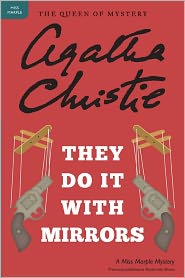
They Do It With Mirrors

They Do It With Mirrors. (Miss Marple). Agatha Christie. 1952/2011. HarperCollins 224 pages.

Mrs. Van Rydock moved a little back from the mirror and sighed. 

Ruth Van Rydock wants her good friend, Jane Marple, to do her a favor. She's worried about their mutual friend Carrie Louise Serrocold. She has a feeling that Carrie Louise is in trouble or in danger. And so she's arranged a visit for Miss Marple. After a few small lies are told to smooth the way, Carrie Louise is happy to welcome her old friend into her home. Miss Marple is introduced to the STRANGE, STRANGE bunch of folks living or working on the estate. Her husband, Lewis. Her daughter, Mildred. Her granddaughter, Gina, and her husband, Walter. Her stepsons from her second marriage, Stephen and Alex Restarick. Her companion-caretaker, Juliet Bellever. Her husband's assistant, Edgar Lawson. (Carrie Louise has been married three times--and it shows. She's carried over wealth and property, but, also children and grandchildren, etc.) Her husband's pet project has him working with juvenile delinquents with part of the estate being converted into a school of sorts. I won't lie, it was a bit confusing at first to see how these characters connect to one another--if they connect to one another. It helps that almost every character seeks out Miss Marple in the days after her arrival. One by one they "unburden" themselves and complain freely about anything and everything.

Of course, it turns out that Ruth had VERY good reason to worry about her friend. And Miss Marple it seems arrived just in time for the drama. Soon there's a murder to be solved...can she solve it in time before more lives are lost?

I enjoy Miss Marple. I do. There is just something satisfying about reading Agatha Christie. While They Do It With Murders isn't my new favorite or anything, it is an enjoyable mystery. Not perfect. But definitely enjoyable enough to recommend.

Ruth to Miss Marple:
"You've always been a sweet innocent looking creature, Jane, and all the time underneath nothing has ever surprised you, you always believe the worst."
"The worst is so often true," murmured Miss Marple.
"Why you have such a poor idea of human nature, I can't think--living in that sweet peaceful village of yours, so old world and pure."
"You have never lived in a village, Ruth. The things that go on in a pure peaceful village would probably surprise you."
"Oh I daresay. My point is that they don't surprise you." (9)

Inspector Curry and Miss Marple:
"This is all very distressing I know. But we've just got to get the facts clear. Get it all clear."
"Oh yes, I know," said Miss Marple. "So difficult, isn't it? To be clear about anything, I mean. Because if you're looking at one thing, you can't be looking at another. And one so often looks at the wrong thing, though whether because one happens to do so or because you're meant to, it's very hard to say. Misdirection, the conjurers call it. So clever, aren't they?" (90)

© 2011 Becky Laney of Becky's Book Reviews


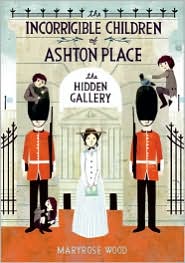
The Hidden Gallery (MG)

The Hidden Gallery (The Incorrigible Children of Ashton Place #2) Maryrose Wood. 2011. HarperCollins. 320 pages.

"But the workmen swore the repairs to the house would be finished by now!"

It's been a few months since the disastrous Christmas affair when the three Incorrigible children--Alexander, Beowulf, and Cassiopeia--went a little crazy in front of all the guests. But the children have made friends with the squirrel, Nutsawoo, and they've been behaving well enough ever since. They've been themselves, true, confusing words like matador and metaphor. But they've not been awful or dreadful. Still, a little change of scene might be just the thing. For Penelope Lumley, the young but bright governess, has been invited to London by one of her former teachers. And Miss Lumley is eager to go with the children. She didn't necessarily expect Lord and Lady Ashton to want to go to London too. But the more the merrier, right?

So this second book is ALL about their London adventure. Do you think that these three children--supposedly raised by wolves--can go unnoticed in London? You're right. Things do get a little messy. But in the midst of the chaos, Miss Lumley discovers that she needs to be extra careful. For there is someone who wants to hurt the children. But who?! Miss Lumley's former teacher is NO help at all. Just warning Penelope to not ask questions of anyone and to leave well enough alone. But does that really sound like something Penelope can do?

I liked The Hidden Gallery. I didn't love it as much as the first one, perhaps, but it was a good read, an enjoyable one. Within this one, Penelope makes a new friend, Simon, whom she trusts almost immediately. At times I forget that Penelope is VERY young herself--just fifteen or so? So it was nice to see that she is interested in boys too. That she can think of more than Latin and geography and such. 

© 2011 Becky Laney of Becky's Book Reviews


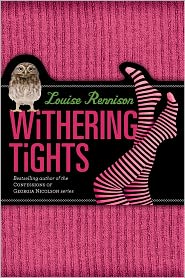
Withering Tights (YA)

Withering Tights. Louise Rennison. 2011. HarperCollins. 288 pages.

Wow, this is it. This is me growing up. On my own, going to Performing Arts College. This is good-bye, Tallulah, you long, gangly thing, and helloooooo, Lullah, star of stage and ...owwwwooo. Ow and ow. The train lurched and I've nearly knocked myself out on the side of the door. I'm bound to get a massive lump. Oh good, I can start college with two heads...

Tallulah, our fourteen-year-old-heroine, is such a delight. She is on her way to a performing arts summer program in Yorkshire. As she was the last to sign up for the course, she won't be staying in the dorm, there wasn't enough room, but a local family, the Dobbins, has welcomed her into their home. As a reader, I must admit, I'm GLAD there wasn't room for her in the dorm. Else we would have missed out on this quirky family and the squirrel slippers. And Tallulah may not have caught so many glimpses of local bad boy, Cain, outside her window. Not that she likes him likes him.

So what is Withering Tights about? It's about her summer. It's about her going to summer school and taking all these classes. It's about her failing to make a great impression with the teachers, and making a funny impression on her classmates. It's about her making some GREAT friends: Jo, Vaisey, Flossie, Ruby, etc. It's about her meeting a couple of guys and getting her first and second kiss...not that either is perfect. Are the guys worth swooning over? Maybe. There's local bad boy, Cain, whom Tallulah does NOT like in that way, not even a little bit. There's Charlie and Ben, two friends of Jo's crush. There are a group of guys that like hanging around with this group of girls. (No one is exactly pairing up and getting serious.) And then there is Alex. He is THE ONE that makes Tallulah swoon the most. He turns her silly--or should that be sillier. He's also Ruby's older brother.

What did I love about Withering Tights? Well, I loved Tallulah. I just loved her. She was such a fun person to spend time with. I did enjoy Alex. And Cain. And Charlie. (Ben didn't thrill me all that much.) I loved Tallulah's friends. I think Ruby may just be my favorite--she is a bit younger than Tallulah. But there was just something about her that made me smile. The great thing was that none of these friends annoyed me. (One of my biggest annoyances with the Georgia Nicholson series was Georgia's friends. I'm not sure if I found them annoying because Georgia found them annoying. Or if they were just super-obnoxious all on their own.) I loved the humor! I did! For example, ONE of the assignments in this drama school was for them to put on a musical based on Emily Bronte's Wuthering Heights.

Here's one of the songs she writes:
I'm out on the moors, the wild moors,
Let's roll about in rockpools.
Oh, it gets lonely without you,
I hate you, I love you.
It's Cathy, trying to get in your Windoooooow ow ow ow... (171)

and
I'm out on the moors, the windy moors,
Let's roll about in mud pools,
Or sheep poo, I hate you, I love you, tooooo.
Heathcliff, it's me, tap-tapping on your windooooow. (220)
Of course, that's just a small part of the Bronte humor!

So I'd recommend Withering Tights for anyone who loves funny romances. Of course, anyone who loved and adored Georgia Nicholson should give Tallulah a try. I actually liked Withering Tights more than most of the more recent Georgia novels. There was nothing tired about it.

© 2011 Becky Laney of Becky's Book Reviews


The Unpleasantness at the Bellona Club

The Unpleasantness at the Bellona Club. Dorothy L. Sayers. 1928/1995. HarperCollins. 256 pages.

"What in the world, Wimsey, are you doing in this Morgue?" demanded Captain Fentiman, flinging aside the "Evening Banner" with the air of a man released from an irksome duty.

Lord Peter Wimsey's skills will be tested in The Unpleasantness at The Bellona Club. For a great deal of money depends on his preciseness, his thoroughness. General Fentiman, a ninety-year-old man, died at his club (and Peter's club). No one thought anything of it at all.

Until they learned that the General's sister, Lady Dormer, had also died that morning. Until they learned that there was some question as to inheritance.

If the General died first, then Ann Dorland would inherit most of Lady Dormer's money, Major Robert Fentiman and Captain George Fentiman would receive a little money. If Lady Dormer died first, then the General would have inherited most of his sister's money. And with the General being dead too, well, that leaves his two sons quite a bit wealthier.

But who died first? The Lady's death was discovered first. But that doesn't necessarily mean she died first. For nobody is quite sure when the General died. No one suspected him of being dead. He was just sitting still in his chair holding a newspaper for hours and hours.

So Lord Peter Wimsey is asked to help 'solve' this mystery. And at first, it is just a matter of determining when he died naturally. But some of the clues just don't make sense unless he died by unnatural causes.

Was it murder? Can Lord Peter Wimsey solve this case?

I love Lord Peter Wimsey. I do. I love him. And I enjoyed The Unpleasantness at The Bellona Club. I thought it was an interesting mystery.

Lord Peter Wimsey to Mr. Murbles:
"Acid man you are," said Wimsey. "No reverence, no simple faith or anything of that kind. Do lawyers ever go to heaven?"
"I have no information on that point," said Mr. Murbles dryly. (15)

Marjorie Phelps to Lord Peter:

"Peter Wimsey! You sit there, looking a perfectly well-bred imbecile, and then in the most underhand way you twist people into doing things they ought to blush for. No wonder you detect things. I will not do your worming for you!" (162)

"Moral certainty is not the same thing as proof." (205)
Other books in the series:
  • Whose Body (1923)
  • Clouds of Witness (1926)
  • Unnatural Death (1927)
  • The Unpleasantness at the Bellona Club (1928)
  • Strong Poison (1931)
  • Five Red Herrings (1931)
  • Have His Carcase (1932)
  • Murder Must Advertise (1933)
  • The Nine Tailors (1934)
  • Gaudy Night (1935)
  • Busman's Honeymoon (1937)
  • Complete Stories of Lord Peter (1972)
  • Thrones, Dominations (Dorothy Sayers and Jill Paton Walsh) (1998)
  • A Presumption of Death (Jill Paton Walsh) (2002)
  • The Attenbury Emeralds (Jill Paton Walsh) (2010)


© 2011 Becky Laney of Becky's Book Reviews


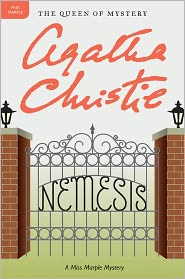
Nemesis

Nemesis. Agatha Christie. 1971/2011. HarperCollins. 304 pages.

In the afternoons it was the custom of Miss Jane Marple to unfold her second newspaper.

I wouldn't say that it's essential that you read A Caribbean Mystery before reading Nemesis. But. If you have read it, you might appreciate Nemesis more.

Nemesis opens with Miss Marple reading about the death of Mr. Rafiel in the newspaper. She met him in the Caribbean, and he was her greatest ally there when she was busy solving that mystery. She liked him a good deal, even though they never reconnected in England afterward. And Mr. Rafiel had great respect for Miss Marple!

One day Miss Marple is contacted by Rafiel's lawyers. They have something important to tell her. It seems that Mr. Rafiel left her a final challenge, a final mystery to solve.

Have you read the book of Daniel? Do you remember when King Nebuchadnezzar dreamed something disturbing and wanted help interpreting that dream. He asked all the wise men for help. But. He refused to tell them the dream. They must come up with the dream and the interpretation. If they weren't able to do both, then they'd be killed.

Nemesis reminded me of this Bible story. For Mr. Rafiel has not provided Miss Marple with any details. Not a where. Not a when. Not a how. Not a who. Not a why. Her greatest chance for solving this one and earning the money he's left her, is for her to go on the vacation he's planned for her: a tour group traveling by bus through England visiting beautiful, historic homes and gardens.

Can Miss Marple do the seemingly impossible?

I enjoyed this one. I wouldn't say it is my favorite Miss Marple mystery. But I'm very glad my library got a copy of this one! (And very happy that HarperCollins has recently published such lovely editions of the Miss Marple mysteries.) If you don't mind a couple of small spoilers, I have something to discuss at the end of this post.

Professor Wanstead and Miss Marple:
"I don't think I know exactly what you mean."
"You are being careful. You are quite right to be careful."
"I have made it a habit," said Miss Marple.
"To be careful?"
"I should not put it exactly like that, but I have made a point of being always ready to disbelieve anything that is told to me." (127)
S
P
O
I
L
E
R

I was disappointed with the way rape was presented in Nemesis. The discussions about rape in the novel were unsettling to say the least. Now, these words weren't coming from Miss Marple herself. So I don't blame the character of Miss Marple for these careless and harmful words.

Professor Wanstead:
"That told against him, of course. Not in the jury's mind, because of course they did not hear about that until after the judge's summing up, but certainly in the judge's mind. It told against him, but I made a few enquiries myself afterwards. He had assaulted a girl. He had conceivably raped her, but he had not attempted to strangle her and in my opinion--I have seen a great many cases which come before the Assizes--it seemed to me highly unlikely that there was a very definite case of rape. Girls, you must remember, are far more ready to be raped nowadays than they used to be. Their mothers insist, very often, that they should call it rape. The girl in question had had several boyfriends who had gone further than friendship. I did not think it counted very greatly as evidence against him." (136)
Mr. Broadribb:
"Well, we all know what rape is nowadays. Mum tells the girl she's got to accuse the young man of rape even if the young man hasn't had much chance, with the girl at him all the time to come to the house while mum's away at work or dad's gone on holiday. Doesn't stop badgering him until she's forced him to sleep with her. Then, as I say, mum tells the girl to call it rape." (165)
These passages made me angry! They did. I wanted to shout at the book. So it's only rape if the woman is a virgin? So the fact that a woman says yes to one man means that she doesn't have the right to say no to any other man...ever? So women are "ready" to be raped? In fact they are out pursuing it?! They are "badgering" and "forcing" them to have sex. Yes, that's right, these poor guys are the victims. Accusing someone of rape is SO MUCH FUN that the women just can't help themselves. They're just begging to be assaulted and raped so they can tell their story to anyone and everyone dumb enough to believe them. What kind of crazy logic is this? It's just wrong on SO MANY levels.


© 2011 Becky Laney of Becky's Book Reviews


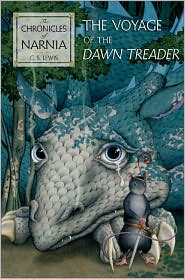
The Voyage of the Dawn Treader

The Voyage of the Dawn Treader. C.S. Lewis. 1952. HarperCollins. 256 pages.

There was a boy called Eustace Clarence Scrubb, and he almost deserved it. His parents called him Eustace Clarence and masters called him Scrubb. I can't tell you how his friends spoke to him, for he had none.

The Voyage of the Dawn Treader is one of my favorite, favorite books. There are seven books in the Chronicles of Narnia, this is the third. Yes, third. For there is NO other way to read the books then in their proper order: The Lion, The Witch, and the Wardrobe, Prince Caspian, The Voyage of the Dawn Treader, The Silver Chair,  The Horse and His Boy, The Magicians Nephew, and The Last Battle.

This third adventure stars Lucy and Edmund Pevensie and their cousin, Eustace Scrubb. These three are transported to Narnia--much to Lucy and Edmund's delight and Eustace's horror and disbelief--through a magical painting. Lucy remarking one day that the ship in the picture looks Narnian, that those waves look like they're moving. Once on board this ship, they meet King Caspian. They join him on his quest to find his father's missing friends, these "seven lost lords": Lord Bern, Lord Octesian, Lord Restimar, Lord Rhoop, Lord Mavramorn, Lord Revilian, and Lord Argoz.

The book is a series of adventures; these adventures being loosely tied together by their one mission, one quest, of discovering the fate of these seven lords. They are NOT out to save the world, NOT out to save Narnia from a dark and evil threat. They are adventuring for the sake of adventuring. They are facing risks, yes, because they are curious and brave and loyal. But they are not facing risks because there is evil lurking and threatening to destroy everything they know and love. Why mention this? Well, if you saw the movie, you might have gotten a different idea of their adventures.

What do I love about this one? The characters and the stories! I love to see how Eustace is turned into a dragon. I love, love, love how he's restored and healed by Aslan. That scene being oh-so-magical! (And the movie? Well? They don't quite capture it the way the book did. They changed things throughout.) There are so many elements that I just loved in this one! Lucy "helping" the invisible dufflepuds, Dark Island and the albatross, etc. And then, of course, there is Reepicheep!!!

So do I recommend this one?! Yes!!! How did I feel about the movie? Well, there were places I enjoyed it. But they rearranged things; they changed things; they added and subtracted. And there were a few scenes that just felt tedious. (The big scene that is supposed to be the climax; the big battle). But it was a beautiful movie. It was compelling even if it was different. Were the changes necessary? I'm not convinced they were. Especially how they felt the need to add conflict and tension between the characters--when there wasn't any in the book. But it wasn't a horrible adaptation.

© 2011 Becky Laney of Becky's Book Reviews


The Spellcoats (MG)

The Spellcoats. Diana Wynne Jones. (The Dalemark Quartet). 1979. HarperCollins. 280 pages.

I want to tell of our journey down the River. We are five. The eldest is my sister Robin. Next is my brother, Gull, and then my brother Hern. I come fourth, and I am called Tanaqui, which is a name from the scented rushes that line the River. This makes me the odd one out in names, because my youngest brother is Mallard--only we always call him Duck.

Did I love it? I'm not sure that I did. Did I like it? Definitely! What I liked most about this one was the setting, the tone. There is something about the way Diana Wynne Jones tells a story. There is something about how she draws readers in slowly but surely. Not that this one has a slow-pace. (Though I wouldn't say the pace is ever thrilling.) It has action, adventure, mystery. All the things you'd expect to find in a fantasy novel, but it's uniquely told, in my opinion. Our heroine, Tanaqui, is weaving this story into two coats--two spellcoats. And there is a richness in the details, in the setting, in the telling. If you're in the right mood, then I think it has great potential. If you're expecting a light, fun, humor-oriented fantasy like Wee Free Men or The Amulet of Samarkand, then you might be disappointed.

My review of Cart and Cwidder.

© 2011 Becky Laney of Becky's Book Reviews


Surviving Antarctica: Reality TV 2083 (MG/YA)

Surviving Antarctica: Reality TV 2083. Andrea White. 2005. HarperCollins. 336 pages.

From the prologue: What chance did Stephen Michael have of winning his Toss? In the year 2080 there were so many fourteen-year-old kids and so few scholarships. And if he lost--he hated to think about his choices then.

From chapter one: THREE YEARS LATER. Andrew Morton was lounging in the soft spot in the tattered couch where he always watched television.

What do Andrew Morton, Polly Pritchard, Robert Johnson, Billy Kanalski, and Grace Untoka have in common with each other? They're all fourteen, and they're all contestants of Historical Survivor, a reality show that 'teaches' by reenactment. This edition of Historical Survivor chronicles the tragic journey of Robert F. Scott and his team. The year? 1912. Their mission? To be the first to reach the South Pole. The Department of Education (DOE) led by Dolly Jabasco (Hot Sauce) will recreate the circumstances faithfully. They will have the tools and resources and supplies that Scott had with him. Can five children succeed where five grown men (experienced explorers) failed? The children, at first, are fearless. They believe that TV is TV. True, there have been a few deaths in past seasons of the show--but those were adults; they're kids. They believe that in a true emergency, the camera crew would be there to save them. Problem is, the camera crew seems to be invisible?! Where are they? How is this show being filmed?!


Told from each teen's perspective and the perspective of one of the editors who chooses to break all the rules, the book is an exciting adventure exploring the ethics and morality of the entertainment industry, society, and the government itself.

Andrea White's novel envisions the world--particularly America in the latter part of the twenty-first century as a shadow of its former self. Having cut all scientific research for economic reasons AND having stopped all public education systems for the same reason. Every household is required to have their children until the age of fourteen watch a certain number of 'educational' programs on TV per week--thirty hours. At the age of 14, each child is given a chance to win a chance at further education (high school, college, etc.) in a roll of the dice type situation. Money is scarce, and society is literally divided into the haves and have-nots.

I loved this one. I would definitely recommend it for fans of The Hunger Games, Divergent, The Maze Runner, and Rash.

Wishes were for people of the twentieth century, not the twenty-first. (10)

She couldn't believe how wrong modern people were. They didn't know that a person's mood came from the inside. (42)

Polly noticed a stack of books on her bedside table. She had read thousands of books on her electronic book card, which she refilled at the computary. But only once had she read a book with an actual cover and pages that turned. It was The Fellowship of the Ring by J.R.R. Tolkien. She could still remember the pleasant hours she had spent with that book one summer on the steps outside her hut, fanning herself because of the heat. (59)

"Did you know that less than ten percent of the public votes in elections?" Chad said.
"No." Steve wasn't old enough to vote yet. But he knew his mom and dad had never bothered to register.
"Well, the more TV people watch, the less likely they are to vote," Chad said. "Do you understand yet?"
Steve shook his head.
"We're still called a democracy," Jacob broke in. "But only the politicians vote. They control who's in office."
"There's a lot of pressure on the Secretary to keep the ratings up," Chad said.
"The stakes are high. She's got to be always on the lookout for a new gimmick," Jacob added.
The series made more sense now. (83)


© 2011 Becky Laney of Becky's Book Reviews


Wyrd Sisters

Wyrd Sisters. Terry Pratchett. 1980/2001. HarperCollins. 288 pages.

The wind howled. Lightning stabbed at the earth erratically, like an inefficient assassin. Thunder rolled back and forth across the dark, rain-lashed hills. The night was as black as the inside of a cat.

Last fall, I discovered the joys of reading Terry Pratchett. This is my first of his adult novels to read. And I did enjoy it very much! It is the story of three witches, Granny Weatherwax, Nanny Ogg, and Magrat, as they attempt to meddle--in a completely non-evil way, of course--with the politics of a kingdom, of a royal family. There is a lost prince--a young person who does NOT know he's the son of the murdered king--living a happy theatrical life. There is the unhappy ghost of the murdered king. And there is the Fool madly in love with Magrat whose sole duty in life is to be loyal to the king--even if this king is a murderer with an unpleasant wife. And then there's Hwel, the dramatic dwarf. I just loved him! There is much to enjoy in this one. The writing is as enjoyable as can be. It's got humor and drama and a certain something that makes Pratchett stand out.

My favorite lines:

Like most people, witches are unfocused in time. The difference is that they dimly realize it, and make use of it. They cherish the past because part of them is still living there, and they can see the shadows the future casts before it. Granny could feel the shape of the future, and it had knives in it. (41)

The duke had managed quite well for fifty years without finding a use for curiosity. It was not a trait much encouraged in aristocrats. He had found certainty was a much better bet. However, it occurred to him that for once curiosity might have its uses. (45)

Particles of raw inspiration sleet through the universe all the time. Every once in a while one of them hits a receptive mind, which then invents DNA or the flute sonata form or a way of making light bulbs wear out in half the time. But most of them miss. Most people go through their lives without being hit by even one. Some people are even more unfortunate. They get them all. Such a one was Hwel. (60)

"What about dwarf bars?"
"You'd hate it," said Hwel, fervently. "Besides, you'd run out of headroom."
"Low dives, are they?"
"Look at it like this--how long do you think you could sing about gold?"
"'It's yellow and it goes chink and you can buy things with it.'" said Tomjon experimentally, as they strolled through the Plaza of Broken Moons. "Four seconds, I think."
"Right. Five hours of it get a bit repetitive." Hwel kicked a pebble gloomily. "Anyway," he added, "you'd get thrown out for being too creative. The actual words are 'Gold, gold, gold, gold, gold, gold.'"
"Is there a chorus?"
"'Gold, gold, gold, gold, gold" said Hwel. (178)

Only in our dreams are we free. The rest of the time we need wages. (195)


© 2011 Becky Laney of Becky's Book Reviews


Divergent (YA)

Divergent. Veronica Roth. 2011. May 2011. HarperCollins. 496 pages.

There is one mirror in my house. Our faction allows me to stand in front of it on the second day of every third month, the day my mother cuts my hair. It is behind a sliding panel in the hallway upstairs.


Beatrice Prior, our sixteen-year-old narrator, is about to make the most important decision of her life. For two big days are coming: the day of the aptitude test and the Choosing Ceremony. Soon Beatrice will have to decide which faction she'll belong to for the rest of her life. If she chooses outside her parents' faction, she may never see them again. For ties to one's faction must come first. The five factions are as follows: Abnegation (the selfless), Amity (the peaceful), Candor (the honest), Dauntless (the brave), and Erudite (the intelligent). Beatrice has been raised Abnegation, but it's always felt like a wrong fit. Selflessness does not come easy for her. She has spent the first sixteen years of her life practically invisible--blending into the background. But Beatrice has secretly been watching her Dauntless classmates. Dare she admit it aloud? She's thinking of choosing the most rebel faction of all!

But not all initiates make it into the Dauntless faction. Only the bravest. Only the strongest. Only the best. Readers follow Tris (Beatrice) on her new journey. We meet fellow initiates--those born Dauntless, and those transferring from other factions. We follow their training through three stages. They will be challenged physically, mentally, and emotionally. We become familiar with their two trainers--Eric and Four. We see the faction's strengths and weaknesses. As does Tris. On the one hand, Tris realizes she is fierce. She can be strong, determined, brave. She is learning to face her fears, learning to face life. But she's also realizing that compassion and love are part of courage. That selflessness has prepared her for her new life. On the other hand, she sees how heartless, how cruel some are. Yes, the Dauntless have their flaws.

Divergent is an action-packed dystopia. It's exciting. It's compelling. It's impossible to put down. The futuristic Chicago setting has been well-crafted. While only two factions are explored in this first novel in the trilogy, the glimpses we get of this world are fascinating. I loved the setting, the world-building. I loved the characters. Tris is such a great heroine. And Four. Well, I don't want to spoil it. But he's definitely a large part of why I loved this one! I would definitely recommend this one. I think I loved it even more than The Hunger Games trilogy.

© 2011 Becky Laney of Becky's Book Reviews


Delirium (YA)

Delirium. Lauren Oliver. 2011. February 2011. HarperCollins.  441 pages.
What the world needs now is love, sweet love
It's the only thing that there's just too little of
What the world needs now is love, sweet love,
No not just for some but for everyone. ~ Hal David, What The World Needs Now, 1965
First sentence: It has been sixty-four years since the president and the Consortium identified love as a disease, and forty-three since the scientists perfected a cure. Everyone else in my family has had the procedure already. My older sister, Rachel, has been disease free for nine years now. She's been safe from love for so long, she says she can't remember its symptoms. I'm scheduled to have my procedure in exactly ninety-five days, on September 3. My birthday. 

Lauren Oliver has created a world without love in her newest YA novel, Delirium. It stars a teen girl, Lena, who falls in love with a guy, Alex, in the last weeks of her freedom, for when Lena turns eighteen, she will receive "the cure" like everyone else. No longer will she be diseased by this thing called love, this destructive force that robs men and women of their reason and logic. When the novel opens, Lena, though susceptible, has not fallen prey to love. (It helps that contact between uncured guys and girls are extremely limited.) But on her Evaluation Day, something happens. Two things really. One, a herd of cows charges through the labs--the building--where the exams are being conducted. Two, someone--a cute boy--winks at her. Can you guess which one has the biggest impact?

Lena is afraid of love, no doubt about it. Her family's history has led her to fear the worst. When she was just six, Lena's mom committed suicide just days before her fourth attempt to be cured. For one reason, or another, the cure just didn't work on her mom. And her mom almost seemed happy about this. Though she had lost her husband, she cherished her memories of him. And above all else, she loved her two kids. She loved singing to them, playing with them, tickling them, laughing with them, hugging and kissing them. In everything she said and did, she showed she cared. But since love was a disease, since love was illegal, Lena is almost ashamed that her childhood had so many happy moments. All her happiest moments should not have happened. For if her mom was normal, chances are she'd still be alive. And Lena's cousin, Gracie, has also suffered from love. For her mom and dad were suspected of being sympathizers and arrested. Gracie will never know her mother. And since her home has been torn apart, Gracie hasn't said one single word. So, yes, Lena has her reasons for her fear.

Will Lena's seventeenth summer be her summer of love? Will she fall in love with the boy who winked at her? Will she fall in love with the boy who encouraged her to listen to music and dance? Will this summer be her happiest yet? Can she be happy knowing that it can never last? That no matter how much she protests, she'll be cured in September? That she'll be expected to live her life according to someone else's plan?

While Delirium is very much a teen romance, it is an interesting premise for a dystopian novel. Because this "cure" does more than prevent broken hearts and passion. For it treats not just romantic love, but all forms of love and desire. It impacts marriages, yes, but it also impact all family relationships. It removes the loving bond between parents and children, between siblings--at least after one of them has received the cure. These "new" families will have no loving parents, grandparents, aunts, or uncles. There will be no one to "model" love or affection to these children growing up in this strange, new world. (Unless a parent is "invalid" and can't be cured.) Friendships among adults are also impacted. As are hobbies, habits, and tastes. Imagine not being able to love anything. Of course, what you'd feel the most is the loss of love in human relationships. But I can't imagine not being able to love reading, listening to music, or the pleasure of savoring dark chocolate. Without love, there can be no joy in any aspect of your life.

The more you "love" Romeo and Juliet, the more you'll appreciate Delirium. I didn't love Delirium because it was a romance novel. It's not particularly better or worse than others I've read in the genre. (Some make me more giddy than others. Alex was no Marcus Flutie.)  But I did enjoy it as a dystopian novel. I enjoyed it because it was thought-provoking.

Favorite lines:

That's the real reason she doesn't speak. All the rest of her words are crowded out by that single, looming one, a word still echoing in the dark corners of her memory. Mommy. I know. I remember. (41)

I'm momentarily distracted by the way he says my name. In his mouth it sounds musical, not clunky and angular, the way my teachers have always made it sound. His eyes are a warm amber color, and as I look at him I have a sudden, flashing memory of my mother pouring syrup over a stack of pancakes. (61)

Snapshots, moments, mere seconds: as fragile and beautiful and hopeless as a single butterfly, flapping on against a gathering wind. (263)

Love: a single word, a wispy thing, a word no bigger or longer than an edge. That's what it is: an edge; a razor. It draws up through the center of your life, cutting everything in two. Before and after. The rest of the world falls away on either side. Before and after--and during, a moment no bigger or longer than an edge. (301)


© 2011 Becky Laney of Becky's Book Reviews


Have His Carcase

Have His Carcase. Dorothy L. Sayers. 1932/1995. HarperCollins. 448 pages. 

The best remedy for a bruised heart is not, as so many people seem to think, repose upon a manly bosom. Much more efficacious are honest work, physical activity, and the sudden acquisition of wealth.

Harriet Vane and Lord Peter Wimsey star in this mystery novel by Dorothy L. Sayers. After the murder charge against her has been dropped, Harriet Vane needs a good vacation. And so we find her, when the novel opens, on a little trip. But relaxing isn't quite the right word for her vacation. For it turns into another murder mystery. She discovers the body of a man on the beach. She has just enough time to take a few quick pictures of the body--of the crime scene--before the tide begins to threaten both. She seeks help--the police--but the damage has already been done. The body has vanished into the sea.

Is this murder? Is this suicide? There seems to be problems with both theories. Lord Peter Wimsey has his ideas--as does Harriet--but can they ever agree with the police in the matter? As these two set about privately investigating the affair, can they work out some of their personal problems too? For you see, Lord Peter still is madly, deeply in love with Harriet. And. He's still proposing. Often.

I still love Harriet and Lord Peter. I do. I just LOVE, LOVE, LOVE Lord Peter Wimsey! I've included some of my favorite scenes--but none of what I include is a spoiler to the mystery, so don't worry about that!

She fell a victim to an inferiority complex, and tripped over her partner's feet.
"Sorry," said Wimsey, accepting responsibility like a gentleman.
"It's my fault," said Harriet. "I'm a rotten dancer. Don't bother about me. Let's stop. You haven't got to be polite to me, you know."
Worse and worse. She was being peevish and egotistical. Wimsey glanced down at her in surprise and then suddenly smiled.
"Darling, if you danced like an elderly elephant with arthritis, I would dance the sun and moon into the sea with you. I have waited a thousand years to see you dance in that frock."
"Idiot!" said Harriet (151).

"Why didn't you sock him one over the jaw?"
"It was a temptation. I felt that you would love me better if I did. But you would not, in your calmer moments, really wish me to put my love before my detective principles."
"Certainly not. But what's his idea?" (152)

"I may be everything you say--patronizing, interfering, conceited, intolerable, and all the rest of it. But do give me credit for a little intelligence. Do you think I don't know all that? Do you think it's pleasant for any man who feels about a woman as I do about you, to have to fight his way along under this detestable burden of gratitude? Damn it, do you think I don't know perfectly well that I'd have a better chance if I was deaf, blind, maimed, starving, drunken, or dissolute, so that you could have the fun of being magnanimous? Why do you suppose I treat my own sincerest feelings like something of a comic opera, if it isn't to save myself the bitter humiliation of seeing you try not to be utterly nauseated by them? Can't you understand that this damned dirty trick of fate has robbed me of the common man's right to be serious about his own passions? Is that a position for any man to be proud of?"
"Don't talk like that."
"I wouldn't, if you didn't force me. And you might have the justice to remember that you can hurt me a damned sight more than I can possibly hurt you."
"I know I'm being horribly ungrateful--"
"Hell!" (167)

"I could kiss you for it. You need not shrink and tremble. I am not going to do it. When I kiss you, it will be an important event--one of those things which stand out among their surroundings like the first time you tasted li-chee. It will not be an unimportant sideshow attached to a detective investigation." (203)

"Now then! My dear, what's happened? You're all of a doodah!"
"Peter! I believe I've been kissed by a murderer."
"Have you? Well, it serves you right for letting anybody kiss you but me. Good heavens! You raise all sorts of objections to a perfectly amiable and reasonably virtuous man like myself, and the next thing I hear is that you are wallowing in the disgusting embraces of a murderer. Upon my soul! I don't know what the modern girl is coming to." (234)
I would definitely recommend Dorothy Sayers. Particularly, Whose Body, Strong Poison, and Have His Carcase.


© 2011 Becky Laney of Becky's Book Reviews


Strong Poison

Strong Poison. Dorothy L. Sayers. 1930/1995. HarperCollins. 272 pages.

There were crimson roses on the bench; they looked like splashes of blood.

I loved this one. I just LOVED, LOVED, LOVED this one! It is a mystery starring Lord Peter Wimsey. And it introduces a new character, Harriet Vane, a novelist. She writes detective novels. Which may not be to her benefit, since when readers first meet her she's on trial for murder, accused of poisoning her ex-boyfriend, Philip Boyes. Since arsenic poisoning happened to be the subject of her latest book, well, they're saying she has all the know-how and a motive to match. One of the last places he was seen--before he took ill--was her place.


But. Hope is not lost. For Lord Peter Wimsey believes wholeheartedly in her innocence. And though he has only a month to prove it, he's determined to find all the proof and evidence needed to clear her name. In Strong Poison, it is more than curiosity motivating him to act. For he has fallen in love with Harriet--heart and soul, truly, deeply, madly in love with her. I *knew* that a romance between these two was coming. I just didn't expect the proposal to be so soon! And it's a little swoon-worthy, I think!
"Such a Victorian attitude, too, for a man with advanced ideas. He for God only, she for God in him, and so on. Well, I'm glad you feel like that about it."
"Are you? It's not going to be exactly helpful in the present crisis."
"No; I was looking beyond that. What I mean to say is, when all this is over, I want to marry you, if you can put up with me and all that."
Harriet Vane, who had been smiling at him, frowned, and an indefinable expression of distaste came into her eyes.
"Oh, are you another of them? That makes forty-seven."
"Forty-seven what?" asked Wimsey, much taken aback.
"Proposals. They come by in every post..." (44)

and
"Why? Oh, well--I thought you'd be rather an attractive person to marry. That's all. I mean, I sort of took a fancy to you. I can't tell you why. There's no rule about it, you know."
"I see. Well, it's very nice of you."
"I wish you wouldn't sound as if you thought it was rather funny. I know I've got a silly face, but I can't help that. As a matter of fact, I'd like somebody I could talk sensibly to, who would make life interesting. And I could give you lots of plots for your books, if that's any inducement."
"But you wouldn't want a wife who wrote books, would you?"
"But I should; it would be great fun. So much more interesting than the ordinary kind that is only keen on clothes and people. Though of course, clothes and people are all right too, in moderation. I don't mean to say I object to clothes." (45)
It was inevitable really. How could I not love Harriet Vane and Lord Peter Wimsey?!

Can Wimsey find the real murderer? Can he free the woman he loves? And if he does free her, will he win her heart?

I would definitely recommend this one. I loved so many things about it--the characters, the writing style, the dialogue, the humor, the suspense.

More of my favorite quotes:
"What a clear mind you have," said Miss Climpson.
"When I die you will find 'Efficiency' written on my heart." (53)
"If anybody ever marries you, it will be for the pleasure of hearing you talk piffle," said Harriet, severely.
"A humiliating reason, but better than no reason at all." (128)

© 2011 Becky Laney of Becky's Book Reviews


Unnatural Death

Unnatural Death. Dorothy L. Sayers. 1927/1995. HarperCollins. 288 pages. 

"But if he thought the woman was being murdered--"

Unnnatural Death begins with Lord Peter Wimsey overhearing a certain conversation. He becomes so curious, he asks the speaker to tell his story--the whole story. Dr. Carr is willing to comply--but, for him, the story does not have a happy ending. Because he followed his instincts, because he voiced his suspicions, he lost his medical practice in a small gossipy town. He is happy to tell what he knows. But he doesn't want to be a part of this new investigation.

Dr. Carr was the physician to an elderly woman, Agatha Dawson. The lady's great niece, Mary Whittaker, was her companion and caretaker. When it became too much for one woman--even a woman with training to be a nurse--to handle, the doctor provided a nurse (or two). The doctor became suspicious when his patient died suddenly. He was almost certain that she had more time to live. He thought for sure she had several months at least. The niece did call him telling him that her aunt was doing poorly, but, his subsequent examination of her didn't match that diagnosis. He definitely had doubts about how "natural" her death was. But he had no proof.

Can Lord Peter Wimsey and Mr. Parker--the 'official' detective from Scotland Yard--find the proof needed to reopen the case? Will this new case prove dangerous?

I liked Unnatural Death. I didn't like it as much as Whose Body? I still like Lord Peter Wimsey. I still like Parker. I still like Sayers' style, her narration. But Unnatural Death seemed more racist (to me) than Whose Body? While Whose Body? was not perfect--in that regard--it didn't seem as abrasive.

Here are a few of my favorite lines:

"I told you I'd be turnin' up again before long," said Lord Peter cheerfully. "Sherlock is my name and Holmes is my nature. I'm delighted to see you, Dr. Carr. Your little matter is well in hand, and seein' I'm not required any longer I'll make a noise and buzz off." (38)

"Who is Miss Climpson?"
"Miss Climpson," said Lord Peter, "is my ears and tongue," said Lord Peter, dramatically, "and especially my nose. She asks questions which a young man could not put without a blush. She is the angel that rushes in where fools get a clump on the head. She can smell a rat in the dark. In fact, she is the cat's whiskers."
"That's not a bad idea," said Parker.
"Naturally--it is mine, therefore brilliant. Just think. People want questions asked. Whom do they send? A man with large flat feet and a note-book--the sort of man whose private life is conducted in a series of inarticulate grunts. I send a lady with a long, woolly jumper on knitting-needles and jingly things round her neck. Of course she asks questions--everyone expects it. Nobody is surprised. Nobody is alarmed." (28-9)

© 2011 Becky Laney of Becky's Book Reviews


The Lost Memoirs of Jane Austen


The Lost Memoirs of Jane Austen by Syrie James. 2007. HarperCollins. 352 pages.

Why I feel the sudden urge to relate, in pen and ink, a relationship of the most personal nature, which I have never before acknowledged, I cannot say. Perhaps it is this maddening illness which has been troubling me now and again of late--this cunning reminder of my own mortality--that compels me to make some record of what happened, to prevent that memory from vanishing into the recesses of my mind, and from there to disappear for ever from history, as fleeting as a ghost in the mist.

Last year, I LOVED Syrie James' The Secret Diaries of Charlotte Bronte. I didn't love, love, love The Lost Memoirs of Jane Austen. I'm not even sure I liked it. But. I found it an entertaining read. The book is a fictionalized autobiography, the supposed "last writing project" of a dying Jane. In her "memoir" she reveals her true love. How her brief relationship with him changed her--for the better. (For the record, this relationship is NOT physical or intimate.)

This love is Mr. Ashford. And he seems to be Jane's perfect match in many, many ways. He's able to hold his own in conversation with her. He is intelligent and handsome and seems to genuinely care for Jane. But Jane's true love, well, he's got a few secrets. And his behavior, well, that "inspires" the messy romances of Sense & Sensibility. For Jane's Mr. Ashford is one part Edward, one part Willoughby.

And Mr. Ashford isn't the only person "inspiring" Austen's fiction. (For example, Mr. Collins is inspired by Mr. Morton.) These "inspirational" scenes can be a bit risky. How many are really needed? How much is too much? I'm not one of those that think every single character in every single book needs to have been "inspired" by a real person. (One of the reasons I hated--yes, HATED, Searching for Pemberley by Mary Lydon Simonsen.)

This memoir blends truth with fiction. We do know some things about Austen's life, for example, especially about her family life. And James does a nice job in adding a bit of romance to that life. And for most of the novel--the second half at least--readers get the chance to see Austen hard at work writing and revising.

I liked to see Austen writing. I liked to see her close friendship with her sister. But. I didn't love the romance. Not really. Because even though Mr. Ashford isn't Tom Lefroy, it still felt similar enough to Becoming Jane for me to not quite like it. Not to the same degree, perhaps, which is good. And I did like this book better than Miss Austen Regrets.

Would reading The Lost Memoirs of Jane Austen make readers want to read more Austen? I'm not sure. The only Austen I've not read (or reviewed) is Mansfield Park. I've read Sense and Sensibility, Northanger Abbey, Persuasion, Emma, Lady Susan, Pride and Prejudice. Have you read this one? What did you think? 

© Becky Laney of Becky's Book Reviews


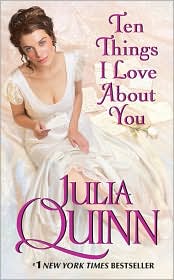
Ten Things I Love About You

Ten Things I Love About You. Julia Quinn. 2010. HarperCollins. 384 pages.
"The key to a successful marriage," Lord Vickers pontificated, "is to stay out of the way of one's wife." Such a statement would normally have little bearing on the life and fortunes of Miss Annabel Winslow, but there were ten things that made Lord Vickers's pronouncement hit painfully close to the heart. One: Lord Vickers was her maternal grandfather, which pertained to Two: the wife in question was her grandmother, who Three: had recently decided to pluck Annabel from her quiet, happy life in Gloucestershire and, in her words, "clean her up and get her married." Of equal importance was Four: Lord Vickers was speaking to Lord Newbury, who, Five: had once been married himself, apparently successfully, but Six: his wife had died and now he was a widower, and Seven: his son had died the year prior, without a son of his own. Which meant that Seven: Lord Newbury was looking for a new wife and Eight: he rather thought an alliance with Vickers was just the thing, and Nine: he had his eye on Annabel because Ten: she had big hips. Oh, blast. Had that been two sevens?
Annabel sighed, since that was the closest she was permitted to slumping in her seat. It didn't really signify that there were eleven items instead of ten. Her hips were her hips, and Lord Newbury was presently determining if his next heir ought to spend nine months cradled between them.
Ten Things I Love About You is the sequel to What Happens In London. It stars Sebastian Grey, the handsome cousin of Sir Harry Valentine. He is spending a lot of time (especially meal times) with Harry and Olivia. What he does outside of their company may shock society--at first--and it's not seducing married women. Every one knows he does that. (Hint: his real secret is revealed in the prologue. So it isn't a secret for long. And it's a rather delightful secret, in my opinion. But I hesitate to mention it because even though it is revealed early on in this book. It might effect how others read What Happens in London.)

The heroine, Miss Annabel Winslow, meets our hero when she is running away from Lord Newbury. The good news? Newbury's lusty advances were thwarted in time. It doesn't make Annabel feel any cleaner. She's still disgusted by the thought of his hands on her body--anywhere on her body. But at least she escaped...this time. She doesn't know Sebastian's name. He doesn't know hers. But for whatever reason, they're able to talk to one another freely. In seclusion. Both know it's improper--she's obviously an innocent. Not his usual "type" at all. But there's just something drawing them together...

When she does learn his name, well, that's when she learns how dangerous it could be. For Lord Newbury is Sebastian's uncle; he's next in line to inherit if Newbury doesn't have another son. She KNOWS that these two are enemies. And she knows that many, many people would disapprove of even the smallest acquaintanceship between the two. He has a horrible reputation. No one has to tell her that much.  (She did come across him politely "waiting" to return to the party after a secret meeting with a woman). So why can't she forget him?

I enjoyed Ten Things I Love About You. I loved Sebastian (though I can't tell you why) and I really liked Annabel. I also liked Olivia and Lady Louisa. While it is different (in quite a few ways) from What Happens In London, I thought it worked. It reminded me more of The Duke and I and When He Was Wicked.   

© Becky Laney of Becky's Book Reviews


What Happens in London

What Happens in London. Julia Quinn. 2009. HarperCollins. 384 pages.

By the age of twelve, Harry Valentine possessed two bits of knowledge that made him rather unlike other boys of his class in England of the early nineteenth century. The first was his complete and absolute fluency in the languages of Russian and French. There was little mystery surrounding this talent; his grandmother, the extremely aristocratic and opinionated Olga Petrova Oblenskiy Dell, had come to reside with the Valentine family four months after Harry's birth.

I love Julia Quinn's Regency romances. I do. There's just something about her writing (most of the time) that I just love. I love how she develops her characters. How well she captures individuality and personality. (Some of her couples I "love" more than others.) They are romances, and there are only so many ways for  it to go; but while reading a Quinn novel, it feels special, it feels different, like she's capturing a unique story between two people falling in love. It's very satisfying to discover each couple's story. I think two things contribute to this:  the narrative style, how most of her romances are presented from both the male and female perspective, and her dialogue. Quinn is able to capture her characters best when they're interacting with one another, when they're talking. Humor helps, of course.

What Happens in London is a great example of her humor. I loved how Olivia Bevelstoke and Sir Harry Valentine fall in love. I love how it is not love at first sight. I love how puzzled they are about one another. He's her new neighbor, and she ends up spying on him through her window. (Until she knows that he knows that she's spying at any rate!) I love how Harry teases Olivia. How he knows he's being "spied" on and acts accordingly. I love how these two get to know one another by reading a book together,  a very "bad" gothic romance by Sarah Gorely called Miss Butterworth and the Mad Baron. I love all the quotes from that book. (Very, funny stuff!) The book ends up being very important to them all...

I also loved some of the secondary characters, especially Sebastian Grey and Olivia's twin brother, Winston.

The "smuttiness" of this one may not be for everyone. (Though I think it's relatively tame compared to some romance authors, and some classics even.) I thought the book as a whole was very well done. I loved the characters. I loved the humor. It is one of my favorite (adult) romances of the year.

© Becky Laney of Becky's Book Reviews


Enchanted Glass (MG/YA)

Enchanted Glass. Diana Wynne Jones. 2010. HarperCollins. 292 pages.

When Jocelyn Brandon died--at a great old age, as magicians tend to do--he left his house and his field-of-care to his grandson, Andrew Brandon Hope. Andrew himself was in his thirties. The house, Melstone House, was a simple matter of making a Will. But it had been old Jocelyn's intention to pass the field-of-care on in the proper way, personally. 

I am NOT a fan of this cover! If I wasn't already a fan of Diana Wynne Jones, if I didn't already know that she can tell some great stories, then I'm not sure I would have ever given this one a try. (What do you think? Do you like the cover? Isn't the UK cover a thousand times better?!)

I enjoyed so many things about Enchanted Glass. I liked "Professor" Hope. I liked Mr. Stock. And Mrs. Stock. (Oh how these two hate each other. One is the gardener, the other the housekeeper. BOTH of course have minds of their own. And think that they always, always know best. This gets quite comical.) I liked Aidan too. Who is he?! Well, that's a good question. One that Andrew eventually gets around to asking. You see, this young boy turns up one day--on a Monday--asking, in a way, for sanctuary. He's being stalked by evil creatures, you see, and his grandmother (who's recently died) always told him to see help at Melstone House if ever he was in trouble. He's just one of three visitors that turned up on that busy, busy Monday. And "Professor" Hope allows them all to stay--in one way or another. He hires an assistant (secretary) despite not really wanting one. He grants her a one month trial period. He hires an assistant groundskeeper, too, though this time on a week's trial. He likes to please people. But don't assume that he doesn't have his own tricks. He can manipulate people as well.

The story centers on Andrew Hope and Aidan Cain. And all the strange people (some human, others not quite) in their lives. Melstone House and its surrounding woods has an interesting history. There's something almost magical about the place. Something that Andrew will need to learn all about...he'll need to... if he hopes to protect those close to him.

I really enjoyed it. I just LOVED the first half. (I found it amusing and charming and lovely). The second half wasn't--in my opinion--as wonderful as the beginning. (Though I suppose you could say most of the action occurs in the second half. The confrontation between good and evil and such.) I didn't like the ending. There was something about it--which, of course, I can't say without spoiling it--that I didn't like at all.

© Becky Laney of Becky's Book Reviews


Twitter Delicious Facebook Digg Favorites More