Showing posts with label YA nonfiction. Show all posts

The Story of Britain

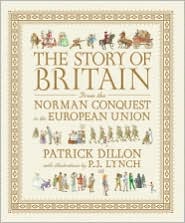
The Story of Britain From the Norman Conquest to the European Union by Patrick Dillon. 2011. Candlewick Press. 352 pages.

From the introduction: Long ago, on the eastern edge of the Atlantic Ocean, there were two islands.

The title for this one says it all. The introduction takes readers from 55 BC to 1066 AD. And the remaining chapters cover the years 1066 to 1999. There are six sections: "The Middle Ages," "The Tudors," "The Stuarts," "The Georgians," "The Victorians," and "The Twentieth Century." So what kinds of things get covered in the entries? Well. Kings. Queens. Parliaments. Wars. Revolutions. Invasions. Religious Conflicts. Politics. Economics. Social class divisions. Scientists and inventors. Explorers and empire-builders. A few influential authors. A little bit of everything really. It isn't just about the monarchy. It isn't just about the wars Britain has taken part in through the centuries. Though both of those take up a significant place in the book. The book also tries to cover Scotland and Ireland and Wales.

The Story of Britain is concise and creative. Within the entries themselves, readers will find it almost impossible to find a date. (I'm guessing that the author did NOT want to be like a text book and use dates to bridge together sentences like "And then this happened. And then this happened. And then this happened.) The dates are instead found within the timeline at the end of each section. The text itself is casual and conversational. And you might say creative. He gives voice to a variety of people in society--groups of people and individuals--by using dialogue. (Most entries have quotation marks--but many of these quotation marks are not quoting a *real* source. Though of course some are. The quotation marks that rely on primary sources or reference materials use italics so readers know what's what.) I'm not sure how I feel about this really. On the one hand, I think it keeps the book light and conversational. But on the other hand, I like to keep fiction and nonfiction separate from one another. And the narrator of this one definitely is not as objective as he could be--as he should be perhaps? I could definitely see some of his statements as having an agenda. For better or worse. I mean when you write with a message, with an agenda, with a slant--readers will either already agree with you because they share your views OR not agree with you because they don't share your viewpoint on that particular issue. While I suppose any history book--any text book--could be seen as having bias, of not really being as objective as it could be, I found this one noticeably so.

Did I like it? In places. I found it informative and reader-friendly. There were gaps in my education--and my education for British history basically came from my literature courses and my love for historical fiction--and this book helped me connect the dots. I don't think I loved it. Not as much as I was hoping. But. It was still an entertaining read.

© 2011 Becky Laney of Becky's Book Reviews


Nonfiction Monday: The Good, The Bad, and the Barbie

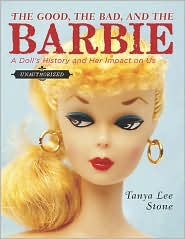
The Good, The Bad, and the Barbie: A Doll's History and Her Impact On Us. Tanya Lee Stone. 2010. October 2010. Penguin. 144 pages.

From the foreword (by Meg Cabot): When I was six, I wanted a Barbie more than I can remember ever wanting anything in my life.
From the prologue: It was a very pink year.
From chapter one: Ruth Handler looked absolutely nothing like a Barbie doll. And she did not aspire to.

Tanya Lee Stone's nonfiction book on Barbie is balanced and objective. She gives every side a voice. So you'll find those who think Barbie is evil, those who loved to destroy Barbie, mutilate her, those who strongly believe Barbie is detrimental to self-esteem. But. You'll also hear stories from those who loved Barbie. In some cases, loved, loved, loved Barbie. Stories about what they loved best about her, how they played with her, how having Barbie helped their imaginations, how Barbie is an inspiration--but not only in the way you might think!

So what should you expect from this one? A bit of history and context. A look at how Ruth Handler helped create the Mattel toy company. A look at how Ruth Handler created Barbie. Readers also learn about the dolls production through the decades. How the culture has impacted Barbie's design--everything from hair color, eye color, skin color, body design, to her clothes and other accessories. There is a whole chapter on the portrayal of race/ethnicity. Readers also learn a little bit about some of Barbie's friends and relations.

But the book goes beyond the doll and her design. The book intimately looks at how she has been played with by children everywhere. How she has been loved. How she has been hated. How she's been given hair cuts. How some have enjoyed making their own clothes for Barbie. And how others feel that only "store bought" clothes will do for their doll. Tonya Lee Stone sprinkles her text with quotes which was a nice touch.

What seems obvious to me--and maybe to you too--is that Barbie is who you want her to be. You have a large role in defining who she is. Not everyone feels that way, of course. Many would argue that there is only one "Barbie" way to be. But I'd disagree. (Perhaps the first step is to never have a Barbie named Barbie. Barbies are given life, given personality, by their owners. You are the one writing her story.)

Did I like this one? Yes and no. I found it disturbing in places. I found it ugly in places. I did NOT want to read about people taking pleasure in torturing, mutilating, abusing Barbie. But. There were places I liked it. I liked, for example, reading about how much Megan McCafferty credits Barbie for helping her develop her storytelling.


© Becky Laney of Becky's Book Reviews


Nonfiction Monday: Shipwreck at the Bottom of the World

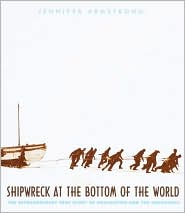
Shipwreck at the Bottom of the World: The Extraordinary True Story of Shackleton and the Endurance. Jennifer Armstrong. 1998. Random House. 144 pages.

Just imagine yourself in the most hostile place on earth. It's not the Sahara or the Gobi Desert. It's not the Arctic. The most hostile place on earth is the Antarctic, the location of the South Pole--what's the difference? The Arctic is mostly water--with ice on top, of course--and that ice is never more than a few feet thick. But under the South Pole lies a continent that supports glaciers up to two miles in depth. Almost the entire southern continent is covered by ice. The mammoth icecap presses down so heavily that it actually distorts the shape of the earth. The ice never melts; it clings to the bottom of the world, spawning winds, storms, and weather that affect the whole planet.

Shipwreck at the Bottom of the World is an amazing survival story. Against all odds, these men--twenty-eight in all--led by Ernest Shackleton survived the harshest conditions imaginable. Of course, when these men set sail they had big dreams. They wanted to become the first team of explorers to cross Antarctica. But life doesn't always go as planned. And when their ship became trapped by ice, their mission changed. To survive was all that mattered. 

I loved this book. I did. There is a very good reason it won the Orbis Pictus Award for Outstanding Nonfiction. It fascinates from cover to cover. Amazing writing--storytelling. The book is so engaging, so compelling, so powerful, so amazing. I think the story would be gripping no matter who told it. But I do think that Jennifer Armstrong did a wonderful job in painting a very human picture of Shackleton and his crew. I think the ending was beautiful--very moving! This one is a book I think everyone should read.


© Becky Laney of Becky's Book Reviews


Twitter Delicious Facebook Digg Favorites More