Showing posts with label YA Science Fiction. Show all posts

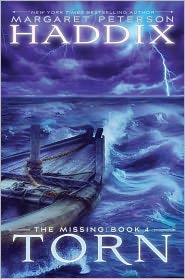
Torn (MG)

Torn. Margaret Peterson Haddix. 2011. Simon & Schuster. 352 pages.

"We didn't know what we were doing," a voice whispered near Jonah's ear. 

I really loved this fourth novel in the Missing series. I can't say that I've loved each of the novels equally. Though each has had its moments. But I can say that I've really enjoyed the series--or the idea behind the series. I love the time travel element. I love how each novel--or to be more precise, the second, third, and fourth novels--have focused on one time in particular. In the fourth novel, Jonah and his sister have been sent to 1611. They arrive on board Henry Hudson's ship just hours before a mutiny occurs. Jonah is posing as Hudson's son, and, well there is a lot depending on him. For the two have been told--and they have every reason to believe it--that time is falling apart and that they are the only two in position to repair the damage.

I would say that this is definitely a series you need to read in order. I'm not sure that Torn would be such a great read if you weren't familiar with the previous books.

If you enjoy action, adventure, history, mystery, and science fiction, then this series is definitely worth trying.

© 2011 Becky Laney of Becky's Book Reviews


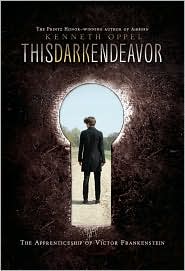
This Dark Endeavour (YA)

This Dark Endeavour: The Apprenticeship of Victor Frankenstein. Kenneth Oppel. 2011. Simon & Schuster. 304 pages.

We found the monster on a rocky ledge high above the lake. For three dark days my brother and I had tracked it through the maze of caves to its lair on the mountain's summit.

What if Victor Frankenstein had a twin? A dying twin desperately in need of a cure. What if Victor Frankenstein's passion for "science" was the result of his desire to save his brother--no matter the cost. Is it that simple? What do you think? This is VICTOR Frankenstein after all!

This is a prequel to Mary Shelley's Frankenstein. Is it perfect? Or should I say a perfect-perfect match to Shelley's original novel? No, I can't say that it is. Perhaps because the original does not take the time to TRULY develop the Frankenstein family. Yes, we get a very, very, very strong idea of who Victor is--or was--but as for his immediate family, do we really get to know them in the original novel? Get to know them in a meaningful way? I don't know that we ever do. Is Elizabeth anything more than a picture or a symbol of a beautiful, innocent woman tragically sacrificed? And his brothers, well, we know their names essentially. Henry Clerval, well, we get a little more--but we get it through the eyes of Victor. And CAN WE REALLY TRUST ANYTHING AT ALL HE SAYS ABOUT ANYONE? (Not that I have opinions.) Anyway, this novel is a chance to meet the characters--or one author's idea of those characters.

Don't expect the details to match Shelley's story. Just don't. But if you can take it for what it is--a good adventure story with plenty of action and suspense--then you may just find yourself enjoying it.

Do I like Oppel's Frankenstein more than Shelley's? I can't say that I did. For even at a young age he seems a bit mad, a bit dark, a bit evil. Not in an oh-so-obvious way perhaps. It's just that his feelings for his brother...and his feelings for Elizabeth...are obviously complex. The way his brother loves, loves, loves Elizabeth, and the way she loves, loves, loves him in return. Well, Victor can't STAND that for a moment.

I am very glad I read this one. I was very curious about it. And I am thrilled to see an adaptation of Frankenstein. I wouldn't say that this one wowed me or that I thought it was the best book ever. But it certainly gave me something to think about. Mainly that Elizabeth was one very strong, very strong-willed, very spunky character. She has faith--it's true--and she's essentially good. But she's a FIGHTER. And she's not afraid to speak her mind. The Elizabeth of this novel cannot easily be reconciled with Shelley's original.

© 2011 Becky Laney of Becky's Book Reviews


Mister Creecher (YA)

Mister Creecher. Chris Priestly. 2011. Bloomsbury. 390 pages.

Billy pulled his clammy coat collar tightly to his throat. It was damp with the fog and felt like the tongue of a dead animal lolling against his neck. His thin body shivered and trembled. He was fifteen but looked eight. A fever sweat glistened on his forehead. His breaths were short; they puffed from his mouth in feeble wisps.

When the novel opens, our hero, Billy, is getting ready to rob a corpse. The corpse in question turns out not to be a corpse at all, but a "Mr. Creecher." A dead-looking man of large proportion. He "saves" Billy just moments later when a mean gang of thieves (Billy's also a thief of course) shows up threatening him. But his "savior" wants Billy to do a little work for him. He wants Billy to follow two men about town. A Mr. Frankenstein and a Mr. Clerval. Billy easily agrees to this. And so it begins...an odd friendship of sorts...partly based on convenience and circumstance.

At first Billy barely knows a thing about Creecher. And he doesn't mind not knowing. What little he has heard, what little mumblings (or grumblings) he's heard, he's been able to ignore. And even when the truth--the Creecher's truth--is revealed, Billy has a hard time REALLY believing that such a thing is so, that something like that is even possible. But as the story progresses, Billy hears more and more of the Creecher's tale. At times Billy thinks he talks WAY TOO MUCH. He accuses him of talking like a girl, a woman. Of being too in-touch with his feelings, of loving novels and reading too much. I didn't agree with every little thing Billy said. (I was later very glad I didn't!!!) But. It provided an interesting perspective of viewing Mary Shelley's creation or creature.
'Shut up!' Billy snapped. 'Why do you have to be such a...'
He snarled and kicked a moss-covered branch and sent it tumbling into the darkness. Without the coachlights, the moon provided the only illumination to the scene.
'You see how it is for me,' said Creecher. 'I try to help and--'
'It's always about you, isn't it?' said Billy. 'Oh, poor me--I'm ugly and no one likes me. Boo hoo, boo hoo. Well, life ain't a bowl of cherries for the rest of us neither!'
'But you can live among them...'
Billy fumed for a few moments, unable to express his feelings. The truth was he had never felt part of 'them.' He had never belonged.
'Oh yeah. I can get treated like filth,' he replied. 'I can starve or steal. I can hang. If you want someone to feel sorry for you, you've come to the wrong place.' (191)
The novel is set in the middle of Frankenstein. The creature has requested Frankenstein create a mate for him, and Victor has agreed. The novel ends with them on their way to Scotland.

I liked this one. I really, really liked it. I'm not sure that I absolutely loved it. I'm not sure it will make my favorites list. But I am SO GLAD I read it. I found it a great read. Very quick, very enjoyable. The tone of this one was just right. It was just a great, great read. It definitely made me think!

© 2011 Becky Laney of Becky's Book Reviews


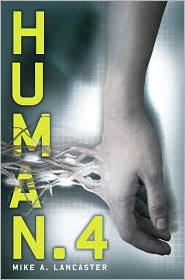
Human.4 (YA)

Human.4 Mike A. Lancaster. 2011. Egmont USA. 240 pages.

When Danny Birnie told us that he had hypnotized his sister we all though he was mad. Or lying. Or both.

Our narrator, Kyle Straker, is living in a strange, strange world where he and three others have suddenly become irrelevant. It started when he volunteered at a local talent show to be hypnotized. It wasn't that he wanted to volunteer, just that in a moment of weakness he had pity on Danny while he was doing his act. His former girlfriend, Lilly, also happened to volunteer just about the same time he did. Two adults, Mrs. O'Donnell and Mr. Peterson, also volunteered. All were hypnotized. All woke up in this strange, strange new reality.

This book is part science fiction, part horror, and part mystery. It was a quick read! I liked it. I wouldn't say I loved it. But for a quick premise-driven read, it was a good choice.

© 2011 Becky Laney of Becky's Book Reviews


Into the Parallel (YA)

Into the Parallel. Robin Brande. 2011. Ryer Publishing. 392 pages.

They said it couldn't be done.
Well, that's not exactly true.
They said it couldn't be done by a 17-year-old girl sitting alone in her bedroom on a Saturday morning.
Well, that's not exactly true, either, since it's not like there's some physicist out there who specifically made that prediction--"A seventeen-year-old girl in her pajamas? Never!"--but the point is, no one is going to believe me even if I can prove what happened, which I'm not really sure I can. 
But I know I did it. I was there. I didn't imagine it or dream it or go into some sort of altered state that confused me. I felt the wind. I smelled the dog's breath. I saw our mother. I drank some tea. It all happened. 
So if she's real--and I know she is--I just have to prove it. Go there again and this time bring something back. Like a strand of her hair or a piece of her fingernail.
Something with her DNA on it. To prove that she is me. 

Audie Masters, our heroine, dreams big. She wants to prove that parallel universes exist. She wants to be accepted into Columbia. She wants her best friend's brother, Will. Of course, all three have seemed impossible--at one point or another. But one day one of her dreams does come true.

She travels to a parallel universe. She meets her alternate-self, Halli. And the two become friends--good friends. They like meeting one another. They like comparing and contrasting their realities. It seems that while some things remain the same, there are many, many differences. There are some things about Halli's world that sound really appealing. Then again, there are a few things that seem a little off.

Audie can't help becoming a little obsessed with her discovery, can't help wanting to spend all her free time in this parallel universe, sacrificing sleep and homework. (Not that it is really a sacrifice to her to sacrifice homework!)

But some secrets are too good to keep to yourself, and she contacts a physicist, Professor Whitfield, and she shares her discovery with him, her excitement with him. He is just as thrilled as she is. Especially when he sees her video. But he has some reservations about experimenting too much with travel between worlds (or universes or realities or whatever you want to call it). But isn't that a little too much to expect?

So the novel is about Audie's adventures in both universes, how she balances her two lives. This is the first in the series.

I'm not so sure my review is doing this one justice. I can only say that the characters were well-developed, and the premise was fascinating. This book is easy to spend an afternoon with! Robin Brande is a talented writer. She creates characters that you care about, characters that you feel like you know. It never takes me long to get hooked on one of her books, and Into the Parallel was no exception.

© 2011 Becky Laney of Becky's Book Reviews


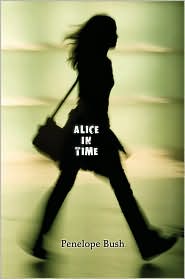
Alice in Time (MG)

Alice in Time. Penelope Bush. 2011. Holiday House. 208 pages.

"I'm not wearing it."
"Yes you are."
"No, I'm not." 
Repeat those last two sentences about fifty times and you'll get some idea of what I'm up against. I'm trying to get my little brother into his page-boy outfit so that we won't be late for Dad's wedding, but I've been trying for the last hour without success.

I picked up Alice in Time because I was interested in the time travel premise. Alice, our heroine, is fourteen and miserable. She thinks her life is ruined, and it just happens that everyone else is to blame for all her woes. Her parents are divorced. Her relationship with her dad and his new wife, a bit awkward. And her brother, well, he's a bother and then some. Her mom is the worst of all. Even Imogen, her best friend, doesn't understand her. It seems the whole world is against her...

One late night in the park, a spin on the merry go round, a little accident ends up changing Alice's life forever. She wakes up from the accident as a seven year old. Her teenage memories are intact, but she's now seven again. She's forgotten how to be a kid, though, which makes this transition a bit tricky. Her mom definitely does NOT like the new Alice, who has turned mean and disrespectful and disobedient. What happened to her little angel that loves playing with Barbie and needed help brushing her hair and braiding it?

Alice soon decides that she'll try to "fix" all the problems of her life. She'll try to stop her cat from getting run over by a car. She'll try to warn her Grandma about the cancer. She'll try to warn anyone and everyone about her mom's postpartum depression. She'll try to stop her mom from throwing her dad out of the house, etc. The question becomes what should she do with her classmates? Should she make the same decisions? Should she choose Imogen over Sasha? Or Sasha over Imogen? Or should she choose a new path altogether? What if she could change her life for the better by choosing a whole new set of friends?

Of course, Alice doesn't really know what the consequences of any of her actions will be... One thing is for sure, this new-new Alice will be a different girl.

I liked Alice in Time. I didn't love it; I didn't hate it. I thought it took a little too long to get to the merry go round. Though that could be just me, since the time travel element is what I was most interested in. And Alice wasn't very likable. She was a brat. A full-time brat. But as she began to grow up a little (by growing down), I began to like her more and more.

© 2011 Becky Laney of Becky's Book Reviews


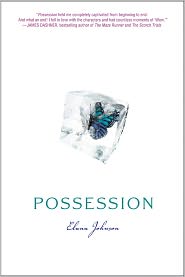
Possession (YA)

Possession. Elana Johnson. 2011. Simon & Schuster. 416 pages.

Good girls don't walk with boys. Even if they're good boys--and Zenn is the best. 

Possession seems like the kind of book a dystopian-lover would love. But this one proved disappointing to me. The more I read, the more that disappointment grew. I'll try to explain.

It's one thing for a dystopian novel to throw the readers into a foreign world where they're unsure of the rules of the society and culture. But to leave readers confused for over 400 pages? To leave readers struggling to even make sense of the basic story structure? That's a big disappointment. As I said, it's one thing if there are a few missing pieces of the puzzle. The author could have done that on purpose, after all. The reader's confusion could be intentional. But I don't know if I believe that an author would intentionally confuse readers for hundreds of pages. (Well, yes, there's James Joyce and T.S. Eliot. But that's a different story.)

I believe that when you read a book, you should be able to turn the pages and know whose head your inside--who is doing the narrating, whose perspective you're seeing. Call me silly, but, that's just the way I am.

Violet, our heroine, has not been quite as obedient as she should have been. She has a way of unplugging from the messages the authorities send--to everybody--messages that tell them how to live, behave, conform, etc. The voices that 'manage' them. But even if she's not brainwashed--she's still capable of thinking for herself, for the most part, she's not extremely rebellious. She's not out to start a revolution, she's not out to break down the powers that be. She just wants to take a little walk with her match and best friend, Zenn. She just wants to have a little alone time now and then. Of course, that breaks the rules. But it hardly seems fair that such offenses would lead to prison either. But that is just what happens to Vi. In prison she meets another boy, Jag, and if labels are to be believed, he is "bad." But this 'bad boy' has a certain appeal and these two seem to share a common destiny, a common enemy. Once these two team up....well, that's when things get started.

The novel has an interesting premise: a mind-controlling government. And the novel has romance potential. Readers know from the start that Vi will at one point or another be called to choose between the boy from her past (Zenn) and the boy of the moment (Jag). Readers--for better or worse--know more about Jag than Zenn. But that isn't necessarily a horrible thing. Zenn is present for the novel, just not in a romantic, heroic way. And Jag, well, even though he's got hero potential. Well, he's not going to go out of his way to act like a ROMANTIC hero when bigger things are at stake. (I actually like that).

While I didn't fall for Jag myself, that is, I didn't find him swoon-worthy, I can see that Vi and Jag belong together. I think they deserve each other. Jag can get under Vi's skin and drive her crazy. And she can get under his skin and drive him crazy. The things she accuses Jag of, she's guilty of doing herself. And the things Jag accuses Vi of, well, he's just as guilty. If either were with a more honest person, there could be trouble. When these two fight--and they do fight--it's impossible to take sides. Because they're the pot and the kettle.

The ending. What can I say? Am I really more disappointed by the ending than I was the middle? It's not fair to say. I do think it's a bit open, a bit of a cliffhanger. If it is truly 'the end.' It is a LOT more open than most YA novels I read. (Which wouldn't be a bad thing.) If it's just trying to build up suspense for a book two, it's a bit annoying, but what else is to be expected these days? 

I didn't hate Vi. I didn't hate Jag. I didn't hate Zenn. I didn't hate the world Elana Johnson created. I really didn't feel strongly enough about it to hate it. Hate requires passion and energy. It's just that I didn't connect with them enough to "like" the novel. Readers are different. Some people love plot-driven or premise-driven novels. I tend to care more about the characters, to want a story to be character-driven. So there's a chance you might appreciate Possession more than I did.

© 2011 Becky Laney of Becky's Book Reviews


Ruby Red (YA)

Ruby Red. Kerstin Gier. 2011. Henry Holt. 336 pages.

I first felt it in the school canteen on Monday morning. For a moment it was like being on a roller-coaster when you're racing down from the very top. It lasted only two seconds, but that was long enough for me to dump a plateful of mashed potatoes and gravy all over my school uniform. I managed to catch the plate just in time, as my knife and fork clattered to the floor.

Gwyneth Shephard has been waiting and watching knowing that at any minute her cousin, Charlotte, could disappear. For Charlotte has the gene, the time traveling gene that has been passed down through the women in the family. Charlotte has had several dizzy spells the last week, but so far, she's remained in her own time.

How does her family "know" that Charlotte is the one? Well, according to the prophecy--or the prediction--the one will have been born on October 7th. Gwyneth, who was born on October 8th, has nothing to worry about. She's not the one.

Does she want to be the one? She's never really given it that much thought. Every member of her family has their own eccentricity, their own "gift." Even if those gifts are just laughable--such as her great-aunts visions. No one takes those visions seriously. And no one--outside her best friend--takes Gwen's gift seriously, Gwen's gift of seeing ghosts.

So what will happen to this very strange, very dysfunctional family when the "wrong" girl vanishes into the past? For Gwyneth it is beyond confusing. She never knows when it will happen, when she'll be pulled back into the past, at what year she'll travel to, what dangers she may be facing, how long she'll stay before returning to her own time. What Gwyneth needs most are answers to her questions.

But answers are hard to come by. For the guardians like to keep their secrets. And Gideon her traveling companion? Well, what does she really know about him? Except for the fact that he feels cheated or disappointed. So they're not off to the best of starts...

I liked Ruby Red. I'm not sure I loved it. It made me curious, I won't lie. But there are still so many questions. I do feel this is just the beginning, that this was just the prologue for all that is to come. So it's got some promise, some potential. But on it's own, well, it doesn't quite satisfy. It leaves me wanting the next book. (Which is NOT a bad thing necessarily!)


© 2011 Becky Laney of Becky's Book Reviews


Legend (YA)

Legend by Marie Lu. 2011. November 2011. Penguin. 336 pages.

My mother thinks I'm dead. Obviously I'm not dead, but it's safer for her to think so. At least twice a month, I see my Wanted poster flashed on the JumboTrons scattered throughout downtown Los Angeles. It looks out of place up there. Most of the pictures on the screens are of happy things: smiling children standing under a bright blue sky, tourists posting before the Golden Gate Ruins, Republic commercials in neon colors. There's also anti-Colonies propaganda. "The colonies want our land," the ads declare. "They want what they don't have. Don't let them conquer your homes! Support the cause!"

Legend is YA dystopia. Perhaps not YA dystopia at the very, very best. But it is definitely one of the better dystopias I've read this year.  Legend is compelling; it is exciting; it is just a great read.

The novel has two narrators: a guy named Day (Daniel) and a girl named June. Both underwent the "trials" at age 10. June received a perfect, perfect score earning her not only the right to higher education (high school and college) but the right to the best education possible, the kind of education that will prepare her for serving the Republic. Day, well, he didn't pass his trials. And like all other low-scoring 10 year olds, he was sent away to labor camp. Once a 10 year old is sent to labor camp, they're never ever heard from again.

When the novel opens, both teens are about 15. Day is a wanted criminal, an outlaw. He doesn't legally exist in the Republic database, in the Republic records. The authorities don't even know what he looks like--what race or ethnicity he may be. So their wanted posters change quite often allowing for every possibility. (It's the occasional finger print on the crime scene that links Day to particular crimes.) Day is in Los Angeles spying on his family. His older brother, John, is the only one in the neighborhood who still knows he's alive. And it is to John he delivers gifts--food, clothes, medicine, money, etc.  Day becomes worried when his family's home is marked with a red X--a symbol that someone within the home has the plague. This is very bad news indeed.

June, on the other hand, is at the top of her class. Though she's just fifteen, she's almost finished with her training, her education. June is anxious to start working for the Republic, to start serving in the military, to start tracking down criminals like Day. Her wish comes true--but not in the way she expected. She wanted to start working with her older brother, Metias. Instead, she takes his place after he is murdered. And it appears that Day is the one responsible for his stabbing. Metias was trying to stop Day from escaping from the hospital after a break in. (Day was hoping to find plague cures for his family.) June is on a mission, and it is personal. She'll track down Day and bring him to justice no matter what.

The chapters alternate in narrators, and for once I think this is a great idea. Usually, I'm not a big fan of this in novels, but in this case, it not only works, it works well! I was able to care about Day and June--almost from the start!

Legend is action-packed. It's an intense read. But an enjoyable one! I'd definitely recommend it!!!


*My review is based on an ARC.
**Have you seen this list of YA dystopias?!


© 2011 Becky Laney of Becky's Book Reviews


As I Wake (YA)

As I Wake. Elizabeth Scott. 2011. September 2011. Penguin. 224 pages.

Wake up.
I'm in bed. Sheets and blankets tucked around me, my legs sprawled out like I've fallen. No light in the room except faint yellow and a darker, colder gleam shining through the window, its curtains only partly closed.
Where I am?
I don't know these sheets, this bed, this room.
I look down at myself, see soft fabric wrapping me from neck to knees. My feet are bare.
There are dark shapes all around.

You never quite know what you're going to get with an Elizabeth Scott novel. This certainly wasn't Bloom or Perfect You or Living Dead Girl or Grace. Then again, that's one of the things that I love about Elizabeth Scott. She never stops surprising me.

As I Wake is part mystery, part science fiction novel. Ava, our heroine, wakes up one day without her memory. There's a woman, Jane, claiming to be her mom. There's a group of teens claiming to be her best friends--Greer, Sophy, Olivia. There's a cute guy, Ethan, whom her friends tell her is her crush. But Ava remembers nothing. There's not a single memory to match her with the life she's supposedly lived. But it's not just that she has no memories of being Ava, it's that she has memories of being a different Ava. The memories that come to her, well, they just don't fit in with what she knows about Ava. Certain people are triggering memories--just not the right memories. So what's going on? That's the mystery Ava and readers have to solve...

I enjoyed this one. I can't say I understood it all while I was reading. I can't even say I'm sure that I understand it now after finishing it and thinking about it for a couple of hours. But was it a compelling read? Yes.

© 2011 Becky Laney of Becky's Book Reviews


Sharp North (YA)

Sharp North. Patrick Cave. 2004/2006. Simon & Schuster. 528 pages.

The girl nearly didn't find out who she was. What she was.

Sharp North is a perplexing YA novel. Part mystery. Part thriller. Part dystopian. It's set in a future world forever altered by global warming. A future world with a corrupt government. (How many fictional future worlds don't have a corrupt government?) A future world threatened by an underground movement, a revolution in the making. Our heroine, Mira, has a role to play in this world--for better or worse. And it's a role that mystifies Mira. For Mira's future is just as uncertain as her past.

Sharp North begins with a murder. Mira witnesses this murder, this hushed up murder, and it forever changes the way she sees the world, the way she sees her community. In part because she finds out that she is connected to the victim. She finds a piece of paper, a mere scrap, with a list of names. Her name is on the list. And so is the name of one of her friends, Gil Moore. He's listed as "her watcher." But why is he watching her? Is he her friend or her enemy? Is he out to see that she survives? Or is he in place to eliminate her? That's what Mira can't forget, can't erase. Are the people who murdered this mysterious woman, this mysterious stranger, out to get her? What led to this crime? For even if the whole world chooses to ignore it, Mira can't. Was it the woman's curiosity? Well, Mira can't help being curious now!

So Mira sets out on a journey to discover the truth, the truth about who she is, what she is. In a way she's running away from danger just as much as she's running straight into it. For Mira hasn't a real clue who her enemies are and who her friends may be. Is there a safe place for Mira? Or is she destined to upset the balance of those around her?

We meet a few interesting characters in Patrick Cave's Sharp North. Including several members of the Saint family, one of the "Great Families" that govern in this new world.

Maybe other readers can piece together this mystery. Maybe other readers can read it without being confused by the ending--as for me, well, I'm puzzled by how it ended. I still don't know what really happened.

So did I like it? Yes and no. I liked the idea of it. But. It felt like two or three stories pieced together. And it didn't always work for me.

© 2011 Becky Laney of Becky's Book Reviews


Outside In (YA)

Outside In. Maria V. Snyder. 2011. Harlequin. 336 pages.

My world changed in a heartbeat, that's how it felt to me. As if one second ago, I was Trella the lower level scrub, cleaning the air and water ducts of Inside, and now I am Trella the victorious leader of the Force of Sheep rebellion.

After the rebellion, after the Lowers proved to themselves and the Uppers that their voice was worth being heard, Trella thought life would start to improve. But a series of terrorist actions threaten everything--soon Trella doesn't know who to trust. For the truth is, no one is quite sure who the enemy is. Is the enemy an old threat or a new foe?

This one is the sequel to Maria V. Snyder's Inside Out. Both books are science fiction. Both are set in space--on space ships. Both have plenty of action and adventure. There's definitely a romantic story to both books. As our heroine, Trella, struggles with matters of the heart under extreme stress. Her world is in danger, yet, she's falling in love.

I enjoyed both books. I found both to be quick reads.

© 2011 Becky Laney of Becky's Book Reviews


Matched (YA)

Matched. Ally Condie. 2010. Penguin. 369 pages.

Now that I've found the way to fly, which direction should I go into the night? My wings aren't white or feathered; they're green, made of green silk, which shudders in the wind and bends when I move--first in a circle, then in a line, finally in a shape of my own invention. The black behind me doesn't worry me; neither do the stars ahead.

Cassia, the heroine of this dystopian YA novel, is on her way to her Match banquet. This is THE night where she will learn the identity of the man she'll spend the rest of her life with. It's also the day Cassia turns seventeen. Just one of many coincidences, perhaps, of Ally Condie's Matched.

For it is revealed that her match is her best friend, Xander. Usually, one's match is a complete stranger. The fact that she knows him--that she knows and loves him--well, it's a strange coincidence. But that's just the beginning. For when she looks on her microcard, a microcard that should be full of pictures and background information on her match--she catches a glimpse of another friend, Ky. For a moment, only a moment, it appears that Cassia has two matches. This kind of mistake should NEVER happen. And it's corrected by a visiting Official who tries her best to convince Cassia that it was a mistake, nothing more. Ky could never, ever, ever be her real match. Because he's not good enough to be anyone's match.

Any guesses which young man Cassia starts to fall in love with?

I enjoyed Matched. I wouldn't say that I loved it absolutely. But I enjoyed it. I found it entertaining and satisfying. I liked Cassia. I liked Ky. I liked Xander. I liked Cassia's family. Her brother, Bram, her father and mother, her grandfather. I was interested in the world Condie created. I liked the role poetry played in this one. How forbidden poems were used to help reveal some of the mysteries. It just worked for me.

Favorite quotes:
The almost-snow reminds me of a line from a poem we studied this year in Language and Literacy: "Stopping by Woods on a Snowy Evening." It is one of my favorites of all the Hundred Poems, the ones our Society chose to keep, back when they decided our culture was too cluttered. They created commissions to choose the hundred best of everything: Hundred Songs, Hundred Paintings, Hundred Stories, Hundred Poems. The rest were eliminated. Gone forever. For the best, the Society said, and everyone believed because it made sense. How can we appreciate anything fully when overwhelmed with too much? (29)
Every minute you spend with someone gives them a part of your life and takes part of theirs. (65)


© 2011 Becky Laney of Becky's Book Reviews


XVI (YA)

XVI. Julia Karr. 2011. Penguin. 272 pages.

"Nina, look." Sandy jabbed me in the ribs.

XVI is a new dystopian novel. I love dystopian novels, usually. But I wasn't loving this one. I didn't connect to the characters. I didn't believe the romance. I failed to connect with the story, with this new world Karr created.

Nina Oberon is the star of this one. Her best friend, Sandy, is unbelievably annoying--though still a few weeks from her sixteenth birthday, she's acting like a sex-teen already. In other words, she's stopped thinking and has bought into the media's belief system completely. Why is Nina best friends with Sandy? Well, it's hard for readers to know for sure. I can only assume that a few years ago, Sandy, had to be less annoying and more likable.

Nina also has a younger sister, Dee. Since their mother is murdered fairly early in the novel, it becomes Nina's responsibility to protect Dee from her father, Ed. So Nina's life is getting crazier by the day, and trying to make sense of her life, her world, what everything means, well, it could be a full time job. Nina does make a few new friends, friends that are actually capable of thinking, to help her in this difficult time, this dangerous time.

One of these new friends is a guy named Sal. Though Nina is convinced she is not ready for a boyfriend, she can't help wanting Sal in her life. She can't stop thinking about him, wanting him, needing him. Will Sal help her solve some of the big mysteries in her life? Will Sal help keep her safe?

So why didn't I love this one? Why didn't I like it? Why didn't I like Nina and Sal? I'm not sure. It just felt a little lacking. I just felt disappointed with it. It could be just bad timing. You may love this one. (I hope you do enjoy it more than I did.)

© 2011 Becky Laney of Becky's Book Reviews


Wither (YA)

Wither. Laura DeStefano. 2011. Simon & Schuster. 368 pages.

I wait. They keep us in the dark for so long that we lose sense of our eyelids. We sleep huddled together like rats, staring out, and dream of our bodies swaying. I know when one of the girls reaches a wall. She begins to pound and scream--there's metal in the sound--but none of us help her. We've gone too long without speaking, and all we do is bury ourselves more into the dark. The doors open. The light is frightening. It's the light of the world through the birth canal, and at once the blinding tunnel that comes with death. I recoil into the blankets with the other girls in horror, not wanting to begin or end.

Did I like Wither? Yes! I really LOVED it! One of the best 2011 books that I've read so far. Rhine Ellery knows almost exactly when she'll die--and why she'll die. Mad scientists, so called geniuses, from previous generations have manipulated human genes too much. Having created the "oh-so-perfect" generation of children, they've cursed the human race. Every woman dies from a deadly virus at age 20. Every man dies from that virus at age 25.Will there be a cure found in Rhine's lifetime? Maybe, maybe not. She's just sixteen. But she's not that hopeful. Rhine knows one thing for sure. She does NOT want to spend her remaining years in a forced marriage with two other sister wives. Even if her husband, Linden, is ignorant of how his three wives really came to be his. Even if he doesn't know the truth about his father's schemes and manipulations. No, Rhine wants to be free, needs to be free. She wants to find her twin brother, Rowan, and live the rest of her days free. But will she find a way to escape?

I enjoyed Wither! I enjoyed spending time with Rhine and her sister wives, Cecily, the youngest, Jenna, the oldest. I also enjoyed spending time with Gabriel, one of the servants who works at the estate. Their developing friendship adds a great deal of excitement to the novel! I didn't hate Linden. While Rhine may not have fallen for him, may not have found that lifestyle tolerable under any circumstances, I can't help pitying him.

Overall, I found the novel fascinating and compelling. The world Lauren DeStefano created was haunting and horrible and so wonderfully developed. I'd definitely recommend this one.

She wanders down one of the aisles, and I follow her as she runs her finger along the spines of books, taps one of them, eases it out of its place. The book is dusty, the cover eaten away, the pages yellow and brittle as she flips through them. All of these books are from the twenty-first century or earlier, which isn't very strange. The television also airs old movies, and most shows are set in the past. It has become a form of escapism to visit a world in which people live a long time. What was once real and natural has become a fantasy. "There are lots of love stories here," she says. "They either end happily, or everyone dies." She laughs, but it sounds more like a sob. "What else is there, right?" (86)

A few minutes later we're huddled under a blanket on a couch in the sitting room, sharing a gallon of vanilla ice cream she ordered from the kitchen, and we're watching an early-morning rerun of yesterday's soap opera. Along with the romance novels, these are another of her guilty pleasures. The actors are all teenagers made up to look much older. Jenna tells me they're constantly changing the actors, since of course the show has been on for more than a decade and the original actors have died by now. The only consistent actors are first generations. And as she's explaining to me who's in a coma and who unknowingly married an evil twin, both of us bathed in the television's glow, I do start to relax a little. (243)
You might also be interested in reading: Divergent by Veronica Roth, Delirium by Lauren Oliver, Across the Universe by Beth Revis, The Hunger Games by Suzanne Collins, and The Maze Runner by James Dashner.


© 2011 Becky Laney of Becky's Book Reviews


Surviving Antarctica: Reality TV 2083 (MG/YA)

Surviving Antarctica: Reality TV 2083. Andrea White. 2005. HarperCollins. 336 pages.

From the prologue: What chance did Stephen Michael have of winning his Toss? In the year 2080 there were so many fourteen-year-old kids and so few scholarships. And if he lost--he hated to think about his choices then.

From chapter one: THREE YEARS LATER. Andrew Morton was lounging in the soft spot in the tattered couch where he always watched television.

What do Andrew Morton, Polly Pritchard, Robert Johnson, Billy Kanalski, and Grace Untoka have in common with each other? They're all fourteen, and they're all contestants of Historical Survivor, a reality show that 'teaches' by reenactment. This edition of Historical Survivor chronicles the tragic journey of Robert F. Scott and his team. The year? 1912. Their mission? To be the first to reach the South Pole. The Department of Education (DOE) led by Dolly Jabasco (Hot Sauce) will recreate the circumstances faithfully. They will have the tools and resources and supplies that Scott had with him. Can five children succeed where five grown men (experienced explorers) failed? The children, at first, are fearless. They believe that TV is TV. True, there have been a few deaths in past seasons of the show--but those were adults; they're kids. They believe that in a true emergency, the camera crew would be there to save them. Problem is, the camera crew seems to be invisible?! Where are they? How is this show being filmed?!


Told from each teen's perspective and the perspective of one of the editors who chooses to break all the rules, the book is an exciting adventure exploring the ethics and morality of the entertainment industry, society, and the government itself.

Andrea White's novel envisions the world--particularly America in the latter part of the twenty-first century as a shadow of its former self. Having cut all scientific research for economic reasons AND having stopped all public education systems for the same reason. Every household is required to have their children until the age of fourteen watch a certain number of 'educational' programs on TV per week--thirty hours. At the age of 14, each child is given a chance to win a chance at further education (high school, college, etc.) in a roll of the dice type situation. Money is scarce, and society is literally divided into the haves and have-nots.

I loved this one. I would definitely recommend it for fans of The Hunger Games, Divergent, The Maze Runner, and Rash.

Wishes were for people of the twentieth century, not the twenty-first. (10)

She couldn't believe how wrong modern people were. They didn't know that a person's mood came from the inside. (42)

Polly noticed a stack of books on her bedside table. She had read thousands of books on her electronic book card, which she refilled at the computary. But only once had she read a book with an actual cover and pages that turned. It was The Fellowship of the Ring by J.R.R. Tolkien. She could still remember the pleasant hours she had spent with that book one summer on the steps outside her hut, fanning herself because of the heat. (59)

"Did you know that less than ten percent of the public votes in elections?" Chad said.
"No." Steve wasn't old enough to vote yet. But he knew his mom and dad had never bothered to register.
"Well, the more TV people watch, the less likely they are to vote," Chad said. "Do you understand yet?"
Steve shook his head.
"We're still called a democracy," Jacob broke in. "But only the politicians vote. They control who's in office."
"There's a lot of pressure on the Secretary to keep the ratings up," Chad said.
"The stakes are high. She's got to be always on the lookout for a new gimmick," Jacob added.
The series made more sense now. (83)


© 2011 Becky Laney of Becky's Book Reviews


This World We Live In (YA)

This World We Live In. Susan Beth Pfeffer. 2010. Houghton Mifflin Harcourt. 239 pages.

I'm shivering, and I can't tell if it's because something strange is going on or because of the dream I had or just because I'm in the kitchen, away from the warmth of the woodstove. It's 1:15AM, the electricity is on, and I'm writing in my diary for the first time in weeks. 

This World We Live In is the sequel to Susan Beth Pfeffer's Life As We Knew It and the dead & the gone. The novel opens at the end of April, it has almost been a full year since the asteroid collided with the moon and life forever changed. In the second novel starring Miranda Evans (and her family), life beyond the sunroom is explored more fully. In Life As We Knew It, there was a routine dullness. Since Miranda, Matt, Jon, and their mom, Laura, rarely ventured out of their two-or-three room sanctuary, there was a sameness to the end of the world. That isn't quite the case with This World We Live In. For this book is ALL about change. Everything is changing--and these changes are coming quite quickly, surprising just about everyone! Soon Miranda's world will include more people--expanding from four to eleven! Among the new people in Miranda's life are Alex and Julie Morales first introduced to readers in the dead & the gone. How will her world change? Will these changes bring hope and love to her bleak life?

This is the second time I've read the novel--the third time if you count listening to the audio book. The first time left me shocked. I couldn't feel satisfied. I couldn't feel hopeful. I couldn't feel much of anything. I needed time and space. I needed to reread the whole trilogy. I needed to see the big picture--to see if there was a big picture.

This World We Live In is a challenging read. It requires readers to care deeply and passionately about these characters, to become a part of their lives, and a part of Pfeffer's strange, cruel world. There is much to contemplate, much to discuss. Particularly when it comes to this ending. I won't go there for this review. I won't. I don't think it's fair to those who have not read the book.

While this one isn't my favorite of the trilogy, I do recommend it.

A year ago I was sixteen years old, a sophomore in high school. Matt was in his freshman year at Cornell and Jon was in middle school. Dad and Lisa had asked me to be godmother to their new baby. Mom was between book projects. I know I've gained a lot in the past year, but I woke up this morning and all I could think about was everything I've lost. No, that's not right. Not everything, everybody. Everything doesn't matter, not really. After a while you get used to being cold, and hungry, and living in the dark. But you can't get used to losing people. Or if you can, I don't want to. So many people in the past year, people I've loved, have vanished from my life. Some have died; others have moved on. It almost doesn't matter. Gone is gone. (61)

If you'd asked me a week ago what it would take for me to feel better, I would've said knowing how Dad and Lisa and the baby were, meeting a boy my own age, and running water.
Now I have all three. I guess I must feel better. (101)

"You don't have to beg here," I said. "We're happy to share."
"No one is happy to share," he said.
Alex looked down then or I looked up. I don't know how it happened, but we made eye contact, and for a moment I was drawn into his soul. I could see everything, the depth of his sorrow, his anger, his despair.
I feel sorrow and anger and despair. I don't think there's a person alive who doesn't. I sometimes feel like my sorrow and anger and despair burn inside me the way the sun used to burn on a hot July day.
But that was nothing compared to what I sensed in Alex. His sorrow, his despair was like a thousand suns, like a galaxy of suns. It physically hurt me to look into his eyes, but I couldn't break away. He turned his head first, and then he apologized, or maybe he thanked me. For Alex I think they're the same thing. (107-8)

© 2011 Becky Laney of Becky's Book Reviews


The Dead and the Gone (YA)

the dead & the gone. Susan Beth Pfeffer. 2008. Houghton Mifflin Harcourt. 321 pages.

At the moment when life as he had known it changed forever, Alex Morales was behind the counter at Joey's Pizza, slicing a spinach pesto pie into eight roughly equal pieces.

The dead & the gone is the companion novel to Susan Beth Pfeffer's Life As We Knew It. While Miranda's story--set in Pennsylvania--chronicles her life from May through March of that decisive year, Alex's story--set in New York City--chronicles his life from May through December. Both are family-oriented. Miranda's life being closely tied to her mom and two brothers; Alex's life being closely tied to his two younger sisters, Brianna and Julie. But Alex's story is stronger in many ways. For Alex is the head of the family--for better or worse. Alex is the one making life-and-death decisions. His mom vanished on May 18th--the day the asteroid struck the moon. His dad may or may not have survived the first terrible week. Having been in Puerto Rico for a funeral, he's unable to make contact with his family. And, well, the coasts were hit hard--again and again. So even surviving the first tsunamis might not mean much in the long term. His older brother, Carlos, is in the Marines. He was far from home when it happened, and while he's able to send word--by phone or mail--a few times throughout the book. He's not the one in charge. He's not the one responsible for making the tough decisions on how to best survive. So while Miranda has to grow-up, it is a gradual growing into adulthood. She still has her relaxed moments. There is never one moment for Alex to relax. He carries a heavy weight day and night.

I enjoyed rereading Life As We Knew It and the dead & the gone back to back. There are things I love about both books. Things I appreciate about both books. One thing that makes the dead & the gone a very different story is the focus on faith and community. The dead & the gone is faith-oriented. Alex and his family are Catholics. They all attend Catholic school. They all regularly attend mass. They take their faith, their spirituality, their religion very seriously. The words mean something. The faith means something to them. Something real. Something personal. While each of the siblings has their own reaction--response--to the crisis, none loses their faith, none lose hope completely. I loved seeing this Catholic community in action. I loved seeing the Catholic church reaching out in love and compassion--with great hope and faith--to their community, to their parishioners. There were so many great scenes of this faith-in-action. Where people were responding with their hearts in faith as opposed to acting out of fear and anxiety. It's courageous and wonderful.

The dead & the gone has a broader outlook as well. While the electricity isn't reliable on a day-by-day basis in the dead & the gone, it is certainly more stable than in Life As We Knew It. Alex is connected to the larger world. He hears--for better or worse--more about the world at large. He is more aware of what is going on in other states. While Miranda and her family may go weeks or months without contact to other survivors, Alex is out of the house most days--at least before the flu epidemic comes. He's not as isolated as Miranda. Does not being so isolated help him cope? Maybe. But every day, every week is a struggle. Alex does things he'd NEVER thought he'd be doing.

Is Alex more of a hero than Miranda? I'm not sure that is exactly fair. Miranda has her courageous moments too. (I'm thinking of the woodstove mishap.) But. Alex's story has power no doubt about it.
I would definitely recommend both books.

"Give the scientists some time and they'll figure out what to do."
"This is too big for the scientists," Lorraine said. "Only God can save us now."
"Then He will," Alex said. (13)

God save their souls, Alex prayed. God save ours. It was the only prayer he could think of, no matter how inadequate it might be. It offered him no comfort, but he repeated it unceasingly. As long as he prayed he didn't have to think. He didn't have to remember. He didn't have to decide. He didn't have to acknowledge he was entering a world where no one had laid out the rules for him to follow, a world where there might not be any rules left for any of them to follow. (65)

"She says you've been having bad dreams."
"Aren't you?" Julie asked. "Isn't everyone?"
Alex burst out laughing. "Only sane people," he said. "Okay, maybe not Bri. But everyone else is."
"Are things going to get better?" Julie asked. "Is that why you listen to the news all the time, because someday things are going to get better?"
Alex shook his head. "That's not why I listen," he replied. "That's why I pray but not why I listen."
"Do you think God listens?" she asked.
"Bri thinks so," Alex said. "Father Franco thinks so." (81)

It was hard being alone in the apartment staring at an unringing phone, haunted by the food in the kitchen, which he wouldn't allow himself to touch, haunted even more by the image of his mother drowning in the subway that very first night. He tried reading. He tried praying. He tried push-ups. He tried counting the cans of soup. He listened to the radio, using up the twenty-dollar batteries. The world was coming to an end. Well, that was nothing new. (123)

"And what's so special about you that you deserve compassion?" Father Mulrooney said. "You have shelter. You have food. You have family and friends. I'm supposed to feel pity for you because of a cut cheek?"
"You don't understand at all," Alex said. "I have shelter for as long as no one thinks about it. Once they do, once they realize my father is gone, they can throw us out. I have food only if I get lunch here. We're down to almost nothing at home, and I have to make sure my kid sister eats. She is my family right now, because my parents are both gone and my older brother is in the Marines somewhere and I sent my other sister to live at a convent with strangers. My cheek was cut because I got caught in a food riot, with my kid sister, and we ended up with no food anyway. I'm not asking you to pity me. I pity me enough for the two of us. But when one of your students asks you for food, you shouldn't say no and feel righteous about it. That's not what Christ would have done, and you know it." (133)

"What do you have planned for tomorrow?"
Alex shrugged. "The usual," he said. "Checking on the elderly, studying theology, fighting for survival. Same old, same old." (151)

"I know it's wrong to feel that way about God and I know it's wrong to not feel anything. I hate it. I don't hate God. I hate not loving Him." (184)


© 2011 Becky Laney of Becky's Book Reviews


Life As We Knew It (YA)

Life As We Knew It. Susan Beth Pfeffer. 2006. Houghton Mifflin Harcourt. 352 pages.


Lisa is pregnant. 

Life As We Knew It by Susan Beth Pfeffer is one of my favorite books. It's one of the few young adult books that I reread regularly. I believe--counting the audio book--that this was my fifth time to read this bleak book. (The only other book I reread with that much regularity is Mary Shelley's Frankenstein.)

It stars Miranda and her family (a mom and two brothers--Matt, the older, Jonny, the younger). Miranda's world is turned upside down one May--and it isn't just her world--when an asteroid crashes into the moon bringing it closer to Earth; nature turns violent, extreme, deadly. No one--at that point--knows how bleak it will be, how many lives will be lost. Not just from tsunamis, floods, earthquakes, and volcanoes, but from disease and malnutrition too.

They are dealing with the loss of modern conveniences-- extremely limited amounts of natural gas and oil, and no electricity. (It's rare to have electricity.)

So how does one survive? Where do you find food? How can you ever have enough when you don't know how long this crisis will last? How long it will be before food supplies reach your town? What if no relief ever comes? How do you find water? How do you cook your food if you have a gas-stove or electric stove? How do you heat your homes without gas, oil, or electricity? How do you keep things sanitary and hygienic? How do you stay healthy? How do you stay smart?     

Miranda is one of the fortunate ones. She has a quick thinking mom who at the first opportunity rushes to the grocery store and buys close to a dozen carts of food and other necessities before the shelves are emptied completely. And they do live in a wooded area and happen to have a wood-burning stove. And miraculously enough they have magic well water that works without an electric pump. (That one still boggles.) But this struggle to survive is very personal, very compelling.

I enjoy Miranda and her family. I enjoy reading Miranda's journal. Is Miranda perfect? No! Is her family perfect? No! They argue. They fight. They get on each other's nerves. They love each other very, very much. And they are all dealing with harsh conditions, bleak situations. There is fear and tension and anxiety. But there's also love and hope.

My favorite quotes:

“Sometimes when Mom is getting ready to write a book she says she doesn’t know where to start, that the ending is so clear to her that the beginning doesn’t seem important anymore. I feel that way now only I don’t know what the ending is, not even what the ending is tonight” (16).

“For a moment I thought about all the people throughout history who saw Halley’s Comet and didn’t know what it was, just that it was there and frightening and awe inspiring. For the briefest flick of a second, I could have been a 16 year old in the Middle Ages looking up at the sky, marveling at its mysteries, or an Aztec or an Apache. For that tiny instant, I was every 16 year old in history, not knowing what the skies foretold about my future.” (18)

“And then it hit. Even though we knew it was going to, we were still shocked when the asteroid actually made contact with the moon. With our moon. At that second, I think we all realized that it was Our Moon and if it was attacked, then we were attacked.” (18-19)
“What about desserts?” I asked. “If the world comes to an end, I’m going to want cookies.” “We’re all going to want cookies if the world comes to an end,” Mrs. Nesbitt agreed. “And chips and pretzels. If the world is coming to an end, why should I care about my blood pressure?” “Okay, we’ll die fat,” Mom said. “Grab what you can grab and ram it into your wagons. But remember if we actually need this stuff, we’re going to be a lot more grateful for a can of soup than for a box of stale cookies.” “Speak for yourself,” Mrs. Nesbitt said. (34)
 “I guess I always felt even if the world came to an end, McDonald’s would still be open.” (46)
“Lately I’ve been trying not to know what’s going on. At least that’s the excuse I’ve been giving myself for not caring about all the stuff that’s happening outside of my little section of Pennsylvania. Who cares about earthquakes in India or Peru or even Alaska?
Okay that’s not fair. I know who cares. Matt cares and Mom cares and if there were any baseball involved, Jonny would care, too. Knowing Dad, he cares. Mrs. Nesbitt, too.
I’m the one not caring. I’m the one pretending the earth isn’t shattering all around me because I don’t want it to be. I don’t want to know there was an earthquake in Missouri. I don’t want to know the Midwest can die, also, that what’s going on isn’t just tides and tsunamis. I don’t want to have anything more to be afraid of.
I didn’t start this diary for it to be a record of death.” (70-71)
“We have clean sheets to sleep on, a clean house, clean clothes, clean dishes. We spent the evening laughing. It wasn’t 90 degrees in the house when we went to bed. We weren’t hungry. We’re not worried about Dad. I know what it feels like to be kissed by a boy. If I could, I would relive this day over and over. I can’t imagine a more perfect one.” (95-96)
“I can’t decide which is worse, no electricity or unreliable electricity. I wonder if I’ll ever have to decide which is worse, life as we’re living or no life at all.” (119)
“Here’s the funny thing about the world coming to an end. Once it gets going, it doesn’t seem to stop.” (120)
“I told Mom I was doing history (she never would have believed me if I said math) and stayed in bed all morning.” (191)

“I know I’m going to have to be strong for the next couple of weeks. No more whining. No more picking fights. I’ll have to do whatever Mom asks me and not protest and not complain. I know I can do it. But for that one moment I felt so weak, so helpless. I felt nothing but fear and despair and the most awful need to be anyplace else. I told myself it was hunger, but I knew that was a lie.
As long as Mom was all right, I could fool myself into thinking we’d all be all right.” (206)
“It’s funny how sorry I feel for Jon these days. I’m 2 1/2 years older than him and I feel like got those 2 1/2 years to go to school and swim and have friends and he got cheated out of them. And maybe he’ll live 2 1/2 years longer than me, or 20 years or 50, but he’ll still never have those 2 1/2 years of normal life.

Every day when I go to sleep I think what a jerk I was to have felt sorry for myself the day before. My Wednesdays are worse than my Tuesdays, my Tuesdays way worse than my Tuesday of a week before. Which means every tomorrow is going to be worse than every today. Why feel sorry for myself today when tomorrow’s bound to be worse?
It’s a hell of a philosophy, but it’s all I’ve got.” (275)


“But I hope when I get closer to death, however old I might be, that I can face it with courage and good sense the way Mrs. Nesbitt does.” (234)

“A while ago Jonny asked me why I was still keeping a journal, who I was writing it for. I’ve asked myself that a lot, especially in the really bad times.
Sometimes I’ve thought I was keeping it for people 200 years from now, so they can see what our lives were like.
Sometimes I’ve thought I’m keeping it for that day when people no longer exist but butterflies can read.
But today, when I am 17 and warm and well fed, I’m keeping this journal for myself so I can always remember life as we knew it, life as we know it, for a time when I am no longer in the sunroom.” (337)


© 2011 Becky Laney of Becky's Book Reviews


The Giver

The Giver. Lois Lowry. 1993. Houghton Mifflin. 180 pages.

It was almost December, and Jonas was beginning to be frightened. No. Wrong word, Jonas thought. Frightened meant that deep, sickening feeling of something terrible about to happen. Frightened was the way he had felt a year ago when an unidentified aircraft had overflown the community twice. He had seen it both times. Squinting toward the sky, he had seen the sleek jet, almost a blur at its high speed, go past, and a second later heard the blast of sound that followed. Then one more time, a moment later, from the opposite direction, the same plane.

The Giver is one of my FAVORITE books, and one of my favorite books to reread. I love spending time with Jonas. I love reading about his world, his family. I love the strangeness of it. How this community has made an idol of sameness and sought to control just about everything. The community chooses not only your life's profession, but your spouse and children too. (If you're lucky enough to be granted either. Not everyone is. Some are common laborers, after all.)  But I don't want to say too much. Because I do think this makes for a better read if you don't know too much ahead of time. 

When the novel opens, Jonas, is preparing for The Ceremony of Twelve. He's apprehensive, yet curious. What occupation will he be assigned? Will he like his training and enjoy his new responsibilities? Will it really take him away from his closest friends? His parents warn him that it will, that this really is the start of his new life, his adulthood. Jonas's assignment is life-changing--no doubt about it! It's also quite unique. It has been several generations since a new Receiver has been announced....

But just what is it he'll be receiving? Can he handle the stress and anguish? Can he handle the truth it will bring to light?!

"We don't dare to let people make choices of their own."
"Not safe?" The Giver suggested.
"Definitely not safe," Jonas said with certainty. "What if they were allowed to choose their own mate? And chose wrong? Or what if," he went on, almost laughing at the absurdity, "they chose their own jobs?'
"Frightening, isn't it? The Giver said.
Jonas chuckled. "Very frightening. I can't even imagine it. We really have to protect people from wrong choices."
"It's safer."
"Yes," Jonas agreed. "Much safer." (98-9)

"Do you love me?"
There was an awkward silence for a moment. Then Father gave a little chuckle. "Jonas, You, of all people. Precision of language, please!"
"What do you mean?" Jonas asked. Amusement was not at all what he had anticipated.
"Your father means that you used a very generalized word, so meaningless that it's become almost obsolete," his mother explained carefully.
Jonas stared at them. Meaningless? He had never before felt anything as meaningful as the memory.
"And of course our community can't function smoothly if people don't use precise language. You could ask, 'Do you enjoy me?' The answer is 'Yes,'" his mother said. "Or," his father suggested, "Do you take pride in my accomplishments?' And the answer is wholeheartedly 'Yes.'"
"Do you understand why it's inappropriate to use a word like 'love'?" Mother asked.
Jonas nodded. "Yes, thank you, I do," he replied slowly.
It was his first lie to his parents. (127)


© 2011 Becky Laney of Becky's Book Reviews


Twitter Delicious Facebook Digg Favorites More