Showing posts with label J Fantasy. Show all posts

The Phoenix and the Carpet (MG)

The Phoenix and the Carpet. E. Nesbit. 1904. 224 pages.

It began with the day when it was almost the Fifth of November, and a doubt arose in some breast--Robert's, I fancy--as to the quality of the fireworks laid in for the Guy Fawkes celebration.

I first read The Phoenix and the Carpet last June, but completing the trilogy last week really made me want to revisit them all. I just love and adore the fantasy world created by E. Nesbit! All three of the novels are magical. The children meet several magical creatures (the Psammead, the Phoenix) and find several magical objects (the Carpet, the Charm).

The children--Cyril, Robert, Anthea, Jane, and Lamb--can be naughty. Not so much Lamb. But the other four, well, they can be TROUBLE.

So how do they meet the Phoenix? How do they get a magic carpet? Well, it all starts when the children decide that it would be a very good idea, a very fun idea, to try out their fireworks--to make sure they work properly--INSIDE the house, inside the nursery to be precise. And when one of the fireworks seems to not be lighting, one of the children pours paraffin on it while another lights it again. While the results are not horribly tragic, the nursery must be repainted/repaired, and a new carpet is a must. The carpet that replaces the old is magical, of course. And inside this roll of carpet is an egg. But not an ordinary egg. Though of course, they don't know that until it accidentally falls into the fire in their nursery. And the Phoenix emerges....

And thus the adventures begin. The Psammead is not completely absent from this second adventure, though the children themselves never ask him directly (face-to-face) for wishes. Still, the Phoenix makes good use of him...because truth be told...the children need to be rescued more than once!!!

There were many things I loved about this one. I loved the trouble that comes about when the wishing carpet makes its own wish--and brings back one-hundred and ninety-nine Persian cats. Of course, that is only the start of that particular mishap...

I also LOVED Lamb's scenes in this novel. In particular when this little one crawled onto the wishing carpet and started babbling. The carpet, of course, understands all languages--even baby ones--and Lamb and the carpet vanish. This puzzles the children, how will they get their baby brother back?! How can they ever explain to their mom what happened?! I won't tell you how this one resolves, but I just loved it!

I loved this one. I don't know that I love it any more than I do Five Children and It. I just know that I love E. Nesbit. I love her narrative style. I love her descriptions. And I am so very thankful I've discovered her! And I'm looking forward to reading more of her books.

Favorite passages:

You can always keep the Lamb good and happy for quite a long time if you play the Noah's Ark game with him. It is quite simple. He just sits on your lap and tells you what animal he is, and then you say the poetry piece about whatever animal he chooses to be. Of course, some of the animals, like the zebra and the tiger, haven't got any poetry, because they are so difficult to rhyme to. The Lamb knows quite well which are the poetry animals. (34)

On this particular Sunday there were fowls for dinner, a kind of food that is generally kept for birthdays and grand occasions, and there was an angel pudding, when rice and milk and orange and white icing do their best to make you happy. (52)

Mother was really a great dear. She was pretty and she was loving, and most frightfully good when you were ill, and always kind, and almost always just. That is, she was just when she understood things. But of course she did not always understand things. No one understands everything, and mothers are not angels, though a good many of them come pretty near it. The children knew that mother always wanted to do what was best for them, even if she was not clever enough to know exactly what was the best. (73)

When people have hurt other people by accident, the one who does the hurting is always much the angriest. I wonder why. (102)

"I wish we could find the Phoenix," said Jane. "It's much better company than the carpet."
"Beastly ungrateful, little kids are," said Cyril.
"No. I'm not; only the carpet never says anything, and it's so helpless. It doesn't seem able to take care of itself. It gets sold, and taken into the sea, and things like that. You wouldn't catch the Phoenix getting sold."
It was two days after the bazaar. Everyone was a little cross--some days are like that, usually Mondays, by the way. And this was a Monday. (117)

© 2011 Becky Laney of Becky's Book Reviews


Five Children and It (MG)

Five Children and It. E. Nesbit. 1902/2004. Puffin Classics. 240 pages.

The house was three miles from the station, but before the dusty hired fly had rattled along for five minutes the children began to put their heads out of the carriage window and to say, 'Aren't we nearly there?' And every time they passed a house, which was not very often, they all said, 'Oh, is this it?' But it never was, till they reached the very top of the hill, just past the chalk-quarry and before you come to the gravel-pit. And then there was a white house with a green garden and an orchard beyond, and mother said, 'Here we are!'

It has been almost two years since I first discovered E. Nesbit. Five Children and It was the very first of her novels that I read, and it was definitely LOVE from the very beginning.

The five children are Robert, Cyril, Anthea, Jane, and Lamb. The 'it' is a sand fairy--a Psammead. The four children discover him one day during their summer vacation while they're digging in a nearby sand pit. They're quite delighted to learn that he can grant wishes. Though it's easy for anyone to see that he doesn't like granting wishes all that much. Still, the children are happy to think of one wish after another after another. A wish per day is what they're allowed. And oh the wishes they think up!!! But it doesn't take them very long to realize that they're not all that smart and clever with those wishes. For almost every day their wish leads them into TROUBLE. If wishing leads to trouble, why wish for anything? Well, even bad wishes make for a way to spend the day.

This book is so much fun! Just a delight to spend time with these characters. I'd definitely recommend it!

My favorite quotes:
Grown-up people find it very difficult to believe really wonderful things, unless they have what they call proof. But children will believe almost anything, and grown-ups know this. That is why they tell you that the earth is round like an orange, when you can see perfectly well that it is flat and lumpy; and why they say that the earth goes round the sun, when you can see for yourself any day that the sun gets up in the morning and goes to bed at night like a good sun as it is, and the earth knows its place, and lies as still as a mouse. (5)

I daresay you have often thought what you would do if you had three wishes given you, and have despised the old man and his wife in the black-pudding story, and felt certain that if you had the chance you could think of three really useful wishes without a moment's hesitation. These children had often talked this matter over, but, now the chance had come suddenly to them, they could not make up their minds. (17)

But the happening of strange things, even if they are not completely pleasant things, is more amusing than those times when nothing happens but meals, and they are not always completely pleasant, especially on the days when it is cold mutton or hash. (54)

Lending ears was common in Roman times, as we learn from Shakespeare; but I fear I am getting too instructive. (59)

When the frock was darned, the start for the gravel-pit was delayed by Martha's insisting on everybody's washing its hands -- which was nonsense, because nobody had been doing anything at all, except Jane, and how can you get dirty doing nothing? That is a difficult question, and I cannot answer it on paper. In real life I could very soon show you -- or you me, which is much more likely. (59)

It is very wise to let children choose exactly what they like, because they are very foolish and inexperienced, and sometimes they will choose a really instructive thing without meaning to. (85)

The people who decide what the weather is to be, and put its orders down for it in the newspaper every morning, said afterwards that it was the hottest day there had been for years. They had ordered it to be 'warmer -- some showers', and warmer it certainly was. In fact it was so busy being warmer that it had no time to attend to the order about showers, so there weren't any. (86)

'I was always generous from a child,' said the Sand-fairy. 'I've spent the whole of my waking hours in giving. But one thing I won't give --that's advice.'
'You see,' Anthea went on, 'it's such a wonderful thing -- such a splendid, glorious chance. It's so good and kind and dear of you to give us our wishes, and it seems such a pity it should all be wasted just because we are too silly to know what to wish for.'
Anthea had meant to say that -- and she had not wanted to say it before the others. It's one thing to say you're silly, and quite another to say that other people are.
'Child,' said the Sand-fairy sleepily, 'I can only advise you to think before you speak--'
'But I thought you never gave advice.'
'That piece doesn't count,' it said. 'You'll never take it! Besides it's not original. It's in all the copybooks.' (89-90)

© 2011 Becky Laney of Becky's Book Reviews


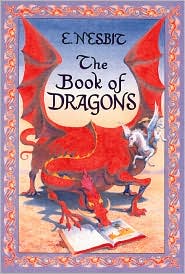
The Book of Dragons (MG)

The Book of Dragons. E. Nesbit. 1900. 180 pages.

The Book of Dragons is a collection of eight short stories by E. Nesbit. While I enjoy fantasy--especially when I'm in the right mood for it, especially when it is written by someone as talented as E. Nesbit--I am not always a big fan of short stories--no matter the genre.

I did enjoy this collection. I didn't love every story within the book, but I enjoyed many of them. The writing was just so delightful, so right, so satisfying. The eight stories are: The Book of Beasts, Uncle James or the Purple Stranger, The Deliverers of Their Country, The Ice Dragon Or Do As You Are Told, The Island of the Nine Whirlpools, The Dragon Tamers, The Fiery Dragon Or the Heart of Stone and the Heart of Gold, and Kind Little Edmund Or The Caves and the Cockatrice.

My favorite stories were The Island of The Nine Whirlpools and The Book of Beasts.

© 2011 Becky Laney of Becky's Book Reviews


The Light Princess

The Light Princess. George MacDonald. 1864. 110 pages.

Once upon a time, so long ago that I have quite forgotten the date, there lived a king and queen who had no children. And the king said to himself, "All the queens of my acquaintance have children, some three, some seven, and some as many as twelve; and my queen has not one. I feel ill-used." So he made up his mind to be cross with his wife about it. But she bore it all like a good patient queen as she was. Then the king grew very cross indeed. But the queen pretended to take it all as a joke, and a very good one too.
"Why don't you have any daughters, at least?" said he. "I don't say sons; that might be too much to expect." 
"I am sure, dear king, I am very sorry," said the queen.
"So you ought to be," retorted the king; "you are not going to make a virtue of that, surely."
But he was not an ill-tempered king, and in any matter of less moment would have let the queen have her own way with all his heart. This, however, was an affair of state. The queen smiled. 
"You must have patience with a lady, you know, dear king," said she.
She was, indeed, a very nice queen, and heartily sorry that she could not oblige the king immediately. (1-2)

The Light Princess is such a DELIGHTFUL book. It seems obvious in a way to call it delightful and charming and oh-so-magical. But it's true. There are no other words that could do it justice. It's the story of what happens when this childless king and queen have a baby girl of their own. It's the story of what happens when one of the princesses (who is also a witch) is NOT invited to the christening.
The king tried to have patience, but he succeeded very badly. It was more than he deserved, therefore, when, at last, the queen gave him a daughter--as lovely a little princess as ever cried.
The day drew near when the infant must be christened. The king wrote all the invitations with his own hand. Of course somebody was forgotten.
Now it does not generally matter if somebody is forgotten, only you must mind who. Unfortunately, the king forgot without intending to forget; and so the chance fell upon the Princess Makemnoit, which was awkward. For the princess was the king's own sister; and he ought not to have forgotten her. But she had made herself so disagreeable to the old king, their father, that he had forgotten her in making his will; and so it was no wonder that her brother forgot her in writing his invitations. But poor relations don't do anything to keep you in mind of them. Why don't they? The king could not see into the garret she lived in, could he?
She was a sour, spiteful creature. The wrinkles of contempt crossed the wrinkles of peevishness, and made her face as full of wrinkles as a pat of butter. If ever a king could be justified in forgetting anybody, this king was justified in forgetting his sister, even at a christening. She looked very odd, too. Her forehead was as large as all the rest of her face, and projected over it like a precipice. When she was angry, her little eyes flashed blue. When she hated anybody, they shone yellow and green. What they looked like when she loved anybody, I do not know; for I never heard of her loving anybody but herself, and I do not think she could have managed that if she had not somehow got used to herself. But what made it highly imprudent in the king to forget her was--that she was awfully clever. In fact, she was a witch; and when she bewitched anybody, he very soon had enough of it; for she beat all the wicked fairies in wickedness, and all the clever ones in cleverness. (3-5)
Of course, the uninvited guest comes, and of course they bring an unwelcome gift. In this case, the princess-witch deprived the baby of gravity. So from the day of the christening on, she floated. The king and queen tried to find some positive aspects to it, but, really what could they do when their apologies failed? Just go on loving their daughter as she was with all their hearts.

But their daughter was different in another way too. She had no gravity in matters of the heart and mind too. She could not take anything seriously. Her reaction to life--to all of life--was laughter. Which is just as serious a curse as the other, in my opinion. For there was an emptiness in all her emotions, her actions.

The Light Princess is the story of what happens when she meets a prince. Will the young woman incapable of falling, be capable of falling in love?

I loved this one. I really loved it. It was charming, delightful, and witty. I loved the writing. Some of the descriptions just had me at hello. Like this one, "The wrinkles of contempt crossed the wrinkles of peevishness, and made her face as full of wrinkles as a pat of butter." To any reader who likes fairy tales, this one is a must!!! It's a beautiful, sweet story. And it's such a quick read. You can easily read it in one sitting.


© 2011 Becky Laney of Becky's Book Reviews


The Story of the Amulet (MG)

The Story of the Amulet. E. Nesbit. 1906. 228 pages.

First Sentence: There were once four children who spent their summer holidays in a white house, happily situated between a sandpit and a chalkpit. 

I believe that this is the final adventure of Cyril, Robert, Anthea, and Jane. The first adventure, Five Children and It, and the second adventure, The Phoenix and the Carpet, were both delightful. The novel has a sad beginning. Their father is off to Manchuria to be a war correspondent, and their mother and Lamb are recovering their health in Madeira. (Their mother has been sick, Lamb has not.) They have been left in the care of Nurse, they have been left in London.

One of the children has the idea that if they leave the house and go explore the city--on their own, with proper permission, of course--that it would cheer everyone up. And that works, in a way. For in their exploring they discover an old, old friend of theirs. Someone that they'd not seen since that oh-so-magical summer. Yes, the four children happen to find Psammead caged up and for sale in a shop. Of course, they have to rescue him. And he is thankful--to a certain extent. But though he may be grateful to be out of the shop, out of the cage, he does NOT want to become a toy for the children, a wish-granter. But not wanting to be completely mean and unsociable, he tells them of an amulet with magical powers. This amulet is also for sale, and if the children purchase it, well, they can have their heart's desire.

Sound too good to be true? Well, if they want their heart's desire they are going to have to prove themselves worthy--or clever. For the amulet they buy is only half of the magical charm. They'll have to find the second half of the charm and the pin that binds these two together in order for this charm to grant their heart's desire. What good is half a charm? Well, it's still plenty powerful! Especially if you like to travel through time! For this amulet--when magical words are spoken, when held in a certain way, in a certain direction, becomes a doorway to the past. The children can step through the amulet to the past on their quest to find the missing half.

And these time travel adventures are fun! They go to Babylon, Egypt, Tyre, Atlantis, etc. Will they ever find the missing half? Will their amulet ever be whole? While the four children may have slightly different ideas on how to go about the quest, they agree on what their wish will be, they know their heart's desire.

I enjoyed this one. I've enjoyed all three of the books very much. I'm so glad that I decided to read E. Nesbit!!!

 © 2011 Becky Laney of Becky's Book Reviews


Smells Like Treasure (MG)

Smells Like Treasure. Suzanne Selfors. 2011. Little, Brown. 416 pages.

There are two types of people in this world--people who sit by their mailboxes and wait for a delivery from the Map of the Month Club and people who don't. You might be asking yourself, What kind of person would sit by his mailbox and wait for a map? An image might pop into your head of a nerdy sort of person with messy hair and pants that are too short. A soft sort of person who'd rather sit in his room and dream about treasure than climb a tree or ride a bike. A smart sort of person because map reading uses 2.5 million more brain cells than watching television. Did you know that the person you've just imagined is Homer Winslow Pudding? 

This is Homer Pudding's second novel. His first adventure can be found in Suzanne Selfors' Smells Like Dog. Once again Selfors assures her readers that Dog, our hero's oh-so-faithful companion, will be alive and well at the end of the novel. From the introduction, "I hate stories about dogs that die, and so I will never, ever write that kind of story. That is my solemn promise. In fact, I believe there should be some sort of punishment for people who write stories about dogs that die. Maybe they should be forced to peel gum off the bottoms of movie-theater seats, or file old people's toenails, or clean the shark tank at the zoo. That's what they deserve after bringing such terrible unhappiness into our lives."

So is Homer Pudding ready for his second adventure? Mostly. He has been looking forward to the county fair for months and months. But when he's banned--in part due to Dog's enthusiasm--on opening night, he's a little relieved to learn that L.O.S.T. will be meeting very, very soon. And their meeting will be to see if he will inherit his uncle's seat within the oh-so-secret-treasure-hunting-club. Zelda shows up in her cloud copter to tell him the news and take him to the club's clever tailor for his first professional treasure-hunting-suit. With a little lie or two, his parents are convinced that their son will be safe with Uncle Drake's good friend, Zelda, whom they've never actually met, for a week. The fair being a very good distraction, I think!

Zelda has told Homer that there is one club member that does NOT want Homer to become a member of the club. But can he figure out which member it is? Well, appearances can be deceiving. It looks like it's just a formality, until a former friend, Lorelei, shows up and starts telling smooth lies. Claiming that Uncle Drake promised her his seat in the club, that Uncle Drake gave her his membership coin. Many know she's lying. Many remember Uncle Drake speaking of Homer and how he is the one to inherit. But not everyone is eager to welcome Homer into the club, and well, this is a convenient way to make him earn it.

If Homer wants to be accepted into L.O.S.T. he'll have to prove himself worthy against his opponent. Both will receive the same clues. Both will have a sponsor member to provide transportation and such. Both will have to solve the mystery and find the "missing" coin that will be hidden somewhere--anywhere--in the world.

Can Homer prove that he has what it takes to be a real treasure hunter?

I liked Smells Like Treasure. I'm not sure that I LOVED, LOVED, LOVED it like I did the first book. But it was nice to visit with Homer and Dog again. I liked getting to know the characters introduced in this second novel like Hercules, Homer's sponsor. I didn't like him immediately, in fact, I thought he was a bit annoying. But by the end of the novel, well, I had changed my mind. I think Hercules is better for having this real adventure.

© 2011 Becky Laney of Becky's Book Reviews


No Passengers Beyond This Point (MG)

No Passengers Beyond This Point. Gennifer Choldenko. 2011. Penguin. 256 pages.

My mom says worry is like a leaky faucet--every drip makes you imagine something bad on the way...trouble...trouble...trouble...do something...do something...do something. But when you're twelve and the only guy in the house, you're responsible for an awful lot. It isn't just the heavy lifting and taking out the garbage either. You've got to be aware.

India, Finn, and Mouse are three children on their way--by plane--to their Uncle Red's house. They're not going on vacation, this won't be a short stay. No, the three will be there to stay. Their mom has every intention of joining them when the school year is through, but for now, they'll need to stick together and take care of one another. This move is sudden and not-so-sudden. It's definitely a surprise to the three kids. To the mom? Well, she's been fighting to save her home from foreclosure for the past six months. And then the fight is over, and she's lost. Now she has to tell her kids they'll be going to stay with Uncle Red in Colorado, they'll be leaving the next day. No time to say goodbye to their friends. No time to pack up their belongings properly. No, one suitcase a piece is all they'll be taking with them. This move seems so crazy, so weird. Yet it's the sanest part of the book, perhaps?!

After the first fifty pages, well, No Passengers Beyond This Point reads like an episode of The Twilight Zone. For those that love realistic fiction--and only realistic fiction--this may be an unpleasant surprise. For those that love a bit of fantasy and mystery, well, this change may be quite welcomed. (Is it a difficult mystery to solve? I'm not a good judge of that. I certainly began putting the pieces together early on, BUT that doesn't mean it won't be suspenseful to kids. And even though I had a good idea on where this one was going, it didn't take the fun out of reading it.)

No Passengers Beyond This Point is narrated by Finn (middle child), India (oldest child), and Mouse (youngest child). And I don't always love appreciate it when authors do this. Multiple narrators can be a big disappointment at times. They can keep me from connecting with a book. They can keep me from getting to know any of the characters well enough. BUT. I didn't have a problem with it in No Passengers Beyond This Point. In fact, it was one of the novel's greatest strengths. Which narrator would I want to give up??? NONE OF THEM!!! I just loved and adored Mouse and her invisible friend, Bing. I loved seeing the world through her eyes. I loved her observations. And Finn, well, he was responsible--though worried--and was able to think things through without giving into panic. I definitely think he's a good brother for these two to have! And India, well, I might have struggled to like her at first. (Though I wouldn't say I see her exactly the same way Mouse does...) But her chapters--especially towards the end--are so INTENSE and compelling. And when it comes down to it, ALL the narrators are so important to the story itself.

So I definitely enjoyed No Passengers Beyond This Point. I loved the characters. I loved the family dynamics. I thought Choldenko did a great job with developing relationships between siblings. And, for me, the atmosphere, the setting--strange as it was--worked very well. I can't say that every reader will love it. But then again, the same is true for ANY book I review!

Some of my favorite Mouse observations:

Ever since I found out they kicked Pluto out of the planets, I have not been feeling so sure about a lot of things. If they can decide Pluto is not a planet all of a sudden like that, things are not being run the right way up top. Pluto is a planet in My Solar System on page one, page six, and all of chapter three.
My brother, Finn, who has no pimples, says that's because Pluto is a dwarf star, but Finn is wrong about this. Finn is wrong about a lot of things, but I keep quiet about how many. He is a nice big brother and I don't want to ruin him.
My sister, India, is fourteen and she's only nice when Mommy makes her. (26-27)

I do not like being way back here with Bing and Marvin. What is Marvin going to ask? I try to think of every answer I know.
"Name?" Marvin asks.
"Geneva Tompkins, but everybody calls me Mouse on account of I'm good at squeaking. Want to hear?"
Marvin shakes his head. "You're traveling with your mother."
"No," I say. "We've used up all our money. Mommy has to work because that's how she gets more. Is that how you get more, Marvin?"
Marvin writes this down on his clipboard. "Who exactly are you traveling with?"
"My sister, India, and my brother, Finn. India, Geneva, and Finland. Two countries and a city. That's me." I raise my hand. "My mother wanted to travel, but instead she had kids."
This is my grown-up joke. I got it from India. Marvin doesn't laugh.
"And your father?" Marvin asks.
"He died when I was in Mommy's tummy. I couldn't see him on account of there was skin in the way. But Bing saw him. He took a picture for me."
"Who is Bing?"
"He's my friend."
"Did you pack your own suitcase?"
"My mom and India did, only I made a few corrections."
"Which means?"
"I added the explosives," I whisper.
His face looks suddenly the color of my snot when Mommy says I have to stay home from school. "Explosives?"
"Have you ever seen mints explode? You put them in soda and Pfffffff." I make my best explosion noise, but it's not as good as Finn's.
"This is some kind of science experiment?" His voice squeaks.
"Oh, no. I don't have science yet. Not until third grade."
Marvin shakes his head and makes grunting noises. "Do you understand you aren't allowed to bring liquids on the plane? Liquids like vinegar, liquids like soda."
"I would have understood if Finn let me read the whole sign, but he said we had to--"
"You stay here," he snaps before I even finish explaining.
When Marvin comes back, Mommy, Finn, and India are with him. Marvin hands me my suitcase. It's very light. He's taken all the good stuff out. (31-32)

Now I have to go to the bathroom. But I don't want to go in a strange bathroom, so I hold it like at school. I will hold it until we get back from Uncle Red's. I only like the toilet paper at home. (42)

I'm used to knowing more than everyone else on account of Bing. He has in some knee-a, you know. You can find out a lot of things when you're awake at night. In the morning, Bing tells me everything he found out the night before. (86)


© 2011 Becky Laney of Becky's Book Reviews


The Search for Wondla (MG)

The Search for Wondla by Tony DiTerlizzi. 2010. Simon & Schuster. 477 pages. 

Eva Nine was dying. The tiny scarlet dots on her hand mirrored the glowering eyes of the snake that had just bitten her.

I didn't love The Search for Wondla. I'm not even sure I liked it. One of the reasons it didn't quite work for me was that the ending left me unsatisfied. I wanted to shout at the book, "That's not an ending!" Then again, maybe it's not fair to judge a first book in a series by the ending.

Eva Nine, our heroine, may just be the last human on the planet. She has spent her whole life underground in Sanctuary. She was raised by a robot--albeit a robot with a mothering program built right in. (Muthr is always, always nagging Eva Nine to do this or that. Little things like picking up her room, etc.) When the novel opens, Eva Nine is in the middle of a test to determine if she's ready to live Sanctuary and venture into the real world above ground. Her muthr isn't convinced that she is ready. But she's going to give her one more chance, if Eva Nine doesn't improve, well, they may just have to go back to the basics.
Six Basic Survival Skills for Humans
1. Trust technology
2. Signal others
3. Find shelter
4. Create fire
5. Procure food and water
6. Know first aid
But ready or not, Eva Nine may be forced into the cruel, ugly world of unknowns. When someone breaks into sanctuary--destroying it in the process--Eva Nine is forced to flee the only home she's ever known. She is taking a few technological items with her, like her Omnipod, but what she soon discovers is that NO technology can protect her now, keep her safe, or guide her. The whole world--the whole planet--is unknown.

But Eva Nine won't be on her own for long, though her companions are not human--not even close.

The Search for Wondla is a blending of so many genres and subgenres. It's both science fiction and fantasy, in my opinion. It's an adventure story--a survival story. And of course it's one big mystery. Where is Eva Nine? What planet is she on? How did she get there? Is she really, truly the last human? Where did all these species come from?

The world Tony DiTerlizzi created is interesting. At times I found it confusing, I had to keep telling myself to keep reading and that it would start making sense eventually if I just read long enough. And that worked, for the most part. It helped when I decided the confusion might just be intentional. Eva Nine, our heroine, is thrust into a world that is completely foreign to her. She doesn't recognize any of the trees or plants. She doesn't recognize any of the life forms. These creatures--animals--speak in their own languages. She doesn't know what's dangerous and what's safe. She's completely out of her element.

Have you read this one? What did you think?

© 2011 Becky Laney of Becky's Book Reviews


The Rumpelstiltskin Problem (MG)

The Rumpelstiltskin Problem. Vivian Vande Velde. 2000. Houghton Mifflin. 116 pages.

The Rumpelstiltskin Problem is a collection of short stories. Each short story puts a twist on the fairy tale Rumpelstiltskin. In the author's note, Vivian Vande Velde picks apart all the problems with the original story, alerts readers of all the holes in logic, argues that the story is obviously incomplete! She plays around with this in her stories, proving that there are many sides to a story, many ways to interpret a story. Some are clever. Some are amusing. All are well-crafted, in my opinion.

If I had to choose just one as a favorite, it would be Straw into Gold.

The six short stories are:

A Fairy Tale in Bad Taste
Once upon a time, before pizzerias or Taco Bells, there was a troll named Rumpelstiltskin who began to wonder what a human baby would taste like.
Straw Into Gold
Once upon a time, in the days before Social Security or insurance companies, there lived a miller and his daughter, Della, who were fairly well-off and reasonably happy until the day their mill burned down.
The Domovoi
Once upon a time, before home security systems and trained guard dogs, if you lived in Russia the way to keep your home safe and happy was to have a domovoi living beneath your basement. 
Papa Rumpelstiltskin
Once upon a time, before bread was plastic-wrapped and sold in supermarkets, there lived a miller named Otto and his daughter, Christina.
Ms. Rumpelstiltskin
Once upon a time, before eyelash curlers and lip liner, there lived a very plain girl by the name of Rumpelstiltskin.
As Good As Gold
Once upon a time, before movie stars or rock singers or professional athletes, the people everybody most wanted to meet were kings and queens.

© 2011 Becky Laney of Becky's Book Reviews


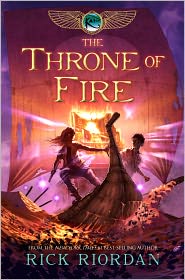
The Throne of Fire (MG)

The Throne of Fire. Kane Chronicles #2 Rick Riordan. 2011. Hyperion. 464 pages.

Carter here. Look, we don't have time for long introductions. I need to tell this story quickly, or we're all going to die.

The sequel to Rick Riordan's The Red Pyramid. Once again it is narrated by a brother-sister team, Carter (14), and Sadie (13). These two were raised apart and they're only now getting to know one another. But surviving dangerous situations one after another after another has helped these two bond a bit. Though they still bicker over who gets to tell what as the story unfolds. In this adventure, the two are looking to piece together the Book of Ra (it is in three sections, each hidden in a secret location). They're hoping the Book of Ra will help them resurrect Ra, a retired Egyptian god. A god they're hoping will be strong enough to help them defeat Apophis. And to add to the pressure, they only have a week to do it.

I'm not a big fan of how this one is told. Of how the book(s) are being recorded on audio, of how both are hoping that by sharing their stories other magicians will step forth to help the two battle the forces of evil and save the world.

And I'm not a big fan of the alternating narrators. It's not that I dislike either Carter or Sadie. It's just that I feel if it was told by one character, that maybe just maybe I'd connect more with the story? I'm not sure if it's the way the story is told or if it's just the story itself.

While I'm mentioning all the little things I didn't quite love, let me focus on the "romance." For me. It distracts from the story. To have Carter DROP EVERYTHING because he discovers the location of a certain someone?! To leave the saving the world to his sister and her friend just so that he can find her, "save" her, and maybe just maybe see if she feels the same way about him as he does about her?! I mean when I got to that section I was like YOU'RE KIDDING ME?! HE'S REALLY GOING TO DO THAT? And I felt the same way when Sadie left Carter--earlier in the novel--to go London so she could celebrate her birthday party with some friends. I mean the world is ending in less than five days and instead of finding a way to STOP it from ending, you want to party?! And Sadie's interest in Anubis and Walt?! It felt weird to me. Not necessarily her having crushes on them both. But on either one being even remotely interested in her in that way. I mean she *just* turned thirteen. And Walt is sixteen. And Anubis--well he's a god, and she's human. I thought the book had more than enough drama without Carter and Sadie being distracted by puppy love.

So what did I love? Well, I loved how compelling the second half of this novel was. I mean once the action starts, it STARTS. And it's hard to put it down once it starts getting good. Once things start to come together, I wasn't distracted by the things that didn't quite work for me. I just had to keep reading; I had to know what happened next.

The Throne of Fire has action, adventure, and drama. Also mythology--Egyptian mythology--of course.

© 2011 Becky Laney of Becky's Book Reviews


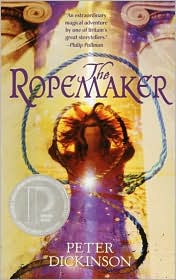
The Ropemaker (MG/YA)

The Ropemaker. Peter Dickinson. 2001. Random House. 384 pages.

It had snowed in the night. Tilja knew this before she woke, and waking she remembered how she knew. Somewhere between dream and dream a hand had shaken her shoulder and she'd heard Ma's whisper.

The Ropemaker reminded me of all the reasons I love reading fantasy. Did I love it? I didn't want it to end! I wanted to savor every moment of it. Why? Well, because I loved not only the characters, not only the story, but the world Peter Dickinson created! My favorite character happens to be our heroine, Tilja.

Tilja's valley has almost always--twenty generations--been protected by magic. Protected from its neighbors--those who would love to tax, tax, tax in the name of "providing protection" and those who would invade and plunder and conquer. There is a story passed down through the generations--a story some scarcely believe these days--about how the valley came to be protected. A story about two people on a quest for a magician named Asarta. We learn this story in chapter two. Here is how it starts:

There was time in the Valley, of course--how could there not be? But there was no history. In all the rich farmland between the northern mountains and the forest there were no wars, or reports of wars, only days, seasons, generations. No kings or other rulers, only parents, grandparents, ancestors. For eighteen generations nothing had happened in the Valley that anyone would have thought worth putting in a book, or setting up a memorial stone to record. So, no history. Only time. And the story of Asarta. (17)

Did I mention I love the writing?! Well, I did!!! Anyway, Tilja, our unlikely heroine, joins three others on a quest to "save" the magic that protects them. For they know the magic is fading, that soon unwelcome guests might invade--when they realize the truth. So Tilja and her grandmother, Meena, and Tahl, and his grandfather, Alnor, set out on a dangerous and uncertain journey. Their quest is to find the magician, Faheel, the magician who first helped the Valley all those generations ago. Is he still alive? Can he be found? Does he want to be found? Will he help them? Can he help them? Has his powers grown stronger or weaker through the years?

The Ropemaker is about their journey, their quest, as they face countless dangers, as they meet many, many people along the way. This journey will require them to be wise and courageous and diligent. To protect the Valley, to protect their families, their homes, their villages, they may have to risk it all.

I enjoyed this one very much! I'd definitely recommend it.

© 2011 Becky Laney of Becky's Book Reviews


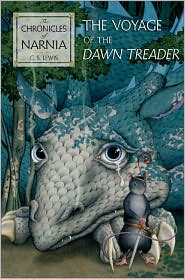
The Voyage of the Dawn Treader

The Voyage of the Dawn Treader. C.S. Lewis. 1952. HarperCollins. 256 pages.

There was a boy called Eustace Clarence Scrubb, and he almost deserved it. His parents called him Eustace Clarence and masters called him Scrubb. I can't tell you how his friends spoke to him, for he had none.

The Voyage of the Dawn Treader is one of my favorite, favorite books. There are seven books in the Chronicles of Narnia, this is the third. Yes, third. For there is NO other way to read the books then in their proper order: The Lion, The Witch, and the Wardrobe, Prince Caspian, The Voyage of the Dawn Treader, The Silver Chair,  The Horse and His Boy, The Magicians Nephew, and The Last Battle.

This third adventure stars Lucy and Edmund Pevensie and their cousin, Eustace Scrubb. These three are transported to Narnia--much to Lucy and Edmund's delight and Eustace's horror and disbelief--through a magical painting. Lucy remarking one day that the ship in the picture looks Narnian, that those waves look like they're moving. Once on board this ship, they meet King Caspian. They join him on his quest to find his father's missing friends, these "seven lost lords": Lord Bern, Lord Octesian, Lord Restimar, Lord Rhoop, Lord Mavramorn, Lord Revilian, and Lord Argoz.

The book is a series of adventures; these adventures being loosely tied together by their one mission, one quest, of discovering the fate of these seven lords. They are NOT out to save the world, NOT out to save Narnia from a dark and evil threat. They are adventuring for the sake of adventuring. They are facing risks, yes, because they are curious and brave and loyal. But they are not facing risks because there is evil lurking and threatening to destroy everything they know and love. Why mention this? Well, if you saw the movie, you might have gotten a different idea of their adventures.

What do I love about this one? The characters and the stories! I love to see how Eustace is turned into a dragon. I love, love, love how he's restored and healed by Aslan. That scene being oh-so-magical! (And the movie? Well? They don't quite capture it the way the book did. They changed things throughout.) There are so many elements that I just loved in this one! Lucy "helping" the invisible dufflepuds, Dark Island and the albatross, etc. And then, of course, there is Reepicheep!!!

So do I recommend this one?! Yes!!! How did I feel about the movie? Well, there were places I enjoyed it. But they rearranged things; they changed things; they added and subtracted. And there were a few scenes that just felt tedious. (The big scene that is supposed to be the climax; the big battle). But it was a beautiful movie. It was compelling even if it was different. Were the changes necessary? I'm not convinced they were. Especially how they felt the need to add conflict and tension between the characters--when there wasn't any in the book. But it wasn't a horrible adaptation.

© 2011 Becky Laney of Becky's Book Reviews


Small Persons With Wings (MG)

Small Persons with Wings. Ellen Booraem. 2011. Penguin. 304 pages.


Last June, my parents jumped off a roof because of a pinky ring.

Small Persons With Wings is an interesting fantasy novel. It stars a young girl, Mellie Turpin, who is tired of being teased. Her nickname? Fairy Fat. It came about like this. In kindergarten, she told one of her classmates that she had a fairy living in her house. His name? Fidius. Those that didn't laugh, believed her. Until she didn't make good on her promise--to bring him for show and tell the next week. Months later, still "troubled" by the aftereffects of this social mess, the school counselor has a conference with her parents to talk about imaginary friends. Mellie never doubted that he was real until her parents called Fidius imaginary. She's been a skeptic ever since.

This overweight teen is still struggling with body issues, with social issues many years later. But. These problems are about to become trivial when her family moves to her grandfather's inn. For there Mellie discovers the truth. Fairies do exist. Fidius was real. And their new home doesn't just have a few fairies--it has a whole colony of fairies living in the basement. It seems her family has quite the legacy. Generations of secrets for one girl to uncover and explore. Mellie's "new" reality has dangers of its own. (Mellie may just end up a frog?!) But with it comes a chance for redemption...

I liked Small Persons With Wings. The story isn't flawless. It was a complex story, and it didn't always flow perfectly. The pacing was a little uneven at times. But it was enjoyable.

© 2011 Becky Laney of Becky's Book Reviews


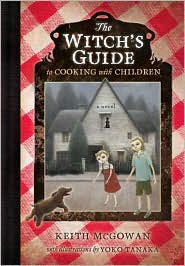
The Witch's Guide to Cooking With Children (MG)

The Witch's Guide to Cooking With Children. Keith McGowan. 2009. Henry Holt. 192 pages.

I love children. Eating them, that is. I've eaten quite a few children over the centuries. You may wonder where I get them all. The answer is: I get them the traditional way. From parents, of course. 

The book begins with a little excerpt from Fay Haladerry's "How to Cook and Eat Children." This mystery novel stars two children--an eleven-year old boy, Solomon, an eight-year-old girl, Connie. These two first get suspicious of their new community when they see a local dog chewing (or perhaps burying?) a human bone. Of course, they don't know right then and there that it is human. But a trip to the library soon has these kids convinced that there is something strange about one of their neighbors, a woman named Fay Haladerry. Readers, of course, know more than our hero and heroine for most of the novel. For they realize early on that a) this woman is a witch--the witch--from Hansel and Gretel and b) that Sol and Connie's parents have it in for them. They see the first few failed attempts. They have a better idea of who to trust and who not to trust.

This book has an interesting premise, a playful premise. Throughout the book, readers get a glimpse into this witch's book. And these scenes may prove the highlight for readers interested in this twisted fairy tale. But, for me, the novel lacks substance when it comes to characterization. The story in many ways seems one-dimensional. Sol and Connie don't deserve to be cooked and eaten--not by any stretch of the imagination--but they do lack the depth needed for this reader (this adult reader) to really care about them as individuals. The book lacks complexity in a way. Beyond the premise, beyond the playful twist to a traditional fairy tale, it isn't as great as the book cover might suggest.

© 2011 Becky Laney of Becky's Book Reviews


Enchanted Glass (MG/YA)

Enchanted Glass. Diana Wynne Jones. 2010. HarperCollins. 292 pages.

When Jocelyn Brandon died--at a great old age, as magicians tend to do--he left his house and his field-of-care to his grandson, Andrew Brandon Hope. Andrew himself was in his thirties. The house, Melstone House, was a simple matter of making a Will. But it had been old Jocelyn's intention to pass the field-of-care on in the proper way, personally. 

I am NOT a fan of this cover! If I wasn't already a fan of Diana Wynne Jones, if I didn't already know that she can tell some great stories, then I'm not sure I would have ever given this one a try. (What do you think? Do you like the cover? Isn't the UK cover a thousand times better?!)

I enjoyed so many things about Enchanted Glass. I liked "Professor" Hope. I liked Mr. Stock. And Mrs. Stock. (Oh how these two hate each other. One is the gardener, the other the housekeeper. BOTH of course have minds of their own. And think that they always, always know best. This gets quite comical.) I liked Aidan too. Who is he?! Well, that's a good question. One that Andrew eventually gets around to asking. You see, this young boy turns up one day--on a Monday--asking, in a way, for sanctuary. He's being stalked by evil creatures, you see, and his grandmother (who's recently died) always told him to see help at Melstone House if ever he was in trouble. He's just one of three visitors that turned up on that busy, busy Monday. And "Professor" Hope allows them all to stay--in one way or another. He hires an assistant (secretary) despite not really wanting one. He grants her a one month trial period. He hires an assistant groundskeeper, too, though this time on a week's trial. He likes to please people. But don't assume that he doesn't have his own tricks. He can manipulate people as well.

The story centers on Andrew Hope and Aidan Cain. And all the strange people (some human, others not quite) in their lives. Melstone House and its surrounding woods has an interesting history. There's something almost magical about the place. Something that Andrew will need to learn all about...he'll need to... if he hopes to protect those close to him.

I really enjoyed it. I just LOVED the first half. (I found it amusing and charming and lovely). The second half wasn't--in my opinion--as wonderful as the beginning. (Though I suppose you could say most of the action occurs in the second half. The confrontation between good and evil and such.) I didn't like the ending. There was something about it--which, of course, I can't say without spoiling it--that I didn't like at all.

© Becky Laney of Becky's Book Reviews


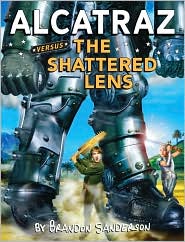
Alcatraz Versus the Shattered Lens (MG/YA)

Alcatraz Versus The Shattered Lens. Brandon Sanderson. 2010. Scholastic. 304 pages.
 
So there I was, holding a pink teddy bear in my hand. It had a red bow and an inviting, cute, bearlike smile. Also, it was ticking.
"Now what?" I asked.
"Now you throw it, idiot!" Bastille said urgently.

Alcatraz Smedry is back for his fourth adventure. (Alcatraz would want me to tell you it is yet another volume in his biography--not a fantasy novel at all.) The first three volumes are Alcatraz Versus the Evil Librarians, Alcatraz Versus the Scrivener's Bones, and Alcatraz Versus the Knights of Chrystallia. While we still don't know how Alcatraz ends up tied to an altar of outdated encyclopedias, readers do finally see how Alcatraz ended up a hero in the Free Kingdoms. For in this fourth adventure story, it is up to Alcatraz and his friends (and family) to save the kingdom of Mokia from the invading army of Evil Librarians. Can Alcatraz make the most of his talents? Can he lead a country--a kingdom--into battle? Can he handle the responsibility?

I love Alcatraz Smedry. I do. He is a great narrator!
If you've ever thought that books are boring, it's because you don't know how to read them correctly. From now on, when you read a book, I want you to scream the words of the novel out loud while reading them, then do exactly what the characters are doing in the story.
Trust me, it will make books way more exciting. Even dictionaries. Particularly dictionaries. So go ahead and try it out with this next part of this book. If you do it right, you'll win the bonus prize. (37)

Change. It's important to change. I, for instance, change my underwear every day. Hopefully you do too. If you don't, please stay downwind.
Change is frightening. Few of us ever want things to change. (Well, things other than underwear.) But change is also fascinating--in fact, it's necessary. Just ask Heraclitus. (56)

In the year 1288, if you were to pass by an old acquaintance on the way to Ye Old Chain Mail Shoppe and call him "nice," you'd actually be calling him an idiot.
If it were the year 1322 instead -- and you were on your way to the bookshop to pick up the new wacky comedy by a guy named Dante -- when you call someone "nice" you would be saying that they were timid.
In 1380, if you called someone "nice," you'd be saying they were fussy.
In 1405, you'd be calling them dainty.
In 1500, you'd be calling them careful.
By the 1700s -- when you were off to do some crowd surfing at the new Mozart concert -- you'd be using the word nice to mean "agreeable."
Sometimes, it's difficult to understand how much change there is all around us. Even language changes, and the same word can mean different things depending on how, where, and when it was said. The word awful used to mean "deserving of awe" -- full of awe. The same as awesome. Once, the word brave meant "cowardly." The word girl meant a child of either gender.
(So next time you're with a mixed group of friends, you should call them "girls" instead of "guys." Assuming you're not too brave, nice, nice, nice, or nice.)
People change too. In fact, they're always changing. We like to pretend that the people we know stay the same, but they change moment by moment as they come to new conclusions, experience new things, think new thoughts. Perhaps, as Heraclitus said, you can never step in the same river twice...but I think a more powerful metaphor would have been this: You can never meet the same person twice. (224-5)
I loved this one. I thought it was a great addition to a fun series of fantasy novels. If you're looking for action, adventure, fantasy, and humor...then consider reading the Alcatraz books! They're great fun!!!

© Becky Laney of Becky's Book Reviews


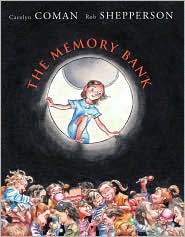
The Memory Bank (MG)

The Memory Bank. Carolyn Coman. Illustrations by Rob Shepperson. 2010. October 2010. Scholastic. 288 pages.

"Don't forget your whistle!" Hope reminded Honey--every morning of every day. Honey needed that whistle, in case of emergency, in case things went terribly wrong. Hope and Honey Scroggins were the closest of sisters, had been right from the start. Truly, they were lucky to love each other so! Not so lucky when it came to their parents, though. Mr. and Mrs. Scroggins were simply awful people.

The Memory Bank is told through words and pictures. (Though not to the extent that The Invention of Hugo Cabret is.) It reminded me--in a way--of several Lois Lowry novels--The Willoughbys and The Giver. It stars a young girl, Hope, who is doing the best she can to cope with incredibly cruel parents. How cruel? One day they leave Hope's younger sister, Honey, on the side of the road. They tell Hope to forget her. And they mean it. Not a word about Honey is allowed. Hope is an only child now. There is nothing good about Mr. and Mrs. Scroggins. Fortunately--for everyone--they enter into the story very little.

For Hope becomes terribly depressed. She stops living life--and starts dreaming it. It's just too painful to be awake. To live her "new" life. She'll spend most hours of the day and night sleeping. She dreams of her sister mostly. While her parents don't notice--or don't care--someone does notice. The powers that be of The World Wide Memory Bank. (They notice that she's not contributing her quota of memories.) And while the strangers that arrive in her home to arrest her seem intimidating at first, Hope soon realizes that there's hope at last for a better life.

It's an interesting book. The "fight" between the World Wide Memory Bank and the Clean Slate Gang. The connection between memories and dreams. I found it an entertaining read.

© Becky Laney of Becky's Book Reviews


Twitter Delicious Facebook Digg Favorites More