Showing posts with label classics. Show all posts

Retro Friday Review & Classics Circuit Tour: The Mysteries of Udolpho by Ann Radcliffe

Doing double duty today with the Classics Circuit Tour of Gothic Lit and a Retro Friday review:

Retro Friday is a weekly meme hosted by Angie of Angieville and "focuses on reviewing books from the past. This can be an old favorite, an under-the-radar book you think deserves more attention, something woefully out of print, etc."

The Mysteries of Udolpho by Ann Radcliffe
Publisher: Various
Publication date: 1794
ISBN: Various
Source: Library


Emily has lived an ideal life with her loving parents, until sorrow is thrust upon her when first one and then the other parent dies. Left alone in the care of an unfeeling aunt, she soon finds herself in the power of the merciless man her aunt marries. Shut away in the gloomy and haunted castle of Udolpho, she suffers afflictions of all kinds. Will she escape from her wicked uncle and the unwholesome company he keeps?

Things I Liked:
This is my first experience with a serious Gothic book (ok, I read Frankenstein and Northanger Abbey, but I'm excluding those).  I admit it was hard getting back into reading a classic, since I'm used to less archaic language.  What totally surprised me was just how creepy the story was!  When it finally got to the interesting stuff (see below for more on that) I was completely enthralled and creeped out!  No wonder young ladies read these with abandon.  All the dreadful and mysterious and unearthly things that could possibly happen to one heroine do.  I really wanted to read this in conjunction with Northanger Abbey, but ran out of time.  But I could see why if Cathy was reading all these Gothic romances she might start imagining and suspecting everyone around her.  It was lurid and disturbing and completely not what I expected.  Which made it quite an enjoyable Halloween read!

Things I Didn't Like:
As I mentioned above, the book really had a slow beginning.  If I hadn't been reading it for the Classics Tour, I'd have given up, which would have been a shame.  But it was about 150-200 pages in before I finally became interested in what was happening.  Enough with descriptions of pastoral scenes and natural beauty!  The story also kind of jumped around weirdly in places, randomly taking us to other characters very briefly to see what they did.  It is definitely a book to be enjoyed by those who aren't daunted by archaic phrasing and pages of description.  A nice abridged version would be great, or even a good movie version!

Read-alikes:
Definitely Northanger Abbey by Jane Austen
Anything else by Ann Radcliffe

BOOK CONTENT RATINGS:
s-factor: !
perhaps one or two


mrg-factor: none
only some obliquely implied stuff

v-factor: ->
it has a touch of some disturbing stuff

Overall rating: ***


Thoughts on Gothic lit or this book in particular?

If you buy through my Amazon linkage, I will get a very small percentage 


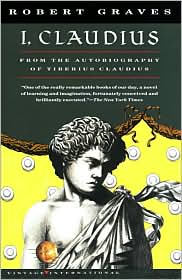
I, Claudius

I, Claudius. Robert Graves. 1934. 480 pages.

I, Tiberius Claudius Drusus Nero Germanicus This-that-and-the-other (for I shall not trouble you yet with all my titles) who was once, and not so long ago either, known to my friends and relatives and associates as “Claudius the Idiot,” or “That Claudius,” or “Claudius the Stammerer” or “Clau-Clau-Claudius” or at best as “Poor Uncle Claudius,” am now about to write this strange history of my life; starting from my earliest childhood and continuing year by year until I reach the fateful point of change where some eight years ago, at the age of fifty-one, I suddenly found myself caught in what I may call the “golden predicament” from which I have never since become disentangled.

This was an impulse read--or reread. I first read it in 2008 and I liked it. I didn't quite love it. I remember thinking at some point I want to read the sequel, one day I want to finish the story. But I wasn't in a rush. Obviously. But a few weeks ago, I saw it on the library shelf, and, well, I just HAD to read it. (I picked up both books because of course I wanted to read them both.)

What did I think the second time through this one? Well, I just LOVED it. I just loved, loved, loved it. Perhaps because I've changed as a reader. Perhaps because I knew the basic story and was free to enjoy the details more. I don't know why some books are just better the second time around. I would say the biggest difference--for me--was that there was no confusion the second time round. I wasn't lost with the names, I wasn't struggling with piecing together the story. The more I read, the more right it felt.

Anyway, the essentials remain:

Narrated by Claudius, I, Claudius is an often bloody memoir of the Roman empire under Augustus, Tiberius, and Caligula. (It might reference pre-Augustan Roman history, but it does so in a flashback kind of way.) What can I say about this one? The narration varies between being very witty and dry and sarcastic and just downright fun in that sort of way. But I won't lie either. There are hundreds of names from first to last. Some turn out to be key players, some disappear a page or two later--and it's hard to distinguish between the two. I did get lost in more than a few places trying to puzzle out who was who. But at the same time, it was enjoyable. Even though I didn't pick up on every single little detail, what I did pick up on and follow I enjoyed for the most part. The book is full of politics, plots, crimes, murders, and plenty of drama both small and grand in scale. Claudius had three wives and two main mistresses, for example, (one at a time though) and a few of them were truly scary. Livia, Claudius's grandmother, is one of the stars of the novel. She's a truly despicable character--poisoning and plotting to kill off most of the opposition even if the opposition were completely innocent and were her own flesh and blood.

© 2011 Becky Laney of Becky's Book Reviews


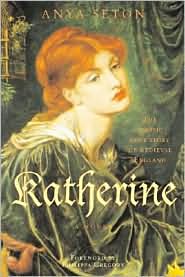
Katherine

Katherine. Anya Seton. 1954/2004. Chicago Review Press. 512 pages.

In the tender green time of April, Katherine set forth at last upon her journey with the two nuns and the royal messenger.

Katherine is the third Anya Seton novel I've read, and it is probably my favorite so far. It is the 'love story' of Katherine de Roet and John of Gaunt (Duke of Lancaster). It's definitely a 'love story' with complications!

The book opens with Katherine traveling with several nuns to visit her sister, Philippa, who is in the service of the Queen. Her arrival catches the attention of at least two guys. The most persistent being Hugh Swynford. Her sister just hopes that her sister has enough sense to know that these men are after one thing and only one thing. And Katherine does know that. But she can't protect herself from unseen dangers.

One day, Katherine takes a walk in the garden thinking that she is alone, that she is safe, only to discover that Hugh Swynford is there and he means to get his way. They struggle. And only fate in the form of John Gaunt, the Duke, saves her. He demands to know what is going on and Hugh stammers something about how he really truly means to marry the penniless girl. The Duke takes the poor woman home to his wife, Blanche, who takes pity on the girl and offers her friendship and kindness.

But within days Katherine learns her fate. She will be the wife of Hugh Swynford. For better or worse, she'll be stuck with him. But it's not like she has much of a say in her future. And a good match is a good match.

Katherine is a novel of medieval England. Readers get more than a quick and easy 'love story.' It's a novel about war and politics and social class. The novel follows the lives of Katherine and John through four decades. The 1360s through the 1390s.

There are plenty of characters to love and hate in this one. And it's a pleasant read. Not too dry, not too boring. But not completely romance either. There is history and politics and talk of war and riots, etc. If you're just looking for romance, this may not be the one for you. But if you want substance to your romance, then you should give it a try.

© 2011 Becky Laney of Becky's Book Reviews


Twenty Thousand Leagues Under the Sea

Twenty Thousand Leagues Under the Sea. Jules Verne. 1870. Puffin Classics. 280 pages.

In the year 1866 the whole maritime population of Europe and America was excited by a mysterious and inexplicable phenomenon.

I didn't seek out an abridged version of this Jules Verne classic. But when I discovered that the edition I'd checked out from the library was abridged--after I was four or five chapters into it--I didn't try to 'fix' it either.

I'll start with the good news. I definitely liked this one more than Journey to the Center of the Earth! There were times I actually thought Twenty Thousand Leagues Under the Sea was a good read. That the story had action and adventure and mystery.

Basic plot: A professor and his servant are 'captured' by a 'sea monster' created by the cranky Captain Nemo.

While reading this one, I started thinking about Frankenstein--which is a good thing, I think. I never did quite decide how the characters matched up between the two. But I think that there are definite similarities in theme. Frankenstein is one of my comfort reads--a book I love and adore. Twenty Thousand Leagues Under the Sea is a good read, but I'm not sure I'll ever want to reread it. If I ever do read it again, I might try the unabridged version.

© 2011 Becky Laney of Becky's Book Reviews


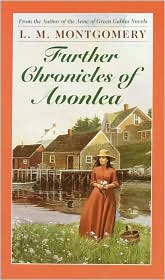
Further Chronicles of Avonlea

Further Chronicles of Avonlea. L.M. Montgomery. 1920/1989. Bantam Classics. 200 pages.

I love L.M. Montgomery. I do. I just love, love, love her books--her novels and her short stories. Chronicles of Avonlea and Further Chronicles of Avonlea are short story collections set on Prince Edward Island during Anne's time. (I get the impression that these stories are set around the time of Anne of Avonlea, Anne of the Island, etc. She has NOT married Gilbert yet.*)

There are fifteen short stories:

Aunt Cynthia's Persian Cat
The Materializing of Cecil
Her Father's Daughter
Jane's Baby
The Dream-Child
The Brother Who Failed
The Return of Hester
The Little Brown Book of Miss Emily
Sara's Way
The Son of His Mother
The Education of Betty
In Her Selfless Mood
The Conscience Case of David Bell
Only a Common Fellow
Tannis of the Flats

This collection features one of the best, best, best short stories, one that practically brings me to tears each and every time: The Brother Who Failed. There is a lot of variety in the stories. Comedy and tragedy and everything in between.

Aunt Cynthia's Persian Cat is the charming story of two sisters, Sue and Ismay, who absolutely hate their aunt's cat, Fatima. But the two are pressured into taking care of the cat while their aunt goes on holiday. One day the cat goes missing, and, well the two are at a loss to know what to do about it. They have to have a Persian cat--the real Fatima or not--to give to their aunt. But how will they find one that is a close enough match...and how will they pay for it?! Sue has been pursued by Max for many, many years. He's proposed over eleven times...he has a solution to the problem...but he wants a different answer to his twelfth proposal...

The Materializing of Cecil is another charming story--another romantic comedy. Charlotte Holmes, our heroine, is an old maid. And she wouldn't mind too terribly being an old maid if anyone had ever wanted her, courted her, etc. If she'd had an opportunity to marry but didn't. So one day--I believe on her fortieth birthday--she tells a little lie to one of the young women in the sewing circle. Before she knows it the whole room is her audience. She spins this tragic tale of a failed love affair. She invents the whole thing, of course, even gives him a name, Cecil Fenwick, and a profession, lawyer. A few months later, however, Charlotte is just shocked--and incredibly embarrassed--that a Cecil Fenwick, a lawyer, has come to town to visit his sister, Mrs. Maxwell. All the details seem to match--that's the odd part. Everyone just knows that this is Charlotte's Cecil. What will she do when she's confronted by Mr. Fenwick?!

Her Father's Daughter is a sadder story, perhaps, because of all the missed opportunities. It's the story of a broken family. Our heroine, Rachel Spencer, has never known her father, David, because her parents quarreled months before she was born. Her parents won't even talk to each other, won't even talk about one another. But Rachel feels the loss. One day she accidentally finds her father and the two share one perfect, perfect day together. She's stumbled across his home in the Cove, and he shows her his place and they talk and laugh, etc. She, of course, wants to come back again, wants to visit him now that she's found him. But he seems to know that her mother will find out about and forbid it. So he tells her not to feel guilty if she can't return, if she can't be a part of his life. Now that Rachel is grown up, now that she's getting married herself, she has a LOT to say about it. And she knows exactly what she wants for her wedding--a wedding with both parents there. Will anyone ever forget her wedding day?!

Jane's Baby isn't my favorite or best. It's about another feud--there are so many feuds it seems in Montgomery's fiction. In this case it is a fight between Miss Rosetta Ellis and Mrs. Charlotte Wheeler. I believe the two are sisters? Anyway, these two are fighting over a baby--an orphaned baby. And Miss Rosetta gets there first. She names the child Cordelia Jane. She takes her home. She loves her dearly and cares for her a few months at least. And then when no one quite expects it, Charlotte kidnaps the baby. She takes the baby home with her, renames it Barbara Jane. But she doesn't let the baby leave her sight for even a minute. She doesn't want Rosetta to have even a few seconds opportunity to get the baby back. But when the baby gets sick, Charlotte knows that Rosetta can help; she may be the only one who can help in time. Will these two women put aside their differences and let this baby have a happy home?

The Dream-Child is definitely a sadder story. It is about a couple who loses their child, David, when he is twenty months old. The two are devastated. But while the husband is deeply saddened by the loss, while he is genuinely in mourning for the child, the wife begins to lose touch with reality. Her loss--her grief, her depression--sends her to a dangerous place. She hears a 'dream-child' call to her by the sea every night. Each night she goes out searching for this child, desperate to reach him in time, fearing that her child doesn't know that his mother is searching--desperately searching--for him. So one night the two are out walking--much like every other night--but this time the crying is real. This time the couple discovers a real toddler. And he DESPERATELY needs a home--a good, safe, loving home. The wife believes that this boy is her boy, that obviously this child has been gifted to her. But the husband wants to find out the truth--where did this baby come from? who are his parents? There is a happy ending--but it is bittersweet, at least to me.

The Brother Who Failed is my favorite, favorite, favorite story of the bunch. It is about the Monroe family. The oldest brother, Robert Monroe, overhears his Aunt Isabel talking to one of his sisters, I believe, about how Robert is a failure, a disgrace to the family. Everyone else in the family has made a success of it, they are somebody. But Robert? What does Robert have going for him except the fact that he's not in debt? Robert doesn't want to believe that his whole family feels this way about him--but part of him fears it just the same. The sister "in conversation" with the mean aunt knows that Robert heard this nonsense. And so she arranges a surprise for Christmas. Readers hear from each member of the family--each brother, each sister--and their testimony speaks volumes!!!! This one is such an emotional story--a true feel-good story. I just LOVED it. You can read the entire story online.

The Return of Hester is a short story about how an older sister, Hester, keeps her younger sister from marrying. Having turned down the love of her life once, the sister agrees to never marry him. This promise being demanded of her while Hester is dying. A few months after Hester's death, this promise is put to the test. Will she ever get her happily ever after?

The Little Brown Book of Miss Emily is a short story narrated by Anne Shirley. There's even mention of Diana! The two young women have never really "liked" Miss Emily. She's old. She's red-faced. She's cranky. How could she have ever been young? How could she have ever been beautiful? So the two are surprised when Miss Emily leaves them something after her death. This chest holds some of Miss Emily's cherished memories--including a little brown book. And the two are forced to realize how much they don't know--can never know--about the people in their lives.

Sara's Way is about a stubborn young girl, Sara, who refuses to consider marriage with the oh-so-perfect Lige Baxter, but who is more than happy to consider marriage with the down-on-his-luck Lige Baxter.

The Son of His Mother is about a mother who will NOT LET GO of her son. Not even a little bit. This woman even hates her son's dog because she sees it as competition for his love, attention, affection. This unpleasant woman demands everything from her son. He must never, ever, ever, ever, ever court a woman--must agree to never even consider marriage. It would be impossible for her to live at all if her son were to think of such a thing... This story is not my favorite or best.

The Education of Betty is an odd story. At least Betty is named Betty and not Renesmee. It's narrated by a man disappointed in love. He sees his best friend, Jack, marry his best girl, Sara. When the story opens, he just knows that Sara is the love of his life. Ten years later, Jack dies leaving Sara a single mom. He proposes again--and is refused again. But he takes an interest in Betty. He tells Sara--let me educate your daughter, let me make all the important decisions about her life, her future, let me shape her. The years go by. She grows up. She becomes a beautiful woman--very smart. Her mother is SHOCKED and a bit disappointed that her daughter has a mind and is capable of actually thinking. And her mom worries that no man will ever want her now that she's been "ruined" by thinking deep thoughts. But someone does want her, of course, do you know who?!

In Her Selfless Mood is about a selfless sister who will do anything to take care of her brother.

The Conscience Case of David Bell is the story of what happens when a revival comes to Avonlea.

Only a Common Fellow is about a not-so-common fellow who lets the woman he loves break her promise to marry him so that she can marry her one true love whom she thought was dead.

Tannis of the Flats is without a doubt the WORST story of the bunch. I thought it a horrible, horrible story. It's rich in phrases like, "There is no worse enemy in all the world than a half-breed. Your true Indian is bad enough, but his diluted descendant is ten times worse."

*L.M. Montgomery wrote and published the Anne books in this order:

Anne of Green Gables (1908)
Anne of Avonlea (1909)
Chronicles of Avonlea (1912) -- not that you have to count it as part of the Anne series, but she is a character in some of the stories
Anne of the Island (1915)
Anne's House of Dreams (1917)
Rainbow Valley (1919)
Further Chronicles of Avonlea (1920) -- again not that you have to count it, but Anne is in a few of the stories
Rilla of Ingleside (1921)
Anne of Windy Poplars (1936)
Anne of Ingleside (1939)

© 2011 Becky Laney of Becky's Book Reviews


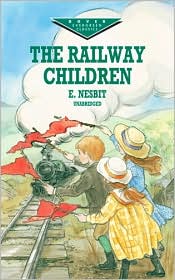
The Railway Children (MG)

The Railway Children. E. Nesbit. 1906/2011. Penguin. 304 pages. 

They were not railway children to begin with.

I loved this one. I did. I don't know how I'd ever choose a favorite, favorite E. Nesbit because all of her books are oh-so-good. The Railway Children stars three siblings: Roberta (Bobbie), Peter, and Phyllis. This one features a strong mother figure, an involved parent. (Or at least the most involved parent I've encountered in Nesbit's fiction.)

This family is under stress. The father disappears quite suddenly from his children's lives. The mother won't explain just why their father has to go away, and why the family has to move to a little place in the country. The children just know that everything is changing--little things and big things. For example, they now must choose between jam or butter for their toast--they can't afford to have both.

But while many things are changing, not all of the changes are bad. For the children discover a new way of living life. And they become involved in their new community! For better or worse! Not every person is instantly charmed by these three children, but, it's hard to resist them for long.

There were many things I enjoyed about this one. I enjoyed the children. I enjoyed their mother. I loved that she was a writer, that she was supporting her family by writing stories. I enjoyed their community, I loved meeting the different characters. It was just a satisfying story with a lot of heart.

© 2011 Becky Laney of Becky's Book Reviews


The Story of the Treasure Seekers (MG)

The Story of the Treasure Seekers. E. Nesbit. 1899. Puffin. 250 pages.

This is the story of the different ways we looked for treasure, and I think when you have read it you will see that we were not lazy about the looking. 

I just loved The Story of the Treasure Seekers. I loved the Bastables. There are six children: Dora, Oswald, Dicky, Noel and Alice, and H.O. (Horace Octavius). The children have a father, but no mother. But the father, for the most part, is absent from their day to day lives. This one has a simple plot. The children know that the family is in desperate need of money, and, well, they decide to look for treasure. Each child has an opportunity (or two) to come up with a plan for 'finding' treasure (getting money). Some of the plans are silly and over the top. (Like Noel's plan to marry a princess when he grew up.) But many of their plans lead to a FUN adventure!

I definitely enjoyed this one and would recommend it! It's a great adventure story with many satisfying moments. IF you've only read Nesbit's fantasy, you should give this one a try.

© 2011 Becky Laney of Becky's Book Reviews


Grapes of Wrath

Grapes of Wrath. John Steinbeck. 1939. Penguin. 619 pages.

To the red country and part of the gray country of Oklahoma, the last rains came gently, and they did not cut the scarred earth. 

It is finished! After three or four false starts, after two library editions and two paperback editions, it is finished. If one word could sum up my experience with this one, it would be sluggish. Of course, I can think of a few other words to describe it. But I'll share just one more: bleak. (Or perhaps bleakity-bleak.)

To sum this one as quickly as possible: The Joad family, devastated by losses in Oklahoma, are forced to pack it all up and head to California where they find that life is just as hard if not harder than they could have ever imagined. There is no happy welcome awaiting them, they are viewed--at best--as mere animals. The only way out of the harsh ugly reality is death. And even death doesn't come easy. The end.

I'm not going to try to convince you that The Grapes of Wrath is a horrible book. I'm not going to try to convince you that The Grapes of Wrath is a wonderful book. I can--at best--only share with you why we're not a good match for one another.

The language. There are certain words that offend me each and every time they're used. It doesn't matter the circumstances. It doesn't matter who or where or why. The Grapes of Wrath uses a great many of these words. (Or should I say repetition of the same word.) Are the words realistic? Probably. But that doesn't change my reaction to those words.

I had big, big, big problems with the character of Jim Casy. This "former preacher" annoyed me every time he opened his mouth. Though annoy isn't quite the right word. I'm not sure offended is the right word either. Simply because people can't use the word offended without people judging them. It's just that his language is so crude, so vulgar. That his "story" is so vulgar--how every time he got worked up "in the spirit" preaching, he had to find sexual release with young women from his church (or audience or wherever). Yes, that was mostly in the past, and yes, this "sin" is what led him to eventually give up faith and religion. Casy, when we meet him, doesn't believe in God, doesn't believe in the church or religion, doesn't believe in prayer, doesn't believe in sin, doesn't believe in the concept of right or wrong, or heaven and hell. Casy doesn't believe in anything at all really. There are no answers, there will never be any answers. Suffer, suffer, suffer, why have hope at all that you will ever do anything but suffer. Any time Casy talked about matters of faith or matters of the heart or anything remotely connected to spirituality or religion or even morals and ethics, I just wanted to yell at him. It doesn't help that according to "experts" Jim Casy is a "Christ figure." I read this on Wikipedia and Spark Notes. There are almost no words for how that makes any sense whatsoever. How someone so foul, so crude, so vulgar, so given-over-to-sin, someone who doesn't believe ANYTHING at all, someone who has no hope, no love, no peace, whose only message is now is all we got, and now is ugly is a "Christ figure." In what way at all--does he resemble Christ? Now, I'm not saying that everyone should hate Jim Casy. I am saying that as a reader I could not stand him.

Another big issue I had with The Grapes of Wrath has to do with style. The narrative style of this one is a bit odd. You have chapters that are clearly narrated by members of the Joad family, chapters that carry this story forward. Then you have chapters that read more like an out of body experience. These may focus on turtles or waitresses or car salesmen. But. They are clearly not like the other chapters in the novel. I never could quite figure out if the people in these chapters were the Joads--as seen from the outside perspective--or if the people (when the focus was on people not trees or turtles, etc.) were meant to represent any family facing this crisis, any family who had been devastated. I don't know that it matters. I just felt a great big disconnect every time we lost the main story, the real story. However, there were a couple of exceptions. There were times when these chapters were beautifully done and the text is richer for them--for the perspective they add to it. (Chapter fourteen comes to mind.)

I struggled with the first sixteen chapters. I did. I wasn't liking it. I wasn't liking it at all. But things began to shift a little with chapter seventeen. I don't know if the story truly improves once the family crosses into California, or if I just was in a better mood that day, but something changed. From that point on, the story while not always pleasant was more compelling. There was still violence to deal with, still some harsh realities to endure, but the second half definitely improved my impressions of the novel.

I am SO GLAD that this wasn't my first introduction to John Steinbeck. If it was, I never would have picked up any of his other books. I would have walked away knowing that I was right, that Steinbeck was not for me. The truth is, that Steinbeck was a good writer--at times great. That he wrote in many, many styles. That he had MANY stories to share with readers. Not just one story over and over and over again. Some of the stories he tells are very funny, very true-to-life, and even in their earthiest moments, there's something there worth reading. His stories can be very raw, very perceptive. The Grapes of Wrath was not for me. Perhaps the message was some things in life are so ugly that no amount of imagination can make them beautiful. I found the lack of hope and the vulgar language to be too much for me. But the very things that I dislike about it--the realistic portrayal of humanity at its weakest and worst--may be the very things some one else loves about it.

I read this book for the Classics Circuit tour. 

© 2011 Becky Laney of Becky's Book Reviews


The Book of Dragons (MG)

The Book of Dragons. E. Nesbit. 1900. 180 pages.

The Book of Dragons is a collection of eight short stories by E. Nesbit. While I enjoy fantasy--especially when I'm in the right mood for it, especially when it is written by someone as talented as E. Nesbit--I am not always a big fan of short stories--no matter the genre.

I did enjoy this collection. I didn't love every story within the book, but I enjoyed many of them. The writing was just so delightful, so right, so satisfying. The eight stories are: The Book of Beasts, Uncle James or the Purple Stranger, The Deliverers of Their Country, The Ice Dragon Or Do As You Are Told, The Island of the Nine Whirlpools, The Dragon Tamers, The Fiery Dragon Or the Heart of Stone and the Heart of Gold, and Kind Little Edmund Or The Caves and the Cockatrice.

My favorite stories were The Island of The Nine Whirlpools and The Book of Beasts.

© 2011 Becky Laney of Becky's Book Reviews


My Theodosia

My Theodosia. Anya Seton. 1941/2007. Chicago Review Press. 432 pages.

At six o'clock on the morning of Midsummer Day, 1800, Aaron Burr's estate, Richmond Hill, was already well into the day's bustle of preparation for the gala dinner to be given that evening in honor of Theodosia's birthday.

My Theodosia was Anya Seton's first novel. When possible I like to begin at the beginning with a new-to-me author. Saving the first book for the end, well, it can end in disappointment. Because if an author keeps improving, then each book will show it.

The heroine, Theodosia Burr, is the daughter of Aaron Burr. At his greatest, her father was Vice President of the United States of America. At his worst, he was a wanted man accused of murder and treason, etc. His greatest fan, by far, was always his daughter. I think he could have done anything, said anything, and she still would have been there standing by him, supporting him with every breath in her body.

I think it is important for readers to know exactly what to expect from My Theodosia. It is NOT historical romance. That is while the novel focuses on Theodosia and the men in her life--her first kiss which came from Washington Irving on her seventeenth birthday, her husband, Joseph Alston, her 'true love', Meriweather Lewis, the novel isn't love and romance and passion. And it most certainly is not about happily ever afters.

My Theodosia is historical fiction. Some who have read it might even call it "historical" FICTION. I'm not one to judge the historical accuracy--or historical inaccuracy--of a novel when I haven't read any nonfiction at all about the subject. I don't have a clue if Anya Seton's characters resemble the people they're supposed to faithfully represent. I do know that in the author's note she claims that the novel is "historically accurate in every detail." And she claims to have read all the Burr biographies, and the published letters of Aaron Burr, and some of the unpublished letters of Aaron Burr. And she claims to have had three sources for the romance between Meriwether Lewis. There are certainly plenty of reviews that say differently. That claim this novel is 100% fiction with no truth in it at all.

The historical time period covered is 1800 to 1812. And for those interested in this period in American history, the novel may prove interesting. I certainly found it fascinating. I read it in two days. And I wasn't bored at any point during the narrative. I can't say that I loved the characters exactly--they were too flawed for that. Aaron Burr being very charismatic and manipulative. But I can say that I found the story compelling and tragic. Maybe I found it fascinating because I didn't know that much. Yes, I knew about the duel. But I didn't know much else. And I certainly didn't know about Mexico. So it definitely held my attention.

© 2011 Becky Laney of Becky's Book Reviews


Genrefied Classics: A Guide to Reading Interests in Classic Literature

Genrefied Classics: A Guide to Reading Interests in Classic Literature. Tina Frolund. 2007. Libraries Unlimited. 392 pages.

Genrefied Classics is essentially a reference book. A book of bookish lists. There are ten genres explored in the book. Each chapter of genres is broken into sub-genres or categories. Each sub-genre has a list of recommended reads. Each entry lists the author, the title, the year and country of initial publication, details about more recent publications, and information about if the title has been done as a movie or an audio book. Each entry also features 'similar reads' and subject headings for that title.

Classics can be interpreted differently by people--depending on each person's definition of what a classic is and is not. This book only includes "classics" published before 1985. (Ender's Game would be an example of a more recent classic included in this one, the oldest examples would be The Iliad, Aesop's Fables, The Aeneid, etc.)

While the intended audience of this one may be adults who work with kids and teens (fifth grade on up through twelfth grade)--in other words librarians, teachers, etc., I think other readers can benefit from browsing this one. I don't think you have to be looking for a classic to put in the hands of a teenager to benefit from it.


There are categories or subcategories within this one which I wish were a bit longer because I would love even more suggestions. I would have LOVED it if the chapter on romance had been longer. I would have thought there would be more categories too. This section just felt a little uninspired, if that makes sense. Because while it's nice to include Jane Austen and Charlotte Bronte, it's not like those aren't oh-so-obvious choices. And to list only one Georgette Heyer?! I also think it would have been nice for Eugenia Price to get a mention or two either in this section or the historical fiction section. And Grace Livingston Hill, for that matter, either here or in inspirational fiction. And it just felt wrong, wrong, wrong for Elizabeth Gaskell not to be included in the romance section or the historical fiction section. Surely North and South and Wives and Daughters and Cranford are more than worthy to be included!!! I mean North and South is absolute must-must-must read in my opinion.

I was pleased to see some of my favorite authors included: Agatha Christie, Dorothy Sayers, Josephine Tey, Ray Bradbury, Orson Scott Card, John Steinbeck, L.M. Montgomery, etc. Some of the authors recommended were unfamiliar, which is a GOOD thing in my opinion. I picked this one up wanting to discover new-to-me-authors in my genres of choice. Unfortunately, some of them might be a bit tricky to find at the library. 

Because of my familiarity with some of the subjects (sub-categories), their recommended reading lists seemed too short, too incomplete, as you might expect. If you come to the book wanting new-to-you authors, new-to-you-books, the more you've read of the basics, the more that will be the case. But these lists aren't supposed to be comprehensive, they're supposed to be more basic than that.

One thing that also GREATLY annoyed me (I have low tolerance for this, don't laugh) is when they used the WRONG, WRONG, OH-SO-WRONG listing for the Chronicles of Narnia. Publication order. Publication order. Publication order. That's all I have to say about that.

As you might expect, the longest chapter is devoted to historical fiction. Over sixty pages worth of recommended reading. The shortest chapter is definitely the one devoted to inspirational fiction.
The ten genres are:

Adventure
  • Espionage
  • Journey
  • Lost World
  • Nature and Animals
  • Sea Stories
  • Survival
  • Swashbucklers
Historical Fiction
  • Ancient Egypt
  • Ancient Greece
  • The Roman Empire
  • The Middle Ages (A.D. 500-1500)
  • Sixteenth, Seventeenth, Eighteenth Century Europe and England
  • The Spanish Colonies
  • Colonial America
  • American Revolution
  • American Civil War 1861-1865
  • Slavery
  • Settlers and Pioneers
  • Westerns
  • Gilded Age
  • Jazz Age
  • The Great Depression
  • Urban Realism and the Growth of City Life
  • World War I
  • World War II
  • Victorian England
  • Russian Novels Nineteenth Century
  • Russia Twentieth Century
Science Fiction
  • Aliens
  • Dystopias and Alternative Futures
  • Science Gone Awry
  • Space Travel, Adventure, and Life in Other Worlds
  • Time Travel
Fantasy
  • General Fantasy
  • High Fantasy
  • Mythology
  • Epic and Legend
  • Arthurian Fiction
  • Folktales
  • Fairy Tales
  • Animal Fantasy and Fables
  • Humorous Fantasy
Horror
  • Ghost Stories
  • Haunted Houses
  • Gothic Horror
  • Vampires
  • Supernatural and Weird Stories
  • Psychological Horror
  • Science Gone Awry
Mystery and Suspense
  • Detectives
  • Hard-Boiled Private Eyes
  • Crime and True Crime
  • Suspense
Coming of Age and Other Life Issues
  • Coming of Age
  • Relationships
  • Family
  • Extreme Mental States (Mental Illness and Drug Addiction)
  • Death
  • Social Conflict
Romance Fiction
  • Gothic Romance
  • Historical
  • Regency Romance
Inspirational Fiction
  • Religious Scriptures
  • Early Christianity
  • Christian Literature
  • Other Inspirational Stories
Humor


© 2011 Becky Laney of Becky's Book Reviews


Sense and Sensibility

Sense and Sensibility. Jane Austen. 1811. (The Complete Novels) Random House. p. 3-175.

The family of Dashwood had been long settled in Sussex. Their estate was large, and their residence was at Norland Park, in the centre of their property, where for many generations they had lived in so respectable a manner as to engage the general good opinion of their surrounding acquaintances.

I don't know why I didn't love Sense and Sensibility the first time I read it. I really don't. Because it's just as good as all the other Austen I've read--or reread as the case may be. Could it be that some Austen novels just need to be read twice to be appreciated? Or could it be that this novel was just in the right place at the right time for me to love it? Mood does factor into my experience after all! Could me loving Colonel Brandon's Diary by Amanda Grange have something to do with it? And I couldn't help making comparisons between Sense and Sensibility with Anthony Trollope's The Small House of Allington. Couldn't help concluding that if Austen had been writing it, readers would have had a FULLY, FULLY satisfying ending! (And if Trollope had been writing Sense and Sensibility, well, Marianne might not have given up some of her notions.) Let's just be thankful that Thomas Hardy did not write Sense and Sensibility or The Small House of Allington!

I almost feel silly not including a summary, but it also feels silly to include a summary. I feel so many people will already be familiar with the basics of the story. So here it goes.

Soon after the novel opens, Mr. Dashwood dies. The second Mrs Dashwood has three daughters and not much money. For most everything went to Mr. John Dashwood, the eldest son, the son of the first Mrs. Dashwood. He promised his father--promised--that he would provide for his half-sisters and step-mother. (For the father was very distraught about his family and how they would be able to live.) To borrow from Dr. Seuss, he said and said and said those words, he said them but he lied them*. Is that exactly fair? Yes and no. He just didn't remember that he's not allowed to have thoughts and opinions of his own. He forgot to take into account his wife, Fanny Dashwood. He forgot that she would most definitely have an opinion on his her their newly inherited money. The scene between the two is quite remarkable and clever. If you can view them as villains providing comic relief. If you consider them as human beings, well, their actions can't be justified so don't even try.

So after many uncomfortable months sharing a home with John and Fanny Dashwood (and their son), Mrs. Dashwood decides she's had enough. She agrees to move with her three daughters to a small cottage (on the estate of Barton Park) where they can afford the rent. It isn't a perfect situation because it brings them into the company of Sir John Middleton, Lady Middleton, and Mrs. Jennings, just to name a few. (A little of their company goes a long, long way). But they are happy enough in their own way.

So Elinor is the oldest daughter, Marianne is the middle daughter, and Margaret is the youngest daughter. Marianne is the one most like her mother. And Marianne and Mrs. Dashwood can clash quite a bit with Elinor. Not in a needing Dr. Phil way. Not in an outrageous way. Just that they have different ideas about love and life and the finer things in life like art, music, poetry, novels, etc. To be quite honest, I found myself taking Elinor's side for many of these conversations. Marianne's strong opinions, well, they irritated me in many ways. And quite a few actually disgusted me. I had to keep telling myself, she's seventeen, she's seventeen, she's seventeen. She just hasn't experienced enough of life, of love, to know any better. Not that I believe she needed to outgrow her spirit. For her passionate spirit, her love of life, isn't a bad thing.

So Sense and Sensibility is a romance. Readers meet the men in Marianne and Elinor's lives. We meet Edward Ferrars, the brother of Fanny. Perhaps because she is already connected--for better or worse--with Fanny, Elinor doesn't hold that against him. It helps that he's not really anything like his sister. We meet John Willoughby, Marianne's ideal romantic hero. He wins Marianne and Mrs. Dashwood over with very little effort. They're just convinced that he's the best thing ever. The problem may just be that he knows it. He knows the effect he has on women--the more romantic, the more passionate, the sillier, the easier it is for him to make them swoon. And then there is Colonel Brandon. The man that perhaps only Elinor can fully appreciate--at least at the beginning. Marianne being too silly, going "he's so old, he's so ancient, who could ever love someone so old and decrepit?" Never considering that he is close to her mother's age--give or take a few years. How old is old? Well, he's 35. (Not so old in my opinion! Definitely not so old that he should just give up living life.)

I loved Sense and Sensibility. I did. I wouldn't say it was like I was reading it for the first time. Because goodness knows that when I read it the first time I was obviously not paying attention to the little things or even the not-so-little things. I suppose I was reading with a limited attention span? Or maybe I just wanted to get done quickly? I read with attention and appreciation this time. I read for pleasure. I read at my own pace. I took in each scene without rushing, without pushing. I saw just how much there was to see.

For example, I noticed that sometimes it wasn't always what was being said that mattered. That sometimes it was all about what was NOT being said. There were many, many times when the words that were being said, weren't meant at all. There were conversations veiled in polite words that were actually quite mean-spirited, full of insult, and revealing some jealousy. The text actually has quite a bit of sarcasm and humor or wit to it. That Elinor might say all the right things--at times--but that doesn't mean she's always sincere. "It was impossible for [Marianne] to say what she did not feel, however trivial the occasion; and upon Elinor, therefore, the whole task of telling lies when politeness required it always fell" (57). And so I was able to "see" more of Elinor this time through, perhaps, in her conversations with the Middletons and Palmers and Steeles and Mrs. Jennings. Like this little gem:
"I have a notion," said Lucy, "you think the little Middletons rather too much indulged; perhaps they may be the outside of enough; but it is so natural in Lady Middleton; and for my part, I love to see children full of life and spirits; I cannot bear them if they are tame and quiet."
"I confess," replied Elinor, "that while I am at Barton Park, I never think of tame and quiet children with any abhorrence." (58)
Almost from start to finish, I thought about each conversation, each relationship. Was it all pretense and politeness? Was it sincere or genuine? What wasn't being said? Was what being said the truth and nothing but the truth? Who did Elinor feel comfortable with? Who was she real with?

So there was much to think about this time through. And I wasn't solely thinking of Elinor throughout. I was trying my best to appreciate all the characters--even the ones I didn't especially like....like Willoughby. What I noticed was that Austen created plenty of flawed characters. That there are characters that have a few quirks, a few flaws, a few weaknesses, but that also have their good qualities too.

So I definitely LOVED this one and would recommend it. I would suggest that you go at your own pace, that you don't read it in a hurry. That you let yourself enjoy it in the moment, enjoying each scene as part of the whole, instead of trying to rush to the happily ever after ending.

*Adapted from "What Was I Scared Of?"

© 2011 Becky Laney of Becky's Book Reviews


Too Many Cooks

Too Many Cooks. A Nero Wolfe Mystery. Rex Stout. 1938/1993. Bantam. 240 pages.

Walking up and down the platform alongside the train in the Pennsylvania Station, having wiped the sweat from my brow, I lit a cigarette with the feeling that after it had calmed my nerves a little I would be prepared to move the Pyramid of Cheops from Egypt to the top of the Empire State Building with my bare hands, in a swimming suit; after what I had just gone through. But as I was drawing in the third puff I was stopped by a tapping on the window I was passing, and, leaning to peer through the glass, I was confronted by a desperate glare from Nero Wolfe, from his seat in the bedroom which we had engaged in one of the new-style Pullmans, where I had at last got him deposited intact. He shouted at me through the closed window: "Archie! Confound you! Get in here! They're going to start the train! You have the tickets!"
I yelled back at him, "You said it was too close to smoke in there! It's only 9:32! I've decided not to go! Pleasant dreams!"
I sauntered on. Tickets my eye. It wasn't tickets that bothered him; he was frantic with fear because he was alone on the train and it might begin to move. He hated things that moved, and was fond of arguing that nine times out of ten the places that people were on their way to were no improvement whatever on those they were coming from. (1-2)
Too Many Cooks starts off great. The first chapter provides so many laughs! As readers witness Archie and Nero Wolfe at their absolute best. Nero being made so vulnerable through his fear of the train ride ahead. Nero being so pathetic as he pleads for the recipe of his favorite-and-best sausage. And, of course, readers witness Archie's weakness as well--as he meets a beautiful young woman. (The daughter of a famous chef, the chef Nero is pleading with so enthusiastically!) Both Nero Wolfe and Archie Goodwin are on their way to a West Virginian spa. Nero Wolfe is even the guest of honor. He'll have the privilege of making a speech on American cuisine.

Ten of the world's greatest chefs will be gathering at Kanawha Spa. These chefs are elected members of Les Quinze Maitres. Among the celebrating, the speech-making, the tasting, the drinking, the dancing, the gossiping, they'll be electing three new members to replace those that have died since the last big gathering. (I believe they meet every five years?) There is much jesting, much teasing, much quarreling between members. And this leads to one making a boast and setting up a game--a test. It seems to be all in fun.

But then, this chef ends up dead.

Nero Wolfe and Archie Goodwin are on vacation. And at first Nero has no interest at all in 'helping' solve this one. But when this investigation complicates his plans to return to New York, his return to routine, he becomes more cooperative. Can Archie and Nero solve this one before anyone else gets hurt?

I liked this one. I just LOVED the first chapter or two. But this one has its squirmy moments, its awkward moments. You could say it shows its age in race relations. The use of the n-word, for example. The way African Americans are treated with hostility, disrespect, and mistrust by the local police and with condescension and kindness by Nero Wolfe. The way Archie is shocked or startled by the appearance of fourteen African-Americans outside Wolfe's door, they are there to be "questioned" by Wolfe as he tries to solve this one. He doesn't trust the police to do it right. And the way the murderer uses blackface as a disguise when he commits the crime. But it isn't only the treatment of one race or ethnicity that makes this one squirmy. The matter-of-fact way they speak about the Chinese wife of one of the chefs, an eyewitness to the crime. (The police may or may not believe her story. She is Chinese after all.)

There are many things about Too Many Cooks that I did enjoy. There were many things that made it a pleasant read, a satisfying read. It's a good mystery. And the dialogue between Archie and Nero is not to be missed. These two are so much fun! They are two of my favorite characters ever created. But I can't say that it's a perfect read.

Some of my favorite quotes:

Archie Goodwin to Nero Wolfe:
"I am not deaf, sir. And while you can beef as much as you want to, because it's your own breath if you want to waste it, I do object to your implying either in word or tone that I am in any way responsible for your misery. I made this speech up last night, knowing that I would need it. This is your idea, this trip. You wanted to come--at least, you wanted to be at Kanawha Spa. Six months ago you told Vukcic that you would go there on April 6th. Now you regret it. So do I. As far as our engine is concerned, they use only the newest and best on these crack trains, and not even a child--" (3)
Archie on love at first sight:
It takes a long time to know people. How are you going to tell about anyone until you know them? Take love at first sight, for instance, it's ridiculous. That's not love, it's just an acute desire to get acquainted. (23)
Archie being surprised by Nero:
For ten years I had been accustomed to being as sure of finding Nero Wolfe where I had left him as if he had been the Statue of Liberty, unless his house had burned down, and it was upsetting, not to mention humiliating, to find him flitting around like a humming bird for a chance to lick the boots of a dago sausage cook. (34)

© 2011 Becky Laney of Becky's Book Reviews


True Grit

True Grit. Charles Portis. 1968. Overlook Press. 224 pages.

People do not give it credence that a fourteen-year-old girl could leave home and go off in the wintertime to avenge her father's blood but it did not seem so strange then, although I will say it did not happen every day. 

Last week I reviewed The Virginian by Owen Wister, this week I'm reviewing True Grit. Could it be that I'm not as allergic to westerns as I thought? Or have I just found two exceptions to the rule?!

What's the word that best describes our heroine, Mattie Ross? Spunky? Stubborn? Strong-willed? No-nonsense? Independent? She's all those things, it's true, but it goes deeper than that perhaps. She does not back down. If Mattie has made up her mind, then there's no changing it. There's no arguing with her...and winning. It just can't be done. She may be a kid--a girl--but she can hold her own in a world of men.

When her father is murdered by Tom Chaney, a man her father had half-way trusted--at least trusted enough to give him a job, a place to live, and a "second" chance at life--then Mattie Ross decides then and there that he will pay for his crime. She'll see that justice is done, even if she has to pay for that justice herself.

Mattie hires a marshal with grit--Rooster Cogburn. The Fort Smith sheriff tells Mattie that Rooster Cogburn "is a pitiless man, double-tough, and fear don't enter into his thinking. He loves to pull a cork" (23). She promises a $100 for a job well done. But she doesn't tell him--at least not at first--that she has every intention in the world of going with him on his search. Yes, this fourteen-year-old girl is going to ride side by side with him on his dangerous mission--hunting outlaws is always dangerous, you know. And then there is the third companion, a Texas Ranger, LaBoeuf. He wants to find Chaney/Chelmsford too. There's money to be find in bringing him to justice. While LaBoeuf's motivation is more monetary, perhaps, for Mattie this is purely personal.

And it was the fact that this was a personal story--though don't expect it to be sentimental or weepy, Mattie is no Elsie Dinsmore--that touched me the most. It is my connection with Mattie that made me love this one. Her character, her personality, her strength as a narrator. I think Mattie is unforgettable.

While I can't say that I loved every scene in this one--especially the one with the poisonous snakes--I have to admit that I did enjoy this one very much. I found it very compelling!

© 2011 Becky Laney of Becky's Book Reviews


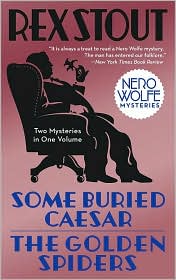
The Golden Spiders

The Golden Spiders. Rex Stout. 1953. Random House. 206 pages.

When the doorbell rings while Nero Wolfe and I are at dinner, in the old brownstone house on West Thirty-fifth Street, ordinarily it is left to Fritz to answer it. But that evening I went myself, knowing that Fritz was in no mood to handle a caller, no matter who it was.

I loved The Golden Spiders very much! Is it because I am absolutely loving Nero Wolfe and Archie Goodwin? Is it because I have found Rex Stout's books to be so charming, so satisfying? Perhaps! Since I seem to be loving each new book I read a little bit more than those I've read before. (Though I'm not sure I could *really* choose between Some Buried Caesar and The Golden Spiders.) I love the characters. I love the writing--the style of it. I love the mystery too. I love how Goodwin and Wolfe *solve* their cases.

In this mystery, Archie Goodwin interrupts Nero Wolfe's dinner to tell him that there is a child at the door--Pete Drossos. This Pete has a case to present to Wolfe. He has witnessed something--a possible crime--and he wants Wolfe to team up with him. While he was washing the windows of stopped cars in traffic--he saw (not heard) a woman ask him to get the police. She had a scratch on her face. And her earrings were quite unique--golden spiders. There was a man with her in the car--and the boy believed (though he didn't see with his own eyes) the man had a gun and was threatening the woman. Being distrustful of cops, the boy sought this famous man's help. Wolfe is interested--mainly because he knows that his interest will annoy Archie--and offers his advice on how to be a good private investigator. He also promises to call the police and let them know about the alleged crime leaving the boy's name out of it. A few days later, well, Goodwin and Wolfe learn that this boy has been the victim of another crime--a murder. The boy's mother insists on fulfilling her son's last request--to give all his money--four dollars and some change--to Wolfe. Wolfe then feels obligated to do something for the boy. True, that amount of money isn't his usual rate for clients, but this is a special case. Archie then suggests they place an ad in the paper looking for the woman with golden spider earrings...

This mystery is compelling! I enjoyed it very much. I would definitely recommend this one.

Nero Wolfe to Fritz on the matter of his starlings:

When the platter was brought in steaming, and placed before him, he sniffed, ducked his head and sniffed again, and straightened to look up at Fritz.
"The sage?"
"No, sir."
"What do you mean, no, sir?"
"I thought you might like it once in a style I have suggested, with saffron and tarragon. Much fresh tarragon, with just a touch of saffron, which is the way--"
"Remove it!"
Fritz went rigid and his lips tightened.
"You did not consult me," Wolfe said coldly. "To find that without warning one of my favorite dishes has been radically altered is an unpleasant shock. It may possibly be edible, but I am in no humor to risk it. Please dispose of it and bring me four coddled eggs and a piece of toast." (2)

Archie on Nero Wolfe:

As I went across to the office, to my desk, and dialed the number of Manhattan Homicide West, I was reflecting that of all Wolfe's thousand techniques for making himself obnoxious the worst was when he thought he was being funny. (9)

© 2011 Becky Laney of Becky's Book Reviews


The Last Chronicle of Barset

The Last Chronicle of Barset. Anthony Trollope. 1867.  928 pages. 

'I can never bring myself to believe it, John.' said Mary Walker, the pretty daughter of Mr. George Walker, attorney of Silverbridge. 

I love Anthony Trollope. I do. You know I do. So finishing The Last Chronicle of Barset was bittersweet for me. On the one hand, I loved it. It was such a great book. There are so many old friends to be found within it. So many characters that I've come to know and love through the first five books--The Warden, Barchester Towers, Doctor Thorne, Framley Parsonage. The Small House At Allington. And it was great to visit with them again. To reconnect with them. There were many new characters to love as well. So I loved it cover to cover. On the other hand, perhaps because it was so wonderful, it made it all the more difficult to say goodbye.

When Mr. Crawley, the curate of Hogglestock, is accused of stealing a cheque, everyone in Barsetshire begins to take sides. Some feel that he couldn't possibly have meant to steal the money, there has to be a valid excuse as to why his wife tried to spend another man's cheque to pay her bill. Others feel that he's guilty. What valid excuse could any man have for having another man's cheque in his possession? This Mr. Crawley may be a clergyman, but he also must be a thief. You might think that the church would stand by him. At least until he's been found guilty and punished by the courts. But the bishop and his wife, Mrs. Proudie, are his harshest critics. She is demanding (or should I say commanding) that he resign. She would call for his resignation because he looks guilty. Even if the courts were to clear him, I think she would want him gone. (Not that every clergyman agrees with the bishop and his wife. In fact, some lean more towards believing Crawley to be innocent because Mrs. Proudie is so sure of his guilt. And they wouldn't want to agree with her on any subject.)

Many people are upset by the Crawley's misfortune. Especially Grace Crawley, his beautiful daughter, and her suitor, Major Henry Grantley, the second son of Archdeacon Grantly. His father has been very firm in opposing this match. Yet Major Grantley can't turn his back on the woman he loves. And speak to her he must. If she'll agree to marry him, then he'll be truly happy. Of course, she is refusing to answer yes or no until her father's trial is over. If her father is found guilty, we're led to believe she would never ever consent to be his wife. (One of my favorite scenes in the entire novel is when Archdeacon Grantley goes to visit Grace Crawley. He approaches her full of anger and wrath, determined that he'll speak bluntly and forcefully with her. Yet by the end of the scene who has won the day?!) So I loved this romance, I did.

The other romance--of sorts--is Lily Dale and Johnny Eames, a non-couple we first met in Small House at Allington, he's still madly in love with his Lily. And she's still stubbornly refusing to even hear him speak of love and marriage. She will never, ever, ever, ever, ever marry. He's not convinced that his love is hopeless. And he's not alone in thinking that his romance is hopeless--there are so many supporters on his side, so many hoping that Lily will one day say yes. But who is more stubborn? Readers learn the answer to that in this final volume.

Of course, those are just some of the stories within The Last Chronicle of Barset. I wish I had some quotes to share. But I've probably marked over a hundred pages--and I couldn't begin to pick and choose from that many. But trust me. Trollope is Trollope and his writing is wonderful like always!

© 2011 Becky Laney of Becky's Book Reviews


Peony

Peony. Pearl S. Buck. 1948/2006. Moyer Bell. 352 pages.

It was spring in the city of K'aifeng, a late spring in the northern Chinese province of Honan. Behind the high city walls the peach trees, planted in courtyards, bloomed earlier than they did upon the farms spreading over the level plains around the moat. Yet even in such shelter the peach blossoms were still only rosy buds at Passover.

Is it possible to be fascinated by a book that you don't quite like? I think so for I found Peony by Pearl S. Buck to be completely fascinating and compelling and yet not quite to my liking. Narrated by a bondmaid, Peony, readers learn about a Jewish community living within the Chinese city of K'aifeng in the early 19th century. Peony, a Chinese servant who was "bought" as a young child to be a companion to the couple's young son, David, a woman who comes to fall in love with him. It is an all-consuming, sometimes quite manipulative love, a forbidden love, but a forever kind of love nonetheless.

Ezra and Madame Ezra could never accept this servant as a daughter-in-law. But both are fond of her in their own way. As for David, he couldn't imagine life without Peony nearby. He promises that as long as he lives, she'll always always have a place in his home. But does he love her? At the beginning? Not really. Does he even know what love is?!

It is Madame Ezra's greatest desire for her son, David, to marry Leah, the daughter of the rabbi. It is her greatest desire that her son will come to embrace the Jewish faith, study under the rabbi, and maybe just maybe take his place since the rabbi's son, Aaron, is no good. She even invites Leah to live with them in their home. Hoping that Leah will be able to persuade David that he is more Jewish than Chinese. (David's father, Ezra, had a Chinese mother and a Jewish father.)

But. David is more like his father, Ezra, than his mother. David tries to learn about Judaism from the rabbi. He reads what he is supposed to read. He studies what he is supposed to study. But he has a hard time believing that God is real, that his people are chosen, that a wrathful God--a jealous God--could be a good God, a holy God, a just God. Instead, David comes to believe that religions are mostly the same--all man-made and essentially nonsense. He's closer to "accepting" the teachings of Confucius than the teachings of the Torah. He brings the rabbi to despair and breaks his mother's heart--for a time at least.

So his mother is pushing him to marry Leah. And Peony is pushing him to marry a pretty (but mindless) Chinese girl, Kueilan. For she believes that she could get along better with her than Leah. That if he chooses Leah--and the faith--that she'll be pushed out of his life. She even goes so far as to write both sides of their love letters! Peony has flaws--plenty of flaws! And it wasn't easy for me to stay on good terms with her.  

So Peony chronicles the lives of this Jewish family. It examines the tension between being Jewish and being Chinese. It examines how living in China for several centuries--at least--has had an impact on their faith, their culture, their teachings. It explores the decay of this community. How almost each generation weakens the faith, weakens the community. Each generation coming to compromise more and more of their faith.

So I liked elements of this one. I found the story itself to be fascinating. The novel covers several decades--at least--of this Jewish community from the point of view of one prominent family. And the afterword by Wendy R. Abraham was equally fascinating. I learned how much was fact, how much was fiction. How Pearl Buck played with the chronology a bit, but was true enough in some ways to do this community justice. But. I can't say that I "liked" the characters themselves--David and Peony especially. I found my heart breaking--along with his mother's heart--when David rejected faith in the one true God. I found it sad--very sad--to see the decay of the faith. How when the rabbi died there was no one within the community to take his place, there was no one left to carry on his work, his teachings. And Peony? Well. I found her to be selfish and manipulative and deceitful. So I liked some things; didn't like other things.

I did find it to be well-written. I think I liked this one more than the Good Earth trilogy, but I still think Kinfolk is my favorite.

© 2011 Becky Laney of Becky's Book Reviews


A House Divided

A House Divided. Pearl S. Buck. 1935/2006. Moyer Bell. 348 pages.  

In this way Wang Yuan, son of Wang the Tiger, entered for the first time in his life the earthen house of his grandfather, Wang Lung.

The third book in Pearl S. Buck's The Good Earth trilogy. (The first two books are The Good Earth and Sons.) Is A House Divided the best of the three? Perhaps if you prefer books where characters actually have names (and some character development).

At the end of Sons, Wang Yuan had returned home to face his father. He'd been sent away to school--to learn how to become a soldier--and now he's returned. In Sons, I didn't quite grasp why he had come home. I knew he was angry--very angry. And I knew his father was shocked--very shocked--by his son's new beliefs, new philosophies. But I didn't know at the time exactly WHAT that meant for them both.

Within a few paragraphs of A House Divided, however, it all became clear. When Yuan came home it was because if he stayed at the school, if he stayed in this new army, this new revolution, it would just be a matter of time before he'd be marching against his father and his father's way of life--against the scattered war lords that dominated the country. And so when it came down to it--he chose his father. Not because he agreed with his father. Not because he wanted to step into his father's place. No, he still rejects almost everything his father stands for. But he's choosing to remove himself from both extremes, he's choosing not to do battle or choose sides at all.

So Yuan cannot--or should I say will not--stay in his father's home. So where can Yuan go? Well, after a very brief stay in his grandfather's hut in the country--Wang Lung--he decides to go to the city to see his half-sister, Ai-lan, and his stepmother. (Is stepmother the right word? His father had two wives. One wife chosen by Wang the Merchant, one wife chosen by Wang the Landlord. I believe he calls her mother but she's not his biological mother.) He remains with them--in the city--for quite a while! In the city, he goes to school--not to learn the art of war, of soldiering--but to pursue his own interests. And he has many interests. He wants to know everything, to learn everything. He wants more, more, more. Part of him is interested in beauty and nature and poetry. And another part of him is interested in agriculture, in farming. He wants to know THE BEST way to work the land. There is a part of him that would love to return to the land and be a farmer, an educated farmer, a farmer who can read and write and philosophize, but a farmer nonetheless. But his life with his half-sister and two cousins Meng and Sheng, leads him into a little trouble. For new ideas abound in the city. And some of these ideas are a little dangerous. There comes a time when his new home is no longer safe...

So Yuan goes to the United States. What will he learn there? Will he be happy? Will he be miserable? Will he hate himself for loving it? Or love himself for hating it? When he returns--how will he see his country? Will he be able to find a place to really belong in China? Will Yuan ever stop over-thinking everything in his life?  

Wang Yuan is SO different from his father, Wang the Tiger. And it was nice to see that change, that contrast. But Yuan's periods of self-doubt and self-loathing--which we see cover to cover--became tiresome. I'm not saying that he wasn't believable as a character, that he wasn't developed enough. It's just that it kept me from liking him as much as I'd hoped at the start. The first third of the book, I thought, held great promise. I was liking Yuan--pleasantly surprised that I was liking him since I hadn't really "liked" Wang Lung or Wang the Tiger--but in the end I didn't really grow to love him.

However, I can say that while I didn't *love* him as a character, I can see how Yuan's inner turmoil matches that of China, that of his generation, those torn between loyalties to the older generation and these new ideas of revolution and freedom. Yuan is not alone in his angst. 

Yuan on his "father's love."

He has never loved me all his life long! He thinks he loves me and that he holds me the only dear thing he has, and yet never once has he asked me what I really want to do, or if he did, it was to refuse me if what I aid was not his wish, so that I always must take thought to say what he wanted and I have had no freedom! (5)

Yuan on why he can't be a soldier:

I cannot kill--I am not brave, I know. The truth is I cannot hate wholly enough to kill a man. I always know how he feels, too. (44)

Yuan on the poor:

At this time of his life Yuan loved pleasure, and he was unwilling to see the poor, and yet he was so shaped within that he saw them all even while he wished he did not. (68)

Yuan on having sons of his own:

Yes, one day he would have sons. But those sons--they should be free--free of any shaping from him who was their father! They should not be made for soldiers, nor shaped for any destiny, nor bound to any family cause. (266)

© 2011 Becky Laney of Becky's Book Reviews


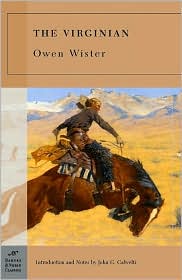
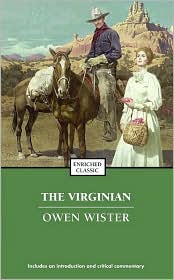
The Virginian

The Virginian. Owen Wister. 1902. Penguin Classics. 370 pages.

Some notable sight was drawing the passengers, both men and women, to the window; and therefore I rose and crossed the car to see what it was. I saw near the track an enclosure, and round it some laughing men, and inside it some whirling dust, and amid the dust some horses, plunging, huddling, and dodging. They were cow ponies in a corral, and one of them would not be caught, no matter who threw the rope.

I do not read many westerns. (If I remember correctly, this is only my second or third western. Depending on if you count These is My Words by Nancy E. Turner. My first western was Riders of the Purple Sage by Zane Grey.) In fact, I have always believed myself to be completely allergic to the genre. Me? Like a western?! Really?! Well, I did more than like this one. I loved it. I maybe even loved, loved, loved it. While I'm not sure that I can echo what Dolce Bellezza said in her review: "It will definitely be in my top ten list for the year, and quite possibly for my life." I definitely agree that it is worth reading. I was very happy to be so surprised!

The Virginian is a collection of interconnected stories. Some are more "connected" than others. Some of the stories are told through a first person account, a first person narrator, whom we come to know simply as Tenderfoot or The Tenderfoot. He's an Eastern man that has come west to Wyoming territory. And The Virginian, our real hero, is his protector as this newbie is learning his way.
When Judge Henry ascertained that nothing could prevent me from losing myself, that it was not uncommon for me to saunter out after breakfast with a gun and in thirty minutes cease to know north from south, he arranged for my protection. He detailed an escort for me; and the escort was once more the trustworthy man! The poor Virginian was taken from his work and his comrades and set to playing nurse for me. And for a while this humiliation ate into his untamed soul. It was his lugubrious lost to accompany me in my rambles, preside over my blunders, and save me from calamitously passing into the next world. He bore it in courteous silence, except when speaking was necessary. He would show me the lower ford, which I could never find for myself, generally mistaking a quicksand for it. He would tie my horse properly. He would recommend me not to shoot my rifle at a white-tailed deer in the particular moment that the outfit wagon was passing behind the animal on the further side of the brush. There was seldom a day that he was not obliged to hasten and save me from sudden death or from ridicule, which is worse. Yet never once did he lose his patience; and his gentle, slow voice, and apparently lazy manner remained the same, whether we were sitting at lunch together, or up in the mountains during a hunt, or whether he was bringing me back my horse, which had run away again because I had again forgotten to throw the reins over his head and let them trail. (45)
But other stories are told in third person. Through a series of adventures, we get to know The Virginian; we get to know the people close to The Virginian. The men he works with and respects. The men he works with and doesn't respect. His friends. His enemies. My favorite of these may just be the woman, the "school teacher spinster" whom he falls in love with, Miss Molly Wood. 

 I found myself enjoying not just the characters, not just the stories, but the writing style itself. After the clumsiness of Zane Grey (at least in Riders of the Purple Sage) I was happy to see a western written by someone who could really write. There was just something about this one that worked for me. It was dramatic. It was suspenseful. It was humorous. It was emotional. It was romantic--in places. Some of my favorite scenes were the ones between The Virginian and Miss Molly Wood. I loved their courtship. How steady he was, how stubborn she was. How he took the time to read *most* of the books she loaned him. How he was fond of a good book--Shakespeare especially. But how he really didn't get why she loved Jane Austen so much! I liked their conversations on the books he read. I liked his conversations with her in general.

But The Virginian isn't just a romance. I mean there is a happily ever after at the end. But in between all the courting scenes--and there are really only a handful--The Virginian is busy working and riding and managing the Judge's ranch--he's foreman--and generally seeing that justice is done. (Because there are cattle thieves about!) So there is plenty of action and adventure and humor. There's plenty of good fun in this one. But it's not without its darker moments, its life-and-death moments.

Favorite quotes:

The Virginian was grave in bearing and of infrequent speech; but he kept a song going--a matter of some seventy-nine verses. Seventy-eight were quite unprintable, and rejoiced his brother cow-punchers monstrously. (62)

No one of her admirers had ever been like this creature. The fringed leathern chaperreros, the cartridge belt, the flannel shirt, the knotted scarf at the neck, these things were now an old story to her. Since her arrival she had seen young men and old in plenty dressed thus. But worn by the man now standing by her door, they seemed to radiate romance. (83)

Molly Wood was regarding him saucily. "I don't think I like you," said she.
"That's all square enough. You're goin' to love me before we get through. I wish yu'd come a-ridin', ma'am."
"Dear, dear, dear! So I'm going to love you? How will you do it? I know men think that they only need to sit and look strong and make chests at a girl--"
"Goodness gracious! I ain't makin' any chests at yu'!" Laughter overcame him for a moment, and Miss Wood liked his laugh very much. "Please come a-ridin," he urged. "It's the prettiest kind of a day."
She looked at him frankly, and there was a pause. "I will take back two things that I said to you," she then answered him. "I believe that I do like you. And I know that if I went riding with you, I should not have an immature protector." (85)

"And now I'll not see you for quite a while. I am going a long way. But I'll be very busy. And bein' busy always keeps me from grievin' too much about you."
Strange is woman! She would rather have heard some other last remark than this.
"Oh, very well!" she said. "I'll not miss you either."
He smiled at her. "I doubt if yu' can help missin' me," he remarked. And he was gone at once, galloping on his Monte horse. Which of the two won a victory this day? (94)

If words were meant to conceal our thoughts, melody is perhaps still thicker veil for them. (142)


© 2011 Becky Laney of Becky's Book Reviews


Dueling Authors: Jane Austen vs. Charles Dickens

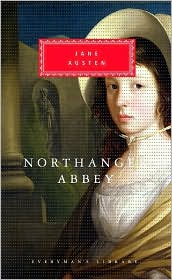
Today I am participating in the Classics Circuit Dueling Author tour. Participants had the option of reading Jane Austen OR reading Charles Dickens OR reading both Dickens and Austen. For this tour, I decided to read Northanger Abbey by Jane Austen and Pickwick Papers by Charles Dickens.

I've been a fan of Jane Austen for almost six years now. I've read Persuasion, Pride and Prejudice, Emma, Sense & Sensibility, Mansfield Park, Northanger Abbey, and Lady Susan. (Persuasion is my favorite and best, by the way. Emma is probably my least favorite.)

For many, many years I was decidedly NOT a fan of Dickens. Why?! Well, I had been forced required to read Great Expectations in high school. And it was so traumatic--perhaps--that I blocked it from my memory. Same thing in college when it was once again required. It seemed to me that Great Expectations was the novel that could not--would not--stick in my memory. But my dear, dear friend gently but firmly persuaded me to change my mind. Not all at once. Little by little. And when I finally gave Dickens a chance, when I came to him without prejudice, I found out something about myself. I really do love and adore bearded Victorians. I love Dicken's style. I love his asides, his ramblings, his descriptions. I love his characters. I even love the way he names his characters. I love the complexities of his writing. Sure there might be people out there who don't think Dickens worth their time, worth their effort. But. For me. I couldn't imagine feeling that way. Last fall, I read Bleak House, and this spring, I read Our Mutual Friend and Little Dorrit. Of those three, my favorite and best is Our Mutual Friend.

Northanger Abbey. Jane Austen. 1817/1992. Everyman's Library. 288 pages. 

No one who had ever seen Catherine Morland in her infancy, would have supposed her born to be an heroine. Her situation in life, the character of her father and mother, her own person and disposition, were all equally against her. 

I love to reread books. And I love to write new reviews of the books I reread. In the case of Northanger Abbey, I get to see how much I've changed as a reader. I can't believe that just a couple of years ago I thought that this Austen book was "just okay" and "not one of my favorites." That I didn't find the romance between Henry Tilney and Catherine Morland to have any spark or sizzle. You can say my opinions on this one have changed considerably!!! For one, Henry Tilney is now one of my favorite, favorite, favorite Austen heroes. And I've come to find the whole novel--not just the first chapter--delightful and charming and delicious and oh-so-satisfying. One of those novels where I could almost open it to any page, start reading, and find myself thinking, "Oh I love that part!"

Our heroine, Catherine Morland, is on vacation with Mr. and Mrs. Allen. They've gone to Bath. And Catherine is longing for something to happen, something exciting, something new, something wonderful. Something worth remembering. At home, well, nothing all that special happens. Certainly nothing as dramatic as what happens in Catherine's favorite novels. There have been no young men, no would-be-heroes, to win her heart. But Mr. and Mrs. Allen aren't the most social of couples. And they don't happen to know any one at Bath when they first arrive. So her adventures are put on hold--for the moment. But when Henry Tilney enters the scene, when the two are introduced, Catherine KNOWS that her life will never be quite the same again. At least not if Tilney is really, truly hero material. And oh how he seems to be!

And then there is the Thorpe family. Isabella Thorpe befriends Catherine quickly and enthusiastically. You'd think they'd been best friends for years and years instead of just ten minutes. There's something almost desperate about how Isabella clings to Catherine at the first. Like she just has to have someone to talk with, to gossip with. And what can I say about her brother John? I truly think that even if he hadn't been a liar, hadn't been so selfish, hadn't been so weird, Catherine would still have never considered him as a love interest. Because. It was always ever Tilney in her thoughts, in her heart. She spent her time with John Thorpe wishing that she was somewhere else, with someone else! Unlike the brother-sister team in Mansfield Park--Mary and Henry Crawford--I feel no sympathy for John Thorpe. He's just not hero material.

The novel focuses on Catherine's adventures and misadventures in the world. Will Catherine meet a true friend that could be closer than a sister? Will Catherine find her hero? Will she live happily ever after? Will real life prove better than any novel?

So the plot of Northanger Abbey is relatively simple. But I found it oh-so-satisfying. Just a joy to read this one.

Favorite quote:
"She had reached the age of seventeen without having seen one amiable youth who could call forth her sensibility; without having inspired one real passion, and without having excited even any admiration but what was very moderate and very transient. This was strange indeed! But strange things may be generally accounted for if their cause be fairly searched out. There was not one lord in the neighborhood; no, not even a baronet. There was not one family among their acquaintances who had reared and supported a boy accidentally found at their door; not one young man whose origin was unknown. Her father had no ward, the the squire of the parish no children. But when a young lady is to be a heroine, the perverseness of forty surrounding families cannot prevent her. Something must and will happen to throw a hero in her way."
 The Pickwick Papers. Charles Dickens. 1836/1837/1999. Penguin Classics. 810 pages.

The first ray of light which illumines the gloom, and converts into a dazzling brilliancy that obscurity in which the earlier history of the public career of the immortal Pickwick would appear to be involved, is derived from the perusal of the following entry in the Transactions of the Pickwick club, which the editor of these papers feels the highest pleasure in laying before his readers, as a proof of the careful attention, indefatigable assiduity, and nice discrimination, with which his search among the multifarious documents confided to him has been conducted.

Did I love Pickwick Papers? Yes. Did I love it as much as Our Mutual Friend or Bleak House? Well, I'm not sure I could honestly say that I love it that much. But the subject matter seems to be much cheerier than his other works. Pickwick Papers focuses on a circle of friends. Mr. Pickwick, of course, is at the center of this circle. Mr. Snodgrass, Mr. Winkle, Mr. Tupman are fellow Pickwickians. They accompany him on some of his journeys. They witness some of these adventures. They lead the group into some trouble, into some fun. Mr. Winkle is probably the most important of his friends.

But the character that I came to love the most--that is if I had to choose just one--would be Sam Weller. Sam Weller is a man we meet in one of the adventures, a man that becomes Mr. Pickwick's valet, a man that becomes a true friend when Mr. Pickwick's life turns a bit topsy-turvy.

Is there ONE central story to The Pickwick Papers? Yes and no. I mean the adventures are very casual, a bit spontaneous. But they're not unrelated. For me, the ONE story is Mr. Pickwick being sued by his former landlady, a widow named Mrs. Bardell. Readers witness what seems to be an insignificant scene, a comical misunderstanding that really only readers understand, a scene that ends with Mrs. Bardell fainting into Mr. Pickwick's arms. Months later Mr. Pickwick learns something startling. He's being sued for breach of promise. Mrs. Bardell is claiming that Mr. Pickwick led her to believe that he was going to marry her. She believes she's entitled to some of his money for the emotional damage he's caused her. He disagrees of course. The thought of his marrying her--of his marrying anyone--never ever ever occurred to him. And he certainly would remember if he ever spoke tenderly, romantically to her. If he ever once said that he cared for her, loved her, wanted to spend the rest of his life with her. No, she's lost it. And come what may, no matter what the court says, he will never ever ever ever give her any money. Not if it costs him his freedom, not if it costs him his reputation. (The court scene had me hooked. From that point on I just couldn't put this one down.)

I enjoyed this one. I enjoyed the characters and character sketches. I didn't love *every* story within The Pickwick Papers. There were some stories, some asides, that just weren't for me. In his adventures, Mr. Pickwick was collecting stories from others, so Mr. Pickwick would meet someone new, and often times, that someone new had a story or two to share with his new friend. Some of the chapters were quite funny. And The Pickwick Papers does have a little bit of romance--just not with Mr. Pickwick in the lead!

For the most part, I enjoyed this one. It made me smile in many, many places. I would recommend it.

Favorite quotes:

There are very few moments in a man's existence, when he experiences so much ludicrous distress, or meets with so little charitable commiseration, as when he is in pursuit of his own hat. (62)

Out came the chaise -- in went the horses -- on sprung the boys -- in got the travellers. (122)

© 2011 Becky Laney of Becky's Book Reviews


Twitter Delicious Facebook Digg Favorites More