Showing posts with label Agatha Christie. Show all posts

A Pocket Full of Rye

A Pocket Full of Rye. Agatha Christie. 1953. 256 pages.

I really enjoyed this Miss Marple mystery. I'm not sure what more I can add to that. I mean, it's a mystery. A mystery with multiple victims. A mystery that kept me guessing until the very end--or close to it.

I always enjoy Miss Marple, she's such a delightful character. And I enjoyed this Miss Marple mystery very much. I wouldn't say it is my favorite and best Marple--but it's certainly worth a read or reread!!!

The first victim, Rex Fortescue, is a business man who dies in his office after drinking his tea. They're almost positive he was murdered--poisoned. But they're also positive the poison was not in the tea. Someone in his family--someone close to him--murdered him. But can they figure out just who the murderer is?

One puzzling clue--you may have guessed it--is a pocket full of rye in his pocket. But that's just one of many puzzling clues that abound in this novel!

I definitely liked this one!

© 2011 Becky Laney of Becky's Book Reviews


A Murder on the Links

A Murder on the Links. Agatha Christie. 1923.  272 pages.

I just LOVED, LOVED, LOVED this mystery novel starring Hercule Poirot and his close friend Arthur Hastings. The novel, I believe, is narrated by Hastings, the same narrator introduced in Poirot's first novel, The Mysterious Affair At Styles.

I usually find Christie's Miss Marple novels to be more delightful, more charming, more satisfying than those starring Hercule Poirot. But this one is definitely an exception. I just loved it from cover to cover.

This mystery, for the most part, occurs in France. And it just works really, really well. I don't want to say too much about the mystery itself. I mean the less you know the better...but you really should give Agatha Christie a try!

© 2011 Becky Laney of Becky's Book Reviews


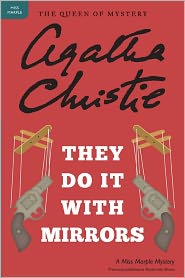
They Do It With Mirrors

They Do It With Mirrors. (Miss Marple). Agatha Christie. 1952/2011. HarperCollins 224 pages.

Mrs. Van Rydock moved a little back from the mirror and sighed. 

Ruth Van Rydock wants her good friend, Jane Marple, to do her a favor. She's worried about their mutual friend Carrie Louise Serrocold. She has a feeling that Carrie Louise is in trouble or in danger. And so she's arranged a visit for Miss Marple. After a few small lies are told to smooth the way, Carrie Louise is happy to welcome her old friend into her home. Miss Marple is introduced to the STRANGE, STRANGE bunch of folks living or working on the estate. Her husband, Lewis. Her daughter, Mildred. Her granddaughter, Gina, and her husband, Walter. Her stepsons from her second marriage, Stephen and Alex Restarick. Her companion-caretaker, Juliet Bellever. Her husband's assistant, Edgar Lawson. (Carrie Louise has been married three times--and it shows. She's carried over wealth and property, but, also children and grandchildren, etc.) Her husband's pet project has him working with juvenile delinquents with part of the estate being converted into a school of sorts. I won't lie, it was a bit confusing at first to see how these characters connect to one another--if they connect to one another. It helps that almost every character seeks out Miss Marple in the days after her arrival. One by one they "unburden" themselves and complain freely about anything and everything.

Of course, it turns out that Ruth had VERY good reason to worry about her friend. And Miss Marple it seems arrived just in time for the drama. Soon there's a murder to be solved...can she solve it in time before more lives are lost?

I enjoy Miss Marple. I do. There is just something satisfying about reading Agatha Christie. While They Do It With Murders isn't my new favorite or anything, it is an enjoyable mystery. Not perfect. But definitely enjoyable enough to recommend.

Ruth to Miss Marple:
"You've always been a sweet innocent looking creature, Jane, and all the time underneath nothing has ever surprised you, you always believe the worst."
"The worst is so often true," murmured Miss Marple.
"Why you have such a poor idea of human nature, I can't think--living in that sweet peaceful village of yours, so old world and pure."
"You have never lived in a village, Ruth. The things that go on in a pure peaceful village would probably surprise you."
"Oh I daresay. My point is that they don't surprise you." (9)

Inspector Curry and Miss Marple:
"This is all very distressing I know. But we've just got to get the facts clear. Get it all clear."
"Oh yes, I know," said Miss Marple. "So difficult, isn't it? To be clear about anything, I mean. Because if you're looking at one thing, you can't be looking at another. And one so often looks at the wrong thing, though whether because one happens to do so or because you're meant to, it's very hard to say. Misdirection, the conjurers call it. So clever, aren't they?" (90)

© 2011 Becky Laney of Becky's Book Reviews


Elephants Can Remember

Elephants Can Remember. Agatha Christie. (Hercule Poirot). 1972. 212 pages.
Mrs. Oliver looked at herself in the glass. 

While I tend to prefer Miss Marple to Hercule Poirot most of the time, when Christie's Poirot novels feature Ariadne Oliver, it becomes trickier to play favorites. For Ariadne Oliver is a writer, a writer of detective fiction or mysteries. And her perspective on the genre--and on writing in general--which is shared with readers is just fun. In Elephants Can Remember, Mrs. Oliver is approached by a woman who is memorable for all the wrong reasons:
 A large woman. Ample proportions, large white champing teeth. What in French could have been called une femme formidable, but who definitely had not only the French variety of being formidable, but the English one of being supremely bossy. Obviously she either knew Mrs. Oliver, or was intent on making her acquaintance there and then. The last was how it happened to go. (8)
 Mrs. Burton-Cox is "concerned" about her son who is contemplating marrying Mrs. Oliver's goddaughter. Now, Mrs. Oliver has had many goddaughters through the decades, and this particular one has slipped her mind completely. Well, until forced to remember by Burton-Cox's persistence. Celia Ravenscroft is the goddaughter in question, the "inappropriate" young woman, that Burton-Cox does not want for her daughter-in-law. Why? Well, there was a family tragedy when Celia was just a girl. Her parents died in an apparent suicide. No one knows if her father shot her mother or if her mother shot her father. No one knows what provoked this murder-suicide. Was her mother involved with another man? Was her father involved with another woman? And though it seems almost everyone has forgotten this tragedy except Mrs. Burton-Cox, she's convinced that Celia is not good for her son.

Mrs. Oliver is annoyed by Mrs. Burton-Cox. But she is also curious. She was out of the country when the tragedy happened all those years ago, and, well, part of her wants to know the truth--or as much of the truth can be discerned or concluded--herself. So she decides that if Celia will give her blessing, she'll begin to snoop around. And she'll even call her old friend, Hercule Poirot. He may be able to connect the dots and solve this one.


I enjoyed this one. I did. I don't know that it is my favorite Agatha Christie, but it is a good read.


Favorite quote:
"Human curiosity," said Poirot. "Such a very interesting thing." He sighed. "To think that we owe to it throughout history. Curiosity. I don't know who invented curiosity. It is said to be usually associated with the cat. Curiosity killed the cat. But I should say really that the Greeks were the inventors of curiosity. They wanted to know. Before them, as far as I can see, nobody wanted to know much. They just wanted to know what the rules of the country they were living in were, and how they could avoid having their heads cut off or being impaled on spikes or something disagreeable happening to them. But they either obeyed or disobeyed. They didn't want to know why. But since then a lot of people have wanted to know why and all sorts of things have happened because of that. Boats, trains, flying machines and atom bombs and penicillin and cures for various illnesses. A little boy watches his mother's kettle raising its lid because of the steam. And the next thing we know is we have railway trains, leading on in due course to railway strikes and all that. And so on and so on." (25)
"As one journeys through life," said Poirot, "one finds more and more that people are often interested in things that are none of their business. Even more so than they are in things that could be considered their business." (117)


© 2011 Becky Laney of Becky's Book Reviews


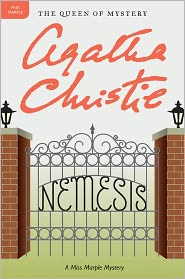
Nemesis

Nemesis. Agatha Christie. 1971/2011. HarperCollins. 304 pages.

In the afternoons it was the custom of Miss Jane Marple to unfold her second newspaper.

I wouldn't say that it's essential that you read A Caribbean Mystery before reading Nemesis. But. If you have read it, you might appreciate Nemesis more.

Nemesis opens with Miss Marple reading about the death of Mr. Rafiel in the newspaper. She met him in the Caribbean, and he was her greatest ally there when she was busy solving that mystery. She liked him a good deal, even though they never reconnected in England afterward. And Mr. Rafiel had great respect for Miss Marple!

One day Miss Marple is contacted by Rafiel's lawyers. They have something important to tell her. It seems that Mr. Rafiel left her a final challenge, a final mystery to solve.

Have you read the book of Daniel? Do you remember when King Nebuchadnezzar dreamed something disturbing and wanted help interpreting that dream. He asked all the wise men for help. But. He refused to tell them the dream. They must come up with the dream and the interpretation. If they weren't able to do both, then they'd be killed.

Nemesis reminded me of this Bible story. For Mr. Rafiel has not provided Miss Marple with any details. Not a where. Not a when. Not a how. Not a who. Not a why. Her greatest chance for solving this one and earning the money he's left her, is for her to go on the vacation he's planned for her: a tour group traveling by bus through England visiting beautiful, historic homes and gardens.

Can Miss Marple do the seemingly impossible?

I enjoyed this one. I wouldn't say it is my favorite Miss Marple mystery. But I'm very glad my library got a copy of this one! (And very happy that HarperCollins has recently published such lovely editions of the Miss Marple mysteries.) If you don't mind a couple of small spoilers, I have something to discuss at the end of this post.

Professor Wanstead and Miss Marple:
"I don't think I know exactly what you mean."
"You are being careful. You are quite right to be careful."
"I have made it a habit," said Miss Marple.
"To be careful?"
"I should not put it exactly like that, but I have made a point of being always ready to disbelieve anything that is told to me." (127)
S
P
O
I
L
E
R

I was disappointed with the way rape was presented in Nemesis. The discussions about rape in the novel were unsettling to say the least. Now, these words weren't coming from Miss Marple herself. So I don't blame the character of Miss Marple for these careless and harmful words.

Professor Wanstead:
"That told against him, of course. Not in the jury's mind, because of course they did not hear about that until after the judge's summing up, but certainly in the judge's mind. It told against him, but I made a few enquiries myself afterwards. He had assaulted a girl. He had conceivably raped her, but he had not attempted to strangle her and in my opinion--I have seen a great many cases which come before the Assizes--it seemed to me highly unlikely that there was a very definite case of rape. Girls, you must remember, are far more ready to be raped nowadays than they used to be. Their mothers insist, very often, that they should call it rape. The girl in question had had several boyfriends who had gone further than friendship. I did not think it counted very greatly as evidence against him." (136)
Mr. Broadribb:
"Well, we all know what rape is nowadays. Mum tells the girl she's got to accuse the young man of rape even if the young man hasn't had much chance, with the girl at him all the time to come to the house while mum's away at work or dad's gone on holiday. Doesn't stop badgering him until she's forced him to sleep with her. Then, as I say, mum tells the girl to call it rape." (165)
These passages made me angry! They did. I wanted to shout at the book. So it's only rape if the woman is a virgin? So the fact that a woman says yes to one man means that she doesn't have the right to say no to any other man...ever? So women are "ready" to be raped? In fact they are out pursuing it?! They are "badgering" and "forcing" them to have sex. Yes, that's right, these poor guys are the victims. Accusing someone of rape is SO MUCH FUN that the women just can't help themselves. They're just begging to be assaulted and raped so they can tell their story to anyone and everyone dumb enough to believe them. What kind of crazy logic is this? It's just wrong on SO MANY levels.


© 2011 Becky Laney of Becky's Book Reviews


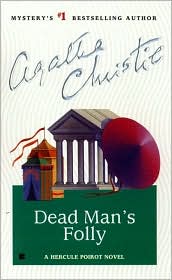
Dead Man's Folly

Dead Man's Folly. Agatha Christie. 1956/2000. Penguin. 240 pages.


It was Miss Lemon, Poirot's efficient secretary, who took the telephone call. 

Hercule Poirot is coming to the aid of his friend Ariadne Oliver. This mystery writer is planning a fun weekend game of mock murder. But days away from the big event, she's getting this uncomfortable feeling. Her instincts are telling her that something is wrong. She's not sure exactly what is wrong. But she feels the need for Poirot. And he's happy to help--happy to show off, perhaps?

Dead Man's Folly has an interesting cast of characters. And I enjoyed reading this one. Christie has a wonderful gift with characterization--each man and woman so complex, so layered. And it's always interesting to see how her stories unfold. To see how the clues unfold. There are plenty of clues--true and false--in this one.

I liked this one. It was a compelling read. I am so happy I discovered Agatha Christie this year!

"The fatal flaw, eh?" he remarked.
"That's just it," said Mrs. Oliver. "There always is one. Sometimes one doesn't realize it until a book's actually in print. And then it's agony!" Her face reflected this emotion. She sighed. "The curious thing is that most people never notice it. I say to myself, 'But of course the cook would have been bound to notice that two cutlets hadn't been eaten.' But nobody else thinks of it at all." (56)

It would be difficult, Bland thought, to forget Hercule Poirot, and this not entirely for complimentary reasons. (101)

"What can you say about how you write books? What I mean is, first you've got to think of something, and when you've thought of it you've got to force yourself to sit down and write it. That's all. It would have taken me just three minutes to explain that, and then the Talk would have been ended and everyone would have been very fed up. I can't imagine why everybody is always so keen for authors to talk about writing. I should have thought it was an author's business to write, not talk." (209)

© 2011 Becky Laney of Becky's Book Reviews


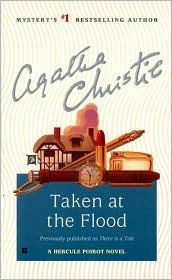
Taken at the Flood

Taken at the Flood. Agatha Christie. 1948/1984. Penguin. 256 pages.


In every club there is a club bore. The Coronation Club was no exception; and the fact that an Air Raid was in progress made no difference to normal procedure.

 Set, for the most part, in Warmsley Vale, this Hercule Poirot mystery focuses on a dysfunctional family in crisis: the Cloade family. Gordon Cloade made a lot of promises--promises it turns out he couldn't keep. He promised to provide for many--if not most--of his family. He helped them with their bills. He helped them with their dreams. His family was comfortable accepting his financial assistance. So when Gordon Cloade dies shortly after his marriage, everyone is upset. For his marriage changes everything, his wife will receive everything. His wife, an American widow, is a young beauty named Rosaleen. She's accompanied by her brother, David Hunter. The Cloade family hates them both. Though some family members play friendly--hoping to get a little money from her now and then. But David is always at her side telling her that her husband's family would love to see her dead.

So who's the victim? How does Poirot get involved? Well. A man shows up in town wanting to see David Hunter. He claims that he has proof that Rosaleen's first husband, a Mr. Underhay, is still alive. He wants money, of course, or he threatens to go to the Cloade family who will only be too happy to have this proof. For if Rosaleen's first husband was still alive when she married Gordon, then she wasn't legally his wife, and the family would get the money. This "Enoch Arden" is murdered--and the main suspect is David Hunter! But did he do it?

Lynn, one of the family, is involved in a very unhealthy love triangle in Taken at The Flood. Since returning home from the war, she's been restless. She's engaged to Rowley, but she's finding herself fascinated by the devilish David Hunter. And he's flirting back. Which will she choose? And will her choice prove deadly?

I enjoyed this one. It was exciting and fascinating. The family is a tangled mess, and Poirot has much to untangle before he can find all the pieces he needs to solve this one.

"Rowley. What's Rowley?"
"A better man than you--touch him if you dare," she said lightly.
"I've no doubt he's a better man than me--but I do dare. I'd dare anything for you, Lynn."
She was silent for a moment or two. She said at last.
"What you don't understand is that I love Rowley."
"I wonder."
She said vehemently: "I do, I tell you, I do."
David looked at her searchingly.
"We all see pictures of ourselves--of ourselves as we want to be. You see yourself in love with Rowley, settling down with Rowley, living here contented with Rowley, never wanting to get away. But that's not the real you, is it, Lynn?"
"Oh what is the real me? What's the real you, if it comes to that? What do you want?"
"I'd have said I wanted safety, peace after storm, ease after troubled seas. But I don't know. Sometimes I suspect, Lynn, that both you and I want--trouble." (58)

© 2011 Becky Laney of Becky's Book Reviews


Evil Under the Sun

Evil Under the Sun. Agatha Christie. 1940/2006. Black Dog & Leventhal. 224 pages.

When Captain Roger Angmering built himself a house in the year 1782 on the island off Leathercombe Bay, it was thought the height of eccentricity on his part. A man of good family such as he was should have had a decorous mansion set in wide meadows with, perhaps, a running stream and good pasture.

Will Hercule Poirot ever vacation in peace? He doesn't get that opportunity in Evil Under the Sun. He may be on vacation at the Jolly Roger, a hotel resort, but the warning signs are there. Murder is probably inevitable as tensions rise between hotel guests. The victim is Mrs. Arlena Stuart Marshall. The suspects? Well, principally her husband, Captain Kenneth Marshall, her lover, Patrick Redfern, the angry wife, Christine Redfern, and the angry step-daughter, Linda Marshall. Of course, there are other guests at the hotel, but these are the ones with possible motives.

I am still enjoying Agatha Christie. I am still finding myself surprised by her revelations. (Some books there is more of a surprise than others!) But this one wasn't my favorite Hercule Poirot.

© 2011 Becky Laney of Becky's Book Reviews


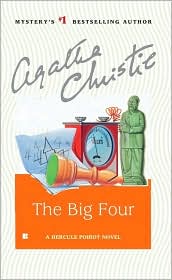
The Big Four

The Big Four. Agatha Christie. 1927/2001. Penguin. 208 pages.

I have met people who enjoy a channel crossing; men who can sit calmly in their deck-chairs and, on arrival, wait until the boat is moored, then gather their belongings together without fuss and disembark.

Captain Hastings narrates this Hercule Poirot novel. First, I must say that it was GREAT to have him back as narrator. I'd missed him lately. Second, I must say that this Hercule Poirot is very different from others I've read. There is a big mystery to be solved. And there are plenty of little mysteries to be solved. The motives for these crimes are very different. More political, more conspiracy theory, more intellectual intrigue than the traditional murder mystery.

Who are the Big Four? Well, Poirot believes them to be a secret organization running the world behind the scenes. The masterminds behind several political upheavals. One from China. One from France. One from the United States. And the fourth, well, that's the mystery. For this "destroyer" is the most elusive of them all. An expert at disguise he certainly must be. For Hastings and Poirot believe they've encountered him at many, many of their recent crime scenes. But no matter how many times they catch a glimpse, they're never able to describe him.

At the beginning, they've only got a lead on the identity of one of the members. But they're hoping to find all four so they can be brought to justice. For the bodies do begin to pile up in this one--and each one gives them a little clue. It won't be an easy case to solve--for it's all a game with traps hidden within traps within traps. But if anyone can solve it, Poirot's the man for the job.

I liked this one. I didn't love it exactly. But it was a good read, a compelling one!

© 2011 Becky Laney of Becky's Book Reviews


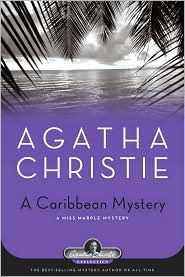
A Caribbean Mystery

A Caribbean Mystery. Agatha Christie. 1964/2007. Black Dog & Leventhal. 256 pages.

"Take all this business about Kenya," said Major Palgrave. 

 Miss Marple is on vacation. And, for the most part, she's enjoying herself. Enjoying getting to know the other people staying at the resort owned by a husband and wife, Tim and Molly Kendal. When the novel opens, she is listening--or pretending to listen--to Major Palgrave. Little knowing that within twenty-four hours this man will be dead. Did he die because he talked too much? Could one of his stories have led to his death? Maybe. Miss Marple will have to investigate to know for sure. But she suspects that his story about having a snapshot of a murderer might be to blame. Since this snapshot is not found after his death.

I enjoyed this one. I wouldn't say it is my absolute favorite Miss Marple--I don't know that I could really choose just one for that. But it was certainly enjoyable! I enjoyed the unfolding mystery of this one. I enjoyed the characters. I enjoyed the setting. I enjoyed the dialogue! It was a fun read!

Miss Marple woke early. Like many old people, she slept lightly and had periods of wakefulness which she used for the planning of some action or actions to be carried out on the next or following days. Usually, of course, these were of a wholly private or domestic nature, of little interest to anybody but herself. But this morning Miss Marple lay thinking soberly and constructively of murder, and what, if her suspicions were correct, she would do about it. It wasn't going to be easy. She had one weapon and one weapon only--and that was conversation.
Old ladies were given to a good deal of rambling conversation. People were bored by this, but certainly did not suspect them of ulterior motives. It would not be a case of asking direct questions. (Indeed, she would have found it difficult to know what questions to ask!) It would be a question of finding out a little more about certain people. (46)
"Conversations with you might be dangerous," he said.
"Conversations are always dangerous, if you have something to hide," said Miss Marple. (142)
"I've been wrong about her," said Mr. Rafiel with characteristic frankness. "Never been much of a one for the old pussies. All knitting wool and tittle-tattle. But this one's got something. Eyes and ears, and she uses them." (148)


© 2011 Becky Laney of Becky's Book Reviews


The Murder of Roger Ackroyd

The Murder of Roger Ackroyd. Agatha Christie. 1926/2006. Black Dog & Leventhal. 288 pages.

Mrs. Ferrars died on the night of the 16th-17th September--a Thursday.

Someone has killed Roger Ackroyd, but who? The police are doing their best--no doubt. But one member of the family wants the best on the case, and the best would be Hercule Poirot, of course. Only he will be able to see through the holes of everyone's stories--their lies and half-truths. Only he will be able to piece together the strange motive for the crime. 

Dr. Sheppard narrates this Hercule Poirot mystery novel. And he's no Hastings, I'll tell you that now! I'll also admit from the start that I did not like this one at all. If I had been reading Christie's Poirot chronologically--there's a good chance I would not have continued on past this one. And I don't think Poirot is to blame. I just had a very difficult time with our narrator.

The Murder of Roger Ackroyd made me appreciate Agatha Christie more. It made me thankful for the Poirot novels that I have enjoyed--really enjoyed. And it made me thankful for the Miss Marple books which--with one exception--I've loved and adored. I picked up A Caribbean Mystery after completing The Murder of Roger Ackroyd, and I realized that I got more enjoyment out of that one chapter of a Marple novel then in the entirety of this one.


© 2011 Becky Laney of Becky's Book Reviews


The Moving Finger

The Moving Finger. Agatha Christie. 1942/2007. Black Dog & Leventhal. 208 pages.

I have often recalled the morning when the first of the anonymous letters came.

Jerry Burton, our hero, has taken a house in the country with his sister, Joanna. He's recuperating from an injury, and his doctor has definitely suggested some rest and relaxation. As for Joanna, she's recuperating from a broken heart. But rural village life isn't as uneventful and peaceful as he expected. For soon after his arrival, an anonymous "poison pen" begins a nasty letter campaign. Which is unpleasant enough, he supposes, but things turn deadly after a woman's "suicide" after receiving a vile letter. The victim leaves behind two young sons, an older daughter from her first marriage, a husband, and a rather pretty governess. Megan, the daughter from the first marriage, soon becomes a major player in this Miss Marple mystery. This "suicide" becomes a bit suspicious when a second death occurs--that of a maid--within the home. The question becomes did this maid--on her day off--see something?

I loved this one. I just LOVED it. It wasn't a purely pleasant read for me. I wouldn't exactly say I was praying throughout, but I was certainly wishful with my repeated pleas, please don't let it be Megan, please don't let it be Megan, please don't let it be Megan. Never have I gotten that involved with a mystery. Who is Megan? For better or worse, she's the young woman our hero described thusly, "She looked much more like a horse than a human being. In fact, she would have been a very nice horse with a little grooming" (17). She's largely ignored not only by the village but by her family as well. But there is something about her that Jerry, our hero, can't ignore. He goes out of his way--time and time and time again--to include her. He even invites her to stay with him and his sister after her mother's death. He is the one person, she's found, willing to listen to her.

While Jerry is making friends with Megan--not always an easy task--Joanna, his sister, is trying to make friends with the local doctor. That is an uphill battle. Joanna has never, ever had to work this hard to get a guy to like her.

So this mystery has a romantic element to it which I just loved. It also stars Miss Marple, though she doesn't enter the case until after the second death occurs. Miss Marple finds Jerry Burton a great help in this one! The details he's observed through his stay, makes solving this one so much easier for her! It gives her quite the lead. But she still has to *prove* it.

The Moving Finger is very compelling! I loved it for so many different reasons.

My favorite quotes:

Emily Barton, I think, has a mental picture of men as interminably consuming whisky-and-sodas and smoking cigars, and in the intervals dropping out to do a few seductions of village maidens, or to conduct a liaison with a married woman.
When I said this to Joanna later, she replied that it was probably wishful thinking, that Emily Barton would have liked to come across such a man, but alas, had never done so. (85)

"The police are doing their best."
"If Agnes could be killed yesterday, their best isn't good enough."
"So you know better than they do?"
"Not at all. I don't know anything at all. That's why I'm going to call in an expert."
I shook my head. "You can't do that. Scotland Yard will only take over on a demand from the chief constable of the county. Actually they have sent Graves."
"I don't mean that kind of an expert. I don't mean someone who knows about anonymous letters or even about murder. I mean someone who knows people. Don't you see? We want someone who knows a great deal about wickedness!"
It was a queer point of view. But it was, somehow, stimulating. (141)

"Yes, it was dangerous, but we are not put into this world, Mr. Burton, to avoid danger when an innocent fellow creature's life is at stake. You understand me?"
I understood. (199)

© 2011 Becky Laney of Becky's Book Reviews


And Then There Were None

And Then There Were None. Agatha Christie. 1939/2000. Buccaneer Books. 192 pages.

In the corner of a first-class smoking carriage, Mr. Justice Wargrave, lately retired from the bench, puffed at a cigar and ran an interesting eye through the political news in the Times. He laid the paper down and glanced out of the window. They were running now through Somerset. He glanced at his watch--another two hours to go.

Ten men and women arrive on Indian island never suspecting the dangers and thrills that are to come. None will leave the island alive. Mr. Justice Wargrave, Vera Claythorne, Captain Philip Lombard, Emily Brent, General MacArthur, Dr. Armstrong, Anthony Marston, Mr. Blore, Mr. and Mrs. Rogers. It seems each has been lured to the island without really knowing their host or hostess. Mr. and Mrs. Rogers being engaged as servants. Miss Vera Claythorne being engaged as a temporary secretary. The others all received letters of invitation. It soon becomes clear that not everything is as it appears.

There are some not-so-hidden clues embodied within a nursery rhyme poem, "Ten Little Indians" (found on pages 21-22 of my edition; you can get an idea of it from this site, though it's not an easy read, it seems it's a combination of two poems, one from 1868 and the other from 1869).  There are also ten little figurines--as each guest dies, a figurine from the table vanishes as well.

Readers get a chance to learn a little about each character. Especially the ones that survive the first few deadly days. None of the characters are particularly likable--none so delightful that you'd want to know them--especially not under these circumstances.

I would say this Christie novel comes the closest to inspiring fear and horror in its readers. There isn't anything particularly cozy or delightful or charming about this one. There are no clever detectives--arrogant or not--to counterbalance the violence. Almost everything that I love about Christie's mysteries seems to be missing in this one. But even though I don't especially "like" this one, I can't deny that it was cleverly written.

© 2011 Becky Laney of Becky's Book Reviews


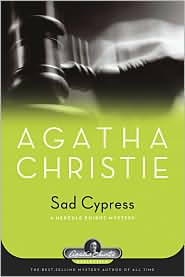
Sad Cypress

Sad Cypress. Agatha Christie. 1939/2007. Black Dog & Leventhal. 256 pages.

"Elinor Katharine Carlisle. You stand charged upon this indictment with the murder of Mary Gerrard upon the 27th of July last. Are you guilty or not guilty?"

Harriet Vane had Lord Peter Wimsey, and Elinor Katharine Carlisle has Peter Lord. Though her hero is not an amateur detective, but a country doctor. Still, Peter Lord, who fell in love with Elinor at first sight, has the wisdom to seek the best of the best to clear her name: Hercule Poirot. He wants Poirot to find evidence that will acquit her of murder. Is love blinding him? Is the woman he loves guilty of murder? It seems that she had opportunity to kill her aunt (supposedly out of greed) and Mary (supposedly out of jealousy). But Lord and Poirot doubt the supposed motives. They see other possibilities. 

I loved this one. I just LOVED it. I loved the characterization! I loved the story! While Peter Lord is no Lord Peter, I did enjoy him very much! I was quite surprised by how pleased I was that Elinor had someone on her side. Not that Elinor was completely lovable. She was flawed--very flawed. But still. By the end, I was seeing her through Peter Lord's eyes, I was seeing her with love.

"One does not practice detection with a textbook! One uses one's natural intelligence." (196)
"One must understand with the cells of one's brain before one uses one's eyes."(196)
"One always likes to know exactly what lies have been told one."
"Did Welman tell you a lie?"
"Definitely."
"Who else has lied to you?"
"Everybody. I think: Nurse O'Brien romantically; Nurse Hopkins stubbornly; Mrs. Bishop venomously; You yourself--"
"Good God!" Peter Lord interrupted him unceremoniously. "You don't think I've lied to you, do you?"
"Not yet," Poirot admitted.
Dr. Lord sank back in his chair. He said, "You're a disbelieving sort of fellow, Poirot." (198)

© 2011 Becky Laney of Becky's Book Reviews


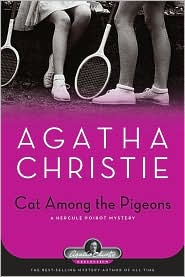
Cat Among the Pigeons

Cat Among the Pigeons. Agatha Christie. 1959/2007. Black Dog & Leventhal. 272 pages.

It was the opening day of the summer term at Meadowbank school.

Set at a girls' boarding school, this Hercule Poirot mystery was oh-so-fascinating. I enjoyed it so much! It's a mystery novel with plenty of narrators--from teachers and secretaries to students. This school term is unlike previous terms--for one of the new students brings mystery and danger to the prestigious school. And this "danger" will cost a few teachers their lives. A quick-thinking student, Julia Upjohn, decides to seek out Hercule Poirot believing that this detective is the man for the job. If anyone can stop this murderer and solve the mystery, he can.

I loved this one. I loved how this mystery unfolds. How Hercule Poirot does not enter into the book too early. How other characters are given the opportunity to shine. So when he does appear, I almost felt like cheering. (I wasn't expecting that!) I am still loving Agatha Christie. I'm still finding her novels clever and wonderful and oh-so-compelling. There is just something so delightful, so satisfying about reading her books!

© 2011 Becky Laney of Becky's Book Reviews


At Bertram's Hotel

At Bertram's Hotel. Agatha Christie. 1965/2007. Black Dog & Leventhal. 272 pages.

In the heart of the West End, there are many quiet pockets, unknown to almost all but taxi drivers who traverse them with expert knowledge, and arrive triumphantly thereby at Park Lane, Berkeley Square, or South Audley Street.

Is Bertram's Hotel too good to be true? Miss Marple senses something is not as it should be. She senses that there is something unreal about this place. It's in the little things, really, and it's hard to put into words almost. But the hotel seems more like an act, a show, a theatrical production, than a proper hotel. Miss Marple is on vacation in London. And she's as observant as ever--which proves useful as a mystery begins to unfold concerning the hotel and its guests. (One guest ends up missing! One clerk ends up dead!) The novel focuses on a broken relationship between mother and daughter and the race car driver that may just come between them in the end.

Though it stars Miss Marple--a character I've come to love and adore--I did not love and adore At Bertram's Hotel. I found it confusing. The shifts in narration. The introduction of new characters, new stories, new mysteries. It felt so chaotic, so unconnected. I knew if I kept reading, it would make sense in the end. I knew that all these elements would come together nicely. That Miss Marple would be Miss Marple and all would be right with the world. And I was right. I did find it compelling by the end. Still. I was a little disappointed that it wasn't love through and through.

Miss Marple seldom gave anyone the benefit of the doubt; she invariably thought the worst, and nine times out of ten, so she insisted, she was right in so doing. (119)

"I learned (what I suppose I really knew already) that one can never go back, that one should not ever try to go back--that the essence of life is going forward. Life is really a one way street, isn't it?" (194)


© 2011 Becky Laney of Becky's Book Reviews


Appointment With Death

Appointment with Death. Agatha Christie. 1937/2007. Black Dog & Leventhal. 256 pages.

"You do see, don't you, that she's got to be killed?" The question floated out into the still night air, seemed to hang there a moment and then drift away down into the darkness towards the Dead Sea. Hercule Poirot paused a minute with his hand on the window catch.

Hercule Poirot is vacationing in Jerusalem when he overhears a private conversation. A man and woman discussing murder quite matter-of-factly. Who are they wanting to murder? Their stepmother. Is their stepmother really wicked? Well, many fellow vacationers seem to think so! She's a mean bully. A cruel tyrant. A woman almost impossible to love, to pity. She "manages" her adult children through fear and manipulation. Though alive, they appear lifeless. This 'strange' American family catches the interest of several fellow travelers including Miss Sarah King and Dr. Theodore Gerard. The family inspires pity--for the most part--and discussion. In just a few short days, this family becomes THE topic of discussion wherever they go--first in Jerusalem, and later in Petra. But when this matriarch, Mrs. Boynton, dies Poirot recalls this conversation. And that, along with a puncture wound on the wrist, becomes enough to interrogate this family and investigate this death. Can he come to the truth in just 24 hours? Even if he discovers the truth, will there be enough evidence to bring to convict should it ever go to trial?

I didn't love this one. It was more like than love. I found it compelling enough to finish. I thought it got off to a nice start--with its reference to Anthony Trollope, it had me hooked actually. But it doesn't do that well when compared to the other Christie mysteries I've read so far. Still, I'm glad I've read it.

© 2011 Becky Laney of Becky's Book Reviews


Cards on the Table

Cards on the Table. Agatha Christie. 1937. Penguin. 224 pages.

"My dear Monsieur Poirot!" 

I loved this one. I just loved, loved, loved this one. In this Hercule Poirot mystery, we meet four sleuths and four criminals. They are brought together by a strange man who loves to collect things, Mr. Shaitana. He boasts one day that he'll be happy to exhibit for his friend, Hercule Poirot, his collection of murderers--men and women who have all gotten away with murder. He suggests an evening of entertainment. The guests (of sleuths) include Hercule Poirot, Ariadne Oliver, Colonel Race, and Superintendent Battle. My favorite of the new characters is Ariadne Oliver, a mystery writer. The four (potential) criminals are Dr. Roberts, Mrs. Lorrimer, Miss Meredith, and Major Despard. Of course, Shaitana doesn't tell his guests his purpose, his plan. Only Poirot knows the reason behind the night's festivities. Two bridge games in two different rooms. Mr. Shaitana is enjoying a cozy night in front of the fire, until, he isn't! For he's murdered! The four guests say that no one entered the room. So it isn't hard to conclude that one of his guests murdered him. But who was it?

These four sleuths decide to work together to solve the crime. Each will interview the suspects. Each will go about it in their own way. (Each has their own method, their own philosophy, their own contacts.) It's fine to keep their own conclusions secret, but all the clues are supposed to be shared with one another. All their cards are to be on the table, so to speak. Readers get to see glimpses of each of these sleuths at work. Through dialogue, we get to know each sleuth, each criminal a little bit better. And I must say it makes for a compelling read! This one was impossible to put down!

I definitely consider this Hercule Poirot to be among my favorite and best. I really enjoyed so many things about it!

Here are a few of my favorite quotes:

"Ask Doctor Roberts if he'll be so good as to step this way."
"I should have kept him to the end," said Mrs. Oliver.
"In a book I mean," she added apologetically.
"Real life's a bit different," said Battle.
"I know," said Mrs. Oliver. "Badly constructed." (25)

"Man is an unoriginal animal," said Hercule Poirot.
"Women," said Mrs. Oliver, "are capable of infinite variation. I should never commit the same type of murder twice running."
"Don't you ever write the same plot twice running?" asked Battle.
"The Lotus Murder," murmured Poirot. "The Clue of the Candle Wax."
Mrs. Oliver turned on him, her eyes beaming appreciation.
"That's clever of you--that's really very clever of you. Because of course those two are exactly the same plot, but nobody else has seen it." (54)

"You are an extraordinary man, Monsieur Poirot."
"I am as the good God made me, Madame."
"We are all that, I suppose."
"Not all, Madame. Some of us have tried to improve on his pattern." (79-80)

"We all make mistakes, Monsieur Poirot."
"Some of us," said Poirot with a certain coldness possibly due to the pronoun the other had used, "make less than others."
Despard looked at him, smiled slightly and said:
"Don't you ever have a failure, Monsieur Poirot?"
"The last time was twenty-eight years ago," said Poirot with dignity. "And even then, there were circumstances--but no matter." (106)


© 2011 Becky Laney of Becky's Book Reviews


4:50 From Paddington

4:50 From Paddington. Agatha Christie. 1957/2007. Black Dog & Leventhal. 288 pages.

Mrs. McGillicuddy panted along the platform in the wake of the porter carrying her suitcase. Mrs. McGillicuddy was short and stout, the porter was tall and free-striding. 

Mrs. McGillicuddy was returning from a busy day Christmas shopping, she certainly didn't expect to witness a murder. No, when she boarded her train, she had no idea that she'd witness a murder--a man strangling a woman--on another train, a passing train. It's a shock to be sure. What's even more shocking, perhaps, though frustrating may be the better word, is the fact that no one believes her story. No one except Miss Marple, her friend. So despite the fact that Mrs. McGillicuddy reported the crime--and Miss Marple joined forces with her to report the crime to all the proper people, this crime remains a non-crime. Why? No body was found on the train. No body was found on the tracks. But Miss Marple knows that her friend is telling the truth. And she's willing to hire someone--a younger woman, Lucy Eyelesbarrow, to help her find the body and solve the case. Will they find the body? Will they learn her identity? Will they be able to find the murderer? Can they reason together his motive for the crime? The first step, for Miss Marple, is to make a reasonable guess as to where a body could be thrown from the train (and concealed). Lucy then takes her place at the closest residence--a large estate, it happens to be, as a servant. She'll "snoop" around to see if she can find the body. And if she does, when she does, she may just stick around to see if the family has been involved in the crime...

I enjoyed this one. I enjoyed Miss Lucy Eyelesbarrow! I did. And, of course, I loved Miss Marple. I found this a satisfying, compelling read!

© 2011 Becky Laney of Becky's Book Reviews


A Murder is Announced

A Murder is Announced. Agatha Christie. 1950/2006. Black Dog & Leventhal. 288 pages.

Between 7:30 and 8:30 every morning except Sundays, Johnnie Butt made the round of the village of Chipping Cleghorn on his bicycle, whistling vociferously through his teeth and alighting at each house or cottage to shove through the letter box such morning papers as had been ordered by the occupants of the house in question from Mr. Totman, stationer, of the High Street.

The local paper has a reputation for having the juiciest gossip, but no one expected to read an announcement quite like this one: A murder is announced and will take place on Friday, October 29th, at Little Paddocks, at 6:30 PM. Friends please accept this, the only intimation. What could it mean? Readers see several households reaction to the announcement, including the reaction of the Blacklock household. Miss Letitia Blacklock, owner of Little Paddocks, is just as shocked as shocked can be. What kind of joke is this? What kind of game is this? If she's not responsible for setting up this announcement, who is? Though she never planned a party--let alone this kind of party--it looks like she'll be expected to play hostess anyway.

A handful of men and women 'attend' the big event at Little Paddocks. Many arriving just minutes before the 'murder' is supposed to occur. Many believing all along that this is a planned joke, a game, a trivial matter meant to bring people together to eat and drink and scream. But they're in for a surprise of their own when the lights go out and shots are fired. Lights reveal one dead man--the supposed mastermind of the robbery--and one bloodied woman, the hostess herself. The injury is slight, still many questions remain. The biggest question of all is was this a burglary gone wrong or a premeditated attempt at murder. Was Miss Blacklock the intended victim? Did the shooter have a motive for wanting the woman dead? And Miss Marple may be the best woman for solving this mystery...unofficially of course.

I enjoyed this one very much! I am just loving Miss Marple and this one was no exception. I enjoyed Inspector Craddock too. The characters, as always, were well done. It was just a satisfying read. And I was certainly surprised by this one!

Sir Henry on Miss Marple:
She's just the finest detective God ever made. Natural genius cultivated in a suitable soil....Remember that an elderly unmarried woman who knits and gardens is streets ahead of any detective sergeant. She can tell you what might have happened and what ought to have happened and even what actually did happen! And she can tell you why it happened! (47-8)

© 2011 Becky Laney of Becky's Book Reviews


Twitter Delicious Facebook Digg Favorites More