Showing posts with label Houghton Mifflin Harcourt. Show all posts

Front and Center (YA)

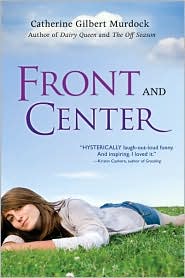
Front and Center. Catherine Gilbert Murdock. 2009. Houghton Mifflin Harcourt. 256 pages.

Here are ten words I never thought I'd be saying...

Dairy Queen and The Off Season. 

D.J. Schwenk, our heroine, is excited to be going back to school. (No, it's not August or September.) But she's been away from home tending to one of her older brothers, Win, after he was seriously injured playing college football. What excites D.J. most--besides returning to a familiar routine--is the fact that it is basketball season. She loves the game, she does. And when she's not worried about pleasing her coach and her family and her teammates and herself and any college coaches or scouts that may be watching her every little move, she's quite good at it. But it's not without pressure. For her coach--wanting only what is best for her--is encouraging her to start looking ahead to college, to start calling different coaches at different universities and seeing what scholarship possibilities there may be for her when the time comes. Yes, she's only a junior, but the time to act is now. If she puts it off until next year, well, chances are that there will be fewer opportunities. But what bothers D.J, what bothers Coach K, what bothers her brother, Win, is D.J.'s inability to vocalize on the court. She sees what needs to be done, but she doesn't speak up. She has all the skills needed to be a great player, but there is something holding her back. And the sooner she finds her voice, the better.

D.J. doesn't like being the 'front and center' of attention. She doesn't like the way one of her best friends, Beaner, is looking at her. He wants more from her than friendship. And while part of her wants a distraction from her heartbreak--her disappointing relationship with Brian Nelson--another part of her knows that she could never, ever feel anything close to romantic love for Beaner. He's great for laughs, great for hanging out with, he's a good guy, a nice guy, but. He's no Brian. Now she tries to talk herself into the relationship, using his very differences from Brian to show that he has to be a better match for her. But still. D.J. knows that it won't really work out.

I loved all three books in the series. I loved D.J. I loved her family. I loved how these novels were about D.J. finding herself and getting to be more comfortable in her own skin. Each book we see a vulnerable D.J. get just a little bit stronger, a little bit better, a little more confident. These novels have heart. They may be about sports--football and basketball--but they are character-driven too!

© 2011 Becky Laney of Becky's Book Reviews


The Rumpelstiltskin Problem (MG)

The Rumpelstiltskin Problem. Vivian Vande Velde. 2000. Houghton Mifflin. 116 pages.

The Rumpelstiltskin Problem is a collection of short stories. Each short story puts a twist on the fairy tale Rumpelstiltskin. In the author's note, Vivian Vande Velde picks apart all the problems with the original story, alerts readers of all the holes in logic, argues that the story is obviously incomplete! She plays around with this in her stories, proving that there are many sides to a story, many ways to interpret a story. Some are clever. Some are amusing. All are well-crafted, in my opinion.

If I had to choose just one as a favorite, it would be Straw into Gold.

The six short stories are:

A Fairy Tale in Bad Taste
Once upon a time, before pizzerias or Taco Bells, there was a troll named Rumpelstiltskin who began to wonder what a human baby would taste like.
Straw Into Gold
Once upon a time, in the days before Social Security or insurance companies, there lived a miller and his daughter, Della, who were fairly well-off and reasonably happy until the day their mill burned down.
The Domovoi
Once upon a time, before home security systems and trained guard dogs, if you lived in Russia the way to keep your home safe and happy was to have a domovoi living beneath your basement. 
Papa Rumpelstiltskin
Once upon a time, before bread was plastic-wrapped and sold in supermarkets, there lived a miller named Otto and his daughter, Christina.
Ms. Rumpelstiltskin
Once upon a time, before eyelash curlers and lip liner, there lived a very plain girl by the name of Rumpelstiltskin.
As Good As Gold
Once upon a time, before movie stars or rock singers or professional athletes, the people everybody most wanted to meet were kings and queens.

© 2011 Becky Laney of Becky's Book Reviews


Rage (YA)

Rage. Jackie Morse Kessler. 2011. Houghton Mifflin Harcourt. 228 pages.

The day Melissa Miller killed her cat, she met the Angel of Death. Except he was no angel--and he wasn't there for the cat. 

Rage is a follow up book to Hunger by Jackie Morse Kessler. While Hunger was about a teen girl with an eating disorder becoming Famine, Rage is about a troubled young woman, Melissa Miller--or Missy, becoming War.

Missy Walker cuts. Very few people in her life know about her cutting--her self-mutilation--but that number is about to become a lot larger. For her ex-boyfriend, Adam, has either placed a bet--or accepted a bet--that he can get Missy naked at the party to reveal all her scars for the crowd at Kevin's party that Friday night. (Either way, Adam shows there is a good reason he's an ex.)

Missy hasn't really felt comfortable partying--at least not lately. But with encouragement from Erica, an old friend that she's distanced herself from, and Adam, who is reaching out to her saying how much he misses her since their break up, well, in a moment of weakness she decides to go. (Of course, if she'd stayed home, the novel would be much shorter!)

After Missy is deeply humiliated, she returns home--ashamed and angry, overwhelmed with emotion--and she decides to cut herself. She takes out her blade and begins hoping that it will help her be able to breathe again, that the emotional pain will lessen as the physical pain begins. But before she even knows it, it's all too much. There is too much blood, she wasn't careful enough. She's dying and knows it will look like suicide.

But Death hasn't been watching her the past few days without good reason. He steps in, if you will, and offers her a choice. Die or become one of the four riders of the apocalypse. To be more precise, become War, and take up War's Sword.

Will Missy learn to deal with her darker emotions. Will having control of the Sword help Missy conquer her own demons, her own darkness? Will she learn to use those dark emotions responsibly? Or will they conquer her?

For the most part, I thought Rage was well written. The blend between real life and fantasy is intriguing, I must say. The writing is strong and powerful. While I still had a few questions--when did Missy begin cutting herself, does she know why she does it--the novel works for me most of the time. I do wish, however, that the epilogue would have been handled differently. (Not necessarily the content. But the style. How the novel itself only covers four days, but the epilogue covers two months. How the novel does a great job of showing and not telling. But the epilogue was too telling, if that makes sense. The narration of it was just off for me. I understand that people want a hopeful ending, an ending that leaves no doubts or questions, but it just felt too much to me.)

Have you read this one? What did you think?

© 2011 Becky Laney of Becky's Book Reviews


Life As We Knew It (YA)

Life As We Knew It. Susan Beth Pfeffer. 2006. Houghton Mifflin Harcourt. 352 pages.


Lisa is pregnant. 

Life As We Knew It by Susan Beth Pfeffer is one of my favorite books. It's one of the few young adult books that I reread regularly. I believe--counting the audio book--that this was my fifth time to read this bleak book. (The only other book I reread with that much regularity is Mary Shelley's Frankenstein.)

It stars Miranda and her family (a mom and two brothers--Matt, the older, Jonny, the younger). Miranda's world is turned upside down one May--and it isn't just her world--when an asteroid crashes into the moon bringing it closer to Earth; nature turns violent, extreme, deadly. No one--at that point--knows how bleak it will be, how many lives will be lost. Not just from tsunamis, floods, earthquakes, and volcanoes, but from disease and malnutrition too.

They are dealing with the loss of modern conveniences-- extremely limited amounts of natural gas and oil, and no electricity. (It's rare to have electricity.)

So how does one survive? Where do you find food? How can you ever have enough when you don't know how long this crisis will last? How long it will be before food supplies reach your town? What if no relief ever comes? How do you find water? How do you cook your food if you have a gas-stove or electric stove? How do you heat your homes without gas, oil, or electricity? How do you keep things sanitary and hygienic? How do you stay healthy? How do you stay smart?     

Miranda is one of the fortunate ones. She has a quick thinking mom who at the first opportunity rushes to the grocery store and buys close to a dozen carts of food and other necessities before the shelves are emptied completely. And they do live in a wooded area and happen to have a wood-burning stove. And miraculously enough they have magic well water that works without an electric pump. (That one still boggles.) But this struggle to survive is very personal, very compelling.

I enjoy Miranda and her family. I enjoy reading Miranda's journal. Is Miranda perfect? No! Is her family perfect? No! They argue. They fight. They get on each other's nerves. They love each other very, very much. And they are all dealing with harsh conditions, bleak situations. There is fear and tension and anxiety. But there's also love and hope.

My favorite quotes:

“Sometimes when Mom is getting ready to write a book she says she doesn’t know where to start, that the ending is so clear to her that the beginning doesn’t seem important anymore. I feel that way now only I don’t know what the ending is, not even what the ending is tonight” (16).

“For a moment I thought about all the people throughout history who saw Halley’s Comet and didn’t know what it was, just that it was there and frightening and awe inspiring. For the briefest flick of a second, I could have been a 16 year old in the Middle Ages looking up at the sky, marveling at its mysteries, or an Aztec or an Apache. For that tiny instant, I was every 16 year old in history, not knowing what the skies foretold about my future.” (18)

“And then it hit. Even though we knew it was going to, we were still shocked when the asteroid actually made contact with the moon. With our moon. At that second, I think we all realized that it was Our Moon and if it was attacked, then we were attacked.” (18-19)
“What about desserts?” I asked. “If the world comes to an end, I’m going to want cookies.” “We’re all going to want cookies if the world comes to an end,” Mrs. Nesbitt agreed. “And chips and pretzels. If the world is coming to an end, why should I care about my blood pressure?” “Okay, we’ll die fat,” Mom said. “Grab what you can grab and ram it into your wagons. But remember if we actually need this stuff, we’re going to be a lot more grateful for a can of soup than for a box of stale cookies.” “Speak for yourself,” Mrs. Nesbitt said. (34)
 “I guess I always felt even if the world came to an end, McDonald’s would still be open.” (46)
“Lately I’ve been trying not to know what’s going on. At least that’s the excuse I’ve been giving myself for not caring about all the stuff that’s happening outside of my little section of Pennsylvania. Who cares about earthquakes in India or Peru or even Alaska?
Okay that’s not fair. I know who cares. Matt cares and Mom cares and if there were any baseball involved, Jonny would care, too. Knowing Dad, he cares. Mrs. Nesbitt, too.
I’m the one not caring. I’m the one pretending the earth isn’t shattering all around me because I don’t want it to be. I don’t want to know there was an earthquake in Missouri. I don’t want to know the Midwest can die, also, that what’s going on isn’t just tides and tsunamis. I don’t want to have anything more to be afraid of.
I didn’t start this diary for it to be a record of death.” (70-71)
“We have clean sheets to sleep on, a clean house, clean clothes, clean dishes. We spent the evening laughing. It wasn’t 90 degrees in the house when we went to bed. We weren’t hungry. We’re not worried about Dad. I know what it feels like to be kissed by a boy. If I could, I would relive this day over and over. I can’t imagine a more perfect one.” (95-96)
“I can’t decide which is worse, no electricity or unreliable electricity. I wonder if I’ll ever have to decide which is worse, life as we’re living or no life at all.” (119)
“Here’s the funny thing about the world coming to an end. Once it gets going, it doesn’t seem to stop.” (120)
“I told Mom I was doing history (she never would have believed me if I said math) and stayed in bed all morning.” (191)

“I know I’m going to have to be strong for the next couple of weeks. No more whining. No more picking fights. I’ll have to do whatever Mom asks me and not protest and not complain. I know I can do it. But for that one moment I felt so weak, so helpless. I felt nothing but fear and despair and the most awful need to be anyplace else. I told myself it was hunger, but I knew that was a lie.
As long as Mom was all right, I could fool myself into thinking we’d all be all right.” (206)
“It’s funny how sorry I feel for Jon these days. I’m 2 1/2 years older than him and I feel like got those 2 1/2 years to go to school and swim and have friends and he got cheated out of them. And maybe he’ll live 2 1/2 years longer than me, or 20 years or 50, but he’ll still never have those 2 1/2 years of normal life.

Every day when I go to sleep I think what a jerk I was to have felt sorry for myself the day before. My Wednesdays are worse than my Tuesdays, my Tuesdays way worse than my Tuesday of a week before. Which means every tomorrow is going to be worse than every today. Why feel sorry for myself today when tomorrow’s bound to be worse?
It’s a hell of a philosophy, but it’s all I’ve got.” (275)


“But I hope when I get closer to death, however old I might be, that I can face it with courage and good sense the way Mrs. Nesbitt does.” (234)

“A while ago Jonny asked me why I was still keeping a journal, who I was writing it for. I’ve asked myself that a lot, especially in the really bad times.
Sometimes I’ve thought I was keeping it for people 200 years from now, so they can see what our lives were like.
Sometimes I’ve thought I’m keeping it for that day when people no longer exist but butterflies can read.
But today, when I am 17 and warm and well fed, I’m keeping this journal for myself so I can always remember life as we knew it, life as we know it, for a time when I am no longer in the sunroom.” (337)


© 2011 Becky Laney of Becky's Book Reviews


The Giver

The Giver. Lois Lowry. 1993. Houghton Mifflin. 180 pages.

It was almost December, and Jonas was beginning to be frightened. No. Wrong word, Jonas thought. Frightened meant that deep, sickening feeling of something terrible about to happen. Frightened was the way he had felt a year ago when an unidentified aircraft had overflown the community twice. He had seen it both times. Squinting toward the sky, he had seen the sleek jet, almost a blur at its high speed, go past, and a second later heard the blast of sound that followed. Then one more time, a moment later, from the opposite direction, the same plane.

The Giver is one of my FAVORITE books, and one of my favorite books to reread. I love spending time with Jonas. I love reading about his world, his family. I love the strangeness of it. How this community has made an idol of sameness and sought to control just about everything. The community chooses not only your life's profession, but your spouse and children too. (If you're lucky enough to be granted either. Not everyone is. Some are common laborers, after all.)  But I don't want to say too much. Because I do think this makes for a better read if you don't know too much ahead of time. 

When the novel opens, Jonas, is preparing for The Ceremony of Twelve. He's apprehensive, yet curious. What occupation will he be assigned? Will he like his training and enjoy his new responsibilities? Will it really take him away from his closest friends? His parents warn him that it will, that this really is the start of his new life, his adulthood. Jonas's assignment is life-changing--no doubt about it! It's also quite unique. It has been several generations since a new Receiver has been announced....

But just what is it he'll be receiving? Can he handle the stress and anguish? Can he handle the truth it will bring to light?!

"We don't dare to let people make choices of their own."
"Not safe?" The Giver suggested.
"Definitely not safe," Jonas said with certainty. "What if they were allowed to choose their own mate? And chose wrong? Or what if," he went on, almost laughing at the absurdity, "they chose their own jobs?'
"Frightening, isn't it? The Giver said.
Jonas chuckled. "Very frightening. I can't even imagine it. We really have to protect people from wrong choices."
"It's safer."
"Yes," Jonas agreed. "Much safer." (98-9)

"Do you love me?"
There was an awkward silence for a moment. Then Father gave a little chuckle. "Jonas, You, of all people. Precision of language, please!"
"What do you mean?" Jonas asked. Amusement was not at all what he had anticipated.
"Your father means that you used a very generalized word, so meaningless that it's become almost obsolete," his mother explained carefully.
Jonas stared at them. Meaningless? He had never before felt anything as meaningful as the memory.
"And of course our community can't function smoothly if people don't use precise language. You could ask, 'Do you enjoy me?' The answer is 'Yes,'" his mother said. "Or," his father suggested, "Do you take pride in my accomplishments?' And the answer is wholeheartedly 'Yes.'"
"Do you understand why it's inappropriate to use a word like 'love'?" Mother asked.
Jonas nodded. "Yes, thank you, I do," he replied slowly.
It was his first lie to his parents. (127)


© 2011 Becky Laney of Becky's Book Reviews


Come Juneteenth (YA)

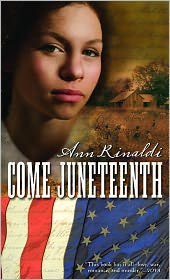
Come Juneteenth. Ann Rinaldi. 2007. Houghton Mifflin Harcourt. 256 pages.

From the prologue: Last night when the fire burned low, when the last of the sweet potatoes under the logs was just a crisp fragrance left of our supper, long after my brother Gabriel had taken his last swig from the flask in his haversack and wiped his mouth with the back of his hand and turned over in his bedroll on the other side of the fire and grunted his good night, last night I lay awake long and unblinking in the spark-filled distance above me. 

From chapter one: I was in the pumpkin patch, counting the ones that were good enough for Old Pepper Apron, our cook, to make into bread.

Secrets. Lies. Lives torn apart. Not by the Freedom War, the War Between the States, the Civil War. But by lies told during those years by masters to their slaves. Come Juneteenth is set in Texas in 1865. Texas slaveholders--like our heroine's father--were able to keep Lincoln's Emancipation Proclamation secret. For two years. Out of necessity? Out of greed? Out of fear? Out of hate or anger? Perhaps we'll never know all the reasons. Luli, our heroine, has struggled with this secret. So has her brother, Gabriel, for both care--in VERY different ways--for Sis Goose, a slave woman who is legally a slave--owned by the family's aunt, but someone who has been raised--since she was a baby--as a member of the family. Luli considers her a sister--an older sister. The two have been very close at times. Though growing up has changed some things. And Gabriel? Well, he's very much in love with Sis Goose. He plans on marrying her and living happily ever after. After, you know, he gets back from fighting the Indians. So when the truth does come out, when the slaves are freed, when the Yankees arrive, well, Sis Goose feels hurt and betrayed and very angry by the family she's loved. 

Come Juneteenth is dramatic and intense. The story is told in flashes by Luli. The transitions between past and present can be tricky, but, for the most part, I liked it.

© 2011 Becky Laney of Becky's Book Reviews


The Last Full Measure (MG/YA)

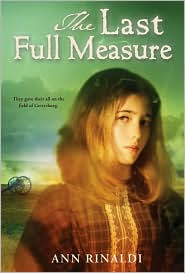
The Last Full Measure. Ann Rinaldi. 2010. [November 2010]. Harcourt. 218 pages.

"Where are you going, Tacy?"

Set in Gettysburg, Pennsylvania in 1863, The Last Full Measure is Ann Rinaldi's latest historical novel. It stars the Stryker family. Our heroine, Tacy, is fourteen. She has two older brothers and a father in the war. But during these troubling summer months, she's going to mature quickly. She'll have to having witnessed some of the atrocities of war. When the novel opens, Tacy's biggest problem is her brother, David, the brother who was unable to join the army because of his bad leg. He has been put in charge of the family; it is his duty to "protect" his mother and his sister, and to look after their home. The responsibility weighs heavily on him, transforming him into a man Tacy can barely recognize. Who is this bossy brother ordering her about? Who is this man that shouts and yells and threatens? Though, perhaps, Tacy needs someone to tell her no--for her own sake.

As the novel progresses, readers get a glimpse of the war, the battle as it unfolds. Readers see the harshness, the devastation, the madness of war. One might think that the battle itself would provide the climax of this one. That its darkest moments would be in the battle itself. But. That's just the beginning. And Tacy's darkest days come after the battle.

I found The Last Full Measure a compelling read. I read it in one sitting, in one afternoon. I enjoyed Tacy as a character. I liked her perspective. How she wasn't above questioning the world around her. And perhaps most importantly, how she wasn't perfect.

But it was a difficult read for me. I reached a point where I was like NO! Are you serious?! Why?! And after that point, it was hard for me to "like" this one. I'm not saying it's not a good book. I'm not saying that it isn't realistic. Or that it isn't well-researched. That it isn't true to the times. But still, it didn't go the way I wanted it to go.

© 2011 Becky Laney of Becky's Book Reviews


Nonfiction Monday: Your Baby Is Speaking To You


Your Baby Is Speaking To You: A Visual Guide to the Amazing Behaviors of Your Newborn and Growing Baby. Dr. Kevin Nugent. Photographs by Abelardo Morell. 2011. January 2011. Houghton Mifflin Harcourt. 106 pages.

I loved the premise of this one. It is a reader-friendly book that can be used as a "tool" to help parents understand and appreciate their baby's body language.The book focuses specifically on newborns. It covers just the first few months of life. (I would have loved to see it cover even more.)

It is divided into seven sections: Sleeping, Crying, Eating (The Sleeping Baby, Deep Sleep, Light Sleep, The Full Cry, Fussing, The Search Response, Feeding), The Amazing Newborn (The Fencer Response, Hand to Mouth, The Sleep Smile, First Steps, Hands, Pre-Reaching, The Smile of Discovery, Crawling, Feet, Yawning), Your Baby's Senses (Responding to Sounds, Visual Exploration, Touch, Cuddliness, The Not Very Cuddly Baby), Settling In (Startles, Drowsiness, Overstimulation, Signs of Distress, Soothability, The Not Easily Settled Baby), The Social Newborn (Looking Into Your Eyes, Feeding and Communication, The Power of Your Voice, Imitation, Learning, Temperament, The Social Smile), The Growing Baby (Reaching Out, Exploring, Empathy, Learning to Love), Parent and Baby and the Lifelong Bond. Six of the sections are divided into chapters.

This one has great layout. Each "chapter" is two pages. Each features at least one black-and-white photograph and a few paragraphs of text. (Some chapters have more photographs than others.) The narrative is written in a conversational style that I found very pleasant. While you could read this one cover-to-cover, I believe it could also be a book that is great for browsing--reading a little here and there. Letting the photos lead the way. 

The photos are amazing. I loved, loved, loved looking at the photographs in this one. The text helps "interpret" the photo. (Do you know the difference between a simple smile, a sleep smile, and a social smile?)

© Becky Laney of Becky's Book Reviews


Twitter Delicious Facebook Digg Favorites More