Showing posts with label YA Mystery. Show all posts

Mister Creecher (YA)

Mister Creecher. Chris Priestly. 2011. Bloomsbury. 390 pages.

Billy pulled his clammy coat collar tightly to his throat. It was damp with the fog and felt like the tongue of a dead animal lolling against his neck. His thin body shivered and trembled. He was fifteen but looked eight. A fever sweat glistened on his forehead. His breaths were short; they puffed from his mouth in feeble wisps.

When the novel opens, our hero, Billy, is getting ready to rob a corpse. The corpse in question turns out not to be a corpse at all, but a "Mr. Creecher." A dead-looking man of large proportion. He "saves" Billy just moments later when a mean gang of thieves (Billy's also a thief of course) shows up threatening him. But his "savior" wants Billy to do a little work for him. He wants Billy to follow two men about town. A Mr. Frankenstein and a Mr. Clerval. Billy easily agrees to this. And so it begins...an odd friendship of sorts...partly based on convenience and circumstance.

At first Billy barely knows a thing about Creecher. And he doesn't mind not knowing. What little he has heard, what little mumblings (or grumblings) he's heard, he's been able to ignore. And even when the truth--the Creecher's truth--is revealed, Billy has a hard time REALLY believing that such a thing is so, that something like that is even possible. But as the story progresses, Billy hears more and more of the Creecher's tale. At times Billy thinks he talks WAY TOO MUCH. He accuses him of talking like a girl, a woman. Of being too in-touch with his feelings, of loving novels and reading too much. I didn't agree with every little thing Billy said. (I was later very glad I didn't!!!) But. It provided an interesting perspective of viewing Mary Shelley's creation or creature.
'Shut up!' Billy snapped. 'Why do you have to be such a...'
He snarled and kicked a moss-covered branch and sent it tumbling into the darkness. Without the coachlights, the moon provided the only illumination to the scene.
'You see how it is for me,' said Creecher. 'I try to help and--'
'It's always about you, isn't it?' said Billy. 'Oh, poor me--I'm ugly and no one likes me. Boo hoo, boo hoo. Well, life ain't a bowl of cherries for the rest of us neither!'
'But you can live among them...'
Billy fumed for a few moments, unable to express his feelings. The truth was he had never felt part of 'them.' He had never belonged.
'Oh yeah. I can get treated like filth,' he replied. 'I can starve or steal. I can hang. If you want someone to feel sorry for you, you've come to the wrong place.' (191)
The novel is set in the middle of Frankenstein. The creature has requested Frankenstein create a mate for him, and Victor has agreed. The novel ends with them on their way to Scotland.

I liked this one. I really, really liked it. I'm not sure that I absolutely loved it. I'm not sure it will make my favorites list. But I am SO GLAD I read it. I found it a great read. Very quick, very enjoyable. The tone of this one was just right. It was just a great, great read. It definitely made me think!

© 2011 Becky Laney of Becky's Book Reviews


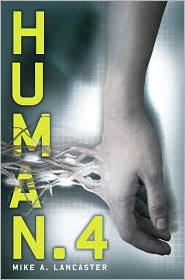
Human.4 (YA)

Human.4 Mike A. Lancaster. 2011. Egmont USA. 240 pages.

When Danny Birnie told us that he had hypnotized his sister we all though he was mad. Or lying. Or both.

Our narrator, Kyle Straker, is living in a strange, strange world where he and three others have suddenly become irrelevant. It started when he volunteered at a local talent show to be hypnotized. It wasn't that he wanted to volunteer, just that in a moment of weakness he had pity on Danny while he was doing his act. His former girlfriend, Lilly, also happened to volunteer just about the same time he did. Two adults, Mrs. O'Donnell and Mr. Peterson, also volunteered. All were hypnotized. All woke up in this strange, strange new reality.

This book is part science fiction, part horror, and part mystery. It was a quick read! I liked it. I wouldn't say I loved it. But for a quick premise-driven read, it was a good choice.

© 2011 Becky Laney of Becky's Book Reviews


As I Wake (YA)

As I Wake. Elizabeth Scott. 2011. September 2011. Penguin. 224 pages.

Wake up.
I'm in bed. Sheets and blankets tucked around me, my legs sprawled out like I've fallen. No light in the room except faint yellow and a darker, colder gleam shining through the window, its curtains only partly closed.
Where I am?
I don't know these sheets, this bed, this room.
I look down at myself, see soft fabric wrapping me from neck to knees. My feet are bare.
There are dark shapes all around.

You never quite know what you're going to get with an Elizabeth Scott novel. This certainly wasn't Bloom or Perfect You or Living Dead Girl or Grace. Then again, that's one of the things that I love about Elizabeth Scott. She never stops surprising me.

As I Wake is part mystery, part science fiction novel. Ava, our heroine, wakes up one day without her memory. There's a woman, Jane, claiming to be her mom. There's a group of teens claiming to be her best friends--Greer, Sophy, Olivia. There's a cute guy, Ethan, whom her friends tell her is her crush. But Ava remembers nothing. There's not a single memory to match her with the life she's supposedly lived. But it's not just that she has no memories of being Ava, it's that she has memories of being a different Ava. The memories that come to her, well, they just don't fit in with what she knows about Ava. Certain people are triggering memories--just not the right memories. So what's going on? That's the mystery Ava and readers have to solve...

I enjoyed this one. I can't say I understood it all while I was reading. I can't even say I'm sure that I understand it now after finishing it and thinking about it for a couple of hours. But was it a compelling read? Yes.

© 2011 Becky Laney of Becky's Book Reviews


A Brief History of Montmaray (YA)

A Brief History of Montmaray. Michelle Cooper. 2009. Random House. 304 pages.

23rd October 1936
Dear Sophie,
Happy birthday to my favorite little sister! I've been trying to recollect the day you were born so I can gush about it in an appropriately sentimental fashion, but I'm afraid it's all a blank.

Sophie FitzOsborne lives an isolated life with her younger sister, Henry, her cousin Veronica, and her mad-uncle John who happens to be King. Except for a handful of villagers and/or servants that make up the "kingdom" of Montmaray, they are the island's only residents. (Toby, her brother, and Simon, the housekeeper's son, being away in England for most of the novel.) But they may not stay isolated for long. The year is 1936, and for whatever reason--bad luck, bad timing, whatever--the Germans have become interested in the island-kingdom. Small though it may be, there is a library in the castle that one or two visiting Germans would just LOVE, LOVE, LOVE to be allowed to explore. But with mad-uncle John still incredibly, fiercely angry at the Germans because of The Great War, the two girls (Sophie and Veronica) dare not let them near the castle. For who knows what King John would do if he discovered Germans on HIS island.

Sophie, our young heroine, is coming of age at an increasingly dangerous time. Plenty of tension and conflict when it comes to European politics and the like. And of course, there is the every day drama of growing up. Should Sophie accept her aunt's invitation to "a season" in London? Should Sophie leave her island home for a big, grand adventure in the city? Her aunt's invitation included Veronica as well. But Sophie knows it would take a LOT of convincing to get Veronica off the island. Because she is VERY VERY busy writing a "Brief History of Montmaray." Sophie may just discover that "love" is a tricky business too.

Historical fiction with plenty of mystery--lies, secrets, murder!

I very much enjoyed Michelle Cooper's A Brief History of Montomaray. I can't wait to begin the sequel, The FitzOsbornes in Exile, which was released this month.


© 2011 Becky Laney of Becky's Book Reviews


Sharp North (YA)

Sharp North. Patrick Cave. 2004/2006. Simon & Schuster. 528 pages.

The girl nearly didn't find out who she was. What she was.

Sharp North is a perplexing YA novel. Part mystery. Part thriller. Part dystopian. It's set in a future world forever altered by global warming. A future world with a corrupt government. (How many fictional future worlds don't have a corrupt government?) A future world threatened by an underground movement, a revolution in the making. Our heroine, Mira, has a role to play in this world--for better or worse. And it's a role that mystifies Mira. For Mira's future is just as uncertain as her past.

Sharp North begins with a murder. Mira witnesses this murder, this hushed up murder, and it forever changes the way she sees the world, the way she sees her community. In part because she finds out that she is connected to the victim. She finds a piece of paper, a mere scrap, with a list of names. Her name is on the list. And so is the name of one of her friends, Gil Moore. He's listed as "her watcher." But why is he watching her? Is he her friend or her enemy? Is he out to see that she survives? Or is he in place to eliminate her? That's what Mira can't forget, can't erase. Are the people who murdered this mysterious woman, this mysterious stranger, out to get her? What led to this crime? For even if the whole world chooses to ignore it, Mira can't. Was it the woman's curiosity? Well, Mira can't help being curious now!

So Mira sets out on a journey to discover the truth, the truth about who she is, what she is. In a way she's running away from danger just as much as she's running straight into it. For Mira hasn't a real clue who her enemies are and who her friends may be. Is there a safe place for Mira? Or is she destined to upset the balance of those around her?

We meet a few interesting characters in Patrick Cave's Sharp North. Including several members of the Saint family, one of the "Great Families" that govern in this new world.

Maybe other readers can piece together this mystery. Maybe other readers can read it without being confused by the ending--as for me, well, I'm puzzled by how it ended. I still don't know what really happened.

So did I like it? Yes and no. I liked the idea of it. But. It felt like two or three stories pieced together. And it didn't always work for me.

© 2011 Becky Laney of Becky's Book Reviews


XVI (YA)

XVI. Julia Karr. 2011. Penguin. 272 pages.

"Nina, look." Sandy jabbed me in the ribs.

XVI is a new dystopian novel. I love dystopian novels, usually. But I wasn't loving this one. I didn't connect to the characters. I didn't believe the romance. I failed to connect with the story, with this new world Karr created.

Nina Oberon is the star of this one. Her best friend, Sandy, is unbelievably annoying--though still a few weeks from her sixteenth birthday, she's acting like a sex-teen already. In other words, she's stopped thinking and has bought into the media's belief system completely. Why is Nina best friends with Sandy? Well, it's hard for readers to know for sure. I can only assume that a few years ago, Sandy, had to be less annoying and more likable.

Nina also has a younger sister, Dee. Since their mother is murdered fairly early in the novel, it becomes Nina's responsibility to protect Dee from her father, Ed. So Nina's life is getting crazier by the day, and trying to make sense of her life, her world, what everything means, well, it could be a full time job. Nina does make a few new friends, friends that are actually capable of thinking, to help her in this difficult time, this dangerous time.

One of these new friends is a guy named Sal. Though Nina is convinced she is not ready for a boyfriend, she can't help wanting Sal in her life. She can't stop thinking about him, wanting him, needing him. Will Sal help her solve some of the big mysteries in her life? Will Sal help keep her safe?

So why didn't I love this one? Why didn't I like it? Why didn't I like Nina and Sal? I'm not sure. It just felt a little lacking. I just felt disappointed with it. It could be just bad timing. You may love this one. (I hope you do enjoy it more than I did.)

© 2011 Becky Laney of Becky's Book Reviews


Wither (YA)

Wither. Laura DeStefano. 2011. Simon & Schuster. 368 pages.

I wait. They keep us in the dark for so long that we lose sense of our eyelids. We sleep huddled together like rats, staring out, and dream of our bodies swaying. I know when one of the girls reaches a wall. She begins to pound and scream--there's metal in the sound--but none of us help her. We've gone too long without speaking, and all we do is bury ourselves more into the dark. The doors open. The light is frightening. It's the light of the world through the birth canal, and at once the blinding tunnel that comes with death. I recoil into the blankets with the other girls in horror, not wanting to begin or end.

Did I like Wither? Yes! I really LOVED it! One of the best 2011 books that I've read so far. Rhine Ellery knows almost exactly when she'll die--and why she'll die. Mad scientists, so called geniuses, from previous generations have manipulated human genes too much. Having created the "oh-so-perfect" generation of children, they've cursed the human race. Every woman dies from a deadly virus at age 20. Every man dies from that virus at age 25.Will there be a cure found in Rhine's lifetime? Maybe, maybe not. She's just sixteen. But she's not that hopeful. Rhine knows one thing for sure. She does NOT want to spend her remaining years in a forced marriage with two other sister wives. Even if her husband, Linden, is ignorant of how his three wives really came to be his. Even if he doesn't know the truth about his father's schemes and manipulations. No, Rhine wants to be free, needs to be free. She wants to find her twin brother, Rowan, and live the rest of her days free. But will she find a way to escape?

I enjoyed Wither! I enjoyed spending time with Rhine and her sister wives, Cecily, the youngest, Jenna, the oldest. I also enjoyed spending time with Gabriel, one of the servants who works at the estate. Their developing friendship adds a great deal of excitement to the novel! I didn't hate Linden. While Rhine may not have fallen for him, may not have found that lifestyle tolerable under any circumstances, I can't help pitying him.

Overall, I found the novel fascinating and compelling. The world Lauren DeStefano created was haunting and horrible and so wonderfully developed. I'd definitely recommend this one.

She wanders down one of the aisles, and I follow her as she runs her finger along the spines of books, taps one of them, eases it out of its place. The book is dusty, the cover eaten away, the pages yellow and brittle as she flips through them. All of these books are from the twenty-first century or earlier, which isn't very strange. The television also airs old movies, and most shows are set in the past. It has become a form of escapism to visit a world in which people live a long time. What was once real and natural has become a fantasy. "There are lots of love stories here," she says. "They either end happily, or everyone dies." She laughs, but it sounds more like a sob. "What else is there, right?" (86)

A few minutes later we're huddled under a blanket on a couch in the sitting room, sharing a gallon of vanilla ice cream she ordered from the kitchen, and we're watching an early-morning rerun of yesterday's soap opera. Along with the romance novels, these are another of her guilty pleasures. The actors are all teenagers made up to look much older. Jenna tells me they're constantly changing the actors, since of course the show has been on for more than a decade and the original actors have died by now. The only consistent actors are first generations. And as she's explaining to me who's in a coma and who unknowingly married an evil twin, both of us bathed in the television's glow, I do start to relax a little. (243)
You might also be interested in reading: Divergent by Veronica Roth, Delirium by Lauren Oliver, Across the Universe by Beth Revis, The Hunger Games by Suzanne Collins, and The Maze Runner by James Dashner.


© 2011 Becky Laney of Becky's Book Reviews


The Vanishing of Katharina Linden

The Vanishing of Katharina Linden. Helen Grant. 2010. Random House. 304 pages.

My life might have been so different, had I not been known as the girl whose grandmother exploded.


Set in 1998 in a small German town, The Vanishing of Katharina Linden focuses on one of the most challenging years of young Pia's life. Within the course of a year, well, her grandmother dies in a freak accident (yes, she explodes), her home life is torn apart as her parents argue time and time again about where they should live--England or Germany--and perhaps most importantly a handful of children--all young girls--disappear from the community.

Our heroine, Pia, is only ten. And before her grandmother exploded, well, her life was normal. Her life wasn't colored or tainted by association. (Some of her classmates refuse to sit by her in case exploding is catching.) But though she may not have many friends, she does have one true friend, Stefan. Yes, this friend is socially undesirable. Before her grandmother's death, she wouldn't have acknowledged he even existed. Still, he's the only one that speaks to her now. So their friendship has a chance to develop. What binds them together--in a way--is their curiosity over the disappearances of the other children. Together they're determined to solve the mystery. Turns out, that other children have vanished from the town through the decades. By listening to the gossip, they think they know the man responsible. But could the village gossips have it all wrong?

While I may not love this one, I certainly found it compelling and enjoyable.

© 2011 Becky Laney of Becky's Book Reviews


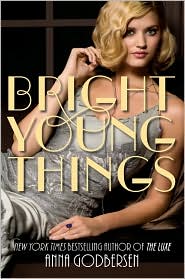
Bright Young Things (YA)

Bright Young Things. Anna Godbersen. 2010. HarperCollins. 400 pages.

It is easy to forget now, how effervescent and free we all felt that summer. Everything fades: the shimmer of gold over White Cove; the laughter in the night air; the lavender early morning light on the faces of skyscrapers, which had suddenly become so heroically tall. Every dawn seemed to promise fresh miracles, among other joys that are in short supply these days. And so I will tell you, while I still remember, how it was then, before everything changed--that final season of an era that roared. 

I enjoyed Anna Godbersen's Bright Young Things. It's set in the summer of 1929--the novel actually starts in May--and is told through three narrators. Three young women--three very different young women--with different dreams, hopes, fears, and weaknesses.

Letty Larkspur dreams of fame. She can sing. She can dance. She wants to be a star. She has come to New York City with her very best friend, Cordelia, but one little argument separates these two friends. Now, on her own in a strange city, Letty is finding life challenging--but in a good way, mostly. Can she make it on her own? Can she charm her way into the good life?

Cordelia Grey is running away from home. It's a good thing her best friend, Letty, has always wanted to 'escape' to New York, has always dreamed of being a star. But, to tell the truth, she isn't going to New York to support her best friend in her pursuit of stardom. No, Cordelia has dreams of her own. She wants to find her father. She thinks her father is Darius Grey. An infamous character if ever there was one. (He's in the "import" business. He's taking full advantage of the Prohibition to make his fortune.) Will she find her father welcoming? Will he be happy to see her? Will knowing him change her life for the better? And can she ever hope to get along with her older half-brother, Charlie?

Astrid Donal is Charlie's girlfriend. Though, she claims to love him--and he claims to love her--this isn't the perfect relationship. There are jealousies on both sides, friction and tension. Astrid meets Cordelia on her first night at the mansion. And Astrid takes to her right away--true this distraction gets her out of a difficult argument with Charlie--but the two become good friends very quickly. What does Astrid want most in life? Perhaps not to be like her mother. Astrid is tired of her mother's selfishness. How her mother uses men and their money. There's definitely more to Astrid than what appears. Yes, she's a "flapper." But she's so much more than that.

I enjoyed this one. I liked the setting--the atmosphere. I liked the characters too. It was interesting to see the relationships develop, the story develop. There is romance and mystery and fashion.

© Becky Laney of Becky's Book Reviews


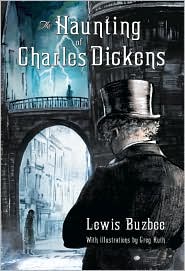
The Haunting of Charles Dickens (MG)

The Haunting of Charles Dickens. Lewis Buzbee. With illustrations by Greg Ruth. 2010. October 2010. Feiwel & Friends. 368 pages.

London. Mid-summer night nearly upon us. Meg Pickel stood, as she had every night for six months now, at the edge of her family's roof-garden, and stared into the City, towards the massive black dome of St. Paul's Cathedral.

Meg, our heroine, is searching for her missing brother, Orion, while Mr. Charles Dickens, our heroine's godfather, is "searching" for his next novel. Can they succeed if they work together? Read and see for yourself in The Haunting of Charles Dickens by Lewis Buzbee.

I really enjoyed reading Steinbeck's Ghost. So I was excited to see Lewis Buzbee's next novel. While Steinbeck's Ghost had a modern day hero "discovering" Steinbeck through his works, The Haunting of Charles Dickens goes beyond that. Meg knows Charles Dickens. Or she knows certain aspects of him at least. He is more than an author she loves and adores. He is her friend. Readers "meet" Charles Dickens--as envisioned by Lewis Buzbee. (I'm not convinced Buzbee's Dickens resembles the actual Charles Dickens, but that's another story. Readers meet a kid-friendly Dickens minus some of his flaws.) It's a book about social injustices.
"We're all haunted, my friends," Mr. Dickens practically sang. "By what we forget. Now that we are un-forgetting, we must cease to be haunted. We must act...We must find Orion, Campion," he said. "You and Julia and myself, and Meg--Meg most of all--we must find Orion!"
Her father stood awkwardly and moved away from Mr. Dickens, his back to him. Aunt Julia leaned forward, suspended. Mr. Dickens waited. Her father turned.
"Charles, don't be so melodramatic. This isn't one of your novels."
"Not yet it isn't!" (83)
To call this head-dress a hat would be a gross injustice to all hats. What the lady wore on her head seemed quite undecided; it could not choose whether it wanted to be a very small piece of architecture or a rather large piece of French pastry. It was a head-dress, Meg thought, of considerable ambition. Along with its ambition, and its height--which matched its ambition--were the golden ornaments that hung about it, hiding here and there in the massive structure like sparrows in a hedge. (182)
I thought there were times when the writing worked well--Buzbee's descriptions were a nice touch. But it's not a perfect novel. There were times the writing seemed forced--like it was trying too hard, if that makes sense. (I'm not sure the Beatles references exactly fit.) But. I enjoyed reading this imagined behind-the-scenes story of Our Mutual Friend. And I enjoyed the illustrations. So while I didn't love, love, love it, I did like it.


© Becky Laney of Becky's Book Reviews


Twitter Delicious Facebook Digg Favorites More