Showing posts with label adult nonfiction. Show all posts

The Reading Promise

The Reading Promise: My Father and the Books We Shared. Alice Ozma. 2011. Hachette. 304 pages.

It started on a train. I am sure of it. The 3,218-night reading marathon that my father and I call The Streak started on a train to Boston, when I was in third grade.

The Reading Promise itself--the promise shared between this father and daughter--was quite simple. The father would read aloud at least ten minutes every day to his daughter. He must get the reading in before midnight. It could--if necessary--be done over the phone. But for the most part it was a commitment to share quality time with one another, and with books, each and every day. Of course, at the very, very beginning neither could have predicted that this hundred-day challenge would become several thousand nights long!

The chapters of this memoir cover the time of The Streak. From a young child (third grade) to a very-soon-to-be-freshman in college. The Streak ended the day the father dropped his daughter off for her first year of college. During this time a LOT happened in the family as you can imagine. The book is a book about reading, a book about family coming together, but it is also a book about growing up. We see quite a few changes as the family goes from four to three to two, to one. As the mom leaves and it becomes a single-parent household. As the older sister goes to college and starts her own life. As Alice Ozma herself leaves to go to college.

Readers also get a small glimpse into the father's profession: school librarian. He loves, loves, loves his job reading aloud to children. He sees reading aloud as fundamental to his job, to his role in these children's lives. But by the end of the book, times have changed significantly--and not for the better. His position as school librarian is being undervalued--to say the least. And he's told that he will not be allowed to read aloud to children. And that even the very youngest need no more than five to ten minutes of a picture book. He's told that his job is to teach these kids how to use computers and the internet. Books are out of the picture--in the eyes of the administration. He fights for what's right, but ends up retiring a half-a-year early.

As I said, it's an interesting book. Readers get a good coming of age memoir that happens to focus on books now and then. The back of the book shares a list of books that she remembers being a part of The Streak.

© 2011 Becky Laney of Becky's Book Reviews


The Private World of Georgette Heyer

The Private World of Georgette Heyer. Jane Aiken Hodge. 2011. Sourcebooks. 256 pages. 

Georgette Heyer was born on 16 August 1902, in the prosperous London suburb of Wimbledon. She was called after her father, George Heyer, who had been called after his. 

I am a big fan of Georgette Heyer, so I was pleased to read Jane Aiken Hodge's biography. Because Heyer was a private person, an author who did not seek much publicity--she let her books speak for themselves--this biography focuses on her writing career. Readers get a glimpse--a behind the scenes picture--of her life as a writer. They learn details about when each book was written, the how, the where, the why. Readers get to read Heyer's thoughts on her own books, her thoughts on other authors, her thoughts on the publishing industry.

The more familiar you are with Heyer's novels--her romances and mysteries--the more you'll enjoy this one. I remember picking this one up a year or two ago and losing interest because all it was--all it seemed to be--was talk about one book after another after another. Now that I've read most of her romances, I have a better appreciation for the biography as a whole. (It could also be a mood thing! For example, after recently reading Anya Seton's Katherine, it amused me to see Heyer call it 'unhistorical' fiction. And I really enjoyed reading Heyer's thoughts on Jane Eyre!!! And the book also includes Heyer's thoughts on some of her book covers!!!)

I would recommend this one to fans of Georgette Heyer. I found it very interesting!

© 2011 Becky Laney of Becky's Book Reviews


By His Own Hand?

By His Own Hand? The Mysterious Death of Meriwether Lewis. Edited by John D.W. Guice. Contributions by James J. Holmberg, John D.W. Guice, and Jay H. Buckley. Foreword by Elliott West. Introduction by Clay S. Jenkinson. 2006. University of Oklahoma Press. 208 pages.

From the foreword: In darker moments I sometimes wonder whether we require our most favored historical characters to die in particular ways. 

From the preface: Late in the afternoon on 10 October 1809 one of the nation's great heroes reined his horse off the Natchez Trace to spend the night at Grinder's Stand. The rustic homestead consisted of two rough-hewn log cabins a few paces apart and a distant barn. It was a pleasant fall day some seventy miles southwest of Nashville, Tennessee. What occupied Meriwether Lewis's mind we will never know, but we do know that shortly after sunup the next morning he died there. Who held the weapon or weapons that fired the fatal shots during the night? Did Lewis take his own life or did an assassin? After nearly two centuries, this remains one of the most fascinating, puzzling, and enduring questions in all of American history. 


I found By His Own Hand? a fascinating read, a true mystery.

In the first chapter, James J. Holmberg presents his case for suicide. He presents the facts of the case and argues that suicide is the most logical explanation, or the best educated guess for what happened that night. He examines several primary resources--letters, written accounts of oral testimonies or oral histories, etc. One of his main points is that Lewis' closest friends--those who knew him best, men like Thomas Jefferson and William Clark--believed that their friend took his own life. The information in the letters primarily comes from the account of Priscilla Grinder. Several men wrote letters recounting these events, but they got their story from talking to her. There were no other witnesses at the inn to verify what Priscilla Grinder heard or saw that night.

In the second chapter, John D.W. Guice presents his case for homicide. He goes over the facts yet again. He provides further context--in some areas--for readers. He argues that while it cannot be proven that it was not suicide, while it can not be thoroughly proven that it was in fact murder, enough questions remain that there is definitely reasonable doubt. Suicide may satisfy some, but for those historians on the other side, there are still so many unanswered questions that they can't just accept that it was suicide. They would need more facts, more answers. While the first chapter tried to argue that Lewis was in a bad state of mind, that he was depressed and suicidal and anxious, that he'd already tried and failed to commit suicide in the weeks leading up to his death, this second chapter tries to argue the opposite. They try to prove that while Lewis was human, while he had moments of doubts or anxieties, there were still plenty of indicators in his life to show that he had not given up, that he had every intention of living. And these rumors of previous suicide attempts are questionable. While one man writes of them, he does not give any clues at all as to the when or the where or the how. If he knew these attempts to be true, why not include at least some detail. If he really, truly thought this man was a danger to himself, why didn't he do something about it? And, of course, that is just one example. The chapter argues that the "witnesses" in the case are not infallible, and in some cases quite questionable. Priscilla Grinder's story changed, and changed quite a bit with each telling or retelling. And her story does not make that much sense even if she'd kept it the same. She claims that she heard two gunshots, when she went to investigate, she saw Lewis walking around begging for help, begging for water, begging for someone to finish the job. She did absolutely nothing...except wait for him to die. Many--if not all--primary accounts of Lewis' death depend on facts as shared by Mrs. Grinder. So William Clark and Thomas Jefferson learned of events second or third hand. Another point argued in this chapter is why would Lewis do such a horrible, horrible job at killing himself? Would he really do such a horrible job aiming twice so that he lingers for hours? Did he really linger for hours or was that Grinder adding drama to the story?

The third chapter by Jay H. Buckley is "a postmortem trial." Buckley provides summaries of the arguments from chapter one and two. He examines the strengths and weaknesses of the suicide theory and the strengths and weaknesses of the assassination theory. He does a great job in highlighting both sides. His goal, of course, is to get readers engaged, to challenge readers to think for themselves and decide which is most likely.

All of the chapters are well written. All are fascinating. Both sides argue quite well...
I really loved the mystery of this one. There are some things in history that are just mysteries. We don't know what happened--what really happened. And sometimes these mysteries are a bit hidden away. Some historians write what they think happened and leave it at that, taking some of the mystery out of life.

© 2011 Becky Laney of Becky's Book Reviews


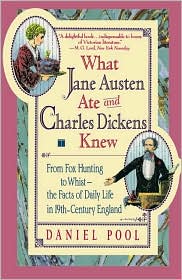
What Jane Austen Ate and Charles Dickens Knew

What Jane Austen Ate and Charles Dickens Knew: From Fox Hunting to Whist -- The Facts of Daily Life in 19th Century England. Daniel Pool. 1994. Simon & Schuster. 416 pages. 

I enjoyed reading What Jane Austen Ate and Charles Dickens Knew. I enjoyed reading about various aspects of life in 19th Century England. I won't lie. There were chapters and sections more appealing, more interesting than others. (I'll admit to "skimming" the sections on lawyers.) But, for the most part, I enjoyed it. I liked all the bookish references. I would say most--if not all--sections reference at least one or two British authors. Charles Dickens and Jane Austen, of course, but also including Anthony Trollope, Emily and Charlotte Bronte, Thomas Hardy, George Eliot, etc. (Sadly, he does not include Elizabeth Gaskell or Wilkie Collins.) He takes the time to name specific characters and situations from specific books to highlight and illustrate social customs. Readers may not be familiar with all of these characters, and sometimes what he says about a book could be considered spoilerish. But since these are books that have been around over a hundred years, keeping things spoiler free isn't a necessity.

This one is in two parts. (I read the first part. The second part is a glossary.) As you can see, it covers a little bit of everything--both public and private.

The Basics:
  • Currency, 
  • The Calendar, 
  • Hogsheads and Drams: English Measurement, 
  • England, 
  • London.

The Public World:
  • Precedence: Of Bishops, Barristers, and Baronets,
  • The Titled,
  • How To Address Your Betters
  • Esq., Gentl., KCB., etc.
  • Status: Gentlemen and Lesser Folk
  • Society: Society and "The Season," Basic Etiquette, How To Address the Nontitled, "May I Have This Dance?', The Rules of Whist and Other Card Games, Calling Cards and Calls, 
  • The Major Rituals: Presentation at Court, The Dinner Party, The Ball, The Country House Visit
  • Money: Being Wealthy, Entail and Protecting the Estate, Bankruptcy, Debt, and Moneylending
  • Power and the Establishment: The Government, Britannia Rules the Waves, The Army, The Church of England, Oxford and Cambridge, Schools, "The Law Is An Ass," Lawyers, Crime and Punishment

Transition:
  • The Horse
  • Please, James, the Coach
  • The Railroad
  • The Mail

The Country:
  • Life on the Farm
  • The Midlands, Wessex, and Yorkshire
  • Who's Who in the Country
  • Shire and Shire Alike: Local Government in Britain
  • "The Theory and System of Fox Hunting"
  • Vermin, Poachers, and Keepers
  • Fairs and Markets

The Private World:
  • "Reader, I Married Him"
  • Sex
  • An Englishman's Home
  • Houses with Names
  • Furniture
  • Lighting
  • How the English Kept Clean
  • "Please, Sir, I Want Some More."
  • Pudding!
  • Tea
  • Drink and the Evils Thereof
  • Women's Clothing
  • Men's Clothing
  • Servants
  • The Governess
  • A Taxonomy of Maids
  • Victorian Recycling

The Grim World:
  • The Orphan
  • Occupations
  • Apprentices
  • The Workhouse
  • Disease
  • Doctors
  • Death and Other Grave Matters

And if you'd like to read Jane Austen or Charles Dickens for the Classics Circuit blog tour, you've still got through tomorrow--April 19th--to sign up!

© 2011 Becky Laney of Becky's Book Reviews


Nonfiction Monday: Your Baby Is Speaking To You


Your Baby Is Speaking To You: A Visual Guide to the Amazing Behaviors of Your Newborn and Growing Baby. Dr. Kevin Nugent. Photographs by Abelardo Morell. 2011. January 2011. Houghton Mifflin Harcourt. 106 pages.

I loved the premise of this one. It is a reader-friendly book that can be used as a "tool" to help parents understand and appreciate their baby's body language.The book focuses specifically on newborns. It covers just the first few months of life. (I would have loved to see it cover even more.)

It is divided into seven sections: Sleeping, Crying, Eating (The Sleeping Baby, Deep Sleep, Light Sleep, The Full Cry, Fussing, The Search Response, Feeding), The Amazing Newborn (The Fencer Response, Hand to Mouth, The Sleep Smile, First Steps, Hands, Pre-Reaching, The Smile of Discovery, Crawling, Feet, Yawning), Your Baby's Senses (Responding to Sounds, Visual Exploration, Touch, Cuddliness, The Not Very Cuddly Baby), Settling In (Startles, Drowsiness, Overstimulation, Signs of Distress, Soothability, The Not Easily Settled Baby), The Social Newborn (Looking Into Your Eyes, Feeding and Communication, The Power of Your Voice, Imitation, Learning, Temperament, The Social Smile), The Growing Baby (Reaching Out, Exploring, Empathy, Learning to Love), Parent and Baby and the Lifelong Bond. Six of the sections are divided into chapters.

This one has great layout. Each "chapter" is two pages. Each features at least one black-and-white photograph and a few paragraphs of text. (Some chapters have more photographs than others.) The narrative is written in a conversational style that I found very pleasant. While you could read this one cover-to-cover, I believe it could also be a book that is great for browsing--reading a little here and there. Letting the photos lead the way. 

The photos are amazing. I loved, loved, loved looking at the photographs in this one. The text helps "interpret" the photo. (Do you know the difference between a simple smile, a sleep smile, and a social smile?)

© Becky Laney of Becky's Book Reviews


Twitter Delicious Facebook Digg Favorites More