Showing posts with label J Mystery. Show all posts

From the Mixed-Up Files of Mrs. Basil E. Frankweiler

From the Mixed-Up Files of Mrs. Basil E. Frankweiler. E. L. Konigsburg. 1967. Simon & Schuster. 162 pages.


Claudia knew that she could never pull off the old-fashioned kind of running away. That is, running away in the heat of anger with a knapsack on her back. She didn't like discomfort; even picnics were untidy and inconvenient: all those insects and the sun melting the icing on the cupcakes. Therefore, she decided that her leaving home would not be just running from somewhere but would be running to somewhere. To a large place, a comfortable place, an indoor place, and preferably a beautiful place. And that's why she decided upon the Metropolitan Museum of Art in New York City.

Claudia Kincaid, our heroine, wants to run away, but she knows she can't do it alone so she recruits her younger brother, Jamie, to go with her. He may just be her favorite brother, and he's definitely her richest brother. Their plan is successful...and they do manage to have quite the adventure.

I really, really liked this one. I thought it was great fun. I loved Claudia. I loved Jamie. I loved the writing of this one. I loved the way we got to know the characters. This brother-sister relationship is done so well. I love that I can relate to both Claudia and Jamie. While we don't get to know anything really about the rest of the Kincaid family--about the parents, about the other kids, we do get to know these two very, very well! Which was enough for me!

Here is one of my favorite scenes between the two:
Upon their return to the museum, Claudia informed Jamie that they should take advantage of the wonderful opportunity they had to learn and to study. No other children in all the world since the world began had had such an opportunity. So she set forth for herself and for her brother the task of learning everything about the museum. One thing at a time. (Claudia probably didn't realize that the museum has over 365,000 works of art. Even if she had, she could not have been convinced that learning everything about everything was not possible; her ambitions were as enormous and as multi-directional as the museum itself.) Every day they would pick a different gallery about which they would learn everything. He could pick first. She would pick second; he third; and so on. Just like the television schedule at home. Jamie considered learning something every day outrageous. It was not only outrageous; it was unnecessary. Claudia simply did not know how to escape. He thought he would put a quick end to this part of their runaway career. He chose the galleries of the Italian Renaissance. He didn't even know what the Renaissance was except that it sounded important and there seemed to be an awful lot of it. He figured that Claudia would soon give up in despair.
When she gave Jamie first pick, Claudia had been certain that he would choose Arms and Armor. She herself found these interesting. There was probably two days' worth of learning there. Perhaps, she might even choose the same on the second day. (47)
Jamie's choice of the Italian Renaissance leads them on their biggest adventure yet. It leads them to a statue. A statue that may have been done by Michelangelo. A small statue of an angel that they learn was donated by a Mrs. Basil E. Frankweiler. Once they become curious about this statue, once they decide they want to "solve" the mystery, well, that's when their adventure finds a purpose, a dream.

I really loved this one. It was such a great read--very satisfying. I would definitely recommend it.

Happiness is excitement that has found a settling down place, but there is always a little corner that keeps flapping around. (151)

© 2011 Becky Laney of Becky's Book Reviews


The Boxcar Children

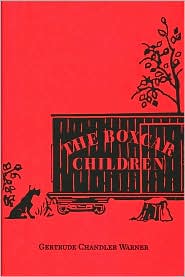
The Boxcar Children. Gertrude Chandler Warner. 1942. 155 pages.

One warm night four children stood in front of a bakery. No one knew them. No one knew where they had come from. The baker's wife saw them first, as they stood looking in at the window of her store. The little boy was looking at the cakes, the big boy was looking at the loaves of bread, and the two girls were looking at the cookies.

Henry, Jessie, Violet, and Benny are orphans. Scared of a grandfather they never met, these children are running away. When the novel opens, they are seeking refuge for the night, asking permission to sleep on the benches of the bakery shop. (They bought bread). After hearing the couple discuss them--on how they should "keep" the three oldest because they would be useful to have around as workers, but how the youngest one would need to go to a Children's Home--Henry and Jessie decide to wake everyone and leave while they still have a chance. They walk most of the night, sleep most of the day. Their journey takes them into the woods, and during a storm, they seek shelter in an abandoned boxcar. It doesn't take the children very long to realize that if a boxcar is good shelter from a storm, it would be a good home for always. There is a town within walking distance so that Henry can find work and buy food. And the rest of the children can do what they can to make it a real home. And that is just what they do...day by day creating a home for themselves.

I liked  The Boxcar Children. I did. I had read it more than a few times growing up, but it had been at least fifteen or twenty years since I'd last read it. It was such a treat to read it again. It's a simple book, in many ways, yet it's got its charms. I liked how these children do make a home for themselves. How they work together as a family. While I wouldn't say that I ever loved this one as much as Mandy or Anne of Green Gables or The Secret Garden, I have definitely always liked it.

© 2011 Becky Laney of Becky's Book Reviews


The Trumpeter of Krakow

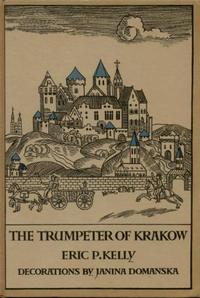
The Trumpeter of Krakow. Eric P. Kelly. 1928. 208 pages.

It was in late July of the year 1461 that the sun rose one morning red and fiery as if ushering in midsummer's hottest day. His rays fell upon the old city of Krakow and the roads leading up to it, along which rolled and rocked a very caravan of peasants' wagons. 

Don't judge a book by its cover. Or, at least don't judge this book by its cover! For appearances can be deceiving, The Trumpeter of Krakow is anything but boring! It's an exciting adventure story with elements that reminded me of some great fantasy novels! (It stars an alchemist and his "student" who is obsessed with finding the philosopher's stone.)

The Charnetski family has come to Krakow seeking protection. The father (Andrew Charnetski) has relatives in the city, and he's hoping to find sanctuary there until he can have an audience with the King (Kazimir Jagiello). But when he arrives, he learns that his relative has died--been murdered--and that the rest of the family has fled. Knowing that his family is in great danger--especially if the man seeking to prevent him from entering the city comes back to cause trouble--he returns to the market to think out his options. Joseph, the son, happens to rescue a young woman from an attacking dog, and in doing so wins the gratitude of her uncle. An invitation is extended to Joseph and his family, and lodgings are arranged. Around the same time, Andrew meets an important man in the city, Jan Kanty, who listens sympathetically and offers great advice. Sell your horses and your cart, change your name, and become the trumpeter in the tower of the Church of Our Lady St. Mary. Andrew is happy to follow this advice closely. He even teaches his son to play the trumpet hymn (Heynal) that is to played four times every hour. There is a story about this hymn, and a legend of sorts about a trumpeter. Readers learn of this at the very beginning, for it is set several centuries before this adventure even begins.

There is never a dull moment in The Trumpeter of Krakow. For there are the neighbors above and below to keep things interesting. The most interesting, perhaps, being the alchemist, Kreutz, he is the distracted uncle of the grateful girl, Elzbietka. He has a student, Johann Tring, a young man that makes many--including Joseph and Elzbietka--nervous. The two--in varying degrees--are obsessed with finding out the secret of how to make gold, fascinated with the philosopher's stone. The niece feels that Tring is a bad, bad influence on her uncle, and that Tring is leading her Uncle into dangerous territory.

And of course, never for a minute forget that this family is being pursued. Why? Well, the family DOES have a secret, they have something in their possession that drives people mad, something that people are willing to kill to have.

The novel is exciting. It has action and adventure, and a bit of magic as well. I do believe this one is more plot-driven than character-driven, but that didn't bother me at all. For it was enough that I wanted to find out what happened next. And the writing, I felt, was pleasant.

© 2011 Becky Laney of Becky's Book Reviews


The Hidden Gallery (MG)

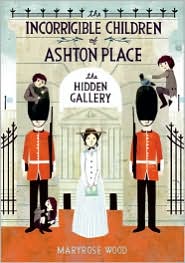
The Hidden Gallery (The Incorrigible Children of Ashton Place #2) Maryrose Wood. 2011. HarperCollins. 320 pages.

"But the workmen swore the repairs to the house would be finished by now!"

It's been a few months since the disastrous Christmas affair when the three Incorrigible children--Alexander, Beowulf, and Cassiopeia--went a little crazy in front of all the guests. But the children have made friends with the squirrel, Nutsawoo, and they've been behaving well enough ever since. They've been themselves, true, confusing words like matador and metaphor. But they've not been awful or dreadful. Still, a little change of scene might be just the thing. For Penelope Lumley, the young but bright governess, has been invited to London by one of her former teachers. And Miss Lumley is eager to go with the children. She didn't necessarily expect Lord and Lady Ashton to want to go to London too. But the more the merrier, right?

So this second book is ALL about their London adventure. Do you think that these three children--supposedly raised by wolves--can go unnoticed in London? You're right. Things do get a little messy. But in the midst of the chaos, Miss Lumley discovers that she needs to be extra careful. For there is someone who wants to hurt the children. But who?! Miss Lumley's former teacher is NO help at all. Just warning Penelope to not ask questions of anyone and to leave well enough alone. But does that really sound like something Penelope can do?

I liked The Hidden Gallery. I didn't love it as much as the first one, perhaps, but it was a good read, an enjoyable one. Within this one, Penelope makes a new friend, Simon, whom she trusts almost immediately. At times I forget that Penelope is VERY young herself--just fifteen or so? So it was nice to see that she is interested in boys too. That she can think of more than Latin and geography and such. 

© 2011 Becky Laney of Becky's Book Reviews


The Witch's Guide to Cooking With Children (MG)

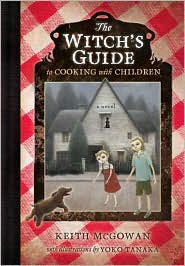
The Witch's Guide to Cooking With Children. Keith McGowan. 2009. Henry Holt. 192 pages.

I love children. Eating them, that is. I've eaten quite a few children over the centuries. You may wonder where I get them all. The answer is: I get them the traditional way. From parents, of course. 

The book begins with a little excerpt from Fay Haladerry's "How to Cook and Eat Children." This mystery novel stars two children--an eleven-year old boy, Solomon, an eight-year-old girl, Connie. These two first get suspicious of their new community when they see a local dog chewing (or perhaps burying?) a human bone. Of course, they don't know right then and there that it is human. But a trip to the library soon has these kids convinced that there is something strange about one of their neighbors, a woman named Fay Haladerry. Readers, of course, know more than our hero and heroine for most of the novel. For they realize early on that a) this woman is a witch--the witch--from Hansel and Gretel and b) that Sol and Connie's parents have it in for them. They see the first few failed attempts. They have a better idea of who to trust and who not to trust.

This book has an interesting premise, a playful premise. Throughout the book, readers get a glimpse into this witch's book. And these scenes may prove the highlight for readers interested in this twisted fairy tale. But, for me, the novel lacks substance when it comes to characterization. The story in many ways seems one-dimensional. Sol and Connie don't deserve to be cooked and eaten--not by any stretch of the imagination--but they do lack the depth needed for this reader (this adult reader) to really care about them as individuals. The book lacks complexity in a way. Beyond the premise, beyond the playful twist to a traditional fairy tale, it isn't as great as the book cover might suggest.

© 2011 Becky Laney of Becky's Book Reviews


Twitter Delicious Facebook Digg Favorites More