Showing posts with label Scholastic. Show all posts

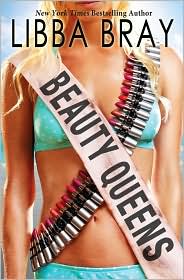
Beauty Queens (YA/Adult)

Beauty Queens. Libba Bray. 2011. Scholastic.  400 pages.

This book begins with a plane crash. We do not want you to worry about this. According to the U.S. Department of Unnecessary Statistics, your chances of dying in a plane crash are one in half a million. Whereas your chances of losing your bathing suit bottoms to a strong tide are two to one. So, all in all, it's safer to fly than to go to the beach. As we said, this book begins with a plane crash. But there are survivors. You see? Already it's a happy tale. They are all beauty queen contestants. You do not need to know their names here. But you will get to know them. They are all such nice girls. Yes, they are nice, happy, shining, patriotic girls who happen to have interests in baton twirling, sign language, AIDS prevention in the animal population, the ancient preparation of popadam, feminine firearms, interpretive dance, and sequins. Such a happy story. And shiny, too.

Beauty Queens has action, adventure, drama, romance, and humor. I can't promise that you'll love Beauty Queens--or even like Beauty Queens. I'm not even sure how I feel about it. It kept me reading. It was over-the-top. It was sarcastic. It was funny. Perhaps some of the humor is a bit twisted, a bit out of the ordinary, a bit insane. A satire of sorts I believe examining our culture, our society, our obsession with reality TV, our obsession with beauty and fashion and celebrity status, our commercialism, our materialism. I do believe there were some hidden and not-so-hidden messages that tend towards the truth--minus some of the exaggeration and ridiculousness. So part of me thought Beauty Queens was clever. At least clever in premise. For I do believe that Beauty Queens is driven by the premise. It is a story where beauty queens battle to survive and are forced to come to terms with who they are as individuals without the attention, without the glamor, without the immediate need to be objectified and validated by others, by society. In other words, can these thirteen survivors get beyond the pretty?

If Beauty Queens has a weakness, it is that the book lacks in believability and characterization. While half the girls are more realized than the others--some we never even learn their names, we just know their state--few really reach their full potential. Perhaps because this novel is told through so many narrators. Or perhaps because we're told more than we're shown. Readers first see stereotypes, then ever so slowly, readers learn more about the characters. Readers come to see them grow through the novel. But some of this growth is a little too sudden. In one chapter they'll be doing this, saying that--and then the next chapter, it seems they've radically changed into better, stronger, smarter, more empowered women. We do follow their individual journeys; we do learn their secrets one by one. So I'm not saying the novel is lacking in all characterization. Perhaps just that it's a bit uneven?

Did I like it? Did I love it? I'm not sure I can say either. I found it a compelling read. I found it hard to put down. I had the need to know what happened next. I found myself smiling at some of the foot notes and some of the commercials and advertisements. I do think this one is so unique, so creative--at least at this moment*--that it will be hard to forget it. I can definitely see the appeal to this one. But did I personally love it--like LOVE, LOVE, LOVE it? Probably not. Still, it was a good way to spend the afternoon.

*There was probably a time when "good" vampires were unique.

© 2011 Becky Laney of Becky's Book Reviews


Ways To Live Forever (MG)

Ways to Live Forever. Sally Nicholls. 2008. Scholastic. 224 pages.

List NO. 1 - Five Facts about Me


1. My name is Sam.
2. I am eleven years old.
3. I collect stories and fantastic facts.
4. I have leukemia.
5. By the time you read this, I will probably be dead. 

Sam is dying of leukemia. Sam is also writing a book; a book about himself, a book with stories, a book with lists. One of his lists, for example, is about all the things he'd like to do before he dies. Another lists ways to live forever. Which includes things like "Become a vampire. Hope you don't meet Buffy" and "Find a Greek goddess and make her fall in love with you. Have her get Zeus the king of the gods to make you immortal" (92-93)

Sam isn't facing this alone. He's got his mom and dad, parents who are supportive of him when they're not busy arguing. He's got his sister, Ella, who's nice to be with...some of the time, if only she didn't throw baby tantrums. He's got his best friend, Felix, too. Felix is also dying, though not of leukemia. The two can be oh-so-honest with each other. One of the things they discuss is how Sam's book should end. Since it would be impossible for Sam to write about his own death before it happened. But it's not like they're talking all death, all the time. They enjoy living life too. Like trying to sneak in a cigarette so they know what it's like to smoke. Like trying to watch an R rated movie without getting caught by their parents.

How do you live life knowing your dying? How do you write about it when you're eleven?

This novel is a quick read, but it's a heavy one. It deals with death and dying in a raw, honest way.


© 2011 Becky Laney of Becky's Book Reviews


Prom & Prejudice (YA)

Prom & Prejudice. Elizabeth Eulberg. 2011. [January 2011] Scholastic. 288 pages.

It is a truth universally acknowledged, that a single girl of high standing at Longbourn Academy must be in want of a prom date.

Lizzie Bennet is a scholarship girl at Longbourn Academy. And it's tough going--many of her classmates (especially girls like Caroline Bingley and Cat de Bourgh) take joy in tormenting her. Fortunately, she's found a friend in Jane, her roommate, and Charlotte, the second scholarship girl. And she loves her piano teacher, Mrs. Gardiner. This opportunity--as challenging as it is, socially--is once in a lifetime. And Lizzie is grateful, most of the time. If only her school wasn't so prom-obsessed. If only every Longbourn girl wasn't expected to go with someone from Pemberley Academy. If only Collin Williams wasn't the only Pemberley guy interested in her.

Lizzie Bennet first meets Will Darcy through Jane. She's unimpressed. Sure, he's cute. Sure, he's rich. But. He's such a snob. (She happened to overhear him saying some not so nice things about scholarship girls.) And these two seem destined to argue if their first few meetings are any indication...but he seems to be going out of his way to see her. He knows her schedule at the coffee shop. And it's rare he doesn't show up for one of her shifts. He seems to want something from her, but what?

I loved this one. I just LOVED it. It's clever; it's funny. As a modernization of Pride & Prejudice, it works really well. There are so many scenes that illustrate this...

One of her conversations with Collin:
"Elizabeth, did you find your jacket?" He motioned toward Jane's red wool coat, which I was now going to be wearing until the end of winter.
"Unfortunately, no."
"Oh, I am so sorry to hear that. I once lost a jacket that I loved very much. It was corduroy. No, tweed. Brownish gray. Really, it was a fine coat. My teddy bear had a matching one. We often wore them together. But then, one day, I left it in a park. When my mother and I went back for it, it was...gone."
"I can see you miss it," I said, looking for an escape route. (101)
One of the scenes where Jane's younger sister, Lydia, "shines":

"I'm just having fun," Lydia protested. "You're so uptight." Her eyes grew wide and she started jumping up and down. "No. Way. This song was, like, THE song from camp last summer. I totally remember the routine we came up with. An up-tempo pop song started playing on the sound system, and before any of us could stop her, Lydia was on the dance floor, spinning around with her arms stretched out. In less than ten seconds, she cleared a space of about ten feet around her. She was relishing the attention.
Jane was horrified. "Please make her stop." Her voice was nearly inaudible.
I headed over to the platform. Lydia was doing something that looked like the Charleston, but with her usual manic energy. She started spinning her fists in the air and shouting "WOO!" every few seconds. I could hear the snickering as I passed through the crowd. (94-95)
I appreciated this adaptation. I loved what Eulberg added to the story. I thought it was a nice balance between staying true to Austen's original story, and creating a great teen romance all her own.

Points of Interest: Romance, High School, Popularity, Bullying, Prom, Dating, Friendship, Music (Piano), Modern Adaptations of Classics, Jane Austen, Pride & Prejudice.

See also: The Lonely Hearts Club. Elizabeth Eulberg. Prada & Prejudice. by Mandy Hubbard.

© Becky Laney of Becky's Book Reviews


The Crossing: How George Washington Saved...

The Crossing: How George Washington Saved The American Revolution. Jim Murphy. 2010. Scholastic. 96 pages. 

On April 19, 1775, British and American soldiers clashed in a bloody battle in Massachusetts. Part of it happened in the village of Lexington, while the other part took place fifteen miles away in Concord. these first shots that started the American Revolution were the result of many years of anger, frustration, and growing hostility over how Great Britain governed and taxed its American colonies.

 I've read several of Jim Murphy's books this year--including An American Plague, Blizzard, and Pick and Shovel Poet--and I've enjoyed them all. What I enjoy about his work is how he makes any subject interesting--how he makes any subject appealing. His books are so reader-friendly. (They don't read like a text book. They read like a story.)

In The Crossing, Murphy focuses on George Washington. How Washington's leadership abilities effected the Revolution--how his choices--for better or worse--impacted the war between America and Britain. Sometimes Washington's decisions were smart ones, other times not so much. Of course, Washington had to work with the soldiers he had available at any given time. (And those soldiers didn't always do exactly what Washington had in mind.)

This is a short book. It doesn't focus on the whole war. It doesn't focus on each and every battle. But I think it is a nice introduction to the subject.

© Becky Laney of Becky's Book Reviews


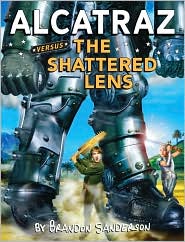
Alcatraz Versus the Shattered Lens (MG/YA)

Alcatraz Versus The Shattered Lens. Brandon Sanderson. 2010. Scholastic. 304 pages.
 
So there I was, holding a pink teddy bear in my hand. It had a red bow and an inviting, cute, bearlike smile. Also, it was ticking.
"Now what?" I asked.
"Now you throw it, idiot!" Bastille said urgently.

Alcatraz Smedry is back for his fourth adventure. (Alcatraz would want me to tell you it is yet another volume in his biography--not a fantasy novel at all.) The first three volumes are Alcatraz Versus the Evil Librarians, Alcatraz Versus the Scrivener's Bones, and Alcatraz Versus the Knights of Chrystallia. While we still don't know how Alcatraz ends up tied to an altar of outdated encyclopedias, readers do finally see how Alcatraz ended up a hero in the Free Kingdoms. For in this fourth adventure story, it is up to Alcatraz and his friends (and family) to save the kingdom of Mokia from the invading army of Evil Librarians. Can Alcatraz make the most of his talents? Can he lead a country--a kingdom--into battle? Can he handle the responsibility?

I love Alcatraz Smedry. I do. He is a great narrator!
If you've ever thought that books are boring, it's because you don't know how to read them correctly. From now on, when you read a book, I want you to scream the words of the novel out loud while reading them, then do exactly what the characters are doing in the story.
Trust me, it will make books way more exciting. Even dictionaries. Particularly dictionaries. So go ahead and try it out with this next part of this book. If you do it right, you'll win the bonus prize. (37)

Change. It's important to change. I, for instance, change my underwear every day. Hopefully you do too. If you don't, please stay downwind.
Change is frightening. Few of us ever want things to change. (Well, things other than underwear.) But change is also fascinating--in fact, it's necessary. Just ask Heraclitus. (56)

In the year 1288, if you were to pass by an old acquaintance on the way to Ye Old Chain Mail Shoppe and call him "nice," you'd actually be calling him an idiot.
If it were the year 1322 instead -- and you were on your way to the bookshop to pick up the new wacky comedy by a guy named Dante -- when you call someone "nice" you would be saying that they were timid.
In 1380, if you called someone "nice," you'd be saying they were fussy.
In 1405, you'd be calling them dainty.
In 1500, you'd be calling them careful.
By the 1700s -- when you were off to do some crowd surfing at the new Mozart concert -- you'd be using the word nice to mean "agreeable."
Sometimes, it's difficult to understand how much change there is all around us. Even language changes, and the same word can mean different things depending on how, where, and when it was said. The word awful used to mean "deserving of awe" -- full of awe. The same as awesome. Once, the word brave meant "cowardly." The word girl meant a child of either gender.
(So next time you're with a mixed group of friends, you should call them "girls" instead of "guys." Assuming you're not too brave, nice, nice, nice, or nice.)
People change too. In fact, they're always changing. We like to pretend that the people we know stay the same, but they change moment by moment as they come to new conclusions, experience new things, think new thoughts. Perhaps, as Heraclitus said, you can never step in the same river twice...but I think a more powerful metaphor would have been this: You can never meet the same person twice. (224-5)
I loved this one. I thought it was a great addition to a fun series of fantasy novels. If you're looking for action, adventure, fantasy, and humor...then consider reading the Alcatraz books! They're great fun!!!

© Becky Laney of Becky's Book Reviews


Mockingjay (YA)

Mockingjay by Suzanne Collins. 2010. Scholastic. 390 pages.

I stare down at my shoes, watching as a fine layer of ash settles on the worn leather. This is where the bed I shared with my sister, Prim, stood. Over there was the kitchen table. The bricks of the chimney, which collapsed in a charred heap, provide a point of reference for the rest of the house. How else could I orient myself in this sea of gray? Almost nothing remains of District 12.

Mockingjay concludes Suzanne Collins' trilogy. Book one: The Hunger Games. Book two: Catching Fire. Katniss, our reluctant heroine, is as strong as ever. As weak as ever too. For Katniss has been tortured by the mind games of those around her. From President Snow to President Coin. If you've not read The Hunger Games and Catching Fire--but you intend to at some point--then don't read this review! 


Katniss has made it through her second Hunger Games--just barely. She was "rescued" just in time. Unfortunately, Peeta, her on-screen romance was not. While Katniss is trying to adapt to her new home in District Thirteen, while Katniss is trying to decide whether or not to become the rebellion's "Mockingjay", he is President Snow's prisoner. And knowing that Peeta is in danger--that he is being tortured--is torture for her.

Is Katniss's reunion with Gale a good thing? You be the judge of that. He does bring out Katniss's anger, her aggression. And not always in the right way. For Katniss finds him infuriating to be around at times. Does Gale make a good soldier for the rebellion? Definitely. But just because he's in favor with the rebellion, with President Coin, doesn't mean that he's a good friend--a good partner--for Katniss.

Katniss is still trying to find herself. She's still having people try to shape her, mold her, conform her, define her, limit her. In many ways, President Coin is just as bad as President Snow in trying to "make" Katniss into something she's not. Coin wants her to be "the face" of the war. In a very artificial way--at least at first. Under the circumstances, Katniss has never had the time--the opportunity--to decide anything for herself. She's forced into everything--either directly or indirectly. Is it any wonder she's so confused? (But Katniss does get her moment in Mockingjay.)


Mockingjay is very much focused on war and politics. And with both sides so committed to war, to destruction, to "winning" it shouldn't be much of a surprise that this one is so violent, so bloody, so ugly.


I liked this one. I thought it was compelling--very intense. It is an emotional book--the subject matter makes it so.

© Becky Laney of Becky's Book Reviews


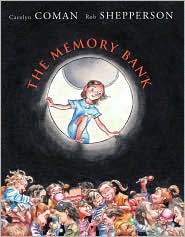
The Memory Bank (MG)

The Memory Bank. Carolyn Coman. Illustrations by Rob Shepperson. 2010. October 2010. Scholastic. 288 pages.

"Don't forget your whistle!" Hope reminded Honey--every morning of every day. Honey needed that whistle, in case of emergency, in case things went terribly wrong. Hope and Honey Scroggins were the closest of sisters, had been right from the start. Truly, they were lucky to love each other so! Not so lucky when it came to their parents, though. Mr. and Mrs. Scroggins were simply awful people.

The Memory Bank is told through words and pictures. (Though not to the extent that The Invention of Hugo Cabret is.) It reminded me--in a way--of several Lois Lowry novels--The Willoughbys and The Giver. It stars a young girl, Hope, who is doing the best she can to cope with incredibly cruel parents. How cruel? One day they leave Hope's younger sister, Honey, on the side of the road. They tell Hope to forget her. And they mean it. Not a word about Honey is allowed. Hope is an only child now. There is nothing good about Mr. and Mrs. Scroggins. Fortunately--for everyone--they enter into the story very little.

For Hope becomes terribly depressed. She stops living life--and starts dreaming it. It's just too painful to be awake. To live her "new" life. She'll spend most hours of the day and night sleeping. She dreams of her sister mostly. While her parents don't notice--or don't care--someone does notice. The powers that be of The World Wide Memory Bank. (They notice that she's not contributing her quota of memories.) And while the strangers that arrive in her home to arrest her seem intimidating at first, Hope soon realizes that there's hope at last for a better life.

It's an interesting book. The "fight" between the World Wide Memory Bank and the Clean Slate Gang. The connection between memories and dreams. I found it an entertaining read.

© Becky Laney of Becky's Book Reviews


Touch Blue (MG)

Touch Blue. Cynthia Lord. 2010. August 2010. Scholastic. 192 pages.

"The ferry's coming!" High on the cliffs, my five-year-old sister, Libby, jumps foot to foot. "Come on, Tess! Mom says we can run down to meet it!"

To save their island school from closing, there is nothing the community of Bethsaida won't try--which is why five foster children are being welcomed into the neighborhood. Aaron is one of them. He'll be the big brother to Tess and Libby. If he stays. As much as Tess wants him to stay--so that she can stay, so that she won't have to move to the mainland, so she won't have to go to a new school--she's heard her father say time and time again that island life isn't for everyone. And Aaron--with his bright red hair and pale white skin--doesn't look like he'll be a good match. Tess wants to be friends with him. At least on friendly terms with him. But Aaron seems hesitant to reach out to anyone, to trust anyone. Can Tess and Aaron find common ground? What can these two learn from one another?

I loved this one. I loved it! Cynthia Lord has created such great characters! I enjoyed Tess very much. And Aaron. I liked the whole community really. I enjoyed spending time reading this one.

© Becky Laney of Becky's Book Reviews


Twitter Delicious Facebook Digg Favorites More