Showing posts with label Random House. Show all posts

The Autobiography of Mrs. Tom Thumb

The Autobiography of Mrs. Tom Thumb. Melanie Benjamin. 2011. Random House. 425 pages.

I suppose it would be fashionable to admit to some reservations as I undertake to write the History of My Life. Popular memoirs of our time suggest a certain reticence is expected, particularly when the author is female. We women are timid creatures, after all; we must retire behind a veil of secrecy and allow others to tell our stories. To that, I can only reply, "Rubbish!" I have let others--one other, in particular--tell my story for far too long. Now is the time to set the record straight, to sort out the humbug from the truth, and vice versa.

Mercy Lavinia Warren Bump (Vinnie) is the star of Melanie Benjamin's novel The Autobiography of Mrs. Tom Thumb. The novel begins with a quick reflection of her life mentioning her celebrity wedding with Tom Thumb (Mr. Charles Stratton) and honeymoon. (On their honeymoon tour they stayed over at the White House.) They married during the Civil War, but their wedding was THE BIG STORY of the day. For some the details of what she was wearing, of what she was buying, was more important than news of the battles. But the novel soon goes back to the beginning of the story. Readers learn of her childhood, of her school years, of her one (or possibly two terms) as school teacher before she was "discovered" and left her quiet life for show business.

Her first exposure to the 'real world' to show business, may not have been the best. (But it could have been a lot, lot worse). But she was determined to be somebody, to be somebody no one would ever forget. A dream that led her to writing P.T. Barnum. And she did indeed become famous! Her fame only grew when she married General Tom Thumb.

The novel focuses on her life, on her relationships. Specifically her relationship with P.T. Barnum. There were many, many things she loved about her life, about being famous, about touring and performing. But she didn't love everything.

The novel, this fictionalized autobiography, is a reflection. It shows a grown woman reflecting on the choices she's made in her life. And one of the things she regrets in this novel is the fact that she brought her younger sister with her into the world, into her crazy touring-and-performing life. She blames herself for her sister's death.

I found the novel fascinating. I found it impossible to put down. It was so captivating, so emotional, so exciting.

The novel mainly focuses on the 1860s, 1870s, and 1880s.

© 2011 Becky Laney of Becky's Book Reviews


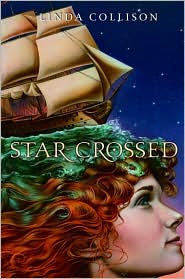
Star-Crossed (YA)

Star-Crossed. Linda Collison. 2006. Random House. 416 pages.

I came aboard with the prostitutes the night before the ship set sail. It was a rash scheme, but I was a brash girl with nothing to my name but a promise.

Patricia Kelley, the heroine of Star-Crossed, was a great annoyance to me throughout the book. I wanted to be honest about that from the start. I don't think that you'll necessarily agree with me on that. And I wouldn't be surprised if others liked this one a lot more than I did.

Some people might not find a stupid clueless heroine such an annoyance. (Star-Crossed reminded me of Emma's Harriet.)

Our heroine is the illegitimate daughter of a gentleman who owns a sugar plantation in Barbados. Perhaps her impressions of her father have been 'helped' by the distance between them, perhaps her impression of him remains what it was when she was still six years old and living at the plantation where she was born. She's spent ten of her sixteen years away at a boarding school in the English countryside for 'gentlemen's daughters.' She believes with all her heart that this school is only for the very, very, finest young ladies. (I'm not completely convinced.) She seems to have complete confidence in the fact that she--the daughter who does not even bear his name--will inherit the plantation. You see, she's learned that her father has died. And she's convinced that if she can just go herself to Barbados, to the plantation, then NATURALLY, everything will go her way.

Not having any money or any friends, she resorts to disguising herself as a prostitute and going on board the merchant ship destined for the West Indies. She's discovered, as might be expected, by a sailor, Brian Dalton, who befriends her. But it is only the fact that she is saved by Dr. MacPherson that keeps her on board after their first stop--for either the captain or the owner--not quite sure which--is very angry to have a stowaway. MacPherson agrees to pay for her passage if she'll be his 'loblolly boy.' She agrees. During the day, she's his assistant. At night--in the early morning hours--she sneaks out of the cabin to find Dalton. He's a most kissable boy when no one is around to see her questionable behavior. She decides she likes some aspects of living at sea. She likes dressing as a boy and playing at doing the work of a sailor--when it's convenient, when there's a cute guy around, etc. BUT for the first third of the novel, she's living in a fantasy world where arriving in Barbados will make her every dream come true. It's not that no one on board is asking her exactly what her plan is, for they all seem to be living in the real world, it's just that our heroine insists that she doesn't need a plan to get what is hers.

Can you predict where this one's going? Maybe that was one of the issues I had with it. Maybe it's an issue you won't have. I could see a few things happening very early on. I could predict what was NOT going to happen at Barbados. And I could predict precisely what was going to happen when it came to the 'romance.'

Another issue I had with this one is that I kept having shouting matches at the heroine. It was SO VERY EASY to shout at her. Not that it did any good. It didn't make her any smarter. It didn't make her have even a little common sense. But I felt better while I was reading it.

So. I didn't hate this one exactly. It could have been MUCH worse. For one, if it had been an adult romance novel, it probably would have included attempted rape/rape scenes. And the doctor would have offered "protection" from other men on the ship--at a cost. So. At least this book wasn't predictable in that way. It was historical adventure with romantic elements. (I didn't find the romantic story enjoyable, but other readers may.) The heroine rather reluctantly perhaps becomes a spunky adventurer/sailor. If the heroine becomes independent and free-thinking by the end of the novel, it is more by chance than design. Well, I'm not sure if that is exactly true. She may just have become better at it. While it's true I didn't like the heroine, I did like some of the minor characters, or the minor-minor characters. (There were some characters that were only in one chapter that I liked better than some of the regulars.)

S
P
O
I
L
E
R

ABOUT

THE

R
O
M
A
N
C
E

So when our heroine returns to the ship actually shocked and devastated by the fact that she is NOT a plantation owner and that she has absolutely nothing to inherit; no money of her own, no place to live, no place to go, etc. She's "comforted" perhaps by two men who love her: Dalton, the boy she just LOVES to make out with. And Dr. MacPherson, a man she has no interest in making out with. Can you guess which one she chooses? Can you guess why?

Our heroine is the illegitimate daughter of a "gentleman" with massive amounts of debts and reckless gambling habits. (Her father also had other illegitimate children. Not that she knew that before she arrived to learn 'the truth.') She has such a high opinion of herself, of her place in society, never doubting FOR ONE LITTLE SECOND that she belongs to the highest ranks of society, never doubting that she is so very very superior to everyone else because her father was a gentleman. She can't understand the basic facts of the case. She is illegitimate. She doesn't share her father's name. Their relationship may have been understood in some circles, and she may been treated fairly well at that boarding school in the country. But a country boarding school isn't exactly London society. You can't very well put on your calling card, illegitimate daughter of Mr. So-and-So. The very fact that she was illegitimate would probably keep her out of the best circles in society. Add to the fact that she has NO MONEY AT ALL. Who in the world would accept a penniless illegitimate daughter into their society? Who would marry her? Who of "her class" would marry her? With NO money and no social connections? Who would "sponsor" her into society at all? Who would "introduce" her into society?

So when she rejects Dalton BECAUSE he is her INFERIOR. Well, it irritated me. Not because I liked Dalton. Not because I preferred him to Dr. MacPherson. Not because Dalton had any personality to him at all. What annoyed me was the why behind it. He's not good enough for her. He is not of her class. She thinks he's DREAMY. She loves to kiss him. She loves to daydream about him. BUT. He's just not quality enough for her. It would be one thing if she was equally attracted to the doctor. But she isn't.

The truth? She's so stuck on herself being somebody big-and-important (even though there's no basis in reality to back this up) that she doesn't see that she doesn't have money, she has no place to call home, she has no way of earning money and THEREFORE it doesn't matter "who" she is. Whether she wants a new beginning or not, she's got one. She could CHOOSE to be with the man she loves best and no one would think a thing of it. There is no society that she belongs to at the moment that would judge her or could judge her. She may think she's the center of the universe, but she's not.

So she chooses who she chooses. And, if I'm being honest, I do actually like Dr. MacPherson. (I think our heroine is not good enough for him. I think he deserved much, much, much better.) The middle section of the novel focuses on her marriage to the doctor. We see her grow--or supposedly grow--into a competent nurse or surgeon mate. I don't know if she grows in intelligence as she matures, but, there are less opportunities for her to be stupid. And, to give her the benefit of the doubt, she could be quite a bit smarter from when we first met her.

The third section of the novel is what happens after her husband dies...how she becomes 'a man' and goes to see as a surgeon mate....and you can guess who she accidentally meets....and how that develops....


© 2011 Becky Laney of Becky's Book Reviews


A Brief History of Montmaray (YA)

A Brief History of Montmaray. Michelle Cooper. 2009. Random House. 304 pages.

23rd October 1936
Dear Sophie,
Happy birthday to my favorite little sister! I've been trying to recollect the day you were born so I can gush about it in an appropriately sentimental fashion, but I'm afraid it's all a blank.

Sophie FitzOsborne lives an isolated life with her younger sister, Henry, her cousin Veronica, and her mad-uncle John who happens to be King. Except for a handful of villagers and/or servants that make up the "kingdom" of Montmaray, they are the island's only residents. (Toby, her brother, and Simon, the housekeeper's son, being away in England for most of the novel.) But they may not stay isolated for long. The year is 1936, and for whatever reason--bad luck, bad timing, whatever--the Germans have become interested in the island-kingdom. Small though it may be, there is a library in the castle that one or two visiting Germans would just LOVE, LOVE, LOVE to be allowed to explore. But with mad-uncle John still incredibly, fiercely angry at the Germans because of The Great War, the two girls (Sophie and Veronica) dare not let them near the castle. For who knows what King John would do if he discovered Germans on HIS island.

Sophie, our young heroine, is coming of age at an increasingly dangerous time. Plenty of tension and conflict when it comes to European politics and the like. And of course, there is the every day drama of growing up. Should Sophie accept her aunt's invitation to "a season" in London? Should Sophie leave her island home for a big, grand adventure in the city? Her aunt's invitation included Veronica as well. But Sophie knows it would take a LOT of convincing to get Veronica off the island. Because she is VERY VERY busy writing a "Brief History of Montmaray." Sophie may just discover that "love" is a tricky business too.

Historical fiction with plenty of mystery--lies, secrets, murder!

I very much enjoyed Michelle Cooper's A Brief History of Montomaray. I can't wait to begin the sequel, The FitzOsbornes in Exile, which was released this month.


© 2011 Becky Laney of Becky's Book Reviews


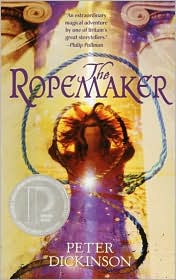
The Ropemaker (MG/YA)

The Ropemaker. Peter Dickinson. 2001. Random House. 384 pages.

It had snowed in the night. Tilja knew this before she woke, and waking she remembered how she knew. Somewhere between dream and dream a hand had shaken her shoulder and she'd heard Ma's whisper.

The Ropemaker reminded me of all the reasons I love reading fantasy. Did I love it? I didn't want it to end! I wanted to savor every moment of it. Why? Well, because I loved not only the characters, not only the story, but the world Peter Dickinson created! My favorite character happens to be our heroine, Tilja.

Tilja's valley has almost always--twenty generations--been protected by magic. Protected from its neighbors--those who would love to tax, tax, tax in the name of "providing protection" and those who would invade and plunder and conquer. There is a story passed down through the generations--a story some scarcely believe these days--about how the valley came to be protected. A story about two people on a quest for a magician named Asarta. We learn this story in chapter two. Here is how it starts:

There was time in the Valley, of course--how could there not be? But there was no history. In all the rich farmland between the northern mountains and the forest there were no wars, or reports of wars, only days, seasons, generations. No kings or other rulers, only parents, grandparents, ancestors. For eighteen generations nothing had happened in the Valley that anyone would have thought worth putting in a book, or setting up a memorial stone to record. So, no history. Only time. And the story of Asarta. (17)

Did I mention I love the writing?! Well, I did!!! Anyway, Tilja, our unlikely heroine, joins three others on a quest to "save" the magic that protects them. For they know the magic is fading, that soon unwelcome guests might invade--when they realize the truth. So Tilja and her grandmother, Meena, and Tahl, and his grandfather, Alnor, set out on a dangerous and uncertain journey. Their quest is to find the magician, Faheel, the magician who first helped the Valley all those generations ago. Is he still alive? Can he be found? Does he want to be found? Will he help them? Can he help them? Has his powers grown stronger or weaker through the years?

The Ropemaker is about their journey, their quest, as they face countless dangers, as they meet many, many people along the way. This journey will require them to be wise and courageous and diligent. To protect the Valley, to protect their families, their homes, their villages, they may have to risk it all.

I enjoyed this one very much! I'd definitely recommend it.

© 2011 Becky Laney of Becky's Book Reviews


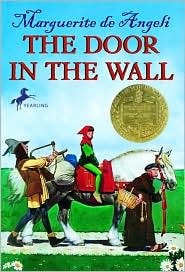
The Door in the Wall (MG)

The Door in the Wall. Marguerite de Angeli. 1949/1990. Random House. 128 pages.

Robin drew the coverlet close about his head and turned his face to the wall. He covered his ears and shut his eyes, for the sound of the bells was deafening. All the bells of London were ringing the hour of Nones. St. Mary le Bow was nearest, St. Swithin's was close by, and not far away stood great St. Paul's. There were half-a-dozen others within soun, each clamoring to be heard. It seemed to Robin as if they were all inside his head screaming to be let out. Tears of vexation started to his eyes, but he held them back, for he remembered that a brave and "gentil" knight does not cry.

This is my first time reading this Newbery winner. It's not a title I would have been drawn to as a kid, much like Adam of the Road, but I am glad I read it as an adult.

Robin, our hero, is all alone. His father is fighting in a war; his mother called to serve the queen. He was supposed to become a page and begin his training to be a knight, but, an illness left him weak, unable to stand or walk. A compassionate monk, Brother Luke, saves him from an uncertain (at best) fate--for his caretaker, his nurse, falls ill with the plague. Robin begins to heal and begins to learn. He learns to read and write. He is strengthened by swimming. And then there's the whittling. (Exciting stuff.) The book chronicles his journey through these dark and sometimes dangerous times. Readers get a glimpse of the Middle Ages.

The Door in the Wall is a pleasant enough read. While I didn't find it the most thrilling book ever, not even the most thrilling book ever set during the Middle Ages, I didn't find it painful either. There are worse ways to spend an afternoon.

You might also be interested in: Adam of the Road, Crispin: The Cross of Lead, Crispin: At The Edge of the World, Crispin: The End of Time. Not to mention Good Masters! Sweet Ladies! Voices from a Medieval Village by Laura Amy Schiltz.

© 2011 Becky Laney of Becky's Book Reviews


Inside Grandad (MG)

Inside Grandad. Peter Dickinson. 2004. Random House. 128 pages.

Gavin and Grandad were fishing for mackerel from the harbor wall when the seal popped its head out of the water. 

Gavin loved his Grandad very much. Grandad is the one who takes care of him; Gran works; his mom works; his dad is gone most of the time. The two are very close. They enjoy doing many things together. They like to fish. They like to build model boats. One day the two are busy at work on a model boat, a boat that Gavin has just decided to name Selkie, when his Grandad has a stroke. The doctors say that Grandad has had a stroke. No one knows how much of a recovery he'll make. It's too soon to say. He's still in a coma.

The novel focuses on how this effects Gavin. He's scared. He's worried. He's anxious. He wants to be at the hospital by his Grandad's side, holding his hand; and yet, he doesn't. He wants to be the one to reach him. He wants to be the one to talk to him, to read to him, to hold his hand, to be there for him. Yet, it seems too much to handle.
At some point, Gavin becomes convinced that selkies may hold the answer. His grandad always said they could help you when you were in need. And that's where this novel becomes a little weird, a little magical.

I didn't care for the selkie twist in this one. Not really. I mean I think some readers will enjoy that aspect of it. But I could have done without it.

So do I like this one? Yes, for the most part. I didn't love it. But I don't need to love everything I read.

© 2011 Becky Laney of Becky's Book Reviews


A Red Herring Without Mustard

A Red Herring Without Mustard: A Flavia de Luce Novel. Alan Bradley. 2011. Random House. 399 pages.

"You frighten me," the Gypsy said. "Never have I seen my crystal ball so filled with darkness."

Flavia de Luce stars in her third novel in Alan Bradley's A Red Herring Without Mustard. Her first adventures can be found in Sweetness at the Bottom of the Pie and The Weed That Strings The Hangman's Bag. Did I love it? Did I find it delightful? Yes and yes! I am still loving the writing, the characterization, the descriptions, the pacing. There are just so many things to love!

After accidentally setting the gypsy's tent on fire after a fortune-telling reading goes awry, Flavia invites the gypsy woman to camp at the Palings--though she knows her father would disapprove. She does her best to make amends with the woman, but the woman's bad luck continues for someone tries to murder her that very night! Fortunately, Flavia de Luce discovers her in time, but that's only the start of the mysterious doings. Truth is Flavia is finding much to keep her busy. (And when she does have a spare moment or two, she's contemplating revenge on her two older sisters.)

I would definitely recommend this series!

Some of my favorite quotes:

"Spare us the pout. There's enough lip in the world without you adding to it." (27)

I had already learned that sisterhood, like Loch Ness, has things that lurk unseen beneath the surface, but I think it was only now that I realized that of all the invisible strings that tied the three of us together, the dark ones were the strongest. (41)

Alone at last! Whenever I'm with other people, part of me shrinks a little. Only when I am alone can I fully enjoy my own company. (102)

When I come to write my autobiography, I must remember to record the fact that a chicken-wire fence can be scaled by a girl in bare feet, but only by one who is willing to suffer the tortures of the damned to satisfy her curiosity. (142)

I had long ago discovered that when a word or formula refused to come to mind, the best thing for it was to think of something else: tigers, for instance, or oatmeal. Then, when the fugitive word was least expecting it, I would suddenly turn the full blaze of my attention back onto it, catching the culprit in the beam of my mental torch before it could sneak off again into the darkness.
"Thought-stalking," I called the technique, and I was proud of myself for having invented it. (180)

Nursery rhyme riddles had been as much a part of my younger years as they had anyone else's. I suppose it was these little rhymes, learned at an early age, that taught me to be good at puzzles. I've recently come to the conclusion that the nursery rhyme riddle is the most basic form of the detective story. It's mystery stripped of all but the essential facts. (207)


© 2011 Becky Laney of Becky's Book Reviews


Jane Goes Batty

Jane Goes Batty. Michael Thomas Ford. 2011. Random House. 304 pages.

"Not again."

Jane Goes Batty is the sequel to Jane Bites Back. The premise is simple (and fun): what if Jane Austen were a vampire? Where would she be living? What would she be doing? What would she think of this 'modern' world? What would she think of the Twilight books? Jane Fairfax knows the answer because she is Jane Austen. True, most folks know her as the owner of an independent book store. And more are getting to know her as the newly published author of Constance. But only a few know her true identity. One, Lucy, is her closest friend. The second, the man who turned her, none other than Lord Byron! (And then there's Our Gloomy Friend. She too knows about Byron and Austen and their new lives as modern writers.)

In the second novel, Jane is struggling with writer's block. Now that her "first" novel, Constance is a success, now that it is being adapted into a movie, she's expected to be hard at work on a second novel. But. Jane finds herself unable to write coherently. Is she distracted by her boyfriend, Walter? Perhaps. Is it worry about his mother coming to town? That she is expecting Jane to convert to Judaism? Could be. Is it anxiety that Walter is thinking of marriage?! That certainly plays a large part in her anxiety. For the question then becomes should she or shouldn't she--tell him the truth. Which would he find harder to believe? The fact that she's a vampire? Or the fact that she's Jane Austen?

I loved the humor and the drama. It's just very clever. I especially liked the scenes about the movie. How it is being "adapted." I loved the references to Twilight too! Very funny! It's just great fun to read these books!

Byron laughed, earning him another fierce look from Jane. "Literature has always been spectacle," he said. "Do you really think we held all those literary salons so that we could exchange ideas? Of course not. It was so we could gossip about everyone who wasn't there. And don't you remember how James Joyce used to wander through Paris mumbling nonsense words until people recognized him?"
He cleared his throat and in perfect imitation of Joyce's impish Irish brogue said, "Spifflepond puppetdingle griffintide! Woozlewoozle crumpetpeal dirf! Why yes, I am James Joyce. You enjoyed Ulysses? Bless you, madam. Bless you." (3)
"Does Walter want children?" Kelly asked.
The question took Jane by surprise. "I don't know," she said. "We've never discussed it. But it really doesn't matter. I'm far too old for that sort of thing."
"You aren't," Kelly said. "They can do wonderful things with in vitro these days. A friend of ours is pregnant for the first time at forty-seven. With twins. Can you imagine?"
Jane did imagine it. And she was horrified. It had never occurred to her that Walter might want children. She wasn't even sure she could have children. Of course, the girl in the Twilight books did, she mused.
"You know I'm joking," Kelly said after Jane had been silent for some time.
"Of course," said Jane. "I was just trying to imagine going to my child's graduation at the age of two hundred and fifty-three." (47)

© 2011 Becky Laney of Becky's Book Reviews


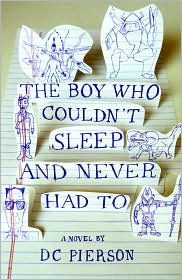
The Boy Who Couldn't Sleep and Never Had To

The Boy Who Couldn't Sleep and Never Had To. DC Pierson. 2010. Random House. 240 pages.

From the prologue: All the newspapers and TV pundits are calling this fall's freshman college class the "Symnitol Generation," but if the activity up and down my dorm hallway is any indication, this fall's freshman college class is the "Stand Around Each Other's Laptops and Play the First Thirty Seconds Of Every Song on the Hard Drive Generation." The noise makes it hard to sit and write this but not impossible.

From chapter one: I've got a system to keep people from seeing what I'm drawing.

I can't say I loved The Boy Who Couldn't Sleep And Never Had To. But I can say it was an interesting read: a coming-of-age novel with a science fiction twist. Our narrator, Darren Bennett, was a loner, a young guy trying to keep his life private. Not wanting anyone to know just how seriously he took his drawing, his stories. But then he meets Eric Lederer, a guy with an even bigger secret to keep, and it just happens that he shares his vision. The two begin working on the project together--creating stories and characters, outlining movies and books, etc. And the two become best friends. Even though Eric doesn't love everything about Darren--his bullying brothers, for example, and his friend's obsession with "his thing." And Darren doesn't love everything about Eric--his friend's reluctance to explore "his thing," and his way of disappearing for a day or two each month. What is Eric's "thing"? Well, it's what the call Eric's big secret: the fact that Eric doesn't ever sleep. He doesn't have to sleep. He has never slept in his entire life. Darren isn't the first person Eric's ever told. But he is the first person who has believed him. And he's the first person to become obsessed with it, to view it as a "super-power." But what Darren fails to realize is just how heavy a burden this "power" is for his friend.

As I said, it's a coming of age novel, so expect angst and rivalry. For what could separate these two friends? Could it be a girl? a drama queen?!

The Boy Who Couldn't Sleep And Never Had To has its moments. I enjoyed quite a few scenes in this one. But--for me--it wasn't quite love. The book had its light moments, its funny moments, it's social commentary. But. I had a hard time believing in the science fiction elements of this one. In Eric's power and ability. And the last third of the novel had me a bit confused--what was real? what was imagined? is Darren reliable as a narrator? are we supposed to like Darren? I do think other readers might like it more than I did.

© 2011 Becky Laney of Becky's Book Reviews


Backtracked (YA)

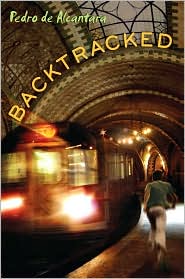
Backtracked. Pedro de Alcantara. 2009. Random House. 272 pages.

By the day I was born, April 3, 1990, I had already lived several lives. But I didn't learn about them until Tuesday, February 28, 2006. This is how it happened.

Backtracked is not a perfect novel. But. I enjoyed it for what it was. Tommy Latrella, our hero, isn't perfect and he knows it. He is TIRED of every one in his life comparing him to his older brother, Jimmy. His brother died a hero in 9/11.

Tommy has never felt like a hero. Not once. But. The subway system might just change all that by giving him three chances to be just that: a hero.

His first stop will see Tommy living in the tenements in 1918; the second stop will see Tommy living in Hooverville--before becoming employed by the Mafia--in 1932; the third stop will see Tommy training to fight in a war he's only read about in textbooks: World War II. Tommy does not control the time travel. The portal seems to change each time. In moments of crisis--great crisis--he goes backwards and forwards in time.

Backtracked is set in New York with a focus on Italian immigrants--Italian communities--in four turbulent decades. The novel is a bit uneven, perhaps, but I liked it all the same. Tommy's decisions aren't always the best decisions--and he can be difficult to relate to at times--but I always wanted to know what happened next. I was interested in these stories, these time periods.

© 2011 Becky Laney of Becky's Book Reviews


Dash & Lily's Book of Dares (YA)

Dash & Lily's Book of Dares. Rachel Cohn & David Levithan. 2010. [October 2010] Random House. 272 pages.

Imagine this: You're in your favorite bookstore, scanning the shelves. You get to the section where a favorite author's books reside, and there, nestled in comfortably between the incredibly familiar spines, sits a red notebook. 
What do you do?
The choice, I think, is obvious:
You take down the red notebook and open it.
And then you do whatever it tells you to do.

Dash and Lily are strangers when the novel begins, but they won't be strangers for long. For Dash--snarls and all--is up to the challenge Lily has presented, for the red notebook is hers. Her brother, Langston, wants her to find love, or maybe he just wants to keep Lily distracted this Christmas vacation, so he can have more alone time with his boyfriend. Their parents are out of town. Dash's parents are out of town as well. His mom with her new boyfriend; his dad with his new girlfriend. Dash and Lily take turns with the notebook, challenging each other to do things. The notebook binds them together. They are getting to know one another through their words. (It's fortunate Lily has a LARGE family.) But should these two meet up in real life?

Alternating chapters--it's narrated by both Dash and Lily--reveal this whirlwind friendship set in New York City during Christmas vacation. Dash hates Christmas. Lily loves Christmas. But though these two have their differences--their different outlooks and perspectives--they have plenty in common. This red notebook is a fun distraction, but it is also good at revealing the character's vulnerabilities. Lily learns more about herself through this experience as does Dash. They learn that writing can be very enlightening, and that words have power.

This book is the third collaboration between Rachel Cohn and David Levithan. And it is by far my favorite of the three. (I did not care for Nick & Norah's Infinite Playlist or Naomi and Ely's No Kiss List.) I thought it was well written. There were elements of this one that I just loved. A few scenes that had me laughing out loud in the middle of the night. But as much as I enjoyed it--I didn't love it. I liked it. I really liked it.

© 2011 Becky Laney of Becky's Book Reviews


The Scorch Trials (YA)

The Scorch Trials. James Dashner. 2010. Random House. 368 pages.

She spoke to him before the world fell apart.

The Scorch Trials is the sequel to The Maze Runner. Thomas and the other Gladers thought the game was over. They thought they had beat the system. They thought they had been rescued. They certainly celebrated that victory. But the opening chapters of The Scorch Trials reveal that the games have just begun. Thomas and his friends will have to survive a second phase of testing in order to be "cured" of the disease that they've just recently learned they have. (Confused? Well, it's meant to be mysterious.)

What is Thomas' role in all of this? What clues to the present danger can be revealed in his dreams--his memories--of the past? And what about Teresa? The woman whom he can communicate with telepathically? Is she to be trusted? Or is she a betrayer?

The Scorch Trials was certainly an intense read. Very suspenseful. Very mysterious. It kept me guessing. I certainly didn't predict where this one was going.

I would recommend these to fans of The Hunger Games trilogy and the Chaos Walking Trilogy.

© Becky Laney of Becky's Book Reviews


The Weed That Strings The Hangman's Bag

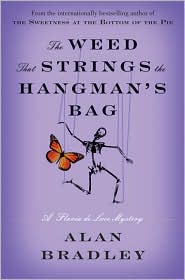
The Weed That Strings The Hangman's Bag. (Flavia de Luce #2). Alan Bradley. 2010. Random House. 364 pages.

I was lying dead in the churchyard. An hour had crept by since the mourners had said their last sad farewells.

I liked Sweetness at the Bottom of the Pie. I did. But as much as I liked it, as charming as I found it, it wasn't quite love.

I LOVED the second novel in the series, The Weed That Strings the Hangman's Bag. I just LOVED it. Flavia is still Flavia. She's still eleven. She's still hating her sisters--but to be fair, they hated her first. She's still to be found in her chemistry lab doing experiments and uncovering the mysteries of poisons--that is when she's not out uncovering the town's secrets on Gladys, her bicycle, and breaking into the library's storage shed where old newspapers are kept.

The mystery begins with Flavia coming across a damsel in distress--a woman crying in the churchyard. This stranger, Nialla, is the assistant to the 'famous' puppeteer, Rupert Porson. The two were traveling the country in their van when it broke down. To earn the money needed to repair it, they agree to do two shows for the community. Performances of Jack and the Beanstalk. The first performance? Wonderful! Couldn't have gone any better. The second? Well, let's just say that it's a show no one will forget. It ends with the police questioning them all!

But as Flavia soon discovers, this isn't Rupert's first trip to town. And discovering his shady past--within the community--may just solve the mystery of who murdered him.

I loved this one. I loved the writing, the style. The descriptions, the details, were great.

"She was prattling. If I kept quiet, it wouldn't be more than a minute before she would be confiding her size in knickers." (20)

"Of the many phrases that came to mind to describe Cynthia Richardson, "good sport," was not among them; "ogress," however was." (30)

Here is Flavia's description of one of the musical "treats" before the show--both performed by church members.
Miss Lavinia, her eyes riveted to the music, was into "Napoleon's Last Charge," and I noticed for the first time that, as she read the music, her lips were moving. I couldn't help wondering what she was saying. There were no lyrics to the piece--could she be naming the chords? Or praying? Mercifully, she took it at a somewhat faster gallop than usual, and the thing was soon over--at least relatively speaking. (147)
Flavia on being eleven.
"You are unreliable, Flavia," he said. "Utterly unreliable."
Of course I was! It was one of the things I loved most about myself.
Eleven-year-olds are supposed to be unreliable. We're past the age of being poppets: the age where people bend over and poke us in the tum with their fingers and make idiotic noises that sound like "boof-boof"--just the thought of which is enough to make me bring up my Bovril. And yet we're still not at the age where anyone ever mistakes us for a grown-up. The fact is, we're invisible--except when we choose not to be. (112)
Alan Bradley is great at developing characters within a community. There are some eccentric people in this one! But it's got heart and soul too! I loved Flavia! I loved her spirit. I loved her intelligence, her curiosity. I would definitely recommend it!

© Becky Laney of Becky's Book Reviews


Blackout

Blackout. Connie Willis. 2010. Random House. 512 pages.

Oxford--April 2060
Colin tried the door, but it was locked.

How does Blackout compare to Doomsday Book and To Say Nothing of the Dog? Well. I'm not sure they can. While both books are about time traveling historians, there's an intensity to this one that can't quite be put into words. Not in a way that would do it justice.

In, Doomsday Book, it gets intense. Bad things are happening. And there's a mystery to be solved. There are unknowns, yes, but you see people hard at work solving the problem. Trying to at least. There's this urgency. Dunworthy is ever-anxious to save Kivrin--with a little help from Colin, of course.

Blackout is more of a mystery. The silence of those stories that are not being told weighs on the reader. At least this reader.

Let's start with what we do know. Blackout tells the story of three historians working on World War II. There's Merope Ward who is "Eileen" on this assignment. She's observing children evacuees. There's Polly Churchhill who is "Polly Sebastian" on this assignment. She's covering the first weeks of the London blitz, working as a shop girl on Oxford Street by day. There's Michael Davies (Mike) who is covering Dover, he's posing as an American reporter covering the Dunkirk evacuation. These three historians--working undercover, of course--are not supposed to have met. For their assignments were not supposed to overlap.

But. One after another these historians learn that their drops are not working. Each expecting a retrieval team at any moment to "rescue" them, to send them home back to where they belong. But no retrieval teams arrive. And each becomes increasingly alarmed. Why aren't the drops working? Is the Net down? But even if the Net was down, this is time travel, it wouldn't effect when they were rescued, right? Is the Net not working because they've changed history? That's supposed to be impossible. Historians (time-travelers) cannot change history. But what if it is possible? What if they have changed history? Why isn't Mr. Dunworthy sending anyone to help them? Where is Colin in all this? Do they even know that these historians are trapped?

Can three historians survive World War II?

Blackout captures the uncertainty, the anxiety, the frustrations of a war-time England. It's compelling, impossible to put down. But. it isn't quite as satisfying as Doomsday Book and To Say Nothing of the Dog because it's incomplete. This is only half the story. All Clear--published this October--completes the story.

© Becky Laney of Becky's Book Reviews


Maze Runner (YA)

The Maze Runner. James Dashner. 2009. Random House. 384 pages.

He began his new life standing up, surrounded by cold darkness and stale, dusty air.

The Maze Runner is certainly compelling--very suspenseful. It's an action-packed dystopian novel. Thomas, our narrator, awakes to find his memory gone. He knows his first name. Nothing more. He's in a strange place. But he's not alone. There are others like him. Others his own age. Others whose memories have been erased--they call themselves the Gladers. They've got a system in place. A system that seems to be working. For the most part. Still there are plenty of creepy things about his new life. There are rules to learn. And while they are forthcoming with the rules--they're not always good at explaining to Thomas why these rules are in place. Can Thomas find the answers he so desperately wants?

I enjoyed The Maze Runner. It is very intense, very exciting, very mysterious. Readers--like Thomas--don't have all the answers by the end of the book. There is a second novel in this series, The Scorch Trials, which releases in October.

© Becky Laney of Becky's Book Reviews


Twitter Delicious Facebook Digg Favorites More