Showing posts with label brothers and/or sisters. Show all posts

Five Children and It (MG)

Five Children and It. E. Nesbit. 1902/2004. Puffin Classics. 240 pages.

The house was three miles from the station, but before the dusty hired fly had rattled along for five minutes the children began to put their heads out of the carriage window and to say, 'Aren't we nearly there?' And every time they passed a house, which was not very often, they all said, 'Oh, is this it?' But it never was, till they reached the very top of the hill, just past the chalk-quarry and before you come to the gravel-pit. And then there was a white house with a green garden and an orchard beyond, and mother said, 'Here we are!'

It has been almost two years since I first discovered E. Nesbit. Five Children and It was the very first of her novels that I read, and it was definitely LOVE from the very beginning.

The five children are Robert, Cyril, Anthea, Jane, and Lamb. The 'it' is a sand fairy--a Psammead. The four children discover him one day during their summer vacation while they're digging in a nearby sand pit. They're quite delighted to learn that he can grant wishes. Though it's easy for anyone to see that he doesn't like granting wishes all that much. Still, the children are happy to think of one wish after another after another. A wish per day is what they're allowed. And oh the wishes they think up!!! But it doesn't take them very long to realize that they're not all that smart and clever with those wishes. For almost every day their wish leads them into TROUBLE. If wishing leads to trouble, why wish for anything? Well, even bad wishes make for a way to spend the day.

This book is so much fun! Just a delight to spend time with these characters. I'd definitely recommend it!

My favorite quotes:
Grown-up people find it very difficult to believe really wonderful things, unless they have what they call proof. But children will believe almost anything, and grown-ups know this. That is why they tell you that the earth is round like an orange, when you can see perfectly well that it is flat and lumpy; and why they say that the earth goes round the sun, when you can see for yourself any day that the sun gets up in the morning and goes to bed at night like a good sun as it is, and the earth knows its place, and lies as still as a mouse. (5)

I daresay you have often thought what you would do if you had three wishes given you, and have despised the old man and his wife in the black-pudding story, and felt certain that if you had the chance you could think of three really useful wishes without a moment's hesitation. These children had often talked this matter over, but, now the chance had come suddenly to them, they could not make up their minds. (17)

But the happening of strange things, even if they are not completely pleasant things, is more amusing than those times when nothing happens but meals, and they are not always completely pleasant, especially on the days when it is cold mutton or hash. (54)

Lending ears was common in Roman times, as we learn from Shakespeare; but I fear I am getting too instructive. (59)

When the frock was darned, the start for the gravel-pit was delayed by Martha's insisting on everybody's washing its hands -- which was nonsense, because nobody had been doing anything at all, except Jane, and how can you get dirty doing nothing? That is a difficult question, and I cannot answer it on paper. In real life I could very soon show you -- or you me, which is much more likely. (59)

It is very wise to let children choose exactly what they like, because they are very foolish and inexperienced, and sometimes they will choose a really instructive thing without meaning to. (85)

The people who decide what the weather is to be, and put its orders down for it in the newspaper every morning, said afterwards that it was the hottest day there had been for years. They had ordered it to be 'warmer -- some showers', and warmer it certainly was. In fact it was so busy being warmer that it had no time to attend to the order about showers, so there weren't any. (86)

'I was always generous from a child,' said the Sand-fairy. 'I've spent the whole of my waking hours in giving. But one thing I won't give --that's advice.'
'You see,' Anthea went on, 'it's such a wonderful thing -- such a splendid, glorious chance. It's so good and kind and dear of you to give us our wishes, and it seems such a pity it should all be wasted just because we are too silly to know what to wish for.'
Anthea had meant to say that -- and she had not wanted to say it before the others. It's one thing to say you're silly, and quite another to say that other people are.
'Child,' said the Sand-fairy sleepily, 'I can only advise you to think before you speak--'
'But I thought you never gave advice.'
'That piece doesn't count,' it said. 'You'll never take it! Besides it's not original. It's in all the copybooks.' (89-90)

© 2011 Becky Laney of Becky's Book Reviews


From the Mixed-Up Files of Mrs. Basil E. Frankweiler

From the Mixed-Up Files of Mrs. Basil E. Frankweiler. E. L. Konigsburg. 1967. Simon & Schuster. 162 pages.


Claudia knew that she could never pull off the old-fashioned kind of running away. That is, running away in the heat of anger with a knapsack on her back. She didn't like discomfort; even picnics were untidy and inconvenient: all those insects and the sun melting the icing on the cupcakes. Therefore, she decided that her leaving home would not be just running from somewhere but would be running to somewhere. To a large place, a comfortable place, an indoor place, and preferably a beautiful place. And that's why she decided upon the Metropolitan Museum of Art in New York City.

Claudia Kincaid, our heroine, wants to run away, but she knows she can't do it alone so she recruits her younger brother, Jamie, to go with her. He may just be her favorite brother, and he's definitely her richest brother. Their plan is successful...and they do manage to have quite the adventure.

I really, really liked this one. I thought it was great fun. I loved Claudia. I loved Jamie. I loved the writing of this one. I loved the way we got to know the characters. This brother-sister relationship is done so well. I love that I can relate to both Claudia and Jamie. While we don't get to know anything really about the rest of the Kincaid family--about the parents, about the other kids, we do get to know these two very, very well! Which was enough for me!

Here is one of my favorite scenes between the two:
Upon their return to the museum, Claudia informed Jamie that they should take advantage of the wonderful opportunity they had to learn and to study. No other children in all the world since the world began had had such an opportunity. So she set forth for herself and for her brother the task of learning everything about the museum. One thing at a time. (Claudia probably didn't realize that the museum has over 365,000 works of art. Even if she had, she could not have been convinced that learning everything about everything was not possible; her ambitions were as enormous and as multi-directional as the museum itself.) Every day they would pick a different gallery about which they would learn everything. He could pick first. She would pick second; he third; and so on. Just like the television schedule at home. Jamie considered learning something every day outrageous. It was not only outrageous; it was unnecessary. Claudia simply did not know how to escape. He thought he would put a quick end to this part of their runaway career. He chose the galleries of the Italian Renaissance. He didn't even know what the Renaissance was except that it sounded important and there seemed to be an awful lot of it. He figured that Claudia would soon give up in despair.
When she gave Jamie first pick, Claudia had been certain that he would choose Arms and Armor. She herself found these interesting. There was probably two days' worth of learning there. Perhaps, she might even choose the same on the second day. (47)
Jamie's choice of the Italian Renaissance leads them on their biggest adventure yet. It leads them to a statue. A statue that may have been done by Michelangelo. A small statue of an angel that they learn was donated by a Mrs. Basil E. Frankweiler. Once they become curious about this statue, once they decide they want to "solve" the mystery, well, that's when their adventure finds a purpose, a dream.

I really loved this one. It was such a great read--very satisfying. I would definitely recommend it.

Happiness is excitement that has found a settling down place, but there is always a little corner that keeps flapping around. (151)

© 2011 Becky Laney of Becky's Book Reviews


The Boxcar Children

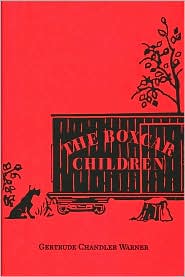
The Boxcar Children. Gertrude Chandler Warner. 1942. 155 pages.

One warm night four children stood in front of a bakery. No one knew them. No one knew where they had come from. The baker's wife saw them first, as they stood looking in at the window of her store. The little boy was looking at the cakes, the big boy was looking at the loaves of bread, and the two girls were looking at the cookies.

Henry, Jessie, Violet, and Benny are orphans. Scared of a grandfather they never met, these children are running away. When the novel opens, they are seeking refuge for the night, asking permission to sleep on the benches of the bakery shop. (They bought bread). After hearing the couple discuss them--on how they should "keep" the three oldest because they would be useful to have around as workers, but how the youngest one would need to go to a Children's Home--Henry and Jessie decide to wake everyone and leave while they still have a chance. They walk most of the night, sleep most of the day. Their journey takes them into the woods, and during a storm, they seek shelter in an abandoned boxcar. It doesn't take the children very long to realize that if a boxcar is good shelter from a storm, it would be a good home for always. There is a town within walking distance so that Henry can find work and buy food. And the rest of the children can do what they can to make it a real home. And that is just what they do...day by day creating a home for themselves.

I liked  The Boxcar Children. I did. I had read it more than a few times growing up, but it had been at least fifteen or twenty years since I'd last read it. It was such a treat to read it again. It's a simple book, in many ways, yet it's got its charms. I liked how these children do make a home for themselves. How they work together as a family. While I wouldn't say that I ever loved this one as much as Mandy or Anne of Green Gables or The Secret Garden, I have definitely always liked it.

© 2011 Becky Laney of Becky's Book Reviews


A Brief History of Montmaray (YA)

A Brief History of Montmaray. Michelle Cooper. 2009. Random House. 304 pages.

23rd October 1936
Dear Sophie,
Happy birthday to my favorite little sister! I've been trying to recollect the day you were born so I can gush about it in an appropriately sentimental fashion, but I'm afraid it's all a blank.

Sophie FitzOsborne lives an isolated life with her younger sister, Henry, her cousin Veronica, and her mad-uncle John who happens to be King. Except for a handful of villagers and/or servants that make up the "kingdom" of Montmaray, they are the island's only residents. (Toby, her brother, and Simon, the housekeeper's son, being away in England for most of the novel.) But they may not stay isolated for long. The year is 1936, and for whatever reason--bad luck, bad timing, whatever--the Germans have become interested in the island-kingdom. Small though it may be, there is a library in the castle that one or two visiting Germans would just LOVE, LOVE, LOVE to be allowed to explore. But with mad-uncle John still incredibly, fiercely angry at the Germans because of The Great War, the two girls (Sophie and Veronica) dare not let them near the castle. For who knows what King John would do if he discovered Germans on HIS island.

Sophie, our young heroine, is coming of age at an increasingly dangerous time. Plenty of tension and conflict when it comes to European politics and the like. And of course, there is the every day drama of growing up. Should Sophie accept her aunt's invitation to "a season" in London? Should Sophie leave her island home for a big, grand adventure in the city? Her aunt's invitation included Veronica as well. But Sophie knows it would take a LOT of convincing to get Veronica off the island. Because she is VERY VERY busy writing a "Brief History of Montmaray." Sophie may just discover that "love" is a tricky business too.

Historical fiction with plenty of mystery--lies, secrets, murder!

I very much enjoyed Michelle Cooper's A Brief History of Montomaray. I can't wait to begin the sequel, The FitzOsbornes in Exile, which was released this month.


© 2011 Becky Laney of Becky's Book Reviews


Five Flavors of Dumb (YA)

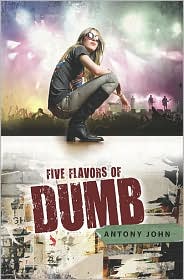
Five Flavors of Dumb. Antony John. 2010. [November 2010] Penguin. 352 pages.

For the record, I wasn't around the day they decided to become Dumb. If I'd been their manager back then I'd have pointed out that the name, while accurate, was not exactly smart. It just encouraged people to question the band's intelligence, maybe even their sanity. And the way I saw it, Dumb didn't have much of it. But they weren't in the mood to be reasoned with. They'd just won Seattle's annual Teen Battle of the Bands, and they were milking their fifteen minutes for all it was worth.

I loved this one. I just loved it. One of the reasons why I loved it so much was the narration. I loved our narrator, Piper. She's a (beautiful) girl who is accustomed to not being heard. Most people--if they notice her at all--notice her for the wrong reasons. Something that will be challenged through the course of the novel. Piper is practically daring people to take notice of her now. For this deaf girl is about to take on a big challenge: she's going to be a manager of a rock band. She's determined to make this band a real band--a band that earns money. But the band, for better or worse, seems to be clashing in all the wrong ways. (Original band members: Tash, Will, and Josh.) In impossible-to-ignore ways. It certainly doesn't help matters that two new band members have joined Dumb since it won the Teen Battle of the Bands (Ed, Kallie). Can Piper do the impossible? Can she be the brains of Dumb?

Another reason I loved Five Flavors of the Dumb was the richness of its characters, the depth of the relationships, particularly family relationships. Piper has complex relationships with her mother, her father, her younger brother, Finn, and her baby sister, Grace. Especially since Grace has just had her cochlear implant turned on. And the operation was paid for with Piper's college fund. So, you can imagine, some of the difficulties Piper is facing as the novel opens.

I also loved how surprising the novel was--for me. I found it warm and satisfying, in all the right places, as the relationships develop and the plot unfolds. But it's more than that. Yes, it's got heart and soul. But it's more than that. It's got humor. It's got drama.

Five Flavors of Dumb is a great coming-of-age story set in Seattle. I'm happy to recommend it!

Winner of the 2011 Schneider Family Teen Book Award.

© 2011 Becky Laney of Becky's Book Reviews


The Last Full Measure (MG/YA)

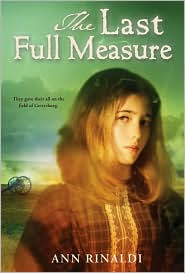
The Last Full Measure. Ann Rinaldi. 2010. [November 2010]. Harcourt. 218 pages.

"Where are you going, Tacy?"

Set in Gettysburg, Pennsylvania in 1863, The Last Full Measure is Ann Rinaldi's latest historical novel. It stars the Stryker family. Our heroine, Tacy, is fourteen. She has two older brothers and a father in the war. But during these troubling summer months, she's going to mature quickly. She'll have to having witnessed some of the atrocities of war. When the novel opens, Tacy's biggest problem is her brother, David, the brother who was unable to join the army because of his bad leg. He has been put in charge of the family; it is his duty to "protect" his mother and his sister, and to look after their home. The responsibility weighs heavily on him, transforming him into a man Tacy can barely recognize. Who is this bossy brother ordering her about? Who is this man that shouts and yells and threatens? Though, perhaps, Tacy needs someone to tell her no--for her own sake.

As the novel progresses, readers get a glimpse of the war, the battle as it unfolds. Readers see the harshness, the devastation, the madness of war. One might think that the battle itself would provide the climax of this one. That its darkest moments would be in the battle itself. But. That's just the beginning. And Tacy's darkest days come after the battle.

I found The Last Full Measure a compelling read. I read it in one sitting, in one afternoon. I enjoyed Tacy as a character. I liked her perspective. How she wasn't above questioning the world around her. And perhaps most importantly, how she wasn't perfect.

But it was a difficult read for me. I reached a point where I was like NO! Are you serious?! Why?! And after that point, it was hard for me to "like" this one. I'm not saying it's not a good book. I'm not saying that it isn't realistic. Or that it isn't well-researched. That it isn't true to the times. But still, it didn't go the way I wanted it to go.

© 2011 Becky Laney of Becky's Book Reviews


The Memory Bank (MG)

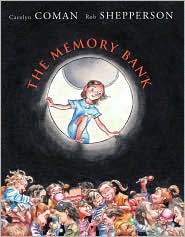
The Memory Bank. Carolyn Coman. Illustrations by Rob Shepperson. 2010. October 2010. Scholastic. 288 pages.

"Don't forget your whistle!" Hope reminded Honey--every morning of every day. Honey needed that whistle, in case of emergency, in case things went terribly wrong. Hope and Honey Scroggins were the closest of sisters, had been right from the start. Truly, they were lucky to love each other so! Not so lucky when it came to their parents, though. Mr. and Mrs. Scroggins were simply awful people.

The Memory Bank is told through words and pictures. (Though not to the extent that The Invention of Hugo Cabret is.) It reminded me--in a way--of several Lois Lowry novels--The Willoughbys and The Giver. It stars a young girl, Hope, who is doing the best she can to cope with incredibly cruel parents. How cruel? One day they leave Hope's younger sister, Honey, on the side of the road. They tell Hope to forget her. And they mean it. Not a word about Honey is allowed. Hope is an only child now. There is nothing good about Mr. and Mrs. Scroggins. Fortunately--for everyone--they enter into the story very little.

For Hope becomes terribly depressed. She stops living life--and starts dreaming it. It's just too painful to be awake. To live her "new" life. She'll spend most hours of the day and night sleeping. She dreams of her sister mostly. While her parents don't notice--or don't care--someone does notice. The powers that be of The World Wide Memory Bank. (They notice that she's not contributing her quota of memories.) And while the strangers that arrive in her home to arrest her seem intimidating at first, Hope soon realizes that there's hope at last for a better life.

It's an interesting book. The "fight" between the World Wide Memory Bank and the Clean Slate Gang. The connection between memories and dreams. I found it an entertaining read.

© Becky Laney of Becky's Book Reviews


Ballet Shoes (MG)

Ballet Shoes. Noel Streatfeild. 1937. Random House. 256 pages.

The Fossil sisters lived in the Cromwell Road. At that end of it which is farthest away from the Brompton Road, and yet sufficiently near it so one could be taken to look at the dolls' houses in the Victoria and Albert every wet day.

Pauline, Petrova, and Posy are three children adopted by Gum. Gum is Great Uncle Matthew. He "found" each one of them and brought them home. He didn't stay home to help with the raising of them, but he provided money enough to keep them for a handful of years. Nana and Miss Sylvia had hoped he'd return soon--very soon--before the money began to run out. But that isn't quite the case. The children--for better or worse--end up in a special performing arts school. Posy, who loves to dance, is thrilled. As is Pauline for whom acting comes naturally. Petrova, on the other hand, is less thrilled by the training. Her heart is just not in it.

Ballet Shoes is their story. A story of three sisters--they chose the last name "Fossil" themselves. A story of how they tried to make a name for themselves. We see them struggle; we see them succeed.

I liked this one very much. It was very enjoyable, very pleasant.


© Becky Laney of Becky's Book Reviews


Dark Sons (YA)

Dark Sons. Nikki Grimes. 2005. Hyperion. 218 pages.

A few weeks ago, I reviewed Nikki Grimes' A Girl Named Mister, a verse novel about how a Christian teen handles her pregnancy by taking comfort from Mary's story.

Dark Sons, like A Girl Named Mister, is a verse novel. It stars a young man, Sam, who is struggling to accept his new reality. His father has left his mom. His dad has fallen in love with a white woman--a young woman--and he is starting a new life, a new family.

Dark Sons is about his struggling to make peace between his past and present. How the father he loved and respected and admired goes missing. How he feels about his father marrying again. How he feels about having a half-brother, David. Where does Sam belong? Has this divorce displaced him forever? Or will he find a place to belong in this new home?

Sam may be confused, but he never falters in his faith. He holds onto his belief in God. He sees God as his Father. The one Father who will never fail him. He identifies with Ishmael's story.

Dark Sons is a verse novel. The book alternates between a modern story (Sam) and an ancient story (Ishmael).

Child of Promise

Long awaited.
Twice promised.
Heir of Canaan.
Born of Sarah.
Son of miracles.
The one intended.
The son
who is
not me. (75)
Newly available in paperback from Zondervan. I really liked this one. I liked both narrators. I liked seeing the bible story through fresh eyes. I liked the poetry.

© Becky Laney of Becky's Book Reviews


Twitter Delicious Facebook Digg Favorites More