Showing posts with label 1942. Show all posts

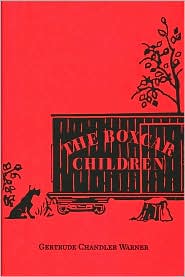
The Boxcar Children

The Boxcar Children. Gertrude Chandler Warner. 1942. 155 pages.

One warm night four children stood in front of a bakery. No one knew them. No one knew where they had come from. The baker's wife saw them first, as they stood looking in at the window of her store. The little boy was looking at the cakes, the big boy was looking at the loaves of bread, and the two girls were looking at the cookies.

Henry, Jessie, Violet, and Benny are orphans. Scared of a grandfather they never met, these children are running away. When the novel opens, they are seeking refuge for the night, asking permission to sleep on the benches of the bakery shop. (They bought bread). After hearing the couple discuss them--on how they should "keep" the three oldest because they would be useful to have around as workers, but how the youngest one would need to go to a Children's Home--Henry and Jessie decide to wake everyone and leave while they still have a chance. They walk most of the night, sleep most of the day. Their journey takes them into the woods, and during a storm, they seek shelter in an abandoned boxcar. It doesn't take the children very long to realize that if a boxcar is good shelter from a storm, it would be a good home for always. There is a town within walking distance so that Henry can find work and buy food. And the rest of the children can do what they can to make it a real home. And that is just what they do...day by day creating a home for themselves.

I liked  The Boxcar Children. I did. I had read it more than a few times growing up, but it had been at least fifteen or twenty years since I'd last read it. It was such a treat to read it again. It's a simple book, in many ways, yet it's got its charms. I liked how these children do make a home for themselves. How they work together as a family. While I wouldn't say that I ever loved this one as much as Mandy or Anne of Green Gables or The Secret Garden, I have definitely always liked it.

© 2011 Becky Laney of Becky's Book Reviews


Black Orchids

Black Orchids. A Nero Wolfe Mystery. Rex Stout. 1941/1942. Random House. 208 pages.

First sentence of Black Orchids: "Monday at the Flower Show, Tuesday at the Flower Show, Wednesday at the Flower Show. Me, Archie Goodwin. How's that? I do not deny that flowers are pretty, but a million flowers are not a million times prettier than one flower. Oysters are good to eat, but who wants to eat a carload?"

First sentence of Cordially Invited to Meet Death: "That wasn't the first time I ever saw Bess Huddleston."

Black Orchids was my first introduction to Rex Stout's Nero Wolfe and Archie Goodwin. And oh how I loved them! The book was narrated by Archie Goodwin, and he had me practically at hello! (While I wouldn't say I loved him *more* than Miss Marple or Lord Peter Wimsey, I can definitely say that I love, love, love him as a narrator!)

So in this book, readers have two novellas. The first, Black Orchids, concerns a murder at a flower show. Archie has been made to go to this flower show day after day after day by his boss who is a little obsessed with orchids. And on the final day (or one of the final days of the show) they go together. And it just so happens that that is the day a dead body is found in one of the exhibits! Archie is the one who makes this discovery--that the "sleeping" man is REALLY not going to be waking up. The police are on the case, of course, as they usually are in detective stories. But Nero Wolfe with some help from Archie and a few others in his employ--may just solve the case first. This botany-themed mystery didn't wow me for its subject--but I did enjoy meeting Nero and Archie.

The second novella, Cordially Invited to Meet Death, is my favorite of the two. In this mystery, we meet Bess Huddleston, a snobbish party planner for the wealthy elite of society. She comes to Nero Wolfe looking for help. Someone is sending out nasty letters--in her name, on her stationary. This "poison-pen" must be stopped! But who is the one behind this unpleasantness? And do they want merely to embarrass her--or is her life at risk?! Archie, our narrator, begins to investigate the case by trying to get close to those who are closest to her, namely: two female assistants, a nephew, a brother, and a local doctor. Can Archie and Nero solve this one before it turns deadly?

Black Orchids is an enjoyable read! I found it very satisfying! I'm not sure how Black Orchids compares with others in the series--so I'm not going to say that this is my favorite or best, it's just too soon to say. But. I enjoyed it and would recommend it!


© 2011 Becky Laney of Becky's Book Reviews


The Moving Finger

The Moving Finger. Agatha Christie. 1942/2007. Black Dog & Leventhal. 208 pages.

I have often recalled the morning when the first of the anonymous letters came.

Jerry Burton, our hero, has taken a house in the country with his sister, Joanna. He's recuperating from an injury, and his doctor has definitely suggested some rest and relaxation. As for Joanna, she's recuperating from a broken heart. But rural village life isn't as uneventful and peaceful as he expected. For soon after his arrival, an anonymous "poison pen" begins a nasty letter campaign. Which is unpleasant enough, he supposes, but things turn deadly after a woman's "suicide" after receiving a vile letter. The victim leaves behind two young sons, an older daughter from her first marriage, a husband, and a rather pretty governess. Megan, the daughter from the first marriage, soon becomes a major player in this Miss Marple mystery. This "suicide" becomes a bit suspicious when a second death occurs--that of a maid--within the home. The question becomes did this maid--on her day off--see something?

I loved this one. I just LOVED it. It wasn't a purely pleasant read for me. I wouldn't exactly say I was praying throughout, but I was certainly wishful with my repeated pleas, please don't let it be Megan, please don't let it be Megan, please don't let it be Megan. Never have I gotten that involved with a mystery. Who is Megan? For better or worse, she's the young woman our hero described thusly, "She looked much more like a horse than a human being. In fact, she would have been a very nice horse with a little grooming" (17). She's largely ignored not only by the village but by her family as well. But there is something about her that Jerry, our hero, can't ignore. He goes out of his way--time and time and time again--to include her. He even invites her to stay with him and his sister after her mother's death. He is the one person, she's found, willing to listen to her.

While Jerry is making friends with Megan--not always an easy task--Joanna, his sister, is trying to make friends with the local doctor. That is an uphill battle. Joanna has never, ever had to work this hard to get a guy to like her.

So this mystery has a romantic element to it which I just loved. It also stars Miss Marple, though she doesn't enter the case until after the second death occurs. Miss Marple finds Jerry Burton a great help in this one! The details he's observed through his stay, makes solving this one so much easier for her! It gives her quite the lead. But she still has to *prove* it.

The Moving Finger is very compelling! I loved it for so many different reasons.

My favorite quotes:

Emily Barton, I think, has a mental picture of men as interminably consuming whisky-and-sodas and smoking cigars, and in the intervals dropping out to do a few seductions of village maidens, or to conduct a liaison with a married woman.
When I said this to Joanna later, she replied that it was probably wishful thinking, that Emily Barton would have liked to come across such a man, but alas, had never done so. (85)

"The police are doing their best."
"If Agnes could be killed yesterday, their best isn't good enough."
"So you know better than they do?"
"Not at all. I don't know anything at all. That's why I'm going to call in an expert."
I shook my head. "You can't do that. Scotland Yard will only take over on a demand from the chief constable of the county. Actually they have sent Graves."
"I don't mean that kind of an expert. I don't mean someone who knows about anonymous letters or even about murder. I mean someone who knows people. Don't you see? We want someone who knows a great deal about wickedness!"
It was a queer point of view. But it was, somehow, stimulating. (141)

"Yes, it was dangerous, but we are not put into this world, Mr. Burton, to avoid danger when an innocent fellow creature's life is at stake. You understand me?"
I understood. (199)

© 2011 Becky Laney of Becky's Book Reviews


Twitter Delicious Facebook Digg Favorites More