Showing posts with label J Historical Fiction. Show all posts

The 21 Balloons

The Twenty-One Balloons. William Pene du Bois. 1947. Viking 180 pages.

There are two kinds of travel. The usual way is to take the fastest imaginable conveyance along the shortest road. The other way is not to care particularly where you are going or how long it will take you, or whether you will get there or not. 

I should have believed my mother. She's been trying to tell me that this was a good read for many, many years. And she was right. This is a good read. I'm not sure I'd say it was the best, best book I've ever read. Or the best Newbery I've ever read. But this book is anything but boring! It surprised me in all the right ways.

The hero of this one is Professor William Waterman Sherman. This teacher-turned-adventurer left San Francisco in August of 1883 hoping to spend about a year in his balloon. He'd chosen his design carefully and thoughtfully. And he was so excited at the thought of being away from it all--all the cares, all the stress, all the worries of this world. He wanted FREEDOM and then some. But that wasn't to be...

For an accident leaves him stranded on a "deserted" island. The island's community does NOT want to be discovered by the world, so any visitors are welcomed permanently in the community and renamed. I don't want to give away all the quirks of this one though! But I found this one to be quite a read!

Enjoyable and satisfying...a great way to spend the afternoon.

© 2011 Becky Laney of Becky's Book Reviews


Swift Rivers (MG)

Swift Rivers. Cornelia Meigs. 1932/2004. Walker. 288 pages.

It was the summer that Chris Dahlberg was seventeen that he mowed the high meadow alone for the first time.

I can't say that I LOVED Swift Rivers. But I can say that I did enjoy it--most of it at least. I checked it out from the library not really knowing what to expect. My plan was to give it a chapter or two to see if it was even something I wanted to read. And it was. Chris Dahlberg is a great hero for an adventure story. After his parents' death, his Uncle became responsible for him. But this responsibility didn't include love and respect. Chris works hard day after day after day with no one to really appreciate him. Since the Uncle absolutely HATES his father--Chris' grandfather--when Chris decides to leave home for four days to check on his grandfather, the Uncle forbids him, warning him that if he leaves he shouldn't bother coming back. For he'll never, ever, ever welcome him back into his home. Knowing that the grandfather is getting older, knowing that there must be a reason why he didn't come to help the mowing this year--like he has every year since he can remember--he makes his decision. He just has to see if his grandfather needs help. He needs to see if grandfather is ready to make it through the winter. The uncle is true to his word, but that doesn't turn out to be such a bad thing. For Chris and his grandfather and a helpful neighbor or two come up with an idea. It's a bit of a risk, it's not really been done before, but if it succeeds, it will be the start of something big. Chris and his grandfather are determined to enter the logging business, to cut down trees, and float the logs down the river, etc.

Half of the novel is the adventure of the logs-down-the-river. How this journey changes Chris. So it's a coming-of-age adventure story set in the 1830s. It's an industrious novel--one that focuses on men hard at work. It's a dangerous job that requires focus and skill and determination.

I liked this one because I liked Chris. I didn't necessarily love all the descriptions of river rafting. But even though I wasn't loving each and every page, I still enjoyed it for the most part. 


© 2011 Becky Laney of Becky's Book Reviews


The Trumpeter of Krakow

The Trumpeter of Krakow. Eric P. Kelly. 1928. 208 pages.

It was in late July of the year 1461 that the sun rose one morning red and fiery as if ushering in midsummer's hottest day. His rays fell upon the old city of Krakow and the roads leading up to it, along which rolled and rocked a very caravan of peasants' wagons. 

Don't judge a book by its cover. Or, at least don't judge this book by its cover! For appearances can be deceiving, The Trumpeter of Krakow is anything but boring! It's an exciting adventure story with elements that reminded me of some great fantasy novels! (It stars an alchemist and his "student" who is obsessed with finding the philosopher's stone.)

The Charnetski family has come to Krakow seeking protection. The father (Andrew Charnetski) has relatives in the city, and he's hoping to find sanctuary there until he can have an audience with the King (Kazimir Jagiello). But when he arrives, he learns that his relative has died--been murdered--and that the rest of the family has fled. Knowing that his family is in great danger--especially if the man seeking to prevent him from entering the city comes back to cause trouble--he returns to the market to think out his options. Joseph, the son, happens to rescue a young woman from an attacking dog, and in doing so wins the gratitude of her uncle. An invitation is extended to Joseph and his family, and lodgings are arranged. Around the same time, Andrew meets an important man in the city, Jan Kanty, who listens sympathetically and offers great advice. Sell your horses and your cart, change your name, and become the trumpeter in the tower of the Church of Our Lady St. Mary. Andrew is happy to follow this advice closely. He even teaches his son to play the trumpet hymn (Heynal) that is to played four times every hour. There is a story about this hymn, and a legend of sorts about a trumpeter. Readers learn of this at the very beginning, for it is set several centuries before this adventure even begins.

There is never a dull moment in The Trumpeter of Krakow. For there are the neighbors above and below to keep things interesting. The most interesting, perhaps, being the alchemist, Kreutz, he is the distracted uncle of the grateful girl, Elzbietka. He has a student, Johann Tring, a young man that makes many--including Joseph and Elzbietka--nervous. The two--in varying degrees--are obsessed with finding out the secret of how to make gold, fascinated with the philosopher's stone. The niece feels that Tring is a bad, bad influence on her uncle, and that Tring is leading her Uncle into dangerous territory.

And of course, never for a minute forget that this family is being pursued. Why? Well, the family DOES have a secret, they have something in their possession that drives people mad, something that people are willing to kill to have.

The novel is exciting. It has action and adventure, and a bit of magic as well. I do believe this one is more plot-driven than character-driven, but that didn't bother me at all. For it was enough that I wanted to find out what happened next. And the writing, I felt, was pleasant.

© 2011 Becky Laney of Becky's Book Reviews


The Hidden Gallery (MG)

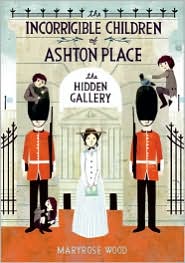
The Hidden Gallery (The Incorrigible Children of Ashton Place #2) Maryrose Wood. 2011. HarperCollins. 320 pages.

"But the workmen swore the repairs to the house would be finished by now!"

It's been a few months since the disastrous Christmas affair when the three Incorrigible children--Alexander, Beowulf, and Cassiopeia--went a little crazy in front of all the guests. But the children have made friends with the squirrel, Nutsawoo, and they've been behaving well enough ever since. They've been themselves, true, confusing words like matador and metaphor. But they've not been awful or dreadful. Still, a little change of scene might be just the thing. For Penelope Lumley, the young but bright governess, has been invited to London by one of her former teachers. And Miss Lumley is eager to go with the children. She didn't necessarily expect Lord and Lady Ashton to want to go to London too. But the more the merrier, right?

So this second book is ALL about their London adventure. Do you think that these three children--supposedly raised by wolves--can go unnoticed in London? You're right. Things do get a little messy. But in the midst of the chaos, Miss Lumley discovers that she needs to be extra careful. For there is someone who wants to hurt the children. But who?! Miss Lumley's former teacher is NO help at all. Just warning Penelope to not ask questions of anyone and to leave well enough alone. But does that really sound like something Penelope can do?

I liked The Hidden Gallery. I didn't love it as much as the first one, perhaps, but it was a good read, an enjoyable one. Within this one, Penelope makes a new friend, Simon, whom she trusts almost immediately. At times I forget that Penelope is VERY young herself--just fifteen or so? So it was nice to see that she is interested in boys too. That she can think of more than Latin and geography and such. 

© 2011 Becky Laney of Becky's Book Reviews


William's Midsummer Dreams (MG)

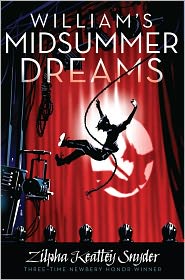
William's Midsummer Dreams. Zilpha Keatley Snyder. 2011. Simon & Schuster. 224 pages. 

It was on a Saturday near the end of September when the doorbell at 971 Eleanor Street rang long and loud, and then rang again. 

In William S. and The Great Escape, William and three of his siblings (Jancy, Buddy, and Trixie) escaped their abusive home and traveled on their own--with a little "help" from a friend, Clarice--to see their Aunt Fiona. They were hoping, of course, that she would be willing to open her home to them. She was. And for the first time in a long time--since the death of his mother--William was able to feel good about his life, his situation.

The first thirty-two pages of William's Midsummer Dreams rushes the reader through nine months of their lives in their new home. (Chapter four, for example, takes us from mid-October to mid-June.) The focus--if you can call anything that abbreviated focused--is on William counting down the days until summer. He is oh-so-excited about the opportunity to audition for a role in Mannsville's summer production of A Midsummer Night's Dream that it is all he can think about, dream about, or talk about. His sister, Jancy, is understandably annoyed. (I thought it was understandable anyway!) He's memorized every one of Puck's lines, every one of his cues. He's READY. He's more than ready. But he can't help being nervous too.

He'll be spending most of his summer vacation in Mannsville with Clarice, Miss Scott, and the rest of the cast and crew. He'll be living his dream, acting in a real production with real actors.

So the novel is ALL about William's adventures in the theatre. The drama that happens on stage and off stage.

If you like Shakespeare OR the theatre OR historical fiction set in the 1930s OR family stories about brothers and sisters, then William S. and The Great Escape and William's Midsummer Dreams may be books you'd enjoy.

Did I like it? Yes. I definitely liked it. I am not sure that I absolutely loved it. (I was a little hesitant about the beginning, it didn't get off to the best of starts.) But. For the most part, I did enjoy this second book about William. I didn't realize until I finished this one how much I missed Jancy and Buddy and Trixie. The novel didn't have quite the same charm as the first one. But what it lacks in family drama, it makes up for in the theatre. 

© 2011 Becky Laney of Becky's Book Reviews


Our Only May Amelia (MG)

Our Only May Amelia. Jennifer L. Holm. 1999. HarperCollins.

My brother Wilbert tells me that I was the first ever girl born in Nasel, that I was A Miracle. 

While it wasn't always easy to keep up with all seven of May Amelia's brothers, I really did enjoy this historical novel very much. May Amelia, our heroine, feels like she doesn't belong. It seems that she's always disappointing someone in her family--be it her father, mother, brother, cousin, or grandmother. She's grown up with brothers--doing the things that boys do--but each year she's expected to act more like a lady--a proper lady--and less like a tomboy. And if you took the time to ask her, she'd tell you truthfully, that she does NOT want to be a lady. She doesn't want to be silly and boy-crazy. She sees the way "young ladies" act around her older brothers. And it disgusts her. No, May Amelia is much too sensible to be a proper lady.

This family novel has its quiet and loud moments. It has plenty of drama, but at the same time it is focused on the characters, the family dynamics, how May Amelia relates to each member of her family for better or worse. Dramatic events include, for example, the arrival of her paternal grandmother, "Grandmother Patience," and her mother going into labor while the family's boating on the river.
Trust me, Grandma Patience is anything but patient. Her true name might be Grandmother Cranky Pants. The scenes were she lets loose and speaks her mind--well, let's just say they made me boo and hiss. She was not my favorite family member. I much preferred getting to know some of May Amelia's aunts and uncles. 

I thought this historical novel was well-written. I thought the characters were well-developed. I enjoyed watching May Amelia mature through the novel.

Set in 1899, Washington State.

© 2011 Becky Laney of Becky's Book Reviews


The Door in the Wall (MG)

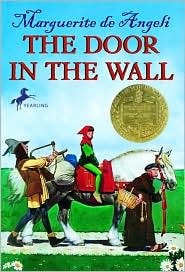
The Door in the Wall. Marguerite de Angeli. 1949/1990. Random House. 128 pages.

Robin drew the coverlet close about his head and turned his face to the wall. He covered his ears and shut his eyes, for the sound of the bells was deafening. All the bells of London were ringing the hour of Nones. St. Mary le Bow was nearest, St. Swithin's was close by, and not far away stood great St. Paul's. There were half-a-dozen others within soun, each clamoring to be heard. It seemed to Robin as if they were all inside his head screaming to be let out. Tears of vexation started to his eyes, but he held them back, for he remembered that a brave and "gentil" knight does not cry.

This is my first time reading this Newbery winner. It's not a title I would have been drawn to as a kid, much like Adam of the Road, but I am glad I read it as an adult.

Robin, our hero, is all alone. His father is fighting in a war; his mother called to serve the queen. He was supposed to become a page and begin his training to be a knight, but, an illness left him weak, unable to stand or walk. A compassionate monk, Brother Luke, saves him from an uncertain (at best) fate--for his caretaker, his nurse, falls ill with the plague. Robin begins to heal and begins to learn. He learns to read and write. He is strengthened by swimming. And then there's the whittling. (Exciting stuff.) The book chronicles his journey through these dark and sometimes dangerous times. Readers get a glimpse of the Middle Ages.

The Door in the Wall is a pleasant enough read. While I didn't find it the most thrilling book ever, not even the most thrilling book ever set during the Middle Ages, I didn't find it painful either. There are worse ways to spend an afternoon.

You might also be interested in: Adam of the Road, Crispin: The Cross of Lead, Crispin: At The Edge of the World, Crispin: The End of Time. Not to mention Good Masters! Sweet Ladies! Voices from a Medieval Village by Laura Amy Schiltz.

© 2011 Becky Laney of Becky's Book Reviews


Miss Spitfire (MG)

Miss Spitfire: Reaching Helen Keller. Sarah Miller. 2007. Simon & Schuster. 240 pages.

"Ticket, please."
I wipe at my eyes and thrust the wretched thing at him. I've already had to change trains six times since Boston. On top of that, I have to take this train north to Knoxville to catch yet another train south to Alabama.

I love Miss Spitfire. I just LOVE, LOVE, LOVE Miss Spitfire. It's such a feel-good, oh-so-magical, ultimate-comfort read--at least for me. It's a novel about Annie Sullivan and Helen Keller. A novel about a teacher who wouldn't accept failure, who kept persevering, no matter how big the challenge, no matter how big the tantrum, Sullivan was NOT going to be beaten by a child.

Annie Sullivan is a young woman on a mission. Her job? To teach a child--a six year old child--who is blind, deaf, and dumb. It won't be easy. There has only been one successful case in the past to base their hopes and dreams on: Laura Bridgman. But Annie is strong-minded and determined. She'll need every ounce of stubbornness she has if she's going to master the willfulness of Helen. Used to getting her own way, Helen runs wild. And as Annie soon points out, the family expects better behavior from the dogs than they do their young daughter. Helen has never been disciplined a day in her life--at least since an illness left her blind and deaf. This journey from despair to hope, from chaos to communication, is an important one. It is full of emotion--as day by day Annie struggles to teach and love a child who fails to comprehend the meaning of words altogether. Anger. Frustration. Rage. Joy. Happiness. Fear. Hope. Despair. It's all here. Annie and Helen. This is their story.

If you've seen The Miracle Worker, you'll know the basic plot of this one. But it is Sarah Miller's writing that impressed me the most. I loved how she told this story.

After years of being blind myself, I can understand a mind without pictures, but I can hardly comprehend a mind without words. Words, songs, stories--they were the things I craved most before my sight was restored, for words explained the things my eyes couldn't show me. When I was blind, words were as vital as breath. (7)
"I'm not sure I can do this job. Yet a part of me understands Helen better than she does herself. I'm no stranger to frustration, anger, isolation. I wonder, though, how Helen can be content to deprive herself of my affection? The thought of her indifference makes my throat sting, yet I can't help feeling drawn to her. If I could only touch her heart, I know I could reach her mind. But she won't even let me hold her hand." (43)
"It seems nothing I do comes out right. But in my heart I know what's right for Helen: obedience, love, and language. Come what may and hell to pay, I'll find a way to give her all three." (64)
All these words, do they linger in her fingers after her lessons are through? (125)

And for the record, I loved, loved, loved the ending. It was oh-so-magical.

© 2011 Becky Laney of Becky's Book Reviews


The Teacher's Funeral (MG)

The Teacher's Funeral. Richard Peck. 2004. Penguin. 208 pages.


If your teacher has to die, August isn't a bad time of year for it. You know August. The corn is earring. The tomatoes are ripening on the vine. The clover's in full bloom. There's a little less evening now, and that's a warning. You want to live every day twice over because you'll be back in the jailhouse of school before the end of the month. Then our teacher, Miss Myrt Arbuckle, hauled off and died. It was like a miracle, though she must have been forty. You should have seen my kid brother's face. It looked like Lloyd was hearing the music of the spheres. Being ten that summer, he was even more willing to believe in miracles than I was. 

I love this book. I am CRAZY in love with this book. It is in my opinion one of those practically-perfect-in-every-ways books. It's a funny historical novel--set in 1904 in Indiana--and it has heart! (Though not *too* much sentiment! It is narrated by a fifteen year old boy after all!) So Russell Culver, our narrator, is thrilled when his teacher dies just days before school was to start. (Who could they ever find to replace her?!) But his joy is short lived, for the answer to that question is his very own sister. Now, he doesn't hate his sister. He's quite fond of her cooking--it being SO MUCH better than his aunt's cooking which they try to live on doing the school year when the sister is away from home. But as his teacher?! It's too unbelievable. It's just SO unfair!!!

The Teacher's Funeral is a funny novel set in rural Indiana at the turn of the century. It draws quite the picture of country life--both at home and school. We get to know each of the eight students in this one-room school house. (Russell, Lloyd, Charlie, Pearl, Glenn, Floyd, Lester, Little Britches). And, of course, we get to know their teacher, Tansy, too! It's just a charming book, a funny book. One of those rare books that I love completely. I wouldn't change a thing!

This was the night me and Lloyd always went to the crick and camped out. It was a sacred part of our year. After the Case Special came through, we always spent that night at the crick, and hung on till morning, no matter what. It was how we kissed the summer goodbye before the darkness of learning fell about us. (13)

"Who died?" I inquired.
"Take a guess," Charlie said. "Go ahead."
"Somebody we know?"
"You can believe that."
"Somebody old or young?"
"Old," Charlie said, "as the hills."
Lloyd was looking back and forth between us, clutching J.W. He was on the hook again, and I was getting there.
"Old as Old Man Lichtenberger?"
"Nobody's that old," Charlie said.
"Man or woman?"
"That'd be tellin' too much."
"Somebody we like?"
"Not hardly," Charlie said.
"Somebody who's been feeling poorly late?" I was wracking my brains.
Charlie shrugged his big shoulders. "She must of felt pretty poorly tonight. She died."
"So it's a woman!"
"More or less," Charlie said.
The truth burst over me. "You don't mean Miss Myrt Arbuckle!" (24)

Nobody would miss Miss Myrt, so Preacher Parr got them to miss the good old days when the winters were worse and the kids were better. At a funeral you want to miss something. (39)

When Pearl came back, she had a grip on the little kid who didn't want to be anywhere near here. Her bonnet hung by its strings. Her dinner pail scraped the floor. She kept setting her bare heels. "Turn me loose," she squawked. "I don't wanna, and I'm not gonna!"
Pearl pushed her toward Tansy and resumed her seat.
Tansy pulled the small girl's skirttails free of her drawers and settled her skirts for her. But it was too late. Forever more, she was known as "Little Britches." Even unto the distant day of her wedding. Besides, come to find out her real name was Beulah.
"Who are you?" Tansy asked with an arm around her.
"I ain't sayin'," said Little Britches. "I ain't stayin'."
"Then whisper who you are in my ear before you go."
Little Britches whispered. It would turn out that she was a Bradley. They were a family who hadn't had anybody in school for some years. Little Britches was an afterthought. "I'm goin' on home now." She wiggled free of Tansy. "Pleased to meetcha."
"Well, you can go home at noon, Tansy told her. "Till then just wait up there at my desk. You can...help me be teacher." (80-1)

"Tansy, how come the female sex think they know more than the male sex?"
"Because we do. What's the capital of Delaware?"
"I don't know."
"Know by tomorrow," Tansy warned. "I'm the teacher, and I won't have dumb brothers." (107)

I thought we'd need a block and tackle to lift her. But getting Aunt Fanny Hamline out of the ditch became one of Tansy's most famous days of teaching. It was a lesson in engineering too. It should have been studied at Purdue University. (127)

© 2011 Becky Laney of Becky's Book Reviews


Chains (MG/YA)

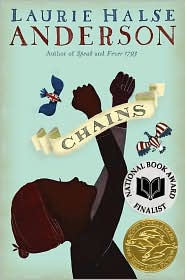
Chains. Laurie Halse Anderson. 2008. Simon & Schuster. 320 pages.

The best time to talk to ghosts is just before the sun comes up. That's when they can hear us true, Momma said. That's when ghosts can answer us. The eastern sky was peach colored, but a handful of lazy stars still blinked in the west. It was almost time.

When the novel opens, Isabel, our heroine, is seeking help from her (dead) mother one last time. But it's to no avail, her mother's ghost does not answer her pleas, can provide no further guidance to her two daughters, Isabel and Ruth.

Their mistress has died. Isabel knows that her mistress freed her and her sister before she died; it's in her will. But her mistress's nephew--Mr. Robert Finch--as her only living relative refuses to believe that consulting a will is even necessary. Naturally, all her aunt's property is his. And since Isabel and Ruth are nothing but property, they are his by right. The fact that there's a will, a lawyer, who could say otherwise? Irrelevant. Mr. Robert sells both girls at the first opportunity. Their buyer? The Locktons of New York. Isabel is even given a new name. One that is "easy" to remember. Sal. But Isabel can never be comfortable wearing a new name, being the property of someone else. Isabel dreams of so much more. She dreams of freedom. What keeps her from acting on impulse? Of running away? Her sister, Ruth. But the actions of a cruel mistress--selling her younger sister--means that Isabel has nothing left to lose. Will Isabel believe the British who are promising freedom to some slaves? Or will Isabel believe the Patriots who claim the same thing--freedom to slaves who help their side.

A nation at war. A young country seeking freedom, justice, liberty. Set in New York City during circa 1776-1777, the story is vibrant and heartbreaking. It's a story rich in detail and emotional and powerful in nature. Isobel's story--her struggles--resonates so deeply that I think this one is a must-read.

I first reviewed Chains in November of 2008. I reread it so I'd be ready for the release of the sequel, Forge.


© Becky Laney of Becky's Book Reviews


Ballet Shoes (MG)

Ballet Shoes. Noel Streatfeild. 1937. Random House. 256 pages.

The Fossil sisters lived in the Cromwell Road. At that end of it which is farthest away from the Brompton Road, and yet sufficiently near it so one could be taken to look at the dolls' houses in the Victoria and Albert every wet day.

Pauline, Petrova, and Posy are three children adopted by Gum. Gum is Great Uncle Matthew. He "found" each one of them and brought them home. He didn't stay home to help with the raising of them, but he provided money enough to keep them for a handful of years. Nana and Miss Sylvia had hoped he'd return soon--very soon--before the money began to run out. But that isn't quite the case. The children--for better or worse--end up in a special performing arts school. Posy, who loves to dance, is thrilled. As is Pauline for whom acting comes naturally. Petrova, on the other hand, is less thrilled by the training. Her heart is just not in it.

Ballet Shoes is their story. A story of three sisters--they chose the last name "Fossil" themselves. A story of how they tried to make a name for themselves. We see them struggle; we see them succeed.

I liked this one very much. It was very enjoyable, very pleasant.


© Becky Laney of Becky's Book Reviews


One Crazy Summer (MG)

One Crazy Summer. Rita Williams-Garcia. 2010. [January 2010] HarperCollins. 218 pages.

Good thing the plane had seat belts and we'd been strapped in right before takeoff. Without them, that last jolt would have been enough to throw Vonetta into orbit and Fern across the aisle.

Historical fiction set in the summer of 1968. 

Three girls travel cross country to visit the mother that abandoned them in Rita Williams-Garcia's newest novel, One Crazy Summer. Delphine, the oldest of the three, narrates. Of the three, she is the one who remembers their mother best--which isn't saying all that much. What can they learn from their mother in 28 days?

In many ways, 28 days feels like forever. Especially since their mother continues to push them away. She makes it clear--time and time again--that she does not want them in her home, in her life, and especially in her kitchen. But. The girls continue to try, continue to cope. Like it or not, they're there for the month. And since their mother doesn't want to spend any of her time with them, well, they're on their own. The three end up spending their days in the community learning about the Black Panthers--from the Black Panthers.

One Crazy Summer is a novel about relationships--between mother and daughter, of course, but also between sisters. These three have their issues--with one another--but they love one another too. And Delphine struggles with being both a sister and a substitute mom. It's also a coming of age story.

I enjoyed One Crazy Summer. It's a great novel. Written very well. The narrative voice is incredible--moving, compelling, believable. I would definitely recommend this one.

© Becky Laney of Becky's Book Reviews


Embers of Love

Embers of Love (Striking a Match #1) Tracie Peterson. Bethany House. 352 pages.

"I won't let you go through with this," Deborah Vandermark declared.

This historical romance is set in Texas in the 1880s. It's the first in a new series. 

Wanting to save her friend, Lizzie, from a loveless marriage, our heroine, Deborah, invites her best friend to stay with her and her family in Texas. Deborah's brother, G.W., likes Lizzie quite a lot. And Lizzie is the first person who has been able to convince him that his father's death is not his fault. But this romance isn't without conflict. For Lizzie's mother--a suffragist--and her former fiance, Stuart, arrive to make everyone's lives miserable. They both insist that the marriage is legal--because she signed the paperwork--even if there were no vows or ceremony. They both insist that she accompany them back East, back to Philadelphia. But Lizzie knows that she could never go back. Even if she wasn't desperately in love with someone else.

Is this Lizzie's story? Partly. It also stars Deborah Vandermark. A well-educated woman returning to her home after several years away, after several years of education. She loves her family. But. She's having a hard time fitting back in the community as well. It's a good thing there is a new doctor in town to distract her. These two become good friends. He is one of the few men in town Deborah feels is smart enough to hold a real conversation with. But the doctor provides some conflict as well. Because he isn't accepted by the community--not at first. For this small Texas town is superstitious and foolish. It may take a major epidemic for him to prove himself worthy.

Plenty of conflict, plenty of drama. (Personally, I could have used a little less.) I liked it well enough, but didn't love it.


© Becky Laney of Becky's Book Reviews


Twitter Delicious Facebook Digg Favorites More